
A corporate reputation management service is a control function for digital exposure rather than a form of PR. It works across four functions: monitoring and detection across search, social, reviews and forums; analysis and triage of what the material is and who controls it; remediation through source takedowns, de-indexing and legal escalation; and prevention so removed content does not resurface.
Key facts
- Image management fails when content is unlawful, leaked, synthetic or replicating fast; risk management handles takedowns and recurrence.
- Source removal, de-indexing and suppression are distinct remedies; a mature operation uses all three selectively.
- Playbooks should define trigger events, decision authority, evidence standards, platform pathways and post-resolution monitoring.
- Deepfakes and NCII need evidence preservation, platform reporting, search treatment, legal notices and repost monitoring together.
Where ContentRemoval.com comes in. ContentRemoval.com is a specialist in this category: confidential intake, threat mapping across hosts, search and mirrors, then removal, de-indexing and repost monitoring run alongside the client’s counsel rather than in place of it. General counsel, a chief of staff or the communications lead usually make the approach. A free 15-minute Exposure Scan sets out the threat map and priority sequence, and the report is yours to keep. Get a Free, Confidential Exposure Scan or read how our reputation management work is done.
A board member forwards a link at 6:12 a.m. The subject line is short and ugly. “Need to discuss now.”
You open it and see the problem immediately. A hostile article is ranking for your company name. A leaked document is circulating in private channels. A manipulated clip is spreading on social media, detached from context and accelerating faster than your internal team can verify facts. Legal wants restraint. Communications wants a holding statement. Your investors want confidence. Your staff is already reading it on their phones.
That’s the moment people stop talking about “brand” in abstract terms.
A serious corporate reputation management service exists for this exact situation. Not for polishing image. Not for posting reassuring content as problems escalate. For containment, removal, verification, escalation control, and prevention. If your exposure involves executives, regulated sectors, confidential documents, impersonation, dark web leakage, or synthetic media, standard PR support won’t carry the load.
The market has grown because companies have finally accepted that digital reputation is part of enterprise risk. The enterprise internet reputation management market was valued at USD 5.2 billion in 2025 and is projected to reach USD 25.5 billion by 2036, with 15.5% CAGR, according to Fact.MR’s enterprise internet reputation management market analysis. That isn’t a vanity trend. It reflects a hard shift from periodic review to continuous monitoring and AI-driven response.
If you’re reading this under pressure, focus on one question. Do you need someone to improve your image, or do you need someone to help you regain control?
The Moment a Digital Crisis Becomes Real
At first, most executives misclassify the event.
They think it’s a media issue because the first symptom appears in search results. They think it’s a social issue because the first surge appears on X, Reddit, TikTok, or LinkedIn. They think it’s a legal issue because the content is false, stolen, defamatory, or unlawfully distributed. In practice, it’s all three at once, and that’s why ordinary internal workflows break down.

What executives actually face in the first hours
The pressure is rarely limited to public perception. It reaches contracts, hiring, board relations, counterparties, family privacy, and lender confidence. A false allegation about a founder can become a due diligence obstacle by lunchtime. A leaked internal image can become a governance question by evening.
That’s why the old model fails. Quarterly checks, agency reporting cycles, and reactive statements were built for a slower internet. The current threat environment doesn’t wait for your next meeting.
Practical rule: If damaging content names the company, a senior executive, or a pending transaction, treat it as an operational risk event immediately.
The organizations that handle these moments well don’t ask whether reputation is a business asset. They already know it is. They ask who has authority, who has evidence, which platforms matter first, and whether removal is possible at the source, in search, or both.
Why periodic oversight no longer works
The broader shift is obvious. Enterprise buyers are moving toward continuous, AI-driven monitoring because the threat surface keeps widening. Search results, review ecosystems, news archives, forums, cloned accounts, AI-generated impersonations, and dark web postings create a single problem from the client’s point of view. Someone important can find the material, believe it, and act on it.
A modern corporate reputation management service has to operate accordingly. It has to detect, classify, prioritize, and respond before bad content becomes accepted fact. The alternative is improvisation under scrutiny, which is exactly how manageable incidents become reputational crises.
Defining a True Corporate Reputation Management Service
Most firms sell one narrow slice of the job and call it reputation management.
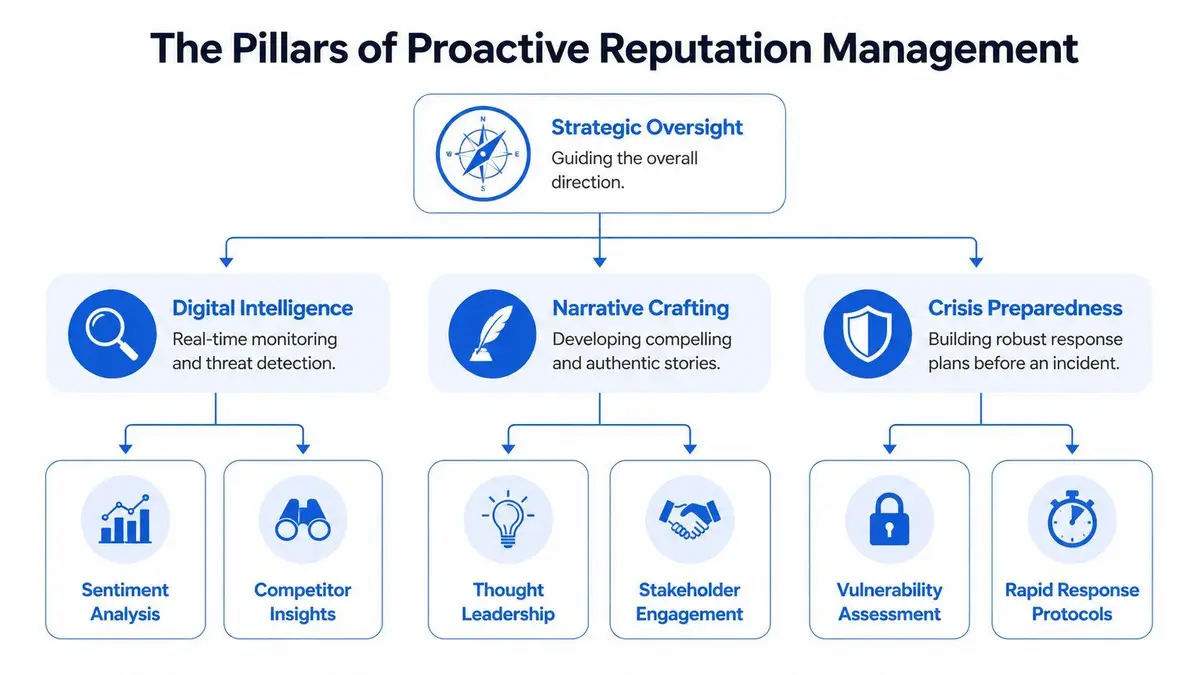
A PR agency will shape messaging. An SEO shop will try to outrank negative pages. A social team will monitor mentions and draft replies. Those services have value, but they are not enough for high-stakes exposure. A real corporate reputation management service is closer to a digital special operations unit than a press office. Its purpose is control. It identifies the threat, determines the viable remedy, executes quickly, and keeps pressure on the issue until the risk is neutralized or contained.
The difference between image work and risk work
You should separate two categories that many vendors deliberately blur.
| Function | What it does | Where it fails |
|---|---|---|
| Image management | Positive content, media relations, search optimization, review strategy | Fails when content is unlawful, malicious, synthetic, leaked, or rapidly replicating |
| Risk management | Monitoring, evidence capture, takedowns, de-indexing, legal escalation, recurrence prevention | Fails if the provider has no technical process or no platform-specific removal capability |
That distinction matters, as research cited by New Media’s reputation management statistics roundup states that 41% of companies facing a reputation crisis suffer a direct loss of brand value and revenue, and that social media crises spread 1,200% faster than traditional news. The same source notes that 28% of US companies still rely on informal crisis response plans. That is a weak position to discover in the middle of an attack.
The four functions that matter
A serious provider usually works across four integrated functions.
- Monitoring and detection means watching for harmful mentions, impersonation, leaks, manipulated media, hostile review campaigns, and executive exposure across search, social, review platforms, forums, and less visible channels.
- Analysis and triage means deciding what the material is, who controls it, whether it violates law or platform policy, how fast it is spreading, and whether the appropriate remedy is removal, de-indexing, rebuttal, preservation, or silence.
- Remediation means acting on the right lever. That may involve source takedown requests, search engine de-indexing, notice escalation, platform abuse reports, legal process support, or coordinated response with outside counsel.
- Prevention means reducing recurrence. If a firm removes one copy and leaves twenty repost pathways intact, it hasn’t solved the problem.
A good vendor reports activity. A serious one changes the exposure profile.
What you should expect from the engagement
You should expect a service model that treats reputation as part of digital risk governance, not as a marketing campaign. That means chain of custody for evidence. Confidential handling. Jurisdiction-aware takedown strategy. Search and platform fluency. Coordination with counsel, and a willingness to tell you when suppression is the wrong answer and direct removal is the only defensible one.
If the provider’s first instinct is to pitch blog content and backlink packages, you’re talking to the wrong team.
The Anatomy of a Reputation Defense Operation
A proper defense operation starts long before any public statement. It starts with visibility, evidence, and control of timing. Once harmful material appears, the job is to determine where it lives, how it spreads, which audiences matter, and what remedy is realistic at each layer.

Detection comes first
Most clients arrive after the first visible hit. That’s understandable, but it’s late in the process. The essential work begins with constant monitoring across search engines, social platforms, review ecosystems, forums, and obscure repost environments.
According to TechnologyAdvice on corporate reputation management, monitoring software can track brand mentions across 100+ platforms, send alerts within 5 to 15 minutes of harmful content emerging, and help prevent 60% to 70% of viral escalations through immediate intervention. Those numbers explain why manual checking fails. If your team learns about a hostile post from a customer or reporter, you’ve already ceded the initiative.
Monitoring alone isn’t enough. The system has to classify what it finds. A complaint from a real customer is handled differently from a coordinated smear. A leaked board memo is different from an indexed article. A synthetic executive video is different from a negative review cluster.
Removal is not the same as de-indexing
Executives often ask whether content can be “taken off the internet.” Sometimes yes. Often partially. Always strategically.
Here’s the distinction that matters:
- Source removal targets the original host, platform, forum, site operator, or account holder. This is the strongest remedy when it works because it attacks the content at origin.
- De-indexing targets search visibility. The material may still exist online, but major search engines stop surfacing it under relevant queries.
- Suppression means publishing and optimizing competing content so harmful results lose prominence. This has a place, but it is weaker than removal when the material is unlawful or highly inflammatory.
A mature operation uses all three selectively. It does not pretend they are interchangeable.
If a vendor cannot explain the difference between search suppression and source-level removal in plain English, don’t give them your matter.
For a deeper look at the operational layers involved, see this guide to online brand protection services.
Coordination with counsel and communications
High-stakes matters fail when legal, security, and communications operate in parallel instead of under one command structure. Counsel may want preservation and controlled escalation. Communications may want a concise statement. Security may be tracing the origin of the leak. The reputation team has to make those tracks reinforce each other instead of collide.
That means one factual record, one escalation map, one approval path, and one understanding of the objective. Sometimes the objective is removal. Sometimes it is silent containment. Sometimes it is preserving evidence while reducing discoverability. The tactics differ, but fragmentation always makes things worse.
A useful overview of how teams think about this work is below.
Playbooks beat improvisation
The best time to decide how your company handles executive impersonation, defamatory review campaigns, leaked media, or employee-generated viral incidents is before any of them happen. Preapproved playbooks save time and protect judgment.
A strong playbook usually defines:
- Trigger events that activate escalation.
- Decision authority across legal, executive leadership, security, and communications.
- Evidence standards for screenshots, URLs, timestamps, and chain of custody.
- Platform pathways for each threat class.
- Post-resolution monitoring so the same material doesn’t resurface.
Improvisation feels responsive. In reality, it burns time, creates contradictory records, and increases the odds that harmful material stays live longer than it should.
Specialized Threats Requiring Elite Intervention
Here, most providers are exposed.
They can talk about brand sentiment and search visibility, but they can’t handle the threats that terrify directors, founders, family offices, and general counsel. Those threats sit outside ordinary PR. They involve leakage, synthetic media, extortion pressure, impersonation, and persistent repost behavior across hostile channels.

Dark web exposure is not a side issue
A private breach becomes a reputation problem the moment executive information is packaged, traded, or weaponized. Leaked email archives, phone numbers, travel details, internal records, and impersonation kits don’t stay underground forever. They migrate outward into phishing, harassment, counterfeit accounts, and targeted publication.
One of the clearest blind spots in the market is dark web monitoring. A 2025 report cited by RBS Reputation Management’s corporate reputation management page found that 68% of Fortune 500 firms had sensitive executive information exposed on the dark web, yet only 22% had specialized monitoring. The same source states that the resulting reputational harm averaged $4.2M per incident. If your provider only watches indexed search results and mainstream review sites, they’re missing a serious part of the threat environment.
Deepfakes and NCII demand combined legal and technical action
An executive’s face on fabricated sexual content. A manipulated boardroom video. A cloned voice attached to an inflammatory statement. These attacks don’t behave like old-fashioned defamation because they exploit platform scale and emotional shock before anyone has time to verify authenticity.
Generalist firms usually respond with reputation messaging and positive content. That is not enough. The response has to combine evidence preservation, platform-specific reporting, search treatment, identity verification, legal notices, and active monitoring for reposts and derivatives.
The first removal is only the first battle. Synthetic media problems are recurrence problems.
This is one area where specialized takedown capability matters more than broad marketing capability. A provider may use monitoring platforms like Brandwatch, Sprout Social, or ReviewTrackers for detection, but the primary distinction is what happens after detection. Can they tackle search engines, social platforms, adult sites, mirror sites, forums, and image hosts with a legally coherent removal strategy? Most can’t.
Coordinated review and defamation campaigns
The more advanced attacks don’t look theatrical. They look plausible. A cluster of negative reviews appears across platforms under newly created accounts. A niche blog republishes allegations that are hard to trace. An anonymous thread picks up the story and frames it as insider knowledge. The goal is to create enough surface evidence that search engines, AI systems, journalists, and counterparties treat the narrative as credible.
This kind of campaign needs forensic pattern analysis and disciplined escalation. You map the publishing sequence, identify account overlaps, compare language and timing, preserve evidence, and separate legitimate criticism from manufactured attack traffic. Then you attack the network at the points where policy, identity fraud, platform abuse, or unlawful publication gives you an advantage.
One option in this category is ContentRemoval.com, which handles source removal, de-indexing, review abuse, leaked media, and continuous monitoring for reuploads through a confidential case assessment and jurisdiction-specific action planning.
Why elite intervention matters
The hardest cases are not solved by one tactic. They are solved by orchestration. Detection, legal pressure, platform fluency, search management, evidence handling, and recurrence prevention have to run together. That is why high-stakes clients need a specialist team, not a vendor stack held together by email threads.
Workflow and Timelines From Detection to Resolution
When you engage a serious firm, the process should feel controlled from the first call. Not theatrical. Not vague. Controlled.
The first priority is confidentiality. You’re not buying a generic discovery call. You’re initiating a protected assessment of risk, visibility, and urgency. The team needs to know what exists, where it appears, who is affected, what has already been attempted, whether legal counsel is involved, and whether silence or immediate action best serves your position.
Phase one is scope, evidence, and triage
A proper intake usually starts with a narrow set of questions and a fast evidence review. The point isn’t to gather everything. The point is to gather what matters enough to decide the operational track.
That initial review usually sorts the matter into categories such as published defamation, privacy breach, leaked media, impersonation, review manipulation, search visibility issue, or dark web exposure. Once that classification is done, the team can identify which remedies are realistic and which are wasted motion.
Then you get an action plan, not a brainstorm
The client should receive a direct plan with priorities. Which URLs matter first. Which platforms are removable. Which assets need preservation. Which communications should wait. Which matters can be de-indexed quickly, and which require longer legal or platform escalation.
A useful reputation defense process also includes active monitoring from day one. An executive-facing reputation monitoring program becomes practical, not cosmetic, with such monitoring. You need alerts, recurrence tracking, and a system for catching reposts before they regain visibility.
Here is what a disciplined workflow often looks like:
- Confidential intake with evidence review and risk classification.
- Threat mapping across source hosts, search results, social distribution, and possible mirrors.
- Action sequence approval covering removal attempts, de-indexing requests, legal notices, and communications coordination.
- Execution with platform submissions, host outreach, escalation, and recurrence watch.
- Verification and reporting so you know what was removed, what remains, and what still requires pressure.
You should never have to ask a reputation firm what they are doing this week. That should already be in the reporting.
Timelines depend on the remedy, not the sales pitch
Clients understandably want a hard answer on speed. The honest answer is that different parts of the matter move on different clocks. Some actions begin almost immediately after intake. Others depend on platform review, host cooperation, search processing, or legal posture.
What matters is whether the firm can move quickly at the points it controls, document every action, and keep pressure on recurrence after the first visible win. The right process restores something valuable early. Not perfect optics. Control.
A Due Diligence Checklist for Evaluating Service Providers
If your name, company, board, or family is exposed online, don’t hire the first firm that sounds confident on a call. This industry has too many agencies selling cosmetic fixes into legal and technical problems.
A provider should be able to withstand serious diligence from a CEO, chief of staff, general counsel, or family office principal. If they can’t answer direct questions, they shouldn’t have your matter.
The questions that separate specialists from vendors
Ask these plainly and listen for precise answers.
- What can you remove at source versus only suppress in search? If they blur removal, de-indexing, and suppression, they either lack capability or hope you won’t notice the difference.
- How do you handle deepfakes, NCII, impersonation, or dark web exposure? You’re testing whether they understand threat classes that fall outside standard PR.
- Do you work directly with outside counsel? A serious firm should fit into legal strategy cleanly, not compete with it.
- What monitoring do you operate after removal? Reappearance is common in high-conflict matters. If they stop at the first takedown, the matter isn’t finished.
- How do you protect confidentiality and internal data? Your remediation provider should not become your next security concern.
For a more detailed framework, review this guide for executives evaluating professional content removal services.
What current threat patterns demand
This is not hypothetical. Gartner data from 2025 to 2026, as summarized by RingCentral’s reputation management service overview, reports that 47% of C-suite scandals involve NCII or manipulated videos, that these incidents can reduce investor confidence by an average of 29%, and that reappearance rates reach 62% without proactive monitoring. Any provider you hire should have a clear, legally compliant answer to that reality.
A short scoring table for decision-makers
| Question | Weak answer | Strong answer |
|---|---|---|
| Removal capability | “We’ll push negative results down” | “We separate source removal, de-indexing, and suppression, then choose by content type” |
| Legal coordination | “We can recommend a lawyer” | “We work under or alongside your counsel with documented escalation paths” |
| Monitoring | “We check major platforms” | “We maintain persistent monitoring and recurrence tracking across relevant channels” |
| Confidentiality | “We take privacy seriously” | “We define access controls, reporting pathways, and handling limits before work begins” |
Ask for process, not promises. Experienced firms describe workflow, evidence standards, and escalation logic. Inexperienced firms describe outcomes they cannot control.
How to think about ROI
Treat this as asset protection, not discretionary marketing spend. A bad provider costs money. A weak response costs influence. Delay costs options.
The right firm helps you preserve executive credibility, deal momentum, internal trust, and negotiating position. Those are not soft benefits. They are often the difference between a contained incident and a durable liability.
Taking Control of Your Digital Narrative
The companies that manage reputational risk well aren’t lucky. They are organized.
They understand that a modern corporate reputation management service is not a nicer form of PR. It is a control function for digital exposure. It watches the environment continuously, distinguishes noise from real threat, acts through the right legal and technical channels, and keeps pressure on recurrence until the matter is stable.
If your issue involves leaked material, false reviews, executive impersonation, dark web exposure, manipulated media, or search-visible defamation, don’t waste time on generic brand advice. You need a team that knows the difference between visibility management and actual removal, and you need that team to move without creating more exposure.
A confidential assessment is the sensible first step. Not because every incident is catastrophic, but because high-stakes matters get harder when the first response is slow, fragmented, or public before it needs to be.
Frequently Asked Questions for Executives
Is content removal permanent
Sometimes. Often, the honest answer is “permanent at one layer, temporary at another.”
If the original host removes the content and related copies are found quickly, you can achieve durable resolution. If only search de-indexing is available, visibility drops but the source may still exist. In high-risk matters, recurrence prevention is part of the job. That means ongoing monitoring for reposts, mirrors, cloned accounts, and modified reuploads.
How does this service integrate with our existing legal counsel
It should function as a specialized operational partner. Your legal team sets strategic boundaries, privilege structure where appropriate, and escalation posture. The reputation team executes technical and procedural remedies inside that framework.
That usually means evidence handling, platform notices, search-related actions, source outreach, and recurrence tracking are coordinated with counsel rather than improvised separately. If a provider tries to displace your law firm, that’s a warning sign.
What is the difference between this and a high-end SEO agency
An SEO agency improves visibility. A reputation specialist handles harmful material as a risk event.
SEO can support suppression and positive ranking strategy. It cannot replace source removal, de-indexing, policy enforcement, evidence preservation, platform escalation, or legally informed takedown work. If your problem is a malicious article, leaked media, impersonation, or deepfake attack, you need more than ranking improvements. You need containment and remedy.
If you need a discreet first step, ContentRemoval.com offers confidential assessments for executives, companies, family offices, and counsel dealing with harmful online content, digital exposure, and high-stakes reputation threats.