
A competitive intelligence report for reputation defense identifies who is driving hostile online activity, which pages are original sources versus amplification nodes, what the actor intends, and which pressure points support takedown, de-indexing or legal action. It is built from public web, social, search manipulation, corporate and legal signals, then ranked by action priority.
Key facts
- A defense-ready report has five parts: threat mapping, narrative analysis, infrastructure review, intent assessment and action priority.
- Reject any report that lists mentions without ranking them by risk and influence or ends in vague observation.
- Shared registration patterns, repeated language and synchronized timing let you pursue attack pages as a network.
- Lawful collection uses only public information; hacking, pretexting or fake identities contaminate evidence and invite counterattack.
Where ContentRemoval.com comes in. ContentRemoval.com turns this kind of intelligence into action: identifying the real dependency in a publication chain, then pursuing source removal, de-indexing and false review takedowns as one coordinated matter with re-upload monitoring afterward. A founder’s counsel, a security lead or a family office usually opens the conversation. A free 15-minute Exposure Scan maps the network and what is removable, and the report is yours to keep. Get a Free, Confidential Exposure Scan or read how our content removal work is done.
A reputation crisis rarely begins with a formal warning. It starts with a search result you didn’t expect, a journalist asking a question they shouldn’t yet know to ask, or a client forwarding a post that has already been copied across platforms. By the time most executives realize they’re under attack, someone else has already shaped the narrative.
That’s why competitive intelligence reports matter far beyond sales, pricing, or market positioning. In a high-stakes reputational fight, they function as an early warning system, an attribution tool, and a map for response. If your name, company, or family office is exposed to targeted online hostility, you don’t need more dashboards. You need intelligence that shows who is moving, where they’re moving, and what they’re likely to do next.
The Anatomy of a Digital Ambush
The pattern is usually cleaner than the victim first assumes.
A false allegation appears on a low-credibility site. Within hours, a cluster of social accounts begins repeating it. A review platform shows a sudden wave of hostile commentary. Then a blog with no obvious ownership republishes the same claims, slightly rewritten, just enough to look independent. Search engines start indexing the spread. Colleagues ask whether you’ve “seen what’s out there.” At that point, you are no longer dealing with a single post. You’re dealing with an operation.
How these attacks usually unfold
The public version looks chaotic. The underlying mechanics usually aren’t.
A competitor may be testing deniability through intermediaries. A former associate may be trying to gain an advantage through humiliation. An activist network may be coordinating pressure from several channels at once. Each actor uses the same advantage. They know more about the attack than you do.
That asymmetry is what makes digital ambushes so effective. The target sees the symptom first. The attacker sees the plan.
The first risk isn’t bad content. It’s bad visibility into the origin, timing, and intent behind that content.
In practical terms, the questions that matter arrive immediately. Is this isolated or coordinated? Is the publisher primary, or just a relay point? Are search results being manipulated? Is someone testing language for a larger media push? If you can’t answer those questions quickly, you’ll waste time arguing with the wrong platform, sending legal notices to the wrong entity, or making public statements that amplify the attack.
Why panic creates secondary damage
Most internal teams react in the same sequence. PR wants messaging. Legal wants preservation. Security wants attribution. The principal wants removal. All are reasonable. None are sufficient if they’re operating without a shared intelligence picture.
That’s where disciplined monitoring changes the situation. A proper intelligence process can reveal whether the same usernames, domains, posting windows, hosting patterns, or content themes keep recurring. It can also identify whether the campaign is opportunistic or linked to a broader commercial dispute.
If you’re already in that position, a tactical response guide on what to do when a competitor spreads rumours online is useful. But the larger point is harder and more important. You don’t want to discover the campaign only after it ranks. You want radar before impact.
What Defines an Actionable Intelligence Report
Most intelligence reports are too broad to be useful in a reputational emergency.
They read like business-school leftovers. Competitor summaries. Pricing notes. generic SWOT tables. A few screenshots. Maybe a chart. That material has a place, but if you’re facing defamation, impersonation, coordinated review abuse, or a silent pre-litigation pressure campaign, a generic report is noise.
The difference between information and intelligence
Competitive intelligence became a formal business research practice when firms moved from ad hoc competitor tracking to structured analysis of public information. Modern guidance defines it as a process that gathers and analyzes external data such as competitor, customer, market, and macro information to support strategic decisions, drawing from sources including annual reports, SEC filings, press releases, reviews, social media, and market reports. It’s commonly organized around competitive analysis, benchmarking, market overview analysis, and monitoring, and in practice it often covers market share, pricing, marketing strategy, customer ratings, and strategic recommendations, according to Study.com’s overview of competitive intelligence reports.
That definition is correct. It’s also incomplete for a client under pressure.
An actionable intelligence report for reputation defense must answer narrower, sharper questions. Who is driving the hostile activity? Which assets are original and which are amplification nodes? What patterns suggest escalation? What pressure points can be used for takedown, de-indexing, legal intervention, or platform enforcement?
What a high-value report should deliver
A proper report doesn’t drown the principal in everything publicly knowable. It filters for operational relevance.
A weak report says:
- What exists: Negative articles, posts, reviews, or domains are listed without hierarchy.
- Who competes: Commercial rivals are named, but motives aren’t assessed.
- What changed: Mentions are tracked, but no one explains why they matter.
A strong report does something else entirely:
- It identifies actors: named entities, probable proxies, anonymous clusters, and repeat publishers.
- It establishes intent: commercial sabotage, extortion pressure, grievance escalation, media seeding, or regulatory influence.
- It isolates points of influence: registrar dependencies, platform policy violations, search vulnerabilities, contradiction in claims, or links to prior conduct.
Practical rule: If a report doesn’t help you decide what to remove first, whom to confront, and what to monitor next, it isn’t intelligence. It’s filing.
That’s why I don’t treat competitive intelligence as a marketing department function. I treat it as a strategic defense brief. In some sectors, a mainstream resource like this Guide to competitive intelligence for SaaS helps explain how structured tracking supports decision-making. For high-profile principals, the same discipline has to be redirected toward threat assessment, attribution, and timing.
What to reject immediately
Use this test when reviewing any report from an agency, analyst, or internal team:
| Report feature | Keep it | Reject it |
|---|---|---|
| Lists of mentions | Only if ranked by risk and influence | If it’s just a dump of links |
| Competitor analysis | Only if tied to motive or capability | If it stays at brand-level trivia |
| Social monitoring | Only if it distinguishes origin from amplification | If it treats every mention equally |
| Recommendations | Only if tied to action | If it ends with vague observation |
The right report reduces uncertainty. The wrong one increases it by creating the illusion of control.
Key Components and Intelligence Sources for Defense
A defensive intelligence report is built from signals, not assumptions. If you rely on a single stream, such as social chatter or search alerts, you’ll miss the structure of the threat. Serious reputation attacks leave traces across multiple environments, and the value comes from correlating them.
High-quality competitive intelligence is increasingly multi-source and signal-driven. Established guidance recommends combining external web data, customer reviews, specialist databases, social listening, job postings, funding rounds, executive hires, and technographic indicators with internal win/loss and CRM data. The advantage is that these signals can reveal both current position and likely future intent, and they become actionable only when tracked against your own benchmarks over time, as outlined in Tierly’s guidance on writing a competitive intelligence report.
Where reputational threats actually surface
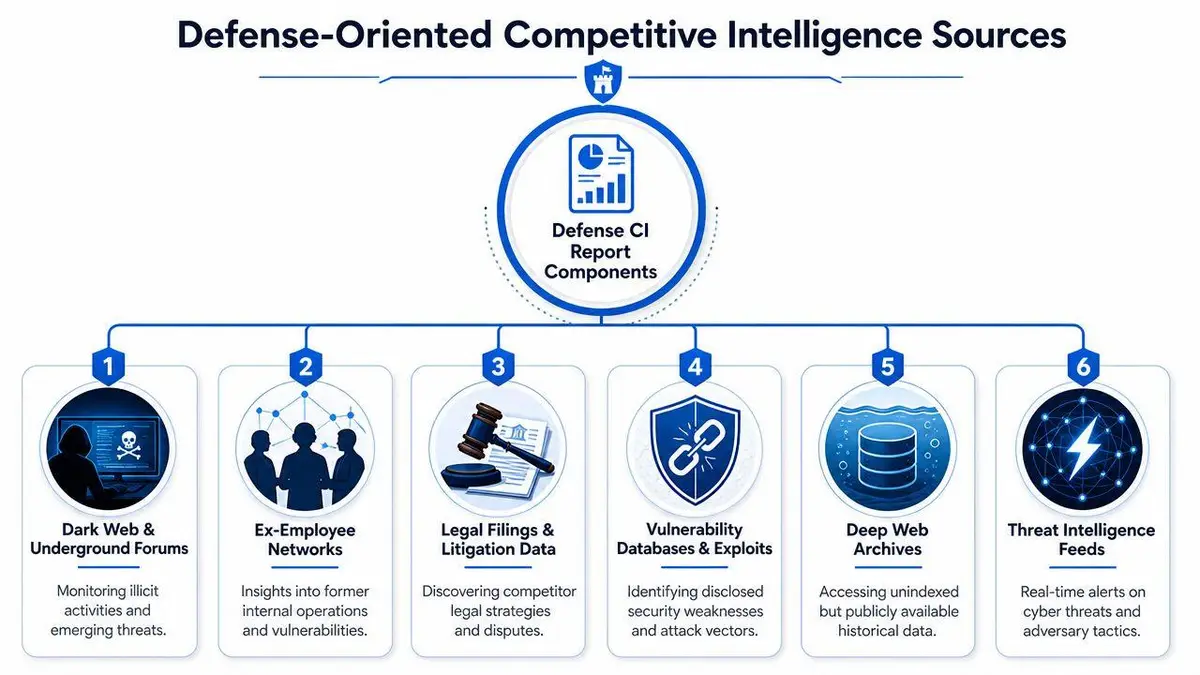
For reputation defense, the source set needs to be broader than ordinary market monitoring. You’re not just watching competitors. You’re watching precursors.
The most useful source classes often include:
- Open web properties: microsites, complaint blogs, cloned press pages, review profiles, affiliate pages, and newly published attack domains.
- Social and pseudo-social channels: X, Reddit, YouTube comments, Telegram groups, Discord servers, niche communities, and creator gossip ecosystems.
- Search manipulation indicators: sudden keyword targeting, mirrored negative pages, backlink anomalies, and coordinated indexing behavior. Teams looking for a stronger foundation in this area often start with practical SEO competitor analysis strategies.
- Corporate and legal signals: litigation filings, director changes, shell entities, commercial disputes, and restructuring activity that may explain motive.
- Human intent indicators: executive hires, agency relationships, job postings, contractor footprints, and former employee networks.
None of these sources is decisive on its own. Together, they often show sequence.
How to read weak signals properly
An executive hire at a rival firm may look unrelated. Then you notice the same firm has retained a specialist agency with aggressive digital tactics. Around the same time, a dormant domain begins publishing commentary aligned with that firm’s commercial interests. Separately, a former contractor starts posting coded allegations. Seen alone, each item is ambiguous. Seen together, they’re not.
That’s why defensive monitoring must be continuous and contextual. A monitoring system such as reputation monitoring matters because it captures recurrence. One hostile mention can be random. Patterned language across domains, accounts, and timestamps usually isn’t.
Raw collection is cheap. Interpretation is where most teams fail.
The minimum components of a defense-ready report
A useful report should contain more than screenshots and alerts. At minimum, it needs:
- Threat mapping
Identify origin sites, amplification channels, associated accounts, and likely operational links. - Narrative analysis
Separate factual criticism from manipulated framing, recycled allegations, and synthetic escalation. - Infrastructure review
Note registrars, hosting relationships, indexing behavior, replication risks, and points of technical dependency. - Intent assessment
Ask what the actor wants. Commercial advantage, revenge, settlement advantage, extortion pressure, or media contagion each require a different response. - Action priority
Rank what must be removed, challenged, preserved, or monitored.
That last point is critical. If everything is urgent, nothing is.
The CI Workflow From Data to Decision
Intelligence work fails when people confuse collection with understanding. A flood of alerts isn’t a strategy. It’s administrative noise with a threatening tone.
What works is a disciplined cycle. The process needs to be narrow enough to stay relevant and flexible enough to keep pace with an evolving attack.
Start with the right intelligence question
The first move isn’t “monitor everything.” That’s amateur behavior. The first move is deciding what you need to know in order to act.
Examples of useful key intelligence needs include:
- Attribution: Is this activity linked to a competitor, former employee, litigant, activist group, or anonymous broker?
- Escalation risk: Is the campaign likely to spread into mainstream media, search results, investor channels, or client networks?
- Operational choke point: Which platform, publisher, intermediary, or infrastructure dependency offers the fastest route to interruption?
Those questions govern collection. Without them, teams gather irrelevant material and miss the signal that matters.
Collection needs structure, not enthusiasm
Modern guidance on competitive intelligence reporting emphasizes that the discipline is built to turn multiple data streams into measurable comparisons, not just narrative summaries. Typical structures use KPI tracking, SWOT analysis, XY matrices, and side-by-side comparisons of products, pricing, market share, and trend changes, while teams increasingly aim for near real-time updates so leadership can make decisions faster, as described in Contify’s discussion of competitive intelligence analysis.
For reputation defense, the same principle applies, but the measurable comparisons are different. You compare origin sites against relay sites. You compare posting cadence before and after legal contact. You compare claim variants across platforms to detect coordination. You compare search persistence after removals to see whether suppression is holding.
Analysis is where the value is created
The collection phase gathers fragments. Analysis creates consequence.
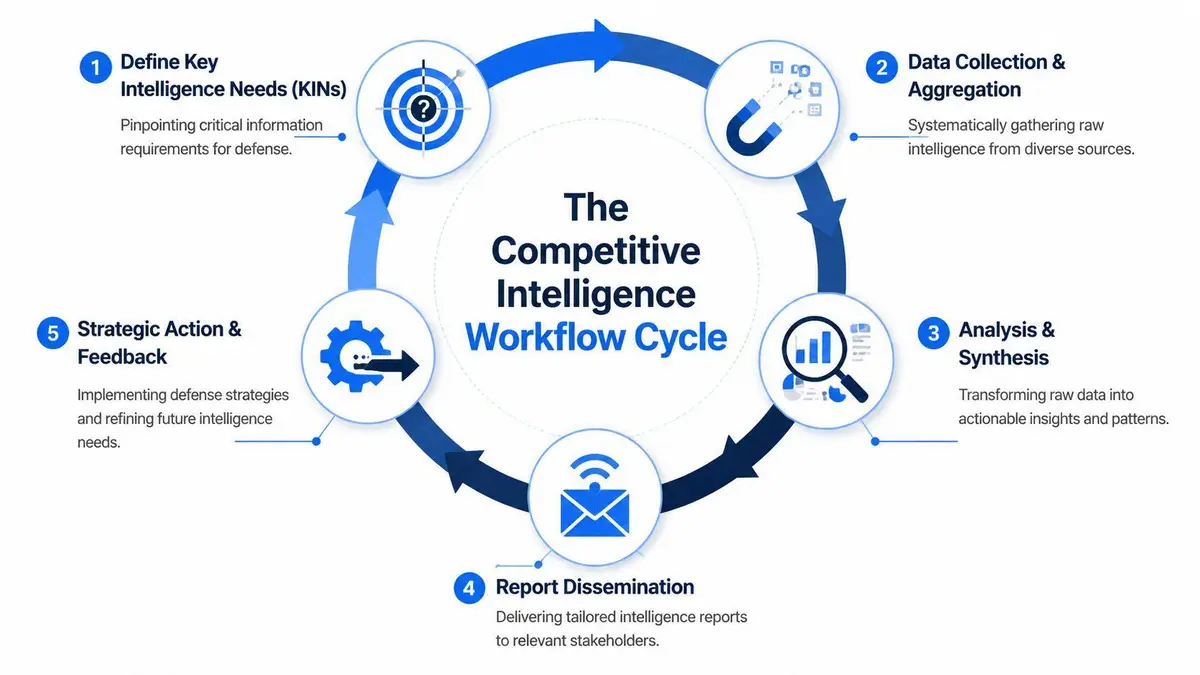
A professional workflow usually looks more like this than most clients expect:
| Workflow stage | What happens | Why it matters |
|---|---|---|
| Define needs | Tight questions are set for legal, PR, security, and executive review | Prevents waste |
| Aggregate signals | Public sources, reviews, forums, filings, and internal observations are combined | Reveals pattern |
| Verify and synthesize | False positives are removed, links between actors are tested, narratives are mapped | Protects credibility |
| Deliver discreetly | Findings are sent only to decision-makers with a need to know | Limits leakage |
| Feed action back in | Takedown results, platform responses, and reupload attempts refine monitoring | Keeps the cycle live |
Intelligence should reach a very small circle. The wider the distribution, the higher the chance that your own response becomes part of the adversary’s information stream.
Reporting should drive decisions, not meetings
A good intelligence cycle ends in movement. It triggers legal review, preservation, takedown requests, search de-indexing, account escalation, or silent watchlisting. A bad cycle ends in a deck.
That distinction matters because crises move faster than internal consensus. If your reporting process takes longer than the hostile content ecosystem takes to duplicate, rank, and amplify, then the report is already late.
Integrating CI with Takedown and Fortification Operations
An intelligence report has no standalone value if it never leaves the page. In reputation work, analysis is only useful when it drives intervention.
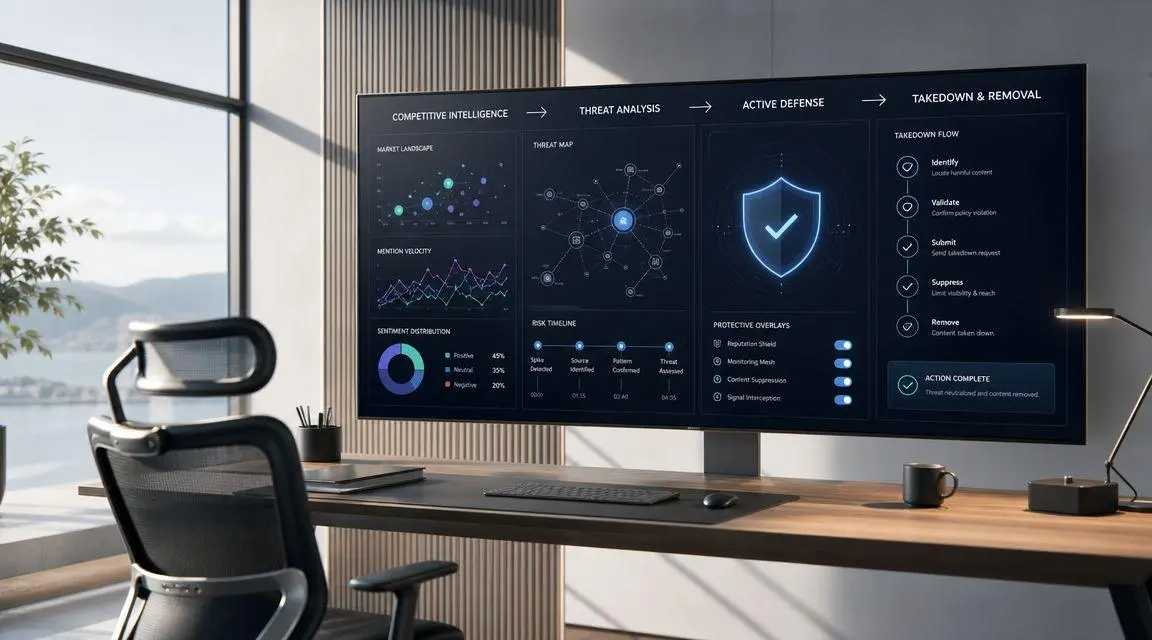
The practical purpose of competitive intelligence reports is to convert uncertainty into a removal plan. Once you know which domains are primary, which accounts are amplifying, and which infrastructure is shared, you can stop arguing about optics and begin disrupting the attack.
How intelligence findings become operational moves
Suppose a report shows that several defamatory pages use common registration patterns, repeated language structures, and synchronized publication timing. That changes the response immediately. Instead of treating each page as a separate annoyance, you pursue them as a network. Registrar notices, host escalation, policy complaints, search de-indexing requests, and legal preservation can then be coordinated rather than fragmented.
If the report shows that a former insider is seeding allegations through a niche platform before they spread to search-visible sites, timing offers a critical advantage. You don’t wait for mainstream pickup. You remove source content early, preserve evidence, and harden known vulnerable channels before the next wave appears.
Takedown strategy depends on attribution quality
There is no universal takedown sequence. The order depends on what the intelligence shows.
A practical response matrix often looks like this:
- If the source is platform-based: use terms-of-service enforcement, impersonation pathways, privacy claims, or defamation review channels.
- If the source is an independent site: assess ownership, host, registrar, indexing exposure, duplicate pages, and legal pressure points.
- If the source is a coordinated review or rumor campaign: isolate repeat wording, account clusters, timing anomalies, and commercial motive.
- If the source is likely to reappear: prepare monitoring triggers, evidence archives, and preventative search and profile fortification.
The fastest takedown is usually not the loudest. It’s the one aimed at the real dependency in the publication chain.
Fortification matters as much as removal
Removal alone is reactive. Fortification keeps the same attack from migrating.
That means strengthening search result resilience, securing vulnerable profiles, monitoring dormant domains, tightening media response protocols, and identifying which narratives are most likely to be reintroduced under fresh wording. In some matters, firms use legal counsel, cyber investigators, platform specialists, and technical monitoring providers in parallel. ContentRemoval.com is one example of a service used for source removal, de-indexing, false review takedowns, dark web monitoring, and ongoing reupload detection when a case requires coordinated execution rather than isolated requests.
The point isn’t vendor selection. The point is integration. Intelligence must tell operations where to strike first, what to preserve, and what to harden next.
What clients often get wrong
High-profile clients often focus on the most offensive piece of content. That’s understandable. It’s also often the wrong target.
The strategically important target may be the account that seeded the claim, the secondary site that made it indexable, or the review cluster that gave the allegation apparent legitimacy. If you remove the visible symptom but leave the distribution architecture untouched, the problem returns wearing different clothes.
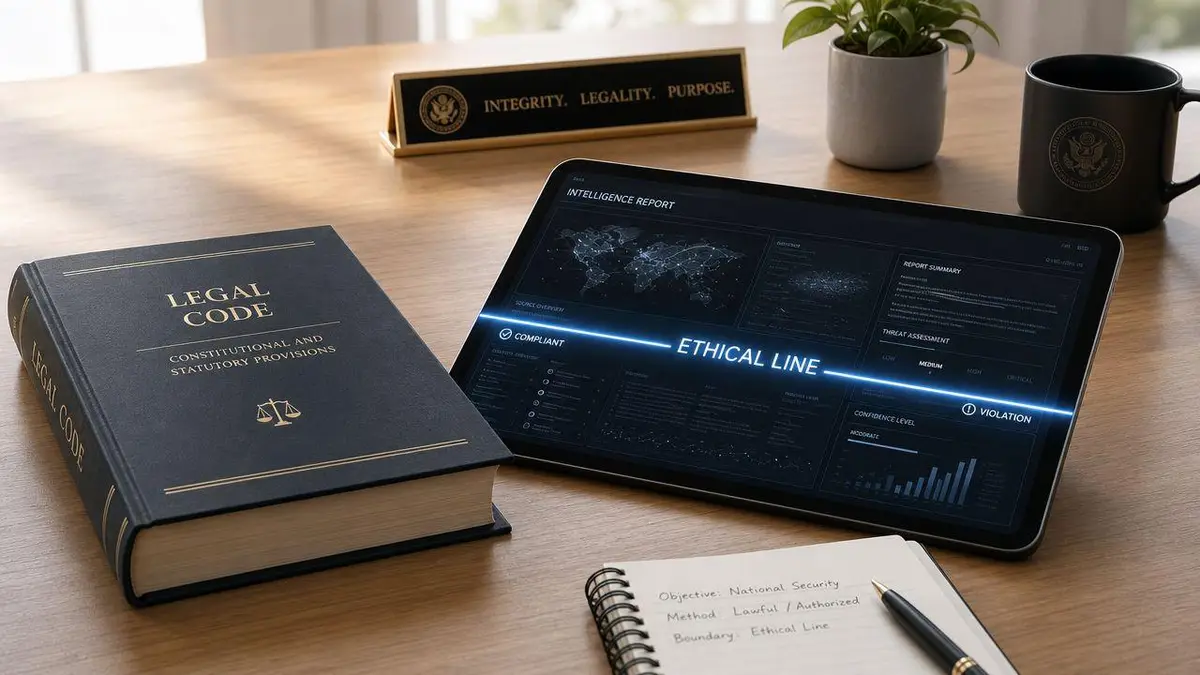
Legal Boundaries and Ethical Lines in Intelligence Gathering
A prudent client should ask a hard question before retaining anyone for intelligence work. Are they gathering public information lawfully, or drifting into conduct that creates a second crisis?
That distinction matters. In this field, many operators talk about “intelligence” when they mean rumor collection, invasive scraping, pretexting, or behavior that won’t survive scrutiny. Serious advisers don’t play that game.
The bright line you should insist on
Lawful intelligence work is built on publicly available information and disciplined analysis. That includes open web content, reviews, public filings, social content, press releases, archived pages, visible corporate relationships, and platform-level observations that can be documented and preserved.
It does not include hacking, credential misuse, unlawful access, deceptive impersonation, or fabricated identities used to obtain restricted information. It also doesn’t include reckless allegations presented as findings. If a provider cannot explain exactly how information was obtained, treat that as a warning.
Why ethics are operational, not cosmetic
Clients sometimes assume ethics are a branding issue. They aren’t. They’re a control issue.
If your adviser gathers information improperly, several things can go wrong at once. Evidence becomes contaminated. Platform complaints lose credibility. Opposing counsel gains a counterattack. Journalists get a second story. Regulators become interested in the wrong party.
That’s why lawful OSINT discipline is more powerful than reckless shortcuts. It produces material you can effectively use. It also protects the principal from inheriting the methods of a careless vendor.
A useful benchmark for executives reviewing legal exposure in removal work is this guide to navigating online content removal laws for executives. The legal pathway matters as much as the technical one.
Questions to ask any intelligence provider
Before engaging a firm, ask them these questions directly:
- What are your collection boundaries?
They should answer clearly and without euphemism. - How do you verify attribution?
They should distinguish evidence, inference, and suspicion. - How do you preserve chain of evidence?
If litigation or platform escalation becomes necessary, this matters. - Who receives the reporting?
Distribution should be tightly controlled. - How do you prevent your own inquiry from alerting the target?
Quiet collection is often as important as lawful collection.
A reputable intelligence partner should make you feel more protected, not more exposed.
The standard worth paying for
In high-pressure matters, discipline is the differentiator. Anyone can gather screenshots. Fewer can produce a report that is discreet, legally usable, operationally relevant, and calibrated to actual risk. Fewer still can do it without creating collateral damage.
That’s the standard to demand. Not cleverness. Not drama. Precision.
If you’re dealing with defamatory content, anonymous attacks, coordinated rumor campaigns, impersonation, or search-visible reputational harm, ContentRemoval.com can assess the threat confidentially and turn fragmented signals into a practical removal and protection strategy. The right response starts with knowing exactly who is moving against you, where the pressure points are, and which action sequence will shut the problem down with the least additional exposure.
Frequently asked questions
How do I tell if negative content about me is a coordinated campaign?
Look for the same usernames, domains, posting windows, hosting patterns or content themes recurring across platforms. One hostile mention can be random; patterned language across domains, accounts and timestamps usually is not, and a report should separate origin sites from relay sites.
Which piece of content should be removed first in an online attack?
Often not the most offensive one. The strategically important target may be the account that seeded the claim, the secondary site that made it indexable or the review cluster that gave it apparent legitimacy. Remove the visible symptom alone and the problem returns in new wording.
What questions should I ask an intelligence provider before hiring them?
Ask about their collection boundaries, how they verify attribution and separate evidence from suspicion, how they preserve the chain of evidence, who receives the reporting, and how they keep their own inquiry from alerting the target.