
To clear your name online, treat it as a reputation threat campaign rather than internet cleanup: preserve full-page evidence before contacting anyone, inventory every URL by removability, file precise platform, host and Google removal requests, escalate to counsel when requests fail, then suppress what cannot be removed with credible owned assets and keep monitoring for reappearance.
Key facts
- The first 48 hours follow assess, act, defend; do not contact the poster before evidence is preserved.
- Google’s Results about you and doxxing removal tools cut search visibility but leave the source page live.
- Match the legal theory to the facts: defamation, DMCA, impersonation, NCII or privacy each open different routes.
- Data broker removals are rarely one-time; Consumer Reports advises checking back every few months.
Where ContentRemoval.com comes in. ContentRemoval.com handles the source removal, de-indexing and monitoring described here for people whose name is under attack, usually after a first attempt at DIY reporting has stalled. Contact often comes from the person’s lawyer or a family office once the matter affects financing, employment or safety. A free 15-minute Exposure Scan maps the viable removal paths, and the report is yours to keep. Get a Free, Confidential Exposure Scan or read how our content removal work is done.
The call usually comes after midnight. A board member forwards a search result. A spouse finds a forum thread. A client asks a careful question that tells you they’ve already seen the allegation. By the time you type your own name into Google, the situation feels larger than the screen in front of you.
That feeling is useful only for the first minute. After that, it becomes expensive.
If you want to clear your name online, stop thinking in terms of “internet cleanup” and start thinking in terms of a reputation threat campaign. The objective is not to scrub the entire web. The objective is to identify what can be removed, suppress what can’t, preserve evidence before anyone edits or deletes it, and prevent the next wave. Strategic clients get results when they treat this as coordinated risk management, not digital whack-a-mole.
From Crisis to Control in the First 48 Hours
Most clients make the same early mistake. They start firing off angry emails, posting public denials, and reporting the same content repeatedly with no record of what was submitted. That feels active. It usually weakens their position.
The first forty-eight hours should be run on a simple command structure: assess, act, defend. Assess means identifying what exists and where it lives. Act means choosing the correct takedown channel instead of improvising. Defend means reducing further spread while you build the permanent record.
Assess the threat, not your feelings
Suppose a false accusation appears on a niche blog, then shows up on X, then gets indexed for your name. Those are not one problem. They are three separate problems with three different pressure points. The blog may require a direct legal or host-level challenge. The social post may fall under platform rules for impersonation, harassment, or privacy abuse. The search result may be eligible for de-indexing, which reduces visibility but doesn’t erase the source.
That distinction matters immediately in high-stakes accusations. If the allegation concerns criminal or sexual misconduct, your legal posture has to be calibrated from the start. For a useful primer on how false accusations can affect reputation and legal risk, see this discussion of Michigan false sexual assault allegations. Even when the jurisdiction differs, the strategic lesson is the same. Casual responses can create evidentiary and reputational damage of their own.
Immediate rule: Don’t contact the poster first if there’s any chance they’ll delete, edit, or multiply the content before you preserve it.
Act with a file, not a rant
Your first outbound actions should be documented requests supported by screenshots, URLs, timestamps, and a theory of removal. “This is false” is not a strategy. “This post contains my home address and phone number, uses a fake identity, and violates the platform’s impersonation and privacy rules” is a strategy.
If an executive needs a sharper playbook for false statements and coordinated online attacks, this guide on what to do if someone is posting lies about you online is a good starting point.
Defend while the case is live
Defense means locking down social profiles, reviewing old posts, alerting internal stakeholders who may receive outreach, and deciding who is authorized to speak. One careless denial by a colleague can become the next screenshot.
The internet rewards speed. Reputation recovery rewards discipline.
Damage Assessment and Evidence Triage
Amateurs search Google once and start reporting whatever appears on page one. Professionals build a map.
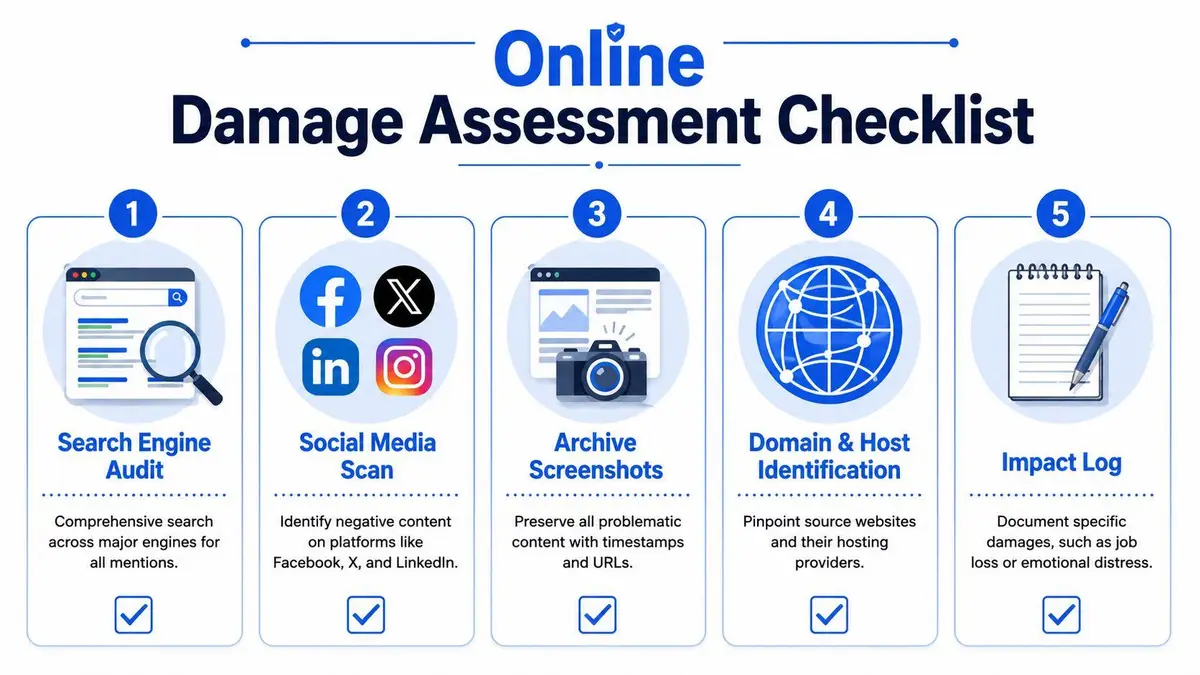
A proper audit has to cover search engines, social platforms, image results, people-search sites, old forums, domain records, and public-facing databases. Security.org makes the point plainly: many self-help guides assume people-search sites are the main problem, yet public records, domain WHOIS data, old forum posts, and social profiles can also surface personal details, which means a real cleanup strategy has to span multiple disclosure channels, not just the obvious ones in its name-removal guide.
Build the inventory first
Start with a controlled worksheet. Track the exact URL, page title, platform, date discovered, whether the content is indexed, whether it includes personal data, and what harm it creates. Harm can be commercial, personal, legal, or security-related. If a result is merely unpleasant, treat it differently from content that exposes an address, names family members, or alleges criminal conduct.
Use a wider search net than most guides suggest:
- Name variants: Search your full name, common misspellings, maiden names, aliases, usernames, and executive title.
- Address and contact trails: Search your home address, office address, phone numbers, and email addresses in quotation marks.
- Image exposure: Run image searches for your face, company headshot, and any stolen personal photos.
- Platform-specific queries: Search within X, LinkedIn, Facebook, Reddit, YouTube, and forum archives for accusations, reposts, or screenshots.
- Source relationships: Note whether one post is the source and others are merely amplifying it.
Preserve evidence like you may need it in court
Bookmarking is useless. You need full-page, timestamped captures that show the URL, date, visible content, and context. Save the page as it appears, not just a cropped excerpt. If there are comments, preserve those too. If the page changes later, your ability to make your case depends on proving what existed when you found it.
A disciplined evidence file should include:
| Record | What to capture | Why it matters |
|---|---|---|
| Full-page screenshot | URL bar, date, visible content, comments | Supports platform and legal requests |
| PDF or web archive copy | Entire page rendering | Preserves context if the page changes |
| Search result screenshot | Query and ranking | Shows discoverability and reputational impact |
| Metadata notes | Date found, account name, host, contact path | Speeds escalation |
| Impact log | Lost deal, internal inquiry, family distress | Helps prioritize and frame harm |
Save first. Report second. If the content disappears before you preserve it, you may lose the best evidence you had.
Triage by removability
Not every item deserves the same effort. Split findings into three categories. First, content likely removable under platform or privacy rules. Second, content that may require legal pressure or host escalation. Third, content you probably won’t remove and must instead suppress later with SEO and PR.
That triage prevents wasted motion. It also tells you when the matter has already outgrown DIY handling.
The Takedown Arsenal for Platforms and Hosts
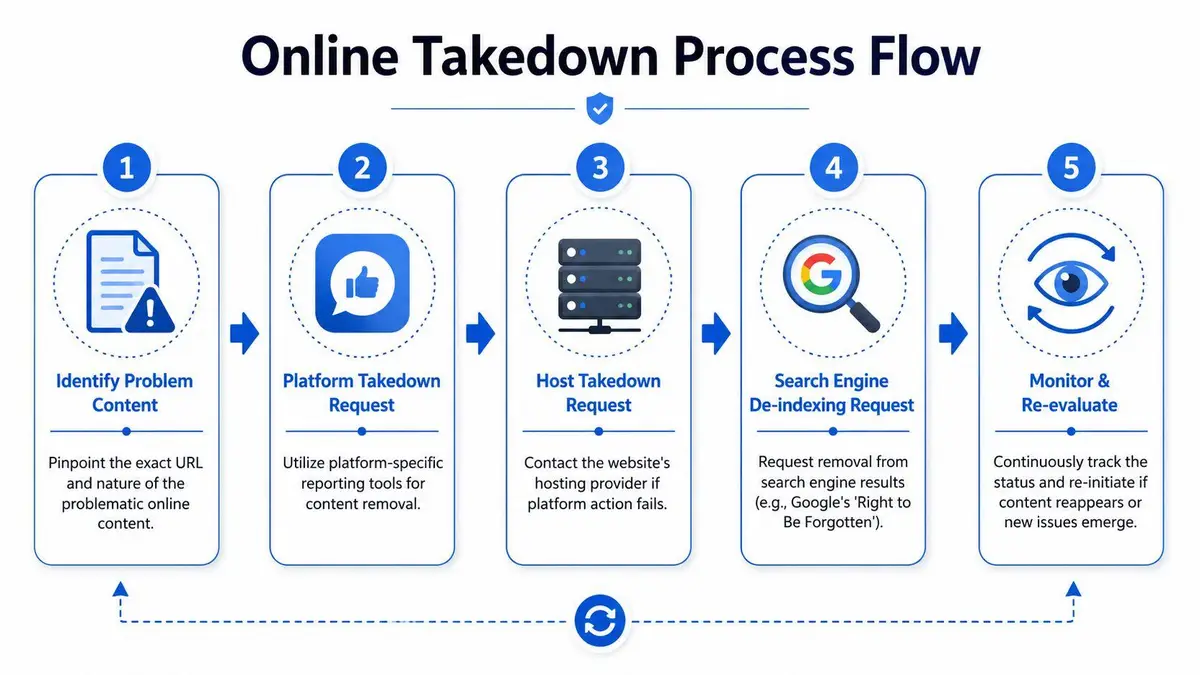
The central mistake in most “clear my name online” advice is treating every problem as a Google problem. It isn’t. Search is distribution. The publisher is the source. If you confuse the two, you’ll think you won when you only made the result slightly harder to find.
Google states that its removal tools apply only to the specific URLs submitted, and the underlying webpage may still remain online even if the search result is removed. Google also allows users to request removal of some private personally identifiable information through Results about you, and people can ask Google to remove doxxing content when a page contains personal information with explicit or implicit threats, or a significant amount of aggregated personal information without a legitimate purpose, as explained in Google’s removal documentation. That is useful. It is not final.
Use search removal for visibility control
If your address, phone number, email, or other sensitive data appears in search results, submit the precise URL through Google’s relevant removal workflow. Precision matters. If five pages expose the same information, you still have five URLs to address.
Search removal is often the fastest way to cut casual discovery. That’s valuable when investors, counterparties, or journalists are actively searching your name. But it is a visibility measure, not a deletion measure.
Push on the source where the rules are stronger
Platforms and hosts usually care about different things than search engines do. Social platforms care about impersonation, harassment, privacy violations, and manipulated identity. Web hosts care about terms-of-service violations, abuse complaints, and risk to their own infrastructure.
When you contact the source, your submission should answer four questions quickly:
- What exactly is the content? Provide the specific URL and account name.
- Which rule does it violate? Don’t complain in general terms. Match the facts to the platform’s published policy.
- What evidence proves the violation? Attach screenshots, identity proof where appropriate, and records of harm.
- What remedy are you requesting? Removal, account suspension, depublication, or urgent review.
A fake review campaign against a business often follows the same strategic pattern. Different facts, same logic. The issue is less “bad publicity” than rule-based platform abuse. For that reason, this guide on protecting your business from spam reviews is useful reading for executives handling reputation attacks that spill across personal and corporate search results.
Here’s a practical explainer before you escalate further:
Escalate to the host when the publisher ignores you
If the site owner won’t respond, identify the host and file a concise abuse complaint tied to the host’s own acceptable use terms. Don’t send a manifesto. Hosts respond better to structured submissions than emotional narratives.
A strong host complaint usually includes the offending URLs, the violation category, preserved evidence, and a short chronology. If the content includes doxxing, impersonation, intimate imagery, threats, or stolen material, say so directly. If a host won’t act, you may need counsel, specialist removal support, or both. One operational option in these matters is ContentRemoval.com, which handles source removal, de-indexing, and monitoring across search engines, websites, and social platforms.
Search suppression buys time. Source removal changes the board.
Escalating to Legal Remedies When Requests Fail
Some publishers ignore platform rules because they know most targets won’t litigate. Others sit behind thin-contact websites, foreign hosts, or anonymous accounts and assume that complexity is protection. Sometimes they’re right. Often they’re only right until someone with a coherent legal strategy shows up.

McAfee’s privacy guidance captures the core reality: removal outcomes depend heavily on the type of content, the jurisdiction, and whether the source is a private site, a public record, or a news page. The rules for search engines and website owners differ, which means legal reality often diverges from what a victim expects, as noted in its removal overview.
Know what legal theory fits the facts
Clients often say, “It’s defamatory.” Sometimes it is. Sometimes the stronger claim is copyright infringement, impersonation, invasion of privacy, or non-consensual intimate imagery. Choosing the wrong theory slows everything down.
Use this as a decision frame:
| Situation | Stronger pressure point | Typical objective |
|---|---|---|
| False factual allegation harming reputation | Defamation or libel analysis | Removal, correction, damages, injunction where available |
| Stolen photos, copied biography, lifted website text | Copyright claim or DMCA route | Fast removal from platforms, hosts, search results where applicable |
| Fake profile posing as you | Impersonation and identity misuse | Account takedown and evidence preservation |
| Leaked intimate content | NCII and privacy rights | Immediate removal and containment |
| Data exposure from private individual site | Privacy, harassment, doxxing, contract or host-policy pressure | Deletion and de-indexing support |
Don’t threaten a lawsuit you won’t file
Weak legal letters are worse than no legal letters. If you send a demand that overstates your position, cites the wrong jurisdiction, or asks for impossible relief, savvy operators will ignore it. Some will publish it.
A serious legal escalation does three things. It states the claim precisely. It preserves optionality. It gives the recipient a path to resolve the matter without forcing public litigation.
Counsel’s view: The best demand letter isn’t the loudest one. It’s the one that makes noncompliance look costly and unnecessary.
Be realistic about public records and news coverage
Many reputation campaigns stall in such situations. A private gossip site is one problem. A government record, mainstream publication, or archived report is another. If the source is lawful, accurate, or protected by public-interest defenses, complete removal may not be available. In those matters, your strategy may shift from deletion to correction, update, contextualization, or suppression.
If you’re dealing with a stubborn publisher or a site that refuses to remove personal information, this guide on what to do when a website won’t remove your information lays out the escalation logic clearly.
Legal intervention becomes necessary when leverage changes
Bring in counsel early when any of the following is true:
- The content alleges criminality or sexual misconduct: Delay increases discovery and screenshot spread.
- The source is anonymous but targeted: Subpoena strategy and preservation become time-sensitive.
- The attack affects employment, financing, licensing, or board governance: You need a record built for third-party scrutiny, not just removal forms.
- The facts cross borders: Jurisdiction and enforceability start driving outcomes.
The internet rewards aggressors who meet no resistance. Legal escalation changes the economics. That’s the point.
Building a Digital Fortress with SEO and PR
Some content won’t come down. If a reputable publication ran a lawful story, or a public record remains accessible, your job shifts. You stop asking, “How do I delete this?” and start asking, “How do I control what serious people see first?”
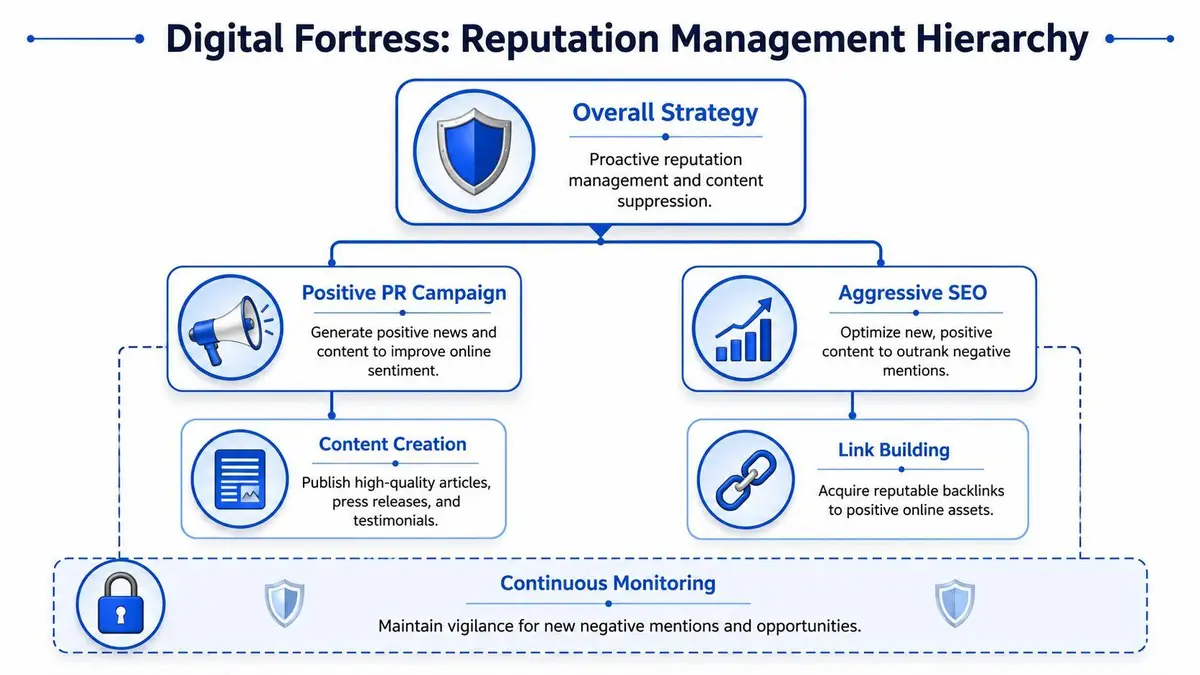
That requires a digital fortress. Not fake praise. Not spammy microsites. A layered portfolio of credible assets you control or can reliably influence.
Build assets with authority, not filler
Your first line of suppression is usually a clean personal website, a fully developed LinkedIn profile, and a consistent executive biography across controlled properties. Then come durable third-party assets: conference profiles, authorship pages, interviews, guest articles, board listings, and legitimate media mentions.
These assets work together only if they’re coherent. The name format must match. The headshot must be consistent. The biography must not contradict itself across platforms. Search engines read fragmentation as weakness.
Treat PR and SEO as one system
Many executives split these functions. That’s a mistake. PR creates authoritative mentions. SEO helps those mentions rank. Neither works as well alone.
A practical suppression campaign usually includes:
- Controlled properties: Your site, LinkedIn, and owned profiles should be optimized for your full name and principal title.
- Credible publishing: Contribute thoughtful bylined pieces to relevant industry outlets. Thin vanity placements don’t hold.
- Entity consistency: Keep titles, bios, images, and company descriptions aligned across profiles.
- Reputation-safe media: Prioritize interviews, podcasts, and commentary where your expertise is the story.
- Search-result shaping: Ensure your strongest assets target the exact branded queries that counterparties will use.
If removal fails, don’t leave the first page to chance. Occupy it deliberately.
Don’t create obvious suppression spam
A sloppy reverse-SEO campaign can make things worse. Generic press releases, empty profile pages, and low-grade guest posts may signal manipulation and won’t stand up against strong negative pages anyway.
The better approach is narrower and higher quality. Publish less, but publish material that real people would cite, link, and share. If you’re a founder, that may mean thought leadership tied to your actual operating experience. If you’re a family office principal, it may mean controlled philanthropic, governance, or speaking-profile visibility. If you’re a physician or attorney, it may mean credentials, publications, and directory profiles with strong trust signals.
A durable digital fortress doesn’t look like a campaign. It looks like a life and career properly documented online.
Long-Term Vigilance and Reputation Monitoring
Most reputation repair fails in the maintenance phase. Someone gets one result removed, sees the immediate crisis calm down, and assumes the matter is over. It rarely is.
Consumer Reports states that removing information from data broker sites is “not always a one-time thing” and recommends checking back every few months because deleted information can reappear in its data-broker removal guidance. That single point should change how you think about online cleanup. The internet republishes. Aggregators refill. Old data returns.
Set a recurring monitoring protocol
Monitoring should be routine, not reactive. At minimum, maintain alerts for your full name, company name, primary aliases, and sensitive identifiers that have surfaced before. Then pair those alerts with scheduled manual reviews across search, image results, social platforms, and key broker sites.
A workable executive protocol usually includes:
- Automated alerts: Track branded queries and obvious variations.
- Recurring manual audits: Review search and social results on a regular schedule.
- Removal ledger: Keep a live record of what was removed, where, when, and by which method.
- Reappearance checks: Revisit prior problem URLs and broker profiles to see whether they have returned.
- Stakeholder routing: Decide who receives alerts and who has authority to respond.
Watch for pattern changes, not just single links
The next attack may not look like the last one. It may appear as a reposted screenshot, a “review,” a forum thread, or an AI-generated summary that picks up old allegations. Monitoring has to account for mutation. That’s why serious clients maintain a case file after the crisis ends.
If you need a structured service layer for that ongoing work, review reputation monitoring. Continuous watch is not paranoia for executives, public figures, and high-risk families. It’s basic protection.
You don’t defend a restored reputation with one takedown. You defend it with repeatable oversight.
The phrase “clear my name online” sounds like a single action. In practice, it’s a standing discipline. The people who handle it well don’t just remove what hurt them last week. They build systems that make the next attack harder to launch and easier to contain.
If your name, family, or business is under pressure online, ContentRemoval.com can assess the exposure, map the viable removal paths, and coordinate a discreet response across search, source sites, and ongoing monitoring. The right move isn’t more panic or more reporting. It’s a confidential action plan with evidence, influence, and follow-through.
Frequently asked questions
Can I get a false accusation removed from Google?
Google’s tools remove specific URLs from search results for certain categories such as exposed personal data or doxxing, but they do not remove a false allegation from the source page. For the accusation itself you need the publisher, the host or a legal route, with de-indexing run in parallel.
What evidence should I collect before reporting defamatory content?
Full-page, timestamped captures showing the URL bar, date, visible content and comments, plus a PDF or archive copy, a screenshot of the search result and ranking, metadata notes and an impact log. Save first and report second.
What if the negative content is a news article or public record?
If the source is lawful, accurate or protected by public-interest defenses, complete removal may not be available. The strategy then shifts to correction, update, context or suppression through stronger assets that rank for your name.