
To clean up an online presence at executive level, map every exposure across search, images, people-search sites, forums and archives, triage each item by control, severity and remedy, contain spread by locking down owned accounts and preserving evidence, then run source removal and de-indexing as separate tracks before building authoritative assets that hold the first page.
Key facts
- Search the way opposing counsel would: name variants, company plus name, phone, email, usernames and image search.
- Sequence matters: preserve evidence, send the strongest source request, file search requests, refile once the source changes.
- Google accepts removal requests for doxxing, exposed financial details and other sensitive personal information.
- Monthly reviews suit high-visibility executives; quarterly is the minimum for anyone with public-facing responsibilities.
Where ContentRemoval.com comes in. When the exposure spans search results, data brokers and hostile pages at once, ContentRemoval.com takes on the de-indexing, takedowns and impersonation removal as a single coordinated matter. Executives rarely call themselves; it is usually an assistant, chief of staff or counsel. A free 15-minute Exposure Scan maps what can be removed and what needs a different remedy, and the report is yours to keep. Get a Free, Confidential Exposure Scan or read how our content removal work is done.
Your name is clean in the boardroom and toxic in search. A journalist sees an old allegation before they see your current work. A prospective investor finds a stale forum thread, a scraped address, a copied mugshot, or a Reddit post built to rank for your name. Your assistant says, “Can’t we just delete it?” Usually, no.
If you need to clean up online presence at an executive level, stop treating it like social media housekeeping. This is a risk-management exercise. The problem isn’t one bad link. The problem is exposure across search, data brokers, public records, repost networks, archived pages, and platforms that move at different speeds and respond to different kinds of pressure.
The internet rewards whatever is easiest to find, not whatever is fairest. One negative result can become your public biography if you leave it untouched long enough. The correct response is structured, fast, and unsentimental.
Discovery and Triage Mapping Your Digital Exposure
A crisis usually starts the same way. Someone important searches your name before a meeting, sees the wrong result first, and forms a conclusion you now have to fight. By the time your team notices, the issue has already moved from visibility problem to business risk.
Start with exposure mapping. A serious cleanup begins with a disciplined inventory of what exists, who controls it, how easily it can spread, and what legal or security risk it creates. Executives and public figures do not have a single online presence. They have a stack of searchable identities across search results, image indexes, people-search sites, archived posts, court-record mirrors, document repositories, and repost networks.
Google itself explains that search can surface personal information across web pages, images, and records, and it outlines removal pathways for certain categories of sensitive content in its guidance on removing personally identifiable information from Google Search. That matters because search is the distribution layer. If a damaging result ranks for your name, title, or company, it becomes part of your professional file whether it is fair or not.
Audit the open web like opposing counsel would
Run searches the way a hostile reporter, litigant, or activist would. Use your full name, common misspellings, former names, company plus name, city plus name, phone numbers, email addresses, usernames, and image searches. Then search the same terms in quotes and without quotes. Check web, images, videos, news, and cached results separately.
Do not stop at page one.
Review enough results to identify patterns, not just obvious embarrassments. Google’s own search operators can help you isolate PDFs, specific domains, and exact-match mentions, and Google documents those operators in its advanced search operators reference. Use that method to find old resumes, board packets, donor lists, local-news reprints, complaint PDFs, and scraped profile pages that standard searching misses.
A weak audit creates false confidence. You are not looking for a single bad link. You are identifying the full attack surface.
Build a triage model tied to risk
Catalog every finding by control, severity, and remedy. If you own it, fix it. If it exposes personal data, contain it fast. If it alleges misconduct, treats rumor as fact, or republishes arrest content, assess it for legal pressure and search suppression. If it includes impersonation, explicit content, doxxing, or stolen documents, preserve evidence and prepare for escalation.
| Exposure type | What it means | Priority |
|---|---|---|
| Controlled but outdated | Content on profiles or sites you own | Fix immediately |
| Personal-data exposure | Address, phone, family details, doxxing vectors | Urgent |
| Reputation damage | Allegations, mugshots, hostile articles, forum attacks | Strategic priority |
| Legal violations | Impersonation, NCII, copyright theft, defamation | Escalate fast |
This classification decides the response path. An outdated bio is an asset-management issue. A home address linked to family members is a personal security issue. A false allegation ranking for your name is a reputation, legal, and search issue at the same time.
Treat severity realistically. If a result creates physical risk, extortion pressure, shareholder concern, hiring friction, or regulator attention, log it as an incident.
Map the channels that do not show up cleanly in search
Search results are only the visible layer. Data brokers, public-record aggregators, forum archives, complaint sites, Telegram channels, Discord servers, and repost blogs often feed the visible layer later. A page that barely ranks today can jump during a news cycle, legal dispute, executive move, or funding event.
This is why amateur cleanup efforts stall. People delete a few old posts and ignore the distribution network connecting their address history, relatives, employers, usernames, and archived photos. Distribute.you’s blog is useful here because it helps explain how identity data spreads across multiple sites and why isolated deletions rarely hold.
For a more formal process, use a documented digital footprint cleanup strategy and build a working exposure map with columns for URL, content type, owner, jurisdiction, ranking status, evidence preserved, risk category, and likely remedy. That document becomes your command sheet. Without it, takedown requests get sent in the wrong order, legal options get missed, and harmful content stays live longer than it should.
Immediate Containment First-Response Actions
Once you identify active risk, your job is to stop amplification. Don’t start arguing in public. Don’t send emotional messages to site owners. Don’t post a denial thread that teaches search engines and users which allegation to connect to your name. Containment comes first.
In the first response window, focus only on assets you control and channels that can make things worse quickly.
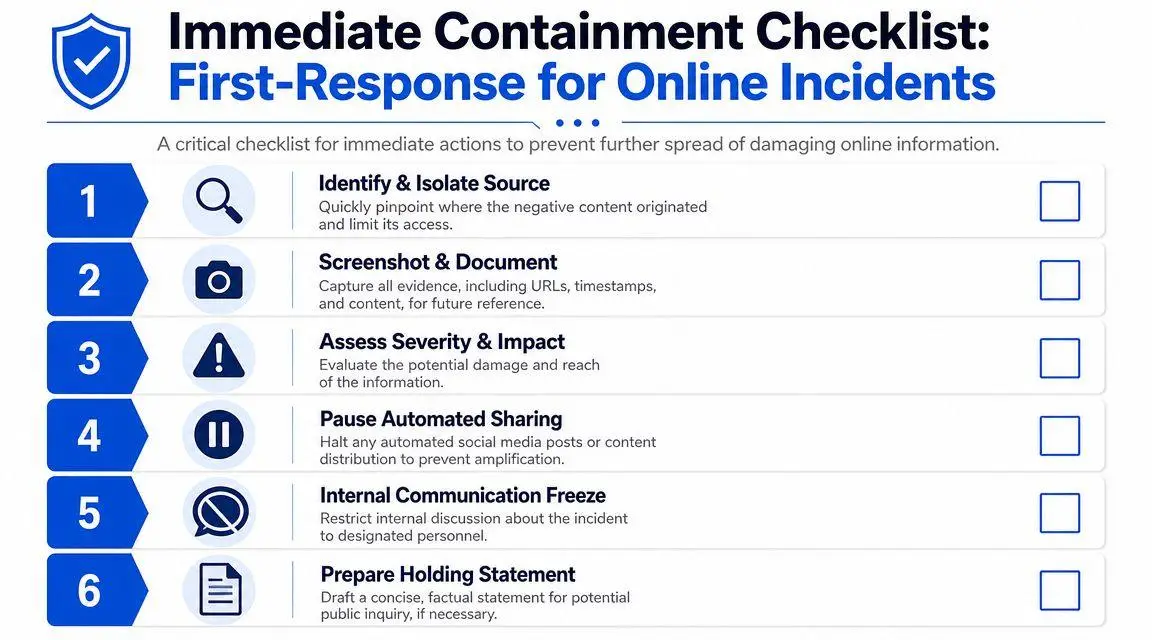
Lock down the surfaces you own
Start with social accounts, personal sites, creator platforms, newsletters, and business profiles. Review privacy settings, disable unnecessary public visibility, remove geotagging where possible, and freeze casual posting until the issue is mapped. If you have automated distribution tied to X, LinkedIn, Instagram, YouTube, or syndication tools, pause it. Nothing should continue publishing while you’re under reputational pressure unless someone is actively supervising.
Use this sequence:
- Preserve evidence first. Capture screenshots, URLs, timestamps, account names, and source code snapshots if needed.
- Remove low-value exposure. Archive or delete old posts, replies, and media that no longer support your professional narrative.
- Harden account access. Reset passwords, review sessions, and tighten admin roles across brand and personal accounts.
- Silence unnecessary outputs. Pause scheduled posts, auto-replies, and cross-posting tools.
- Restrict internal chatter. Staff should know who is authorized to respond and who is not.
- Prepare a holding line. If someone must answer inquiries, the message should be short, factual, and non-expansive.
Don’t feed the search result
Clients often want to rebut instantly. That impulse is understandable and often destructive. Public rebuttals can validate the topic, create fresh indexable pages, and give hostile parties wording to reuse. If a platform issue is algorithmic rather than purely reputational, such as suppressed visibility tied to moderation signals, diagnose the mechanics before posting more. Resources like Klap’s shadowban solutions are useful because they show how visibility problems can worsen when people react blindly.
When a harmful narrative starts moving, your first duty is control. Explanation comes later, if it’s needed at all.
Use native reporting tools where the violation is obvious
Immediate containment isn’t the stage for novel legal theory. It’s the stage for obvious wins. Report impersonation accounts through the platform’s identity abuse channels. File copyright complaints for stolen headshots, copied website text, or unauthorized reposts of owned media. Remove tags from third-party photos where platforms allow it. Ask colleagues and family members to stop commenting publicly, even if they mean well.
A short decision table helps:
| Situation | First response |
|---|---|
| Fake profile using your name or image | Platform impersonation report |
| Stolen photo or copied article text | Copyright complaint |
| Old post on your own account | Archive or delete |
| Doxxing details on your own profile | Remove and tighten privacy |
| Team members discussing the issue publicly | Immediate communications freeze |
Containment doesn’t solve the whole problem. It buys time, reduces spread, and keeps you from making the situation easier to index, quote, or weaponize.
Escalated Remediation De-Indexing and Takedowns
A board candidate loses an appointment because a stale search result surfaces before the background memo is finished. The article is old, misleading, and still ranking. The publisher may ignore you. Search engines may still show it even after edits. That is why serious remediation requires two separate tracks from the start. One targets the source. The other targets visibility.
Search engines, platforms, and privacy regimes now offer formal routes to remove or suppress certain content. In the EU, the right to be forgotten established that some search results can be de-indexed under defined circumstances. Google also accepts requests involving doxxing, exposed financial details, and other sensitive personal information. For executives and public figures, this changes the assignment. You are no longer trying to “clean up the internet.” You are reducing exposure, limiting rediscovery, and building a record that supports stronger action if the matter escalates.
Start with the process below.
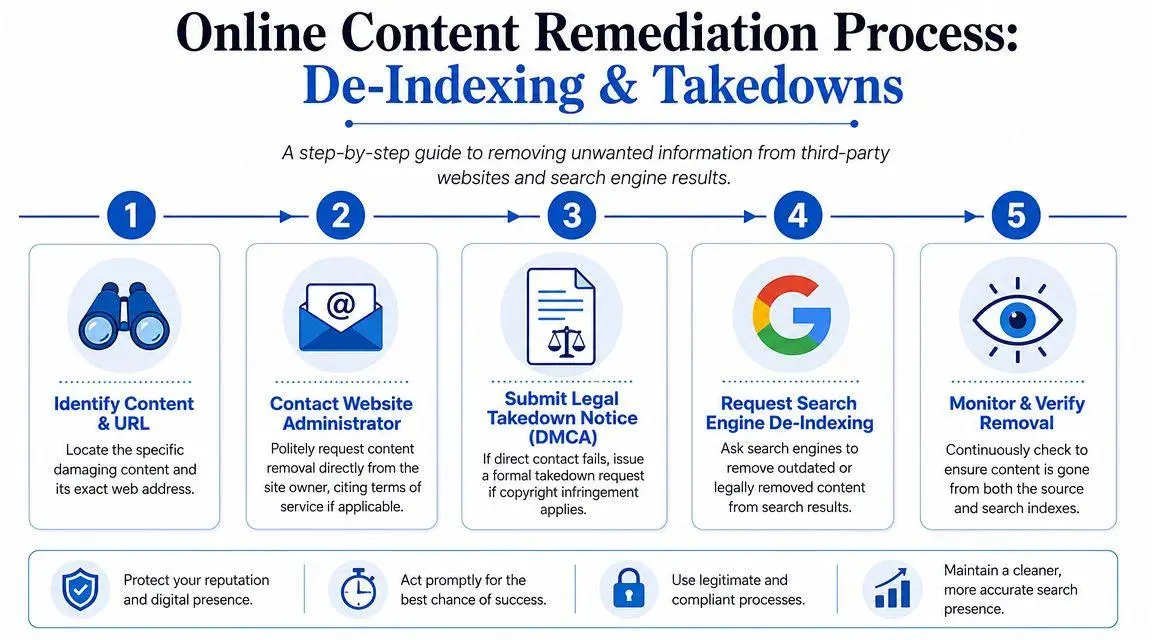
Source removal and de-indexing are not the same
Source removal changes the underlying page. De-indexing changes whether people find that page through search. You often need both.
If content is false, unlawful, non-consensual, infringing, or clearly barred by a site’s own rules, pursue removal from the host. If the page is hard to erase but qualifies under search policies, privacy rules, or regional rights, file for de-indexing at the same time. Treat them as separate workstreams with separate evidence files.
| Remedy | What changes | Best use |
|---|---|---|
| Source removal | Content disappears from the host site | Policy violations, copyright, factual falsehoods, exposed private data |
| De-indexing | Search result visibility is reduced or removed | Outdated coverage, privacy-sensitive material, jurisdiction-specific search issues |
If your team keeps mixing up hosting issues, ranking issues, and cached-result issues, use this guide to de-indexing and search result removal. It explains the mechanics clearly enough to keep a remediation plan from drifting.
Write requests that give the recipient a reason to act
Weak requests fail because they read like personal complaints. Effective requests read like risk memos.
State the exact URL. Quote or capture the exact material at issue. Cite the policy, law, or factual defect that supports removal. Ask for a specific remedy, such as deletion, redaction, de-indexing, cache removal, or snippet update. Include evidence once, in a clean package. Do not send a rambling narrative, a thread of emotional follow-ups, or a threat you are not prepared to carry out.
Use webmaster outreach when the publisher is identifiable and the issue can be solved by correction, deletion, or redaction. Use platform complaint channels when the material sits inside a network with clear abuse rules. Use formal notices when the facts support copyright claims, impersonation, privacy violations, non-consensual intimate imagery, or false statements that create measurable harm. If the source page comes down, file search removal requests immediately so dead links, cached copies, and stale snippets stop doing damage.
The video below gives a useful general primer on search-result cleanup. Watch it for process, not strategy. Process without the right legal and factual theory wastes time.
Sequence controls outcome
File in the wrong order and you create your own delays. A host may refuse a vague complaint that should have been a copyright notice. A search engine may reject a request because the page is still live in the same form. Duplicate submissions across channels can also create conflicting records that make later escalation harder.
Use a disciplined sequence:
- Preserve evidence before anything changes.
- Send the strongest source-level request available.
- File platform or search requests that fit the exact violation.
- Refile with updated proof once the source changes or comes down.
- Verify removal in branded search, image search, and cached results.
De-indexing reduces visibility. It does not remove the underlying asset, and it does not eliminate legal risk if the material remains accessible.
Handle this work like an exposure-control project. Remove what can be removed. Suppress what qualifies for de-indexing. Document every refusal, delay, and republication. That record is what supports the next level of escalation when ordinary requests stop working.
Advanced Escalation Legal and Platform Interventions
Some matters should never be handled as routine customer support tickets. If the content involves NCII, impersonation, extortion, coordinated harassment, deepfake abuse, or a fabricated allegation built to damage your name, escalation isn’t optional. It’s the only serious path.
The mistake I see most often is under-escalation. Clients keep filing generic reports into systems designed for ordinary moderation issues while the attacker republishes, mirrors, and adapts. That approach burns time and creates a false sense of progress.
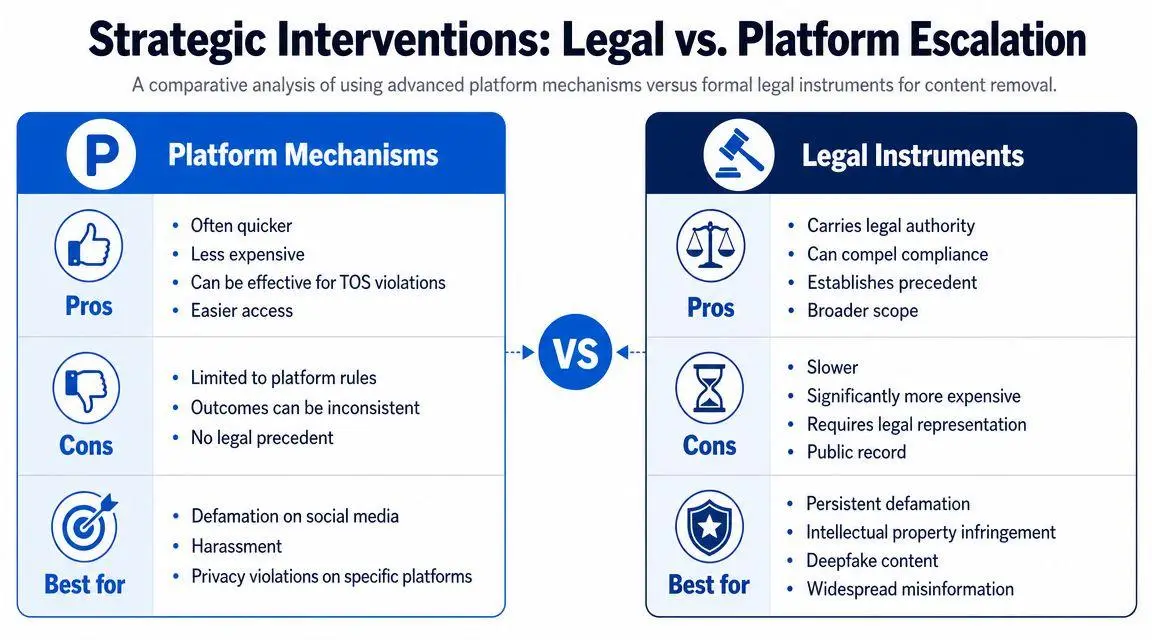
Know when platform tools are enough
Platform mechanisms can work well when the violation is clear and native to the platform’s rules. A fake Instagram profile, a stolen LinkedIn headshot, or a harassment campaign on X may be removable through impersonation, privacy, or abuse channels without immediate court action.
That said, platform tools have limits:
- They enforce platform rules, not your full legal rights. If your complaint is nuanced, moderation teams may miss it.
- They can be inconsistent. Similar reports often get different outcomes across platforms or even within the same platform.
- They rarely solve off-platform spread. A removal on one service doesn’t neutralize mirrors, reposts, or search residue.
Use platform systems aggressively when the evidence fits. Don’t pretend they’re a substitute for legal strategy when the issue is severe.
The threshold for legal intervention is lower than most executives think
If someone posts non-consensual intimate imagery, legal counsel and specialist removal support should be engaged immediately. The same goes for impersonation used to solicit money, disseminate false statements, or contact employees or customers under your name. Mugshot extortion pages, doxxing campaigns, and repeat defamers also belong in the legal lane early.
A simple comparison makes the choice clearer:
| Scenario | Platform route | Legal route |
|---|---|---|
| Fake social account copying your profile | Strong first move | Use if platform fails or damage expands |
| NCII or intimate image leak | Immediate emergency reporting | Immediate parallel legal escalation |
| Mugshot extortion page | Limited usefulness | Usually necessary |
| False review by anonymous actor | Maybe, if policy violation is clear | Needed if persistence causes material harm |
| Coordinated harassment across multiple sites | Fragmented and slow | Often required to centralize pressure |
If the attacker is anonymous, persistent, and distributing across multiple properties, you don’t have a content problem. You have an adversary problem.
Build the record before you swing harder
Legal escalation works when the evidentiary file is tight. Preserve URLs, timestamps, screenshots, account handles, source copies, notices sent, and responses received. If the material is defamatory, isolate the exact false statements and document the damage pathway. If it’s copyright infringement, identify ownership clearly. If it’s impersonation, show the overlap in names, images, logos, or communication patterns.
This is one of the few points in the process where specialized providers become practical tools rather than luxuries. Firms such as ContentRemoval.com handle de-indexing, impersonation takedowns, leaked-image removal, and monitoring across search engines, websites, and social platforms. That’s useful when a matter spans several systems at once and ordinary platform reports aren’t enough.
The right question isn’t “Can I report this myself?” Of course you can. The right question is whether delay, procedural mistakes, or fragmented action will increase the harm. For executives, public figures, and family offices, the answer is often yes.
Proactive Defense Suppression and Reputation Fortification
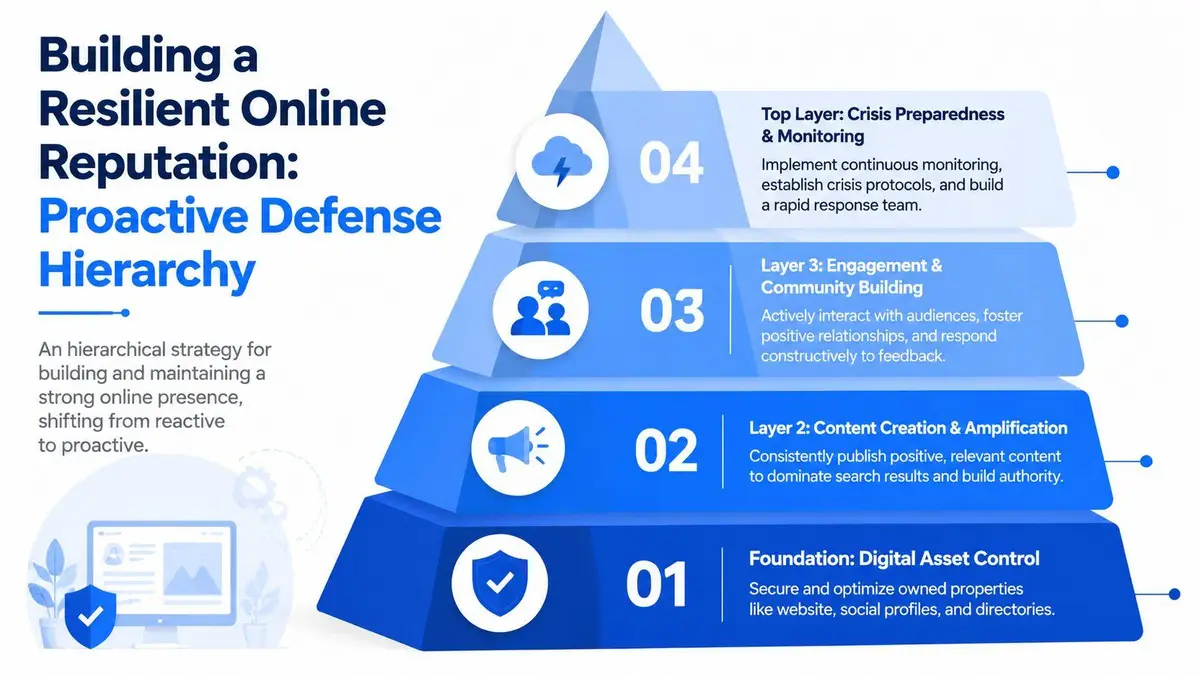
It’s often thought that cleaning up an online presence means removing the bad. That’s incomplete. If you don’t build controlled, credible assets that rank for your name, you leave a vacuum. Vacuums get filled by gossip, lazy summaries, scraped records, and old controversy.
A defensive strategy alone won’t hold. You need a fortification strategy.
Build properties you control
Own your name where you can. That usually means a personal website, a clean executive biography, updated company leadership pages, properly structured professional profiles, and consistent imagery across major platforms. Search engines favor clarity and authority. Give them both.
If your profile ecosystem is fragmented, tighten it. A concise personal site, a strong LinkedIn presence, reputable bylines, and accurate directory entries create a stable foundation. For practical ideas on tightening social-profile presentation and link architecture, lnk.boo insights for digital branding are useful because they focus on how profile surfaces shape discoverability.
Suppression is a publishing problem
Search suppression, sometimes called reverse SEO, is not magic. It is the disciplined creation and promotion of better assets that deserve to rank above the harmful or outdated material you can’t fully remove. That means publishing thought leadership, interviews, press features you can stand behind, firm bios, speaker pages, podcast appearances, and topical articles connected to your expertise.
Weak efforts prove ineffective here. A couple of generic guest posts won’t displace a high-authority negative result. You need durable assets with coherent branding, consistent naming, and enough authority signals to compete over time. A specialist resource on suppressing negative content and rebuilding digital authority is useful here because suppression only works when content strategy and search behavior are aligned.
A clean reputation isn’t the absence of negative content. It’s the presence of stronger, more authoritative truth.
Treat reputation like infrastructure
Executives often outsource their image to chance. They update nothing until a crisis hits, then expect deletion to solve a structural weakness. That’s backwards. The resilient approach is to maintain a portfolio of authoritative pages that answer the search query before an attacker, critic, or tabloid does.
The strongest online presence looks boring in the best way. Clear bios. Verified profiles. Accurate press references. No personal-data leakage. No abandoned accounts. No contradictory versions of your history. If someone searches your name, they should find a coherent, defensible record that you either control or can influence.
Sustaining a Clean Presence and Knowing When to Call for Aid
A reputation incident rarely ends when one damaging page disappears. Copies survive on scraper sites. Cached versions remain visible. A forum post gets quoted into a fresh thread. A data broker rebuilds a profile from public fragments. If you stop after the first visible win, exposure returns on someone else’s schedule.
Treat maintenance as a standing risk-control function. Run scheduled reviews of your name, your company, key executives, and family members who are publicly tied to you. Check branded search results, image search, social platforms, people-search sites, and any page that could influence investors, boards, clients, journalists, or hostile actors. Assign ownership to a specific person. If nobody owns the review cycle, it does not happen.
Put your review cycle on a calendar
Use a fixed cadence and document it. Monthly is appropriate for high-visibility executives. Quarterly is the minimum for anyone with public-facing responsibilities, prior incidents, or heightened privacy concerns.
Your review process should cover four areas:
- Search surveillance: Review priority name queries and branded terms to catch new exposure early.
- Asset maintenance: Update biographies, headshots, employer profiles, and other controlled pages before inaccuracies spread.
- Resurfacing checks: Revisit past removals, de-indexing requests, and edited pages to confirm the issue has not returned.
- Escalation triggers: Define in advance what goes to legal, what goes to communications, and what goes straight to an outside specialist.
Keep records. Save screenshots, URLs, dates, case numbers, and correspondence. If the matter escalates into platform appeals, legal complaints, or a defamation review, incomplete documentation slows you down and weakens your position.
Know when DIY stops making sense
DIY cleanup works for stale accounts, old blog posts you control, and basic privacy settings. It fails when the threat carries legal, financial, or personal-safety consequences.
Bring in outside help immediately if the issue involves anonymity, impersonation, extortion, non-consensual intimate content, doxxing, coordinated harassment, false allegations tied to employment or financing, or repeated republication after prior removal. Those cases require speed, technical follow-through, platform fluency, and legal judgment. Delay increases visibility. Public missteps create more searchable material.
Here is the practical threshold:
| Trigger | Why outside help is warranted |
|---|---|
| Anonymous publisher or coordinated network | Identification, evidence capture, and shutdown efforts are harder and more time-sensitive |
| False claims affecting employment, financing, licensing, or board appointments | The business consequences justify formal escalation and documented handling |
| NCII, impersonation, extortion, or doxxing | Safety and legal exposure require urgent specialist action |
| Search results remain after edits or deletions at the source | The issue usually needs de-indexing requests, cache handling, and technical follow-up |
| Executive time constraints or active media attention | Delay gives the material time to spread and harden into the record |
If the consequence of error is legal exposure, investor concern, reputational loss, or a safety threat, stop testing platform workflows on your own.
The people who manage this well do not treat it like a side task. They handle it like compliance, litigation, and executive protection. They review on schedule, document everything, escalate early, and keep watching after the noise dies down.
If your search results, personal data exposure, or reputation threats need confidential handling, ContentRemoval.com provides assessment and action planning for de-indexing, takedowns, impersonation removal, and longer-term reputation protection. The right course is simple. Contain the issue fast, choose the correct remedy, and avoid public mistakes that make removal harder.
Frequently asked questions
Should I publicly deny a false allegation about me online?
Not in the first response window. Public rebuttals can validate the topic, create fresh indexable pages and hand hostile parties wording to reuse. Preserve evidence, lock down the accounts you control and prepare a short factual holding line instead.
What is the difference between removing content and de-indexing it?
Source removal changes or deletes the page on the host. De-indexing reduces or removes its visibility in search without touching the page itself. They are separate workstreams with separate evidence files, and executives often need both.
When does online cleanup stop being a do-it-yourself job?
When the matter involves anonymity, impersonation, extortion, intimate content, doxxing, coordinated harassment, false claims tied to financing or employment, or content that returns after prior removal. Those cases need speed, platform fluency and legal judgment.