

Cleaning up an executive’s online presence combines a deep audit of every digital mention, triage of threats into three tiers, immediate containment through platform reporting, hardening of personal accounts, publishing authoritative content to suppress negative results, and de-indexing or legal takedowns for the most damaging URLs, followed by continuous monitoring.
Key facts
- The first 48 hours run as Audit, Triage, Act: map every mention, tier the threats, contain the worst first.
- Three legal routes for removal: defamation, DMCA copyright infringement and right-to-privacy violations.
- Google de-indexing works for sensitive data or policy violations, rarely for major news or public records.
- Mugshot pages that charge for removal can be reported to Google under its exploitative removal practices policy.
Where ContentRemoval.com comes in. ContentRemoval.com does the removal and de-indexing side of this playbook for executives whose internal team has hit a wall: sticky news results, denied takedowns, impersonation, or a coordinated attack. The first contact is often a chief of staff, general counsel or communications lead. A free 15-minute Exposure Scan maps what is removable and what needs suppression, and the report is yours to keep. Get a Free, Confidential Exposure Scan or read how our content removal work is done.
Cleaning up an executive’s online presence is a meticulous process combining proactive content strategy with reactive, surgical removals. It begins with a deep-dive audit of every digital mention, progresses to securing personal profiles, suppressing negative results with positive content, and employs technical or legal means to remove the most damaging information. This is not digital housekeeping; it is a critical requirement for modern leadership with a direct impact on corporate valuation and personal career trajectory.
Why a Clean Digital Footprint Is No Longer Optional
For a senior executive, an online presence is either a powerful asset or a catastrophic liability. There is no middle ground. This is not about vanity. It is about the immediate financial and career impact of a compromised digital reputation. The link between Google search results and boardroom decisions is direct and unforgiving.
Negative, misleading, or outdated information quietly erodes stakeholder trust and undermines authority. A single damaging article can stall a nine-figure merger. An old, irrelevant legal dispute can poison a fundraising round before it begins.
This exposure is magnified by the way credibility is now assessed. A significant 91% of 18 to 34-year-olds trust online reviews as much as personal recommendations. For an executive, this means future hires, potential partners, and investors form their first, and often final, impression based on a quick search.
The Real-World Cost of a Compromised Reputation
A compromised digital footprint creates friction. It injects risk into every transaction and encourages second-guessing.
Consider a private equity firm conducting due diligence. They scrutinize not just the company’s balance sheet but also the leadership team’s public profiles. Unresolved negative press, mentions of litigation, or embarrassing personal content dramatically increase the perceived risk of a deal. This can devalue an offer or terminate it outright.
The same applies to executive recruiters and corporate boards, for whom exhaustive digital background checks are standard practice. A history of controversial social media posts or a prominent negative news story can disqualify an otherwise perfect candidate before an interview. The investment required to clean up an executive online presence is a rounding error compared to the cost of a single lost opportunity.
Your online reputation is the new currency of trust. What is published about you online is the de facto truth until you actively prove otherwise. It is an active balance sheet item for both your career and your company.
Moving From Reactive Panic to Proactive Strategy
Viewing reputation management as a crisis-only function is a strategic error. It is an essential, ongoing component of leadership and risk management.
The objective is not merely to address negative items as they appear. The true goal is to build a fortified digital identity resilient to future attacks or misinformation. This requires a deliberate strategy of creating and promoting authoritative, positive content that establishes control over the public narrative. This includes the ability to absorb and deflect criticism, a skill addressed in this Guide To Not Letting Others Put You Down.
This proactive approach ensures that when a journalist, investor, or potential partner searches your name, they find what you intend for them to find: a curated portfolio of professional achievements and thought leadership. For a deeper analysis of this defensive posture, our guide on protecting your online identity with a strategic framework provides the necessary foundation. This playbook is built on that truth: controlling your digital narrative is a core function of leadership.
Executing a 48-Hour Audit and Containment Protocol
When a reputation crisis emerges, the first 48 hours are decisive. A social media flare-up can propagate 1200% faster than a traditional news story, leaving no time for hesitation. A swift, calculated response can contain the damage before it metastasizes.
This is not a time for committee meetings or protracted debate. It is a time for action. The objective is to move from reactive shock to a full understanding of the situation and the reassertion of control. This begins with a forensic investigation of the executive’s digital footprint to map the damage and initiate immediate containment.
We follow a disciplined three-stage process: Audit, Triage, and Act.
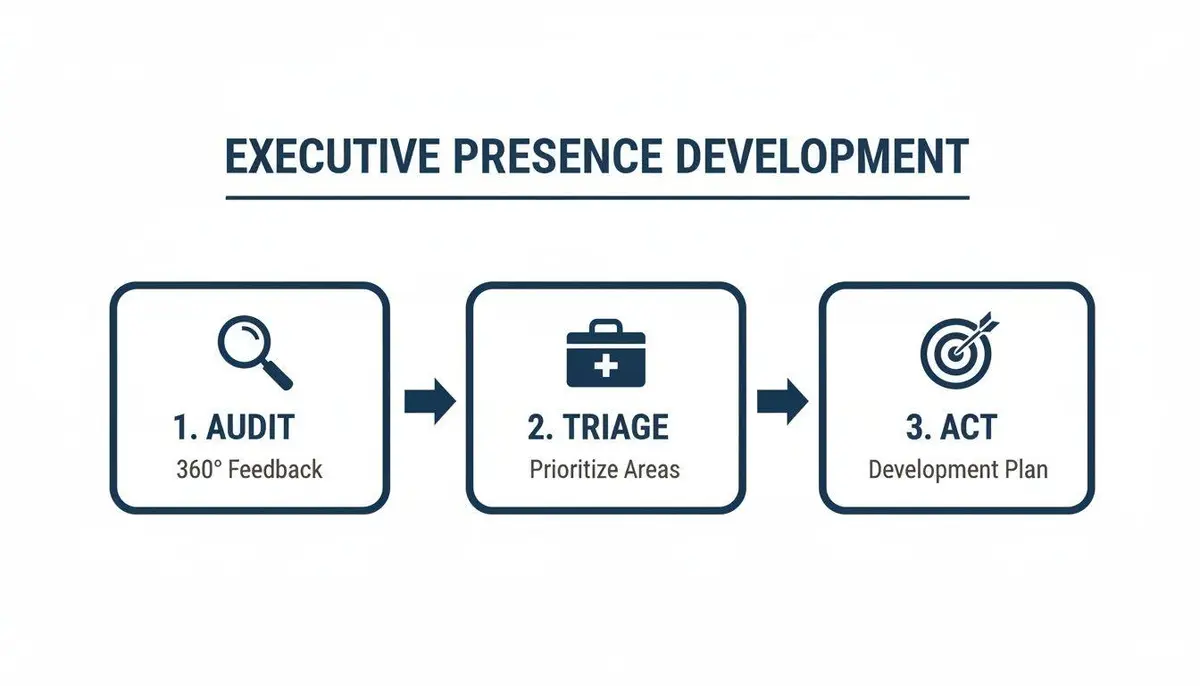
This framework provides a repeatable playbook to follow under pressure, ensuring no critical step is missed in the effort to clean up an executive’s online presence.
First: Map the Digital Battlefield
Before any remedy can be applied, you must understand the full scope of the problem. This demands a systematic audit far beyond a simple Google search. Your team’s initial task is to catalog every mention of the executive across the public web.
A thorough audit is the foundation of any successful cleanup operation. Meticulously scan search results, social media, news articles, and any other online footprint. A standard website SEO audit checklist can be adapted to track all public-facing information discovered.
This search must be exhaustive, covering these key domains:
- Search Engines: Investigate at least five pages deep on Google, Bing, and DuckDuckGo. Use search operators for the executive’s name, their name plus the company, and any key phrases associated with the crisis.
- Social Media: Conduct deep searches on X (formerly Twitter), LinkedIn, Facebook, and Instagram for direct mentions, tagged photos, and related conversations, not just posts from the executive.
- News and Forums: Employ advanced search commands to analyze news archives, press releases, industry forums, and community sites like Reddit, which often act as incubators for negative sentiment.
- Data Brokers: Do not neglect people-search sites and data aggregators. These platforms frequently surface personal information without consent and can be a source of significant vulnerabilities.
Log every link, screenshot, and discovery date. This organizational discipline produces a crucial body of evidence should legal action become necessary.
Second: Triage and Prioritize Threats
With a complete map of all online mentions, you must perform triage. Not all negative content carries equal weight. Categorize each item to focus resources where they will have the greatest impact.
Threats are sorted into three distinct tiers:
| Tier | Threat Description & Examples | Action Priority |
|---|---|---|
| 1 | Critical Threats Defamation, impersonation, leaked confidential data, NCII, active security risks. | Immediate |
| 2 | High-Impact Negatives Misleading news, prominent negative reviews, old legal issues. | High |
| 3 | Low-Impact & Outdated Irrelevant mentions, inaccurate but benign data, old directory listings. | Standard |
This system forces a disciplined response. A defamatory blog post accusing an executive of fraud (Tier 1) demands a completely different and more urgent action than an outdated biography on a conference website (Tier 3).
The core principle of the 48-hour protocol is containment first, cleanup second. Your initial goal is to stop the bleeding. This means neutralizing the most virulent threats before they can metastasize across the internet.
For example, if a false rumor is gaining traction on X, the immediate priority is using the platform’s reporting tools to remove the posts for violating community standards. Polishing the executive’s LinkedIn profile, while important, can wait. The active, spreading threat cannot.
Third: Execute Initial Containment
With threats triaged, your team can take action. These initial steps are focused on swift containment, limiting the visibility of damaging content, and preserving options for more in-depth remediation.
For Tier 1 threats such as an impersonation account or doxxing, the first action is to report it to the platform’s trust and safety team. Major social networks maintain fast-tracked reporting channels for these violations. Document every report filed.
For Tier 2 threats, like a factually accurate but unflattering news article, containment is about narrative control. This may require preparing a statement for internal and external stakeholders to shape the story before it is defined by others. This structured approach is what it takes to clean up an executive online presence under fire and sets the stage for the substantive remediation work that follows.
Building Your Digital Fortress: Foundational Reputation Work
With immediate fires contained, the focus shifts from defense to offense. This phase moves beyond reactive measures to the proactive construction of a strong, resilient digital presence. The work is about asserting control, transforming online vulnerabilities into authoritative assets that you manage.

This is not damage control; it is narrative shaping. We achieve this by securing personal data, optimizing core professional profiles, and initiating strategic content publication. Every subsequent action should be designed to solidify your control over how you are perceived online.
Secure the Perimeter: A Personal Data Lockdown
The first move is to secure all entry points to your digital life. This requires a full audit and hardening of privacy settings on every social media account connected to the executive, their immediate family, and their inner circle. A poorly secured personal Instagram account is a trove of information for those seeking to cause harm.
Data confirms this risk: 70% of employers use social media to screen candidates, and 57% have rejected an applicant based on their findings. For an executive, the consequences are far more severe.
This is a non-negotiable process. Analyze each platform with forensic precision:
- Facebook & Instagram: Set all personal accounts to Private. Audit friend and follower lists, removing anyone not personally known or trusted. Critically, disable photo tagging permissions to prevent association with compromising images without consent.
- X (formerly Twitter): If it is a personal account, make it private. For public-facing professional accounts, conduct a deep audit of old “likes” and replies, as these are often used to construct a negative narrative.
- LinkedIn: Control who can view your connections list, disable data sharing with third-party applications, and enable two-factor authentication.
The objective is to draw a clear demarcation between the executive’s private life and their public, professional identity. If it is not suitable for a journalist or investor to see, lock it down or delete it.
Polish Your Core Professional Assets
Once personal accounts are secured, focus on the profiles you want people to discover. A LinkedIn page, corporate biography, and other professional listings are more than online résumés; they are powerful narrative tools. They must project authority and align with your desired narrative.
This extends beyond updating a job title. A fully optimized profile is a comprehensive, information-rich asset capable of dominating the first page of Google search results for an executive’s name.
A well-optimized LinkedIn profile is one of the most powerful assets in reputation management. It is a high-authority domain that Google trusts, making it a cornerstone for suppressing less desirable search results.
Populate these profiles completely with detailed project histories, links to published works, board memberships, and speaking engagements. Use a crisp, professional headshot consistently across all platforms to build a unified brand. The tone should be sharp, confident, and a true reflection of the executive’s leadership. These polished biographies can then be syndicated across the company website, conference platforms, and industry directories. For a more detailed approach, our guide provides a strategic framework for removing personal information from the internet.
Start Publishing Positive Content
The final piece of this foundational work is creating positive content. This is the most effective long-term defense against future negative attacks. You cannot simply react to negative search results; you must displace them with strong, positive content that you own and control.
Identify appropriate platforms for the executive to share their expertise. This can take several forms:
- Publishing articles on LinkedIn or in respected industry journals.
- Authoring posts for the corporate blog about key market trends.
- Appearing as a guest on reputable podcasts or in video interviews.
Each piece of content creates a new, positive search result tied to the executive’s name. Over time, this web of owned media functions as a digital firewall, making it exceptionally difficult for new negative press to gain traction and rank on Google. This is the essential groundwork that supports all future efforts to clean up an executive’s online presence and ensures their reputation remains fortified.
Advanced Suppression and Technical Removal Tactics
When foundational digital hygiene is insufficient and a negative result is cemented on the first page of Google, it is time for a technical offensive. This is where we move from a defensive posture to actively shaping search engine results pages.
Think of it this way: foundational work builds a strong perimeter fence. These advanced tactics are the strategic operations run to neutralize specific threats that have already breached the walls.

These strategies are not about polite requests. They involve using the technical rulebook of the internet (search engine optimization (SEO), platform policies, and strategic content creation) to assert control over search results.
Controlling the Narrative with Suppression Campaigns
The vast majority of searchers never click past the first page of results. A suppression campaign is engineered around this reality. The goal is to push a negative link to page two, three, or beyond, effectively rendering it invisible. This is accomplished by creating and promoting a network of positive, high-authority digital assets that outrank the problem content.
Instead of attempting to erase the negative, you build a wall of positive, credible information that search engines will find more relevant and authoritative. It is a meticulous process requiring a deep understanding of Google’s algorithms.
A successful campaign typically involves:
- Developing New Digital Properties: This entails creating a portfolio of high-quality content you control. Examples include personal websites, new profiles on authoritative sites like Quora or Medium, and publishing thought leadership articles on respected industry blogs.
- Targeting Specific Keywords: Every new asset is precisely optimized to rank for the executive’s name and any related search terms that surface the negative result. We create direct competition for that valuable first-page real estate.
- Building Authoritative Links: We then work to secure backlinks from reputable websites to your positive assets. In Google’s algorithm, a backlink functions as a vote of confidence, signaling that your content is trustworthy and important.
The objective is to flood the first page of search results with content that tells your story, leaving no room for the damaging material.
Leveraging Technical SEO for Removal and De-Indexing
Beyond creating new content, there are technical levers to address harmful URLs directly. While not guaranteed, they are essential tools in any comprehensive effort to clean up an executive’s online presence.
De-Indexing Requests
A de-indexing request is a formal appeal to a search engine like Google to remove a specific URL from its results. This does not delete the content from the host website; it simply makes it undiscoverable via search. This is a primary tactic when a website owner is unresponsive or refuses a removal request.
Google’s “Removals” tool in Google Search Console is the formal channel for these requests. Success hinges on meeting specific criteria. The content typically must be outdated, contain sensitive personal information, or violate a clear Google policy, such as those against non-consensual explicit imagery (NCII) or exploitative mugshot sites.
De-indexing is a tactical move, not a silver bullet. It’s most effective when the negative content is on a low-authority blog or clearly falls into a policy violation category. For a negative article from a major news outlet or a public government record, this approach almost never works.
Strategic Use of Canonicalization
Canonicalization is an advanced SEO technique using a rel="canonical" HTML tag to inform search engines that one URL is the “master copy” of a page. While typically used to resolve duplicate content issues, it can be a powerful reputation management tool.
Imagine a negative story syndicated to dozens of smaller, lower-quality news sites. It may be possible to work with the original publisher, if their article was more balanced or has since been updated, to have them add a canonical tag pointing back to their “master” article. This consolidates all search engine authority into that single, preferred URL, often causing the less-desirable, syndicated copies to disappear from search results. This delicate maneuver depends entirely on securing the webmaster’s cooperation.
When Technical Tactics Are the Only Way Forward
While basic profile optimization is a necessary starting point, it will not dislodge a high-ranking negative article from a major newspaper or a defamatory blog post that has gained traction. These situations demand a full-scale suppression campaign.
Consider a common scenario: An executive was named in a lawsuit ten years ago. The case was dismissed, but a sensational, one-sided article about the initial filing remains on page one for their name. The publication has refused to remove it, citing editorial policy.
A suppression campaign is the only viable path. The approach would be as follows:
- Build a professional personal website for the executive, showcasing their official biography, accomplishments, and a portfolio of work.
- Secure guest post placements in high-authority business journals, publishing insightful articles under the executive’s name.
- Create and fully optimize new professional profiles on other relevant platforms, such as an industry-specific forum or a personal blog.
- Launch a targeted campaign to earn backlinks from other credible sites to all these new, positive assets.
Over several months, this coordinated effort systematically elevates the positive content in search rankings, pushing the old, negative article down until it no longer threatens their reputation. This is how the technical battle to clean up an executive’s online presence is won.
While suppressing negative content is a powerful long-term strategy, some attacks are so damaging they require surgical removal at the source. This is where we shift from narrative management to direct takedowns.
Successful content removal is not achieved through angry emails or empty threats, which often backfire. A successful takedown hinges on constructing a case that clearly violates a platform’s terms of service or a specific law.
This is analogous to filing a legal motion. The goal is to present a claim so clear and well-documented that the platform’s reviewer can make an easy, affirmative decision. Any ambiguity or procedural error can invalidate the request or protract the process for weeks.
Distinguishing Legal Claims for Removal
Content cannot be removed simply because it is disliked. A removal request must be grounded in a recognized legal framework, each with its own rules of evidence.
The three most common legal arguments for compelling a removal are:
- Defamation: This applies to a false statement of fact that is published and harms a reputation. The key is proving the statement is factually incorrect, not merely a negative opinion. This requires gathering evidence that directly refutes the claim and demonstrates the resulting reputational damage.
- Copyright Infringement (DMCA): The Digital Millennium Copyright Act is the primary tool for removing original work (photos, articles, or videos) used without permission. A DMCA takedown notice is a formal declaration identifying your original work and the infringing copy, asserting ownership under penalty of perjury.
- Right-to-Privacy Violations: This covers the unauthorized publication of private, sensitive information, such as personal financial data or medical records. Success requires showing the information was never intended for public view and that its exposure would be highly offensive to a reasonable person.
Each path requires a distinct strategy. A DMCA notice is often a straightforward process, whereas a defamation claim can involve complex legal arguments. For those considering litigation, it is critical to first understand the costs and potential outcomes, which we explore in our guide to online defamation lawsuits and their strategic evaluation for executives.
A takedown request isn’t a negotiation; it’s the presentation of a non-negotiable legal or policy violation. The strength of your case rests entirely on the quality and organization of your evidence.
Executing Platform-Specific Takedown Protocols
The quickest path to removal is often a direct appeal to a platform’s own Terms of Service rather than a formal legal claim. Most social networks and search engines have specific policies against harassment, impersonation, and other harmful content.
Knowing how to navigate these proprietary reporting systems is a crucial skill. While each platform’s form differs slightly, the formula for an effective report is constant: be precise, provide documentation, and cite a clear violation.
Playbook for Common Takedown Scenarios
The following are exact steps for handling some of the most common and damaging attacks executives face.
Social Media Impersonation
An account impersonating an executive can cause enormous damage by spreading misinformation or contacting clients inappropriately.
- Action: Locate and use the platform’s dedicated impersonation reporting form. Do not use the generic “report profile” button, as it will not be prioritized correctly.
- Evidence: You will need a photo of the executive’s government-issued ID (e.g., passport or driver’s license) to prove their identity. Provide a direct link to the fake account and a brief explanation of the harm it is causing.
Non-Consensual Intimate Imagery (NCII)
The unauthorized sharing of private, intimate images is a severe violation that platforms and search engines treat with the highest urgency.
- Action: Immediately use the specialized NCII reporting tools offered by Google and major social media platforms. These requests are sent to dedicated teams for fast-tracked review.
- Evidence: The forms will require you to identify the specific images or videos. The policies are designed to protect victims, so the focus is on confirming lack of consent, not proving harm.
Exploitative Mugshot Websites
These predatory sites publish old arrest records, even for dropped or expunged cases, and then demand thousands of dollars for removal. While the records may be public, this business model constitutes a form of extortion.
- Action: Go directly to Google’s reporting tool and file a request under its policy against “exploitative removal practices.”
- Evidence: Provide the URL of the page with the mugshot and the search terms that surface it. State clearly that the website demands payment for removal. As this is a direct violation of Google’s policies, the success rate for these takedowns is very high.
Knowing when to engage specialists is a critical executive decision. While an internal team can manage digital hygiene, some situations are beyond their scope. Attempting to combat a complex reputation attack internally often backfires, exacerbating the problem and prolonging the damage.
Engaging a specialist is not an admission of defeat; it is a strategic decision to deploy the necessary tools, industry contacts, and legal leverage that an in-house team lacks. This is particularly true when you must clean up an executive’s online presence while under active assault.
When DIY Hits a Brick Wall
There is a clear line between what an internal team can manage and what demands professional intervention. If you encounter any of the following, it is time to escalate. Even the most talented marketing or communications team is not equipped for these battles.
These are the red flags:
- Coordinated Smear Campaigns: This is not a single bad review but a multi-front attack involving anonymous blogs, social media mobs, and manufactured outrage on forums, all appearing simultaneously. This is a deliberate campaign requiring forensic analysis to identify the source and a sophisticated counter-strategy.
- Sticky, High-Ranking Negative News: A negative article from a major news outlet on the first page of Google will not be dislodged by a few blog posts. Suppressing such powerful content requires an intense, resource-heavy SEO campaign, often involving the creation of dozens of high-authority websites and profiles.
- Legal or Platform Roadblocks: When takedown requests are denied and publishers refuse to correct false information, you have hit a wall. Specialists have spent years building relationships with legal departments and high-level contacts inside major tech platforms, enabling them to reopen and win cases closed to the public.
- Doxxing or Dark Web Threats: When an attack involves the release of private information (doxxing) or moves to the dark web, it crosses from reputation management into personal security. Specialized firms have intelligence units that monitor these threats and know how to work with law enforcement.
Bringing in a specialist firm is like deploying a surgical strike team. It means you’ve identified a threat serious enough to require a group whose only job is to neutralize complex digital attacks with precision and speed.
How to Vet and Hire the Right Firm
Choosing a reputation management partner is a high-stakes decision. The industry contains operators who make promises they cannot substantiate with the requisite technical, legal, or strategic expertise. Your vetting process must be ruthless.
When interviewing a potential firm, demand to know their exact methods. Ask direct, pointed questions:
- What is your strategy: legal takedowns or technical suppression? A true professional will immediately distinguish between the two and explain which approach fits your situation and why, citing specific platform policies or legal precedents.
- Can you walk me through a similar case you have handled? They should be able to describe past scenarios, while maintaining client confidentiality, that are analogous to yours. You need to hear the tactics they used and the results they delivered.
- How will you measure success, and what is a realistic timeline? Discard any firm that guarantees results or offers vague platitudes. A specialist sets clear expectations and defines concrete KPIs, such as the removal of specific URLs or achieving a clean first page of search results, and provides a phased timeline.
Protecting Your Investment with Ongoing Monitoring
Once a reputation is restored, the work is not finished. It must be protected. The most critical long-term service a specialist provides is continuous monitoring. The internet has a long memory, and old problems can resurface.
This is not a matter of setting up a Google Alert. It involves sophisticated tools that constantly scan the surface, deep, and dark web, 24/7, for any mention of the executive’s name. This system is an early-warning radar, flagging new threats the moment they emerge so they can be neutralized before gaining momentum. This proactive defense is the only way to protect the significant investment made in restoring your executive’s online presence.
When you’re facing coordinated attacks, stubborn negative content, or complex legal hurdles, your internal team is outmatched. ContentRemoval.com delivers the specialized legal, technical, and strategic power needed to defend your reputation with speed and certainty. Schedule your confidential assessment today.
Frequently asked questions
How do I get an impersonation account of an executive taken down?
Use the platform’s dedicated impersonation reporting form rather than the generic report button. You will typically need a photo of the executive’s government ID, a direct link to the fake account and a short note on the harm it is causing.
Does a Google de-indexing request delete the content?
No. De-indexing removes a URL from search results but leaves the page live on the host. It is most effective when the content is outdated, contains sensitive personal information or clearly breaches a Google policy, and it almost never works against major news outlets or public records.
When should an executive hire a reputation firm instead of using the internal team?
When the problem is a coordinated smear campaign, a high-ranking negative news article, denied takedowns, or doxxing and dark web threats. Those situations need forensic analysis, platform escalation contacts and legal routes an in-house marketing team does not have.