
A professional digital footprint cleanup starts with a forensic audit of search results, social platforms, third-party sites, data broker listings and archived copies, ranks each finding by discoverability and decision-making risk, then executes source removal, de-indexing and suppression in that order of priority, followed by ongoing monitoring for re-uploads and new exposure.
Key facts
- Source removal, de-indexing and suppression are different outcomes and should be scoped separately in the engagement letter.
- The audit ranks findings by ease of discovery, decision-making risk and whether action is possible at source or index.
- Anonymous complaint sites, foreign-hosted domains and scraper networks need jurisdiction-aware, multi-track responses.
- Contacting hostile publishers personally can alert the operator and undermine later legal positioning.
Where ContentRemoval.com comes in. ContentRemoval.com runs this engagement end to end: the audit, the removal and de-indexing work, and the monitoring that follows. Founders ahead of a transaction, their chiefs of staff and their counsel are the usual first contact. A free 15-minute Exposure Scan maps what exists, what is removable and what must be watched, and the report is yours to keep. Get a Free, Confidential Exposure Scan or read how our content removal work is done.
A board is ready to approve the transaction. Counsel has finished diligence. Then someone surfaces an old forum thread, a stray comment, a cached profile, or a reposted image you forgot existed. The issue isn’t whether the material is fair. The issue is that it’s now part of the file.
That’s how digital liability usually appears for high-net-worth clients. Not as a vague concern about privacy, but as a concrete threat to valuation, hiring, partnerships, lending, board confidence, or family security. By the time you see it, someone else has already formed an opinion.
If you’re searching for how to clean up digital footprint professional style, skip the consumer advice. You don’t need a list of privacy settings. You need a controlled engagement with legal, technical, and investigative discipline.
Your Digital Past Is an Open Liability
A founder nearing the finish line on a strategic deal doesn’t lose sleep over an old college photo. They lose sleep over a discoverable record that changes how another party assesses judgment, stability, or exposure. A decade-old Reddit comment, a legacy domain profile, an archived complaint page, or a tagged image from an event can become a negotiating lever against you.
That’s why this isn’t social media housekeeping. It’s reputation risk management.
The professional stakes are obvious. 71% of U.S. hiring decision-makers agree that viewing candidates’ social media profiles is an effective screening method, and 80% of employers Google potential hires before interviews, according to the University of Wisconsin Division of Continuing Studies analysis. If that level of scrutiny applies to ordinary hiring, assume materially more scrutiny in capital raises, board appointments, licensing reviews, matrimonial disputes, succession planning, and public-facing executive roles.
What clients usually get wrong
Most clients begin in the wrong frame of mind. They ask, “Can I delete a few things?” That’s not the right question. The right question is, “What exists, where does it live, how visible is it, who is amplifying it, and what’s the fastest lawful path to reduce the damage?”
A professional cleanup starts with a hard distinction:
- Embarrassing content can sometimes be deleted, hidden, or buried.
- Persistent hostile content must be attacked through source removal, de-indexing, policy enforcement, and monitoring.
- Sensitive exposure such as addresses, leaked media, impersonation, or dark web circulation becomes a security matter, not just a branding matter.
Your digital footprint doesn’t become dangerous when you remember it exists. It becomes dangerous when someone else finds it first.
Why this becomes urgent fast
Search engines, social archives, and repost networks preserve material long after you think it’s gone. Screenshots travel. Mirror sites copy. Data brokers collect. Anonymous operators republish. By the time a client calls, the problem is rarely a single URL. It’s a cluster.
That’s why serious clients retain specialists. A proper engagement identifies the full exposure, prioritizes what threatens you, and executes removal and suppression in the right order. You’re not buying tips. You’re buying judgment under pressure.
Conducting the Comprehensive Digital Footprint Audit
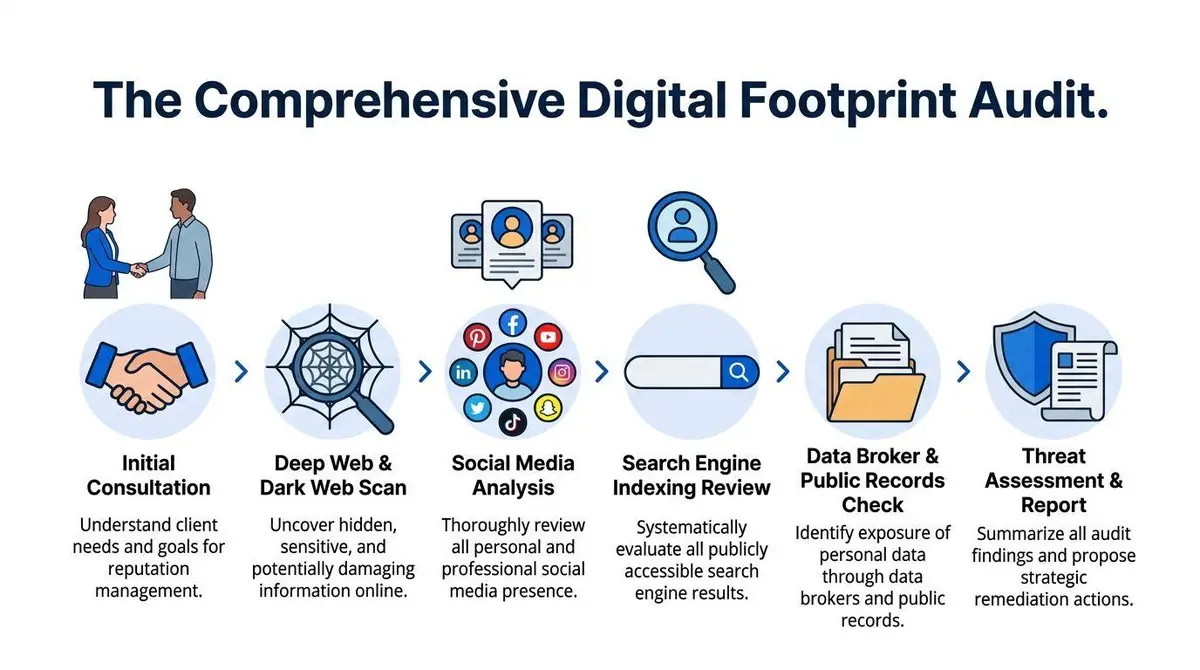
A real audit doesn’t begin and end with Google. That advice is too shallow for executives, public figures, and family offices. The first phase of a professional engagement is a forensic inventory of what exists across public search, social platforms, archives, broker databases, public records, forums, cached pages, and harder-to-reach environments.
The reason is simple. The average internet user maintains dozens, if not hundreds, of online accounts, which creates a persistent footprint indexed, archived, and scraped over time, as outlined by Kaspersky’s analysis of deleting digital footprints. High-profile clients usually have more exposure, not less. They’ve held more roles, appeared in more directories, attended more events, generated more media, and attracted more third-party commentary.
What a forensic audit actually covers
A proper audit maps exposure by category, not by platform alone.
| Exposure area | What we look for | Why it matters |
|---|---|---|
| Search results | Branded queries, image results, news results, cached pages | This is what counterparties, journalists, and investigators see first |
| Social platforms | Active profiles, dormant accounts, comments, likes, tags, reposts | Old behavior often survives in searchable fragments |
| Third-party sites | Forums, blogs, complaint sites, biographies, event pages | You often don’t control these sources |
| Data exposure | People-search listings, broker records, directory entries | Privacy risk can become physical risk |
| Sensitive ecosystems | Archive copies, piracy channels, dark web mentions, impersonation signals | These threats don’t appear in simple searches |
The audit is about prioritization, not curiosity
Clients often assume every negative result deserves equal attention. It doesn’t. We rank findings by three practical questions:
- Can the result be discovered easily?
A buried page with no indexation is different from a first-page search result. - Does the result carry decision-making risk?
A stale biography isn’t the same as a leaked image, accusation page, or impersonation profile. - Can action be taken at the source, in the index, or both?
Strategy depends on whether you can remove, correct, suppress, or monitor.
That prioritization creates the roadmap. Without it, clients waste time chasing low-impact debris while the main threat remains visible.
Archived material is where many clients lose control
Deleted doesn’t always mean gone. Cached copies, quoted reposts, screenshots, and web archives can keep material discoverable after the original source changes. That’s why an audit has to trace the content chain, not just the obvious URL. If you want to understand how stale personal information persists after removal, review archived private information and how to find it.
Practical rule: If a result can still be searched, screenshotted, or cross-linked, it’s still operationally relevant.
The output you should expect
At the end of this phase, a serious firm should hand you something useful, not a generic checklist. You should receive a risk map that separates:
- Immediate-action targets that threaten deals, hiring, safety, or active litigation
- Medium-priority clutter that weakens your name search but doesn’t control the narrative
- Background exposure that should be monitored in case it resurfaces
You should also know which items require legal escalation, which fit platform policy enforcement, which call for de-indexing, and which are better handled through defensive publishing and monitoring.
That’s what a clean up digital footprint professional engagement really starts with. Discovery first. Action second. Clients who reverse that order usually make the problem harder to fix.
Executing Strategic Takedown and De-Indexing Campaigns
Once the audit is complete, execution becomes a campaign. Not a single request. Not a polite email. Not a hope that the platform will “do the right thing.” Different content types require different pressure points, and the order matters.
A false accusation on a low-quality blog is handled differently from an impersonation profile, a leaked internal file, a mugshot page, or a cached search result that persists after source deletion. Treating all of them the same is how amateur cleanup efforts stall.

Source removal and search suppression are different tools
Clients often say they want content “removed from Google.” That can mean two very different things.
| Objective | What it means | When it works |
|---|---|---|
| Source removal | The original content is deleted or materially altered at the host | Best when the publisher, platform, host, or operator is reachable |
| De-indexing | Search engines stop surfacing the result for relevant queries | Useful when the source remains live but visibility can be reduced |
| Suppression | Stronger, controlled content outranks harmful or irrelevant pages | Useful when lawful removal paths are limited |
A competent operator uses all three when necessary.
The main channels of execution
Some matters are legal. Others are technical. Many are procedural.
- Platform enforcement: If content violates terms involving impersonation, harassment, privacy invasion, copyright issues, or non-consensual exposure, the fastest route is often a policy-based takedown request aligned with the platform’s own standards.
- Publisher engagement: When a site owner is reachable and rational, direct negotiation can secure edits, removals, anonymization, or corrections without escalating conflict.
- Search de-indexing: Cached pages and stale search visibility often require direct search-engine removal work. If you need the mechanics explained clearly, this guide to search result removal and de-indexing is the right reference point.
- Manual escalation: Reuploads, mirrors, and duplicate pages usually require repeated submissions tied to a documented evidence trail.
What speed actually looks like
In the right cases, action can move quickly. Professional de-indexing processes via Google’s removal tools can achieve 85-95% suppression of cached pages within 48 hours in major markets, and when combined with bulk deletion and manual requests, personal data removal success rates can reach 99.9%, according to SysTools’ digital footprint removal overview.
That doesn’t mean every matter resolves in two days. It means specific removal pathways, especially around cached or indexed visibility, can produce early wins fast. High-stakes clients should insist on that distinction. Early suppression buys breathing room while harder source-level work continues.
Fast relief and final resolution are not the same thing. Good firms know how to secure the first while building the second.
What gets removed first
The right order is rarely emotional. It’s strategic.
- Immediate reputational threats
First-page search results, viral social posts, exposed personal data, and active impersonation usually move to the top. - Replicable content clusters
If one damaging image or claim has already spawned copies, mirrors, or commentary, the cluster must be mapped and tackled together. - Dormant but combustible material
Old accounts and archive pages may sit unnoticed for years, then reappear during a dispute, promotion, transaction, or press cycle.
Why clients shouldn’t freelance the outreach
Many clients make things worse by contacting hostile publishers personally. That alerts the operator, creates screenshots of your panic, and sometimes triggers more publication. In other cases, informal outreach undermines later legal positioning because the wrong facts were conceded too early.
The better approach is controlled escalation. Every request should be framed according to the content type, the platform, the jurisdiction, the likely defenses, and the client’s broader objectives. Sometimes silence is an advantage. Sometimes speed is an advantage. The point is to choose, not react.
A clean up digital footprint professional campaign works when each action serves the larger map. Remove what can be removed. De-index what can be de-indexed. Suppress what can’t be erased cleanly. Monitor all of it.
Navigating Uncooperative Jurisdictions and Malicious Actors
Simple advice often falls short. Anyone can tell you to submit a removal request. The true challenge begins when the site owner ignores it, the host sits overseas, the operator hides behind anonymity, or the content has already spread across scraper networks.
That’s not an edge case. It’s common.
Morgan Stanley notes that a major challenge in digital footprint cleanup is dealing with uncooperative sites, data brokers, and international jurisdictions, and that copied, cached, and reposted information makes full erasure difficult without professional intervention, as discussed in Morgan Stanley’s digital footprint protection strategies. For affluent clients, that reality changes the assignment. The objective is no longer “ask nicely and wait.” It’s to reduce discoverability, cut distribution pathways, and build pressure where pressure works.

The stubborn categories
Some targets are structurally difficult:
- Anonymous complaint sites that monetize outrage and ignore conventional correspondence
- Foreign-hosted domains in jurisdictions with weak enforcement or slow response patterns
- Broker and scraper ecosystems that republish data from each other
- Dark web or invite-only channels where material circulates outside ordinary reporting pathways
These aren’t impossible. But they require a different toolkit.
What professionals do differently
A specialist doesn’t rely on a single notice. The work usually combines several tracks at once.
| Challenge | Weak response | Effective response |
|---|---|---|
| Anonymous publisher | Direct personal plea | Forensic identification, host and registrar pressure, structured legal strategy |
| Foreign jurisdiction | Domestic complaint only | Jurisdiction-aware escalation and technical visibility reduction |
| Reposted content | Remove one URL | Trace duplicates, mirrors, caches, and likely reupload nodes |
| Data broker spread | One-off opt-out | Coordinated removals plus follow-up verification |
The hardest digital cleanup cases are rarely about one page. They’re about one operator using many pages.
Reuploads are part of the threat model
Clients often think success means one takedown. Malicious actors think in cycles. If they’ve published once, they may republish after you act, especially if they believe you’re distracted, embarrassed, or unwilling to escalate.
That’s why durable remediation requires evidence preservation, pattern tracking, and a plan for recurrence. If a hostile actor uses multiple usernames, rotating domains, or copy sites, you need continuity in the response. Otherwise, you’ll keep paying to solve the same problem in slightly different forms.
The truth about “full erasure”
You should expect candor here. Total erasure is often impossible. Cached material, screenshots, and private-channel redistribution can survive long after public visibility drops. But clients don’t need fantasy. They need results that matter operationally.
Those results are straightforward:
- Make harmful material hard to find
- Remove what can be removed at the source
- Cut off indexing where possible
- Limit data exposure that creates security risk
- Detect reappearance before it regains traction
That’s how professionals win difficult cases. Not by promising the internet will forget, but by making the material materially less visible, less credible, and less damaging.
Establishing Long-Term Digital Armor and Proactive Defense
Removal work is only half the assignment. Once harmful content is reduced, the next question is whether your digital profile is strong enough to withstand the next incident. For executives and public figures, the answer is often no.
A vulnerable online presence has the same problem as an unsecured property. It invites attention because no one is visibly controlling it.

Monitoring is now part of executive risk management
Generic cleanup advice stops at account deletion and privacy settings. That’s not enough for people with wealth, visibility, or legal exposure. Advanced threats such as dark web monitoring, leaked media removal, piracy, and impersonation require specialized remediation because standard tools don’t cover cross-jurisdictional takedowns or complex identity abuse, as described in Redact’s discussion of reducing online presence.
That means post-cleanup defense should include active watch across search, social, impersonation surfaces, data exposure, and sensitive-content channels. For clients who need a standing watch function, reputation monitoring services are the relevant operating model.
What long-term protection actually looks like
A durable defense usually has three layers.
Controlled visibility
You don’t want an empty internet presence. That creates a vacuum. You want a controlled one. Accurate bios, current professional profiles, verified or official social accounts where appropriate, and clean search assets reduce confusion and make hostile content easier to isolate as anomalous.
Early warning
Threats are cheaper to handle when they’re found early. A fresh impersonation account, reposted image, or newly indexed complaint page is far easier to contain in the first stage than after weeks of spread. Monitoring gives you lead time, and lead time is an advantage.
Defensive publishing
Suppression only works when there’s something stronger to rank. That usually means building and maintaining authoritative assets tied to your real name, role, organization, and expertise. Done properly, this doesn’t look like self-promotion. It looks like evidence of legitimacy.
If you leave your name search unattended, other people will define it for you.
After core defenses are in place, visual and media hygiene matter as well. Interviews, biographies, event listings, and social profiles should align. Contradictions create openings for impersonators and gossip accounts.
This short overview is useful for clients who need to understand why passive defense isn’t enough:
The shift clients need to make
Most high-net-worth clients come in asking for cleanup. They should leave with a protection system.
That system should answer five standing questions:
- What new mentions appeared?
- What reuploads were detected?
- What sensitive data surfaced in broker or leak ecosystems?
- What high-authority positive assets now control the search results?
- What requires legal or technical escalation before it spreads?
This is the part many firms neglect. They remove a problem and disappear. That’s shortsighted. A serious reputation strategy treats digital exposure as a continuing security issue with search, legal, media, and privacy components working together.
One toolset among several
For clients managing broad exposure, firms may use platform tools, legal channels, monitoring systems, and bulk cleanup tools together. In this environment, ContentRemoval.com offers digital footprint cleanup, de-indexing, source removal, leaked-media response, and ongoing monitoring as part of a coordinated remediation model. That’s useful when a client needs one operating team to handle both immediate takedowns and ongoing vigilance.
Professional Engagement Timelines Costs and Expectations
Clients ask three questions first. How long will this take, what will it cost, and what should I expect from the engagement? Those are the right questions. If a firm answers them vaguely, walk away.
Timelines depend on the target, not your patience
Some actions move fast. Search suppression for cached visibility can begin quickly. Platform reports on obvious policy violations may also move quickly. Source removal from hostile publishers, foreign hosts, anonymous operators, and copied networks takes longer because each target has its own resistance point.
A serious timeline is built around categories of work:
| Workstream | Typical pace | What affects duration |
|---|---|---|
| Audit and risk mapping | Early-stage, front-loaded | Number of platforms, aliases, old accounts, and exposed data points |
| Immediate takedown attempts | Short-cycle | Platform responsiveness and quality of evidence |
| De-indexing and cache suppression | Often one of the faster tracks | Search engine criteria and whether the source changed |
| Difficult source removal | Variable | Jurisdiction, anonymity, host posture, republication behavior |
| Ongoing monitoring | Continuous | Threat recurrence and client risk profile |
The right expectation is phased progress, not magical completion. You should expect early wins where the law, platform rules, or indexing systems allow them. You should also expect some matters to become campaigns rather than transactions.
Costs are driven by complexity
No credible firm should quote a serious digital cleanup matter as if it were a fixed consumer product without understanding the terrain first. Budget depends on the number of targets, the type of content, the jurisdictions involved, the need for legal drafting, the amount of verification work, and whether the matter includes recurring monitoring.
The key cost drivers are usually these:
- Volume of harmful material
One page is one problem. A network of pages, mirrors, profiles, screenshots, and reposts is a different class of problem. - Difficulty of the source
Cooperative social platforms differ sharply from anonymous websites or operators outside your home jurisdiction. - Sensitivity of the content
Leaked media, family privacy, personal addresses, impersonation, and reputational attacks against senior executives require tighter handling and often broader coordination. - Need for discretion
Some matters can be resolved discreetly. Others require extra layers of confidentiality, limited internal circulation, and carefully controlled communications.
Client standard: If the proposal doesn’t explain what is being attempted at the source, in search, and in monitoring, you’re not looking at a strategy. You’re looking at a placeholder.
What “removal” should mean in the engagement letter
Clients get frustrated when firms use the word removal loosely. You shouldn’t allow that.
A professional scope should distinguish between:
- Source deletion
The original page, file, or profile is taken down or materially altered. - De-indexing
The content may still exist at the source, but it becomes harder to find through major search queries. - Suppression
Better assets outrank harmful or stale material.
Those are all valid outcomes. They are not interchangeable. Your advisor should identify which one is realistic for each target before work begins.
Reporting and communication should be disciplined
High-stakes clients don’t need chatter. They need controlled updates that answer specific questions: what was found, what action was taken, what remains blocked, what risk still exists, and what the next move is. Good reporting is concise, documented, and suitable for sharing with counsel or a family office if needed.
You should also expect confidentiality protocols from the outset. Sensitive matters should move on a need-to-know basis. Evidence should be preserved carefully. Internal circulation should be narrow. If a matter touches litigation, corporate governance, a family dispute, or security concerns, your reputation advisor should work in a way that doesn’t create unnecessary exposure for you later.
What success looks like
Success is not “the internet is clean forever.” That’s unserious.
Success looks like this:
- The highest-risk material is removed, reduced, or de-indexed
- Search results stop amplifying old or hostile narratives
- Sensitive personal data becomes harder to exploit
- Reuploads are caught early
- Your professional identity is represented by assets you control
- You know what remains, why it remains, and how it’s being managed
If you’re a new client under pressure, that’s the standard you should demand. Clear scope. Clear priorities. Clear reporting. No vague promises.
If your name, company, or family is exposed online and you need a disciplined response, start with a confidential assessment through ContentRemoval.com. The right engagement will tell you what exists, what can be removed, what can be de-indexed, what must be monitored, and how to regain control without adding noise or risk.
Frequently asked questions
What does a digital footprint audit include for an executive?
It maps exposure by category: branded search and image results, active and dormant social accounts, forums and complaint sites, people-search and broker records, and archive copies or impersonation signals. The output is a risk map separating immediate targets from background exposure.
Is it possible to erase my digital footprint completely?
Total erasure is often impossible because cached copies, screenshots and private-channel reposts can survive after public visibility drops. The realistic goal is to remove what can be removed, cut indexing where possible, limit exposed data and catch reappearance early.
How long does a professional digital footprint cleanup take?
It depends on the target rather than the calendar. De-indexing and cache suppression are often among the faster tracks, while source removal from hostile publishers, foreign hosts or anonymous operators is variable. Expect phased progress and some matters to become campaigns.