
A cease and desist letter in Texas is a formal demand, not a court order, and the recipient has no legal obligation to comply. It works when the recipient is identifiable, the conduct is specific, the legal basis such as defamation or trademark is credible, and you are ready to escalate. For fake reviews or intimate images, add platform removal.
Key facts
- Five elements per ContractsCounsel: identified conduct, legal basis, unambiguous demand with deadline, consequences, supporting evidence.
- Texas practitioners recommend certified mail with return receipt to create a verifiable record of notice.
- Business disparagement addresses false statements causing commercial harm to a company’s goods, services or operations.
- Recipients may publish the letter, cast themselves as victims or use it as a roadmap to your theory and evidence.
Where ContentRemoval.com comes in. ContentRemoval.com is typically brought in when a Texas demand letter has served its purpose and the content is still public, handling de-indexing, source removal, impersonation takedowns, false review matters and intimate image response in parallel with any litigation. Founders, physicians and brands usually reach out through their Texas counsel once the post remains live and ranking days after the letter went out. A free 15-minute Exposure Scan maps what is removable, and the report is yours to keep. Get a Free, Confidential Exposure Scan or read how our content removal work is done.
A false review is ranking for your name. An anonymous account is impersonating your company. A private image has been reposted and is spreading faster than your counsel can react. When such incidents occur, many ask the wrong initial question. They ask, “Can I send a cease and desist?” The better question is, “Will a cease and desist letter solve this problem, or just document it?”
A Texas cease and desist can be useful. It can also waste time, expose your position early, and leave the harmful content live while you wait for someone with no incentive to cooperate. If you’re dealing with a business dispute, IP misuse, or a reputational attack with a real legal basis, the letter can be the right opening move. If you’re dealing with false reviews, impersonation, or non-consensual intimate imagery, legal pressure alone often isn’t enough. You need a strategy that matches how the harm is being distributed.
The Purpose and Power of a Texas Cease and Desist
A Texas cease and desist letter is a pressure tool, not a judicial command. That distinction matters because many recipients panic when they receive one, and many senders overestimate what it can do.
Under Texas law, a cease and desist letter is not a legally binding court order or enforceable by law. It serves as a formal written notice demanding that a person or business stop specific conduct, warns that legal action may follow, and carries no legal requirement for the recipient to comply merely because they received it. Even so, it has real strategic value because it can trigger deadlines, frame later litigation, and establish that the other side had notice of the complaint, as explained by Nava Law Texas on cease and desist letters.
What the letter actually does
If you use it correctly, the letter performs three jobs at once:
- It creates a record: You document the conduct, the date you objected, and the remedy you demanded.
- It tests the other side: A serious recipient may remove the content, preserve evidence, or send the matter to counsel.
- It sharpens your next move: Their response tells you whether negotiation, takedown work, or litigation is realistic.
That is the power. Not magic. Not automatic compliance. Influence.
Practical rule: Send a cease and desist only when you’re prepared for what happens if they ignore it.
Where people misuse it
The most common mistake is treating the letter as a performance. People write an angry threat, copy boilerplate from the internet, demand impossible action, and assume the recipient will fold. Experienced targets don’t. They look for weaknesses. If your allegations are vague, your legal theory is thin, or your deadline is ridiculous, you’ve shown your hand and weakened your position.
The second mistake is using a legal letter to solve a distribution problem. If a fake review remains indexed in Google, or a leaked image keeps resurfacing across platforms, your issue isn’t only that someone acted unlawfully. Your issue is that search engines, reposts, and platform replication are amplifying the harm. A letter may address the actor. It doesn’t automatically address the visibility.
When it earns its keep
A Texas cease and desist is most effective when the recipient is identifiable, the conduct is specific, the legal basis is credible, and the sender is willing to escalate. In that setting, the letter can reset the dispute immediately. It tells the other side you aren’t bluffing and that the record has started.
If those conditions aren’t present, don’t romanticize the tool. Use it as one part of a broader enforcement plan, not as a substitute for one.
Legal Grounds for Action Under Texas Law
Not every offensive act justifies a demand letter. You need a legal theory that can survive scrutiny. If you can’t explain what right was violated and what conduct must stop, your letter is just a complaint on law firm stationery.
Defamation and business disparagement
For executives, founders, physicians, and brands, this is often the first category that matters. A post, article, review, or social thread may accuse you of fraud, criminal conduct, abuse, dishonesty, or professional misconduct. Some of those statements may support a defamation claim. Others are opinion, rhetorical abuse, or unverifiable commentary.
The threshold question is simple. Is the statement presented as fact, and is it false? If the answer is unclear, a reckless cease and desist can backfire because you may end up amplifying the accusation rather than neutralizing it. If you need a sharper framework for separating opinion from actionable falsehood, review this guide on what constitutes online defamation for executives and founders.
Business disparagement raises a related issue. The target isn’t personal reputation alone. It’s commercial harm caused by false statements about a company’s goods, services, or operations. That’s where fake reviews, competitor smears, and fabricated “consumer warnings” often land.
Harassment, impersonation, and privacy abuse
Some conduct is less about false statements and more about repeated unwanted contact or identity misuse. Impersonation can include fake accounts, copied branding, or profiles created to confuse customers, investors, or the public. Privacy abuse can include leaked personal material, intimate content, or disclosures that expose family members and private contact details.
A cease and desist has value here when the actor is known and the platform isn’t moving quickly. But if the material is circulating through anonymous accounts, mirror posts, or search results, the legal demand should be paired with technical action from the outset.
When the harm is digital distribution, not just wrongful conduct, legal theory alone won’t control the damage.
Trademark, copyright, and related misuse
Intellectual property disputes are often the cleanest fit for a formal demand. If someone is using your mark, copying protected materials, or passing off your brand, a carefully drafted notice can force a fast decision. Either they have rights or they don’t. Either the use stops or the dispute escalates.
This category also benefits from platform-specific enforcement. Copyright complaints often move through a different lane than defamation complaints. Trademark misuse may require a different evidentiary package than a false review case. Don’t collapse them into one generic demand.
A short comparison helps:
| Issue | Strong basis for a letter | Weak basis for a letter |
|---|---|---|
| Defamation | Specific false factual claim | Pure opinion or insult |
| Business disparagement | False statement tied to commercial harm | General criticism without factual assertion |
| Impersonation | Fake identity causing confusion | Parody or clearly labeled commentary |
| Copyright misuse | Unauthorized copying of protected work | Dispute over ownership without proof |
| Trademark misuse | Confusing use of mark in commerce | Incidental reference or nominative use |
The point isn’t to turn you into your own litigator. The point is to stop you from sending a letter on a theory that collapses the moment the recipient pushes back.
Drafting an Effective Texas Demand Letter
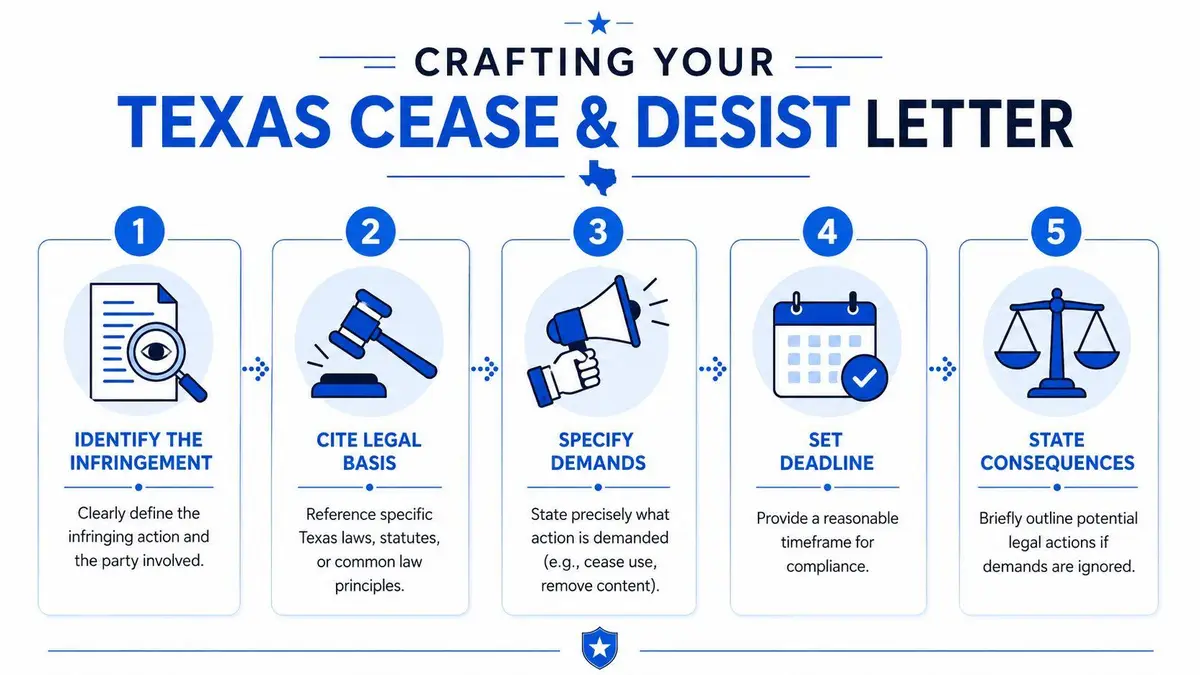
In Texas, the proper legal framing is often a demand letter, not some cinematic “cease and desist” threat loaded with bluster. Precision wins. According to ContractsCounsel’s discussion of Texas cease and desist letters, an effective Texas demand letter should include five technical elements: clear identification of the offending conduct, the legal basis, an unambiguous demand with a firm compliance deadline, consequences for non-compliance, and supporting evidence.
Start with conduct, not outrage
Your first paragraph should identify the conduct in a way a third party can understand immediately. Name the account, URL, post, publication, product listing, listing title, or copied asset. Include dates where they matter. If the conduct happened more than once, describe the pattern without drifting into editorial commentary.
Weak version: “You have been attacking my company online and causing major harm.”
Better version: “On [date], the account [identifier] published statements on [platform] alleging that our company engaged in criminal and fraudulent conduct. Those statements appear at [location] and were republished through [additional location], where they remain publicly accessible.”
That opening does two things. It removes ambiguity and shows you can prove what you’re alleging.
State the legal basis like you expect it to be challenged
Most self-drafted letters fail here. They say the conduct is “illegal” without identifying why. That’s amateur work. If your basis is defamation, say so. If it is trademark infringement, unfair competition, copyright misuse, privacy invasion, or impersonation, say so and tie the facts to that theory.
Use language that is firm but disciplined:
- For online libel: “These statements are false assertions of fact and have caused reputational and commercial harm.”
- For impersonation: “Your use of our name, branding, and identity markers creates confusion as to source, affiliation, or endorsement.”
- For copied content: “You are reproducing and displaying protected material without authorization.”
If the issue is copyright infringement, pair the demand with the platform route that removes the content. This guide on how to write and file a DMCA takedown notice is often more useful than a generic threat letter when protected media has been reposted.
A short checklist keeps the legal basis clean:
- Match the claim to the facts: Don’t call criticism “defamation” unless it’s a false factual claim.
- Name the violated right: General accusations of wrongdoing won’t carry weight.
- Avoid overclaiming: If your strongest issue is impersonation, don’t pad the letter with weak side claims.
Before you escalate, this video gives a useful overview of the demand-letter mindset and process.
Demand specific action
The recipient should know exactly what compliance looks like. “Cease all harmful activity” is lazy. Spell out the required acts.
For example:
- Remove the identified post, review, or listing from the platform and any site under your control.
- Stop using the name, mark, likeness, or media identified in this letter.
- Preserve relevant records pending resolution, including account information, upload history, and communications.
- Confirm compliance in writing by the deadline stated below.
Specificity changes the psychology of the exchange. The recipient no longer gets to pretend they didn’t understand what you wanted.
A strong demand letter reads like a document prepared for a judge, even if no judge ever sees it.
Set a real deadline and real consequences
An effective deadline is firm, not theatrical. If you demand action by “close of business today” in a dispute that plainly requires review, you look unserious. If you give endless time, you surrender urgency.
Your consequences section should also be credible. Don’t threaten every conceivable claim if you aren’t prepared to bring them. A measured example works better: “If you fail to comply, we will evaluate all available remedies, including injunctive relief, claims for damages where applicable, and platform-based enforcement.”
Attach proof
Evidence changes a letter from assertion to dossier. Include screenshots, copies of registrations, excerpts from contracts, notices of ownership, archived links, and side-by-side comparisons where useful. If the issue concerns review fraud, impersonation, or leaks, preserve every visible artifact before you send anything.
Here’s the blunt truth. Most letters fail because they read like indignation instead of evidence.
Strategic Delivery and Evidence Preservation
A sharp letter sent badly is still a bad strategy. If you can’t prove delivery, you lose one of the main reasons for sending the letter in the first place.
Why delivery method matters
Email is convenient. It is not always enough. Messages get filtered, denied, ignored, or challenged later. If the dispute may escalate, you want a delivery method that creates a formal record the recipient can’t casually explain away.
Texas practitioners commonly recommend using certified mail with return receipt to create a verifiable paper trail of notice. That record can become useful evidence if the matter moves toward court, as noted in the earlier discussion of Texas demand-letter practice. In serious matters, use multiple channels. Certified mail for the record. Email for speed. Service to counsel if counsel is already known.
Build the file before you press send
Often, evidence is preserved after the other side denies everything. That’s backwards. Build the record first.
Use a case file that includes:
- Screenshots with visible context: Capture the full page, username, date, and URL where possible.
- Archived copies: Save the content in a form that survives deletion or editing.
- Communications log: Track calls, emails, platform complaints, and response times.
- Monitoring snapshots: If search visibility matters, preserve how the content appears in results over time.
For ongoing attacks, active tracking is part of the legal strategy because it shows repetition, evasion, and republication patterns. That is where a system for reputation monitoring becomes operationally useful, not cosmetic.
Preserve first, threaten second. Once the content changes or disappears, proving what happened becomes harder.
Treat evidence like future litigation material
Even if you never sue, act as though every screenshot may be reviewed by opposing counsel or a court. Label files clearly. Save original emails. Keep metadata where available. Don’t annotate over the only copy you have. Don’t rely on your memory, and don’t send your only evidence to the other side without retaining a complete version for your own file.
This discipline does two things. It protects your position. It also signals professionalism if the matter lands on a lawyer’s desk across the table.
Assessing Risks and Knowing When to Involve Counsel
People talk about cease and desist letters as if they’re harmless. They aren’t. A weak one can make your problem worse.

The letter can trigger a counterattack
Some recipients comply. Others weaponize the letter itself. They post it publicly, cast themselves as a victim, rally an audience, or provoke more commentary around the accusation. If your matter already carries public-interest overtones, that risk is not theoretical. It is obvious.
Another problem is strategic exposure. Your letter may reveal your legal theory, your evidence, your urgency, and what you’re willing to settle for. If the other side is represented, litigious, or seeking an upper hand, you’ve just given them a roadmap.
Common backfire scenarios
A cease and desist is higher-risk when any of these are true:
- The target is combative: Anonymous trolls often ignore letters. Ideological critics may publish them.
- The issue is borderline: If your claim sits near opinion, parody, or fair comment, aggressive legal threats can damage your credibility.
- The audience is public-facing: Journalists, activists, consumer critics, and online communities often treat demand letters as content.
- The recipient has resources: A well-resourced company or represented individual may respond with procedural aggression rather than compliance.
A simple matrix helps:
| Situation | DIY letter risk | Counsel involvement |
|---|---|---|
| Former vendor misusing your logo | Moderate | Advisable |
| Anonymous fake review campaign | High | Strongly advisable |
| Leaked intimate content | High | Immediate |
| Clear copyright repost by identifiable site operator | Moderate | Often manageable with legal review |
| Public accusation by media-adjacent figure | High | Immediate |
When you shouldn’t handle it yourself
If the attack involves intimate imagery, coordinated impersonation, investor-facing falsehoods, family office privacy, or a likely public-relations spillover, bring counsel and digital response professionals in early. The same applies if the recipient is a former employee with documents, a competitor with motive, or someone already threatening to “go public.”
If the letter could become an exhibit, a viral post, or the start of a larger dispute, treat it like contested litigation from day one.
There is also a practical line. Once the harm is spreading across search, social, review platforms, and repost sites, the matter is no longer just legal. It is operational. You need legal judgment, platform fluency, and removal sequencing. Most individuals and many law firms only have one of those three.
Beyond the Letter Enforcement and Digital Remediation
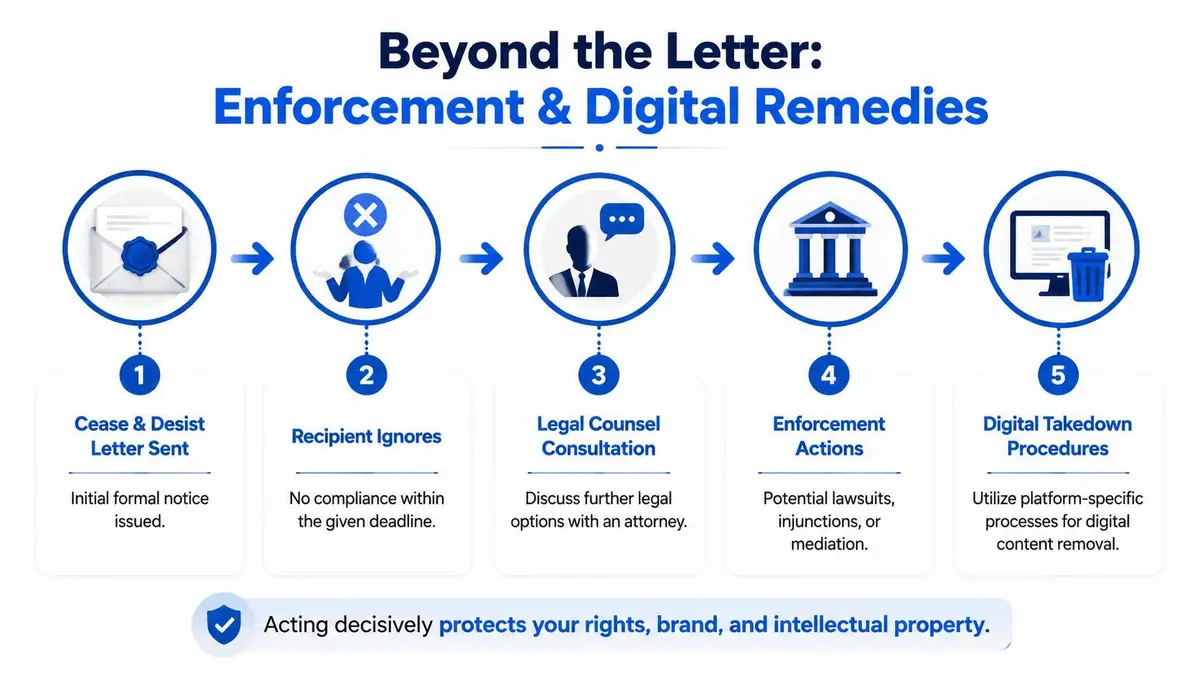
Your letter goes out on Monday. By Wednesday, the post is still live, the fake reviews are still ranking, and screenshots have already spread to other platforms. At that point, the question is not whether your demand was forceful enough. It is which action will reduce harm fastest.
The traditional path
Formal enforcement still matters. If the speaker is identifiable, the statements are actionable, and you need a court order, damages, or injunction, have counsel prepare for suit. A credible filing threat can change behavior. An actual filing can force disclosure, preserve claims, and create consequences a demand letter cannot.
It also takes time.
That delay is the core problem in online reputation matters. Courts decide rights, but search engines and platforms control visibility in the meantime. If your name, company, or executives are being hit by defamatory posts, impersonation, fake reviews, or leaked intimate content, waiting for litigation alone is often the wrong sequence.
The modern path for online attacks
Online harm spreads operationally, not just legally. Search results surface it. Aggregator sites copy it. Social accounts repost it. Review platforms keep it in front of customers while lawyers exchange letters.
Use the remedy that matches the objective. If you need punishment or compensation, litigate. If you need the content out of search, off the source page, or removed under platform policy, pursue platform reporting, search de-indexing, host complaints, and NCII-specific takedown channels. As noted in Murray Lobb’s discussion of cease and desist strategy and digital remedies, legal pressure and digital removal often need to run in parallel, not in sequence.
A practical framework helps:
- Litigation fits known actors, recoverable damages, and repeat misconduct.
- Platform and search action fits fake reviews, impersonation, doxxing, leaked images, and defamatory content that is actively ranking.
- Hybrid response fits the cases that matter most. Identifiable actor, live content, ongoing visibility, and urgent reputational harm.
ContentRemoval.com is often brought in at this stage for de-indexing, source removal, impersonation takedowns, false review matters, and NCII response after the letter has served its purpose and the content is still public.
Be candid about the limit of a cease and desist letter. It can pressure a person. It does not remove a search result by itself. It does not force a platform to act. It does not stop screenshots from circulating. In digital attacks, the legal issue and the visibility issue are related, but they are not the same problem.
Pick the path that matches the business goal. If you need to establish liability, build toward enforcement. If you need the public-facing damage reduced now, shift quickly to removal strategy and platform action. Boilerplate threats rarely solve a live reputation crisis.
Frequently asked questions
Is a cease and desist letter enforceable in Texas?
No. Under Texas law it is a written notice demanding that specific conduct stop, with a warning that legal action may follow, but it carries no legal requirement to comply. Its value is creating a record, testing the other side and framing later litigation.
What should a Texas demand letter include?
A factual description of the conduct with account names, URLs and dates, a stated legal basis such as defamation or trademark misuse, and a list of specific required actions. Add a firm but realistic deadline with credible consequences and attached evidence including screenshots, registrations and archived links.
Can sending a cease and desist letter make things worse?
Yes. Anonymous trolls often ignore letters, ideological critics may publish them, borderline claims near opinion or parody can damage your credibility, and a well-resourced recipient may respond with procedural aggression. The letter also reveals your theory, evidence and urgency, so the article advises counsel for high-risk cases.