
Branding and reputation management are one discipline for high-profile individuals and companies. Branding is the fortress architecture: owned assets, a consistent narrative and search positioning built before any threat. Reputation management is the active defense: monitoring, evidence preservation, platform removal, de-indexing, suppression and measured public response, all run under one command structure.
Key facts
- Cited statistics put reputation at 63 percent of market value; 41 percent of companies lose value after a negative event.
- Four immediate crisis actions: verification, preservation, classification and parallel escalation across legal, platform, search and communications.
- Platform removal suits impersonation, privacy breaches and intimate imagery; de-indexing leaves the source page live.
- Useful KPIs are first-page search control, sentiment velocity, time to resolution and re-upload recurrence.
Where ContentRemoval.com comes in. ContentRemoval.com is the enforcement layer in the unified model this article describes, handling content removal, de-indexing and monitoring while the client’s marketing and communications teams hold the narrative assets. A chief of staff, general counsel or the executive’s crisis lead typically brings the firm in when a hostile result is climbing for the principal’s name. A free 15-minute Exposure Scan maps what is removable, and the report is yours to keep. Get a Free, Confidential Exposure Scan or read how our reputation management work is done.
You search your own name before a board meeting, a financing round, or a keynote. A hostile article is sitting near the top of the results. A thread built on half-truths is gaining traction. Someone has copied private material into places your team doesn’t even monitor. Marketing says they’re handling the brand. Legal says they’ll review options. PR drafts a statement. None of that helps if the search results solidify before lunch.
That’s the governance failure most knowledgeable people still tolerate. They treat branding and reputation management as separate functions, then act surprised when the brand story collapses under reputational pressure. For high-profile individuals and companies, that split is dangerous. Your brand is the identity you publish. Your reputation is the judgment others attach to it. Online, those are no longer separate domains.
If you want a practical overview of that overlap, brand reputation management fundamentals are a useful starting point. But for a high-stakes client, the issue is simpler: your name, company, family office, and leadership profile need one integrated defense system.
The Inescapable Link Between Brand and Reputation
A respected chief executive can spend years building authority. Then one false allegation, one manipulated narrative, or one stale legal dispute gets indexed, discussed, copied, and reframed by people with no obligation to be fair. The executive still has the same credentials, the same track record, and the same enterprise value. Yet counterparties, recruits, journalists, and investors now encounter a different first impression.
That’s why the old distinction between branding and reputation management no longer holds. A carefully produced website, polished interviews, and disciplined messaging don’t matter much if search results and public commentary tell a conflicting story. The market reads both at once.
The financial exposure is real
A reputation problem isn’t cosmetic. A company’s reputation constitutes 63% of its overall market value, and 41% of companies that experience a negative reputation event report a tangible loss in both brand value and revenue, according to reputation management statistics compiled here.
Those figures matter because they force a harder conclusion. If reputation is tied that tightly to value, then leaving it to siloed teams is a strategic error. Marketing can shape perception. Legal can pursue remedies. Communications can manage messaging. But none of those functions alone can control the full chain of digital harm.
Practical rule: If a harmful result affects how someone verifies your credibility, it is a brand issue and a reputation issue at the same time.
What clients usually get wrong
Most high-profile clients come in with one of two assumptions. The first is that this is a press problem. The second is that this is a search problem. Usually it’s both, with legal, privacy, and platform enforcement layered on top.
A fractured response creates delays:
- Marketing publishes content but doesn’t know which harmful assets require removal, de-indexing, or suppression.
- Legal sends notices but doesn’t control the broader search architecture around the incident.
- PR drafts talking points but can’t neutralize copied material, impersonation, or anonymous reposts.
The internet doesn’t care about your org chart. Search engines, review platforms, forums, social networks, private channels, and data brokers all shape the same public judgment. That judgment becomes your effective brand, whether you curated it or not.
Defining the Unified Framework
The right model is straightforward. Branding is the architecture of the fortress. Reputation management is the active defense system. If you only build the walls, an attacker finds the gates. If you only defend, with no strong structure behind you, every attack lands on exposed ground.
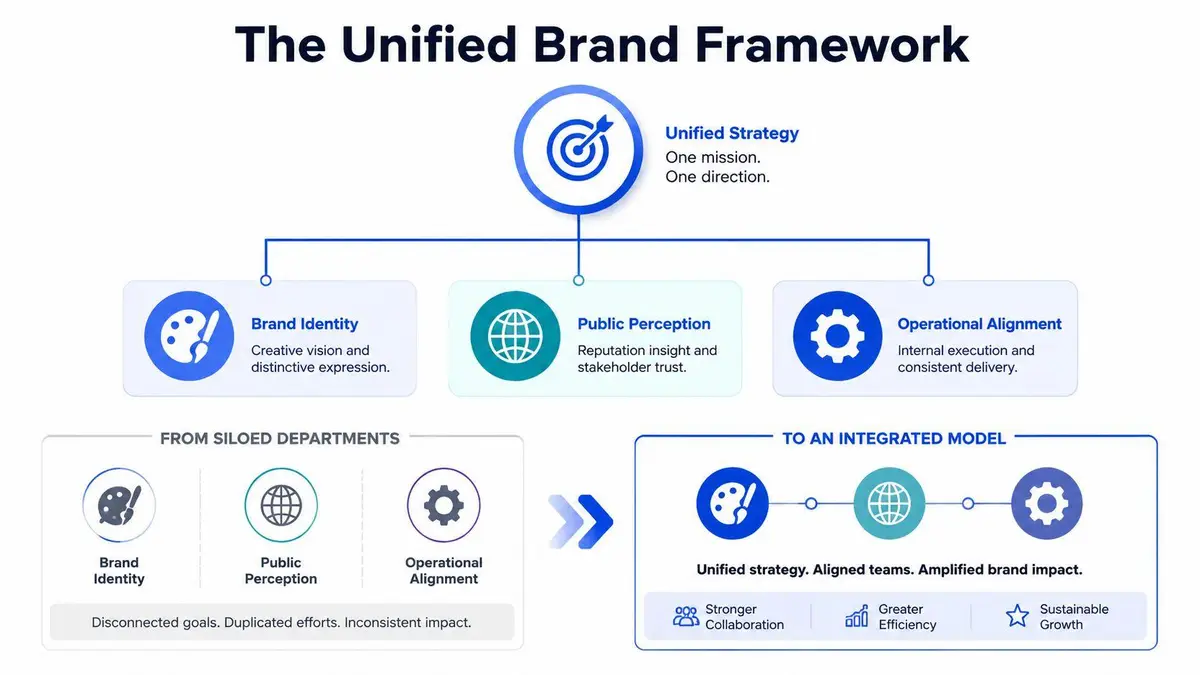
The fortress architecture
The architectural side is commonly referred to as branding. It includes your core narrative, your visual identity, your executive biography, your corporate site, your verified profiles, your thought leadership placements, and the assets you control directly. Those assets establish what should be true about you in the public record.
Without that structure, a response effort has nowhere to anchor. You can’t defend a name that has no authoritative footprint. You can’t displace harmful search results if you don’t own credible destinations capable of ranking. You can’t reassure stakeholders if your official digital presence is thin, outdated, or inconsistent.
The essential components look like this:
| Component | What it does | Why it matters |
|---|---|---|
| Owned assets | Gives you controlled platforms such as websites and verified profiles | Lets you publish durable, authoritative material |
| Narrative discipline | Aligns biography, company story, and public messaging | Reduces contradictions that adversaries exploit |
| Search positioning | Places credible assets where people actually look | Builds resilience before a dispute or attack |
| Documentation hygiene | Keeps public records, bios, and profiles accurate | Limits avoidable credibility gaps |
The active defense layer
Defense starts where branding stops. Monitoring identifies hostile content, impersonation, leaks, manipulated reviews, and coordinated commentary. Response protocols determine what gets escalated first. Remediation then moves through platform reporting, legal notices, de-indexing requests, suppression work, and evidence preservation.
Many companies fail at this stage. They assume a strong brand will absorb reputational hits. It won’t. A polished executive profile does not neutralize defamation. A good social presence does not remove leaked material. A communications team does not automatically have the workflow to stop replication across platforms.
A modern reputation program should function like incident response, not seasonal marketing.
The operating model that actually works
For high-stakes individuals, the unified framework needs one command structure. Someone must control both the narrative assets and the response machinery. That lead can coordinate counsel, communications, security, and specialist vendors, but the authority can’t be fragmented.
Three operating principles matter most:
- Build assets before you need them. Your website, executive pages, media profiles, and authored content should already exist and already rank.
- Treat monitoring as intelligence. Alerts are not inbox clutter. They’re early warning.
- Match the remedy to the threat. Some content should be answered. Some should be removed. Some should be de-indexed. Some should be suppressed by stronger assets.
A unified framework isn’t abstract brand strategy. It’s asset protection with a publishing layer and an enforcement layer.
Proactive Fortification of Your Digital Presence
Most executives still treat proactive content as vanity. That’s a mistake. Search visibility is not just marketing. It is defensive infrastructure.
If someone searches your name, your company, or both together, you need more than a homepage and a dormant LinkedIn profile. You need a controlled search field made up of assets you own, assets you influence, and assets third parties regard as credible. That field becomes the buffer between an attack and your commercial reality.

Own the first impression
A fortified digital presence starts with controlled properties. That means a personal site or executive profile hub, a current LinkedIn presence, well-maintained corporate leadership pages, and authoritative bios on relevant industry platforms. If you write, speak, invest, litigate, advise, or appear publicly, those facts should appear in credible places that search engines can trust.
This is the practical reason firms build online brand protection services. The work isn’t about posting more. It’s about controlling the identity layer that stakeholders encounter before they ever contact you.
Build ranking depth, not just polished pages
One strong page is fragile. A resilient search environment requires depth. If a hostile article enters page one, you need enough relevant, credible material to compete for those positions. That usually means a portfolio, not a single asset.
Use a mix such as:
- Executive biography pages on company and personal domains that are updated and internally linked.
- Verified professional profiles on platforms that carry authority in search.
- Published commentary and bylined articles in reputable trade or business outlets.
- Media and speaking pages that document expertise with substance, not slogans.
A weak digital footprint invites distortion. A deep one doesn’t guarantee immunity, but it gives you an advantage.
Publish with a suppression mindset
The purpose of proactive publishing is not applause. It is search control. Every credible asset you create should serve at least one of these functions:
- Identity confirmation: It tells searchers they’ve found the authentic person or company.
- Context control: It frames your record before others do.
- Displacement support: It gives search engines alternative results to rank above lower-value or harmful material.
The best time to build protective content is before the first threat. The second-best time is before the second page of results becomes the first.
There’s also a discipline question here. Don’t scatter effort across channels that don’t matter to your audience or to search. A family office principal doesn’t need noisy posting. They need authoritative assets with clear identity signals. A founder in a regulated industry needs accurate bios, credential reinforcement, and strategically placed third-party mentions. A public figure needs rapid publication lanes that can support future recovery efforts.
What proactive fortification is not
It is not spin. It is not fake positivity. It is not flooding the internet with low-grade content in the hope that quantity beats credibility. Search engines and serious stakeholders both discount that approach.
Fortification is precise. You identify the terms that matter. You secure the assets that should rank. You make those assets stronger over time. Then, if a hostile result appears, you already have the framework needed to contest it.
The Reactive Defense and Crisis Playbook
At 6:40 a.m., your chief of staff sees a hostile post gaining traction, a search result starts climbing for your name, and screenshots are already moving through group chats your team does not control. By 9:00 a.m., this is no longer a communications problem. It is an identity control problem across search, platforms, legal exposure, and stakeholder trust.

A weak response treats brand and reputation as separate lanes. One group drafts language. Another looks at legal options. A third watches search rankings. That fragmentation is a governance failure. In a live incident, your brand assets, reputation controls, and enforcement channels must operate as one defense system.
The first window defines the outcome
The first response window is short. Once a false or distorted narrative starts to spread, delay gives it distribution, screenshots, reposts, commentary, and search signals. Internal debate is expensive.
Your first objective is containment. Not polish. Not consensus. Containment.
That means four actions happen immediately:
- Verification: Confirm what is live, where it sits, who is amplifying it, and whether the content triggers platform, privacy, intellectual property, or defamation issues.
- Preservation: Capture the full record before edits, deletions, mirrored posts, or reposts muddy the evidence trail.
- Classification: Separate defamation, impersonation, review fraud, data exposure, harassment, and legitimate criticism. Each category calls for a different remedy.
- Escalation: Open legal, platform, search, security, and communications tracks in parallel.
High-profile clients get hurt when teams treat a public attack as a messaging exercise. The actual task is coordinated control of visibility, evidence, and response authority.
Removal, de-indexing, suppression, and public response
Clients usually start with the wrong question. They ask, “Can we get it taken down?” Sometimes yes. Often the better question is, “What combination of actions reduces exposure fastest without making the story bigger?”
Use the response path that fits the threat:
| Response path | Best use case | Main limitation |
|---|---|---|
| Platform removal | Impersonation, privacy breaches, non-consensual intimate imagery, certain fraudulent or policy-violating content | Platform rules and review speed set the pace |
| Search de-indexing | Harmful URLs that may remain online but should stop surfacing in search | The source page can still exist |
| Suppression | Content that cannot be removed quickly but can be outranked by stronger, relevant assets | Requires authority, relevance, and disciplined execution |
| Public response | Cases where silence creates business, investor, employee, or regulatory risk | Poor wording can increase reach and prolong the cycle |
This is why branding and reputation management cannot sit in separate boxes. The same assets that define identity in calm periods become recovery assets in a crisis. The same governance model that controls executive bios, company narratives, and third-party profiles should also govern rebuttals, takedown strategy, and search remediation.
For targeted attacks, sequencing matters more than rhetoric. This executive playbook for handling a targeted online smear campaign gets that point right. If you choose the wrong first move, you can strengthen the very material you want to contain.
Monitoring has to cover the spaces where attacks start
Google is only one surface. So are major social networks. Serious attacks often begin in smaller forums, private groups, encrypted channels, or anonymous communities, then move into public view after the narrative has been tested and sharpened.
Your monitoring model has to reflect that reality. Search tracking, social listening, evidence capture, platform escalation, and legal support belong in the same operating picture. If those functions are split across vendors who do not coordinate, you lose time and context.
One provider in that response stack is ContentRemoval.com, which handles content removal, de-indexing, monitoring, and dark web remediation. The point is operational, not promotional. You need operators who can work across legal, platform, and search channels at the same time.
A useful outside example appears in The AI CMO’s H&M Spain case study. The lesson is not retail messaging. The lesson is how fast public interpretation changes once a narrative leaves its original setting and gets recirculated under pressure.
After the first containment phase, visual briefings can help align decision-makers fast:
The structure of a strong crisis response
Effective response teams do not improvise. They assign decision rights in advance, preserve privilege where appropriate, separate public messaging from private enforcement, and know which issues demand silence versus direct statement.
If a harmful narrative is spreading, every hour spent debating ownership of the problem gives the attacker more distribution.
Off-platform exposure raises the stakes. Harmful material can circulate in private communities, broker channels, data leak networks, or closed chats before it reaches journalists, litigants, activist groups, or industry insiders. A defense program that watches only visible search results does not protect identity. It reports damage after distribution has already started.
Case Studies in Executive Reputation Management
At 6:15 a.m., a board chair forwards a search result, a family office asks for clarification, and a reporter leaves a voicemail. By noon, the issue is no longer a branding problem or a reputation problem. It is an identity control problem. Treat those functions separately and you slow the response at the exact moment speed and coordination matter most.
The chief executive and the hostile article
A chief executive discovered that a misleading article was ranking for searches of his name and company. It stitched together old allegations, stripped out procedural context, and triggered commentary on industry forums. Inside the company, communications wanted to answer publicly. Legal wanted to pressure the publisher. Marketing wanted to publish positive content. Split those tracks too early and you create noise instead of control.
The better approach was unified command. The team preserved evidence, assessed legal and platform options, and ran removal review alongside search correction. At the same time, they strengthened assets already tied to the executive’s identity: the company leadership page, a current biography, bylined commentary, and verified third-party profiles. That work was not cosmetic. It gave search engines and stakeholders a cleaner, more authoritative record to rank and reference.
The eventual statement stayed narrow and factual. No grand rebuttal. No emotional overreach. As noted earlier, disciplined transparency and prompt action improve recovery odds. In practice, that means correcting the record, avoiding speculative language, and replacing a thin search footprint with assets the executive controls. The outcome was controlled recovery, which is what serious clients should want.
The public figure and the leak of private material
A public figure faced the spread of intimate material and identifying information across open platforms, repost accounts, and fringe communities. The immediate threat was personal safety, extortion pressure, and long-tail reputational harm. In matters like this, branding teams often freeze because the event looks too severe for normal communications. That is a mistake. Identity defense still applies. It just has to be run with stricter discipline.
The response had three tracks. First came rapid takedown work across visible platforms, plus evidence preservation and impersonation review. Second came repeat suppression: monitoring repost chains, filing follow-on notices, tracking account migration, and addressing search previews and references that kept the material discoverable. Third came search environment repair. The client’s name needed to resolve to verified, professional, and official assets rather than exploitative pages and commentary.
The commercial fallout starts before courts, platforms, or press inquiries catch up. Sponsors pause. Partners hesitate. Event organizers reconsider. A single harmful result or widely shared post can change how gatekeepers assess risk, even if the underlying material is misleading, stolen, or unlawful.
For clients comparing how organizations create avoidable exposure, lessons from brand reputation issues offer a useful outside reference. The pattern is consistent: delayed acknowledgment, fragmented ownership, and confusion about the difference between public messaging and actual remediation.
You protect an executive identity by running brand management and reputation management as one defense system, with one fact pattern, one command structure, and one set of priorities.
Establishing Governance and Measuring Success
If branding and reputation management are unified, ownership must sit high enough to cut across departments. For a serious enterprise, this is a principal-level responsibility. A founder, chief executive, general counsel, or tightly designated crisis lead needs authority to direct marketing, communications, legal, HR, security, and outside specialists without delay.
That’s not bureaucracy. It’s control.
What governance should look like
A practical governance model has one accountable owner, one escalation path, and one reporting rhythm. The owner doesn’t personally execute every task. They make sure the search footprint, platform posture, legal remedies, and stakeholder communications move together.

The KPI set should also mature. Vanity metrics distort judgment. Followers, raw impressions, and campaign reach tell you little about actual protection. Better measures include:
- Search result control: How much of the first page for core identity queries is owned, favorable, or neutral.
- Sentiment velocity: Whether negative conversation is accelerating, stabilizing, or losing momentum.
- Time to resolution: How quickly harmful content is identified, escalated, and acted on.
- Re-upload recurrence: Whether removed or suppressed material returns across platforms or variants.
Measure the blind spots, not just the visible wins
The final governance problem is scope. Traditional programs measure what’s easy to see. Advanced threats often sit elsewhere. The growing threat environment of decentralized attacks on dark web forums and private channels represents a significant blind spot in traditional reputation management, leaving harmful content outside normal monitoring while still exposing executives and public figures to serious risk, as outlined in this analysis of branding and reputation risks.
That’s why mature governance includes regular threat review, not just media review. If you want to pressure-test perception itself, structured instruments can help. A resource like this SaaS brand perception research guide is useful not because it solves crisis response, but because it shows how to gather perception data systematically instead of relying on anecdotes.
The central point is simple. If your public identity affects deals, litigation posture, recruiting, family privacy, or enterprise value, you cannot afford a split model where branding is aspirational and reputation management is reactive. They are one discipline. Govern them that way.
If your name, company, or family office is facing a live threat, or you need a discreet assessment before one surfaces, ContentRemoval.com can evaluate the search, platform, privacy, and takedown issues involved and outline a confidential action plan. For high-profile matters, speed and coordination matter more than generic advice.
Frequently asked questions
What is the difference between branding and reputation management?
Branding is the identity you publish: your site, executive bios, verified profiles and thought leadership. Reputation is the judgment others attach to it, shaped by search results, reviews, forums and commentary. The article argues they must be governed together because stakeholders read both at once.
Who should own reputation management inside a company?
One accountable owner senior enough to direct marketing, communications, legal, HR, security and outside specialists without delay, such as the founder, chief executive, general counsel or a designated crisis lead. Fragmented ownership is described as a governance failure.
Does publishing positive content protect against a reputation attack?
It helps but does not neutralize defamation or remove leaked material. Proactive content builds ranking depth so a hostile article lands in a crowded, credible search field, while removal, de-indexing and platform enforcement still have to run when the threat appears.