

The benefits of proactive reputation management are financial: shorter sales cycles, faster investor due diligence, stronger recruiting and a buffer that holds when a crisis hits. It works by building a reserve of positive, authoritative content, monitoring for threats as they appear, and removing or de-indexing damaging material at the source rather than only answering it in public.
Key facts
- An Ipsos report cited found 51 percent of people who deeply trust a firm forgive it during a scandal.
- De-indexing a harmful link can often be initiated within 24 to 48 hours; source deletion takes days to weeks.
- Removal routes cited include DMCA, trademark statutes, GDPR privacy arguments and de-anonymizing attackers.
- Over 90 percent of searchers never click past the first page of results.
Where ContentRemoval.com comes in. ContentRemoval.com does the removal and de-indexing work that turns reputation management from monitoring into protection, for executives, family offices and public figures facing defamatory articles, leaked material or coordinated attacks. Contact typically comes from the individual, a chief of staff or outside counsel when a search result threatens a transaction or appointment. A free 15-minute Exposure Scan maps what is removable, and the report is yours to keep. Get a Free, Confidential Exposure Scan or read how our reputation management work is done.
Effective reputation management delivers a measurable return on investment. This is not a defensive exercise in public relations; it is the active safeguarding of revenue, the reinforcement of trust, and the pre-emptive neutralization of crises. For an executive, high-net-worth individual, or public figure, this is not a discretionary cost. It is a core financial strategy that protects your most valuable asset: your name.
Why Reputation Is Your Most Valuable Financial Asset

Your online reputation is not an abstract concept of public opinion. It is a hard asset with a direct impact on your company’s valuation and your personal net worth. If success is measured in financial terms, reputation management must be treated as a proactive engine for growth and stability, not a reactive expense.
The link between a positive reputation and strong financial performance is undeniable. A meticulously managed digital presence leads directly to higher client lifetime value, improved conversion rates, and the capacity to command premium pricing. What stakeholders find online dictates their perception of your value long before any direct contact is made.
The Financial Impact of Digital Trust
Trust functions as a currency. When a potential client, investor, or partner conducts due diligence and discovers a clean, authoritative profile, unblemished by negative articles or misleading search results, friction is removed from the engagement.
Sales cycles shorten. Investor due diligence accelerates. Partnerships are established on a foundation of confidence, not skepticism. This is not a matter of ego; it is a matter of pure economic efficiency.
Empirical data substantiates this. A well-known Harvard Business School study found that a single-star increase in a Yelp rating can precipitate a 9% revenue increase. Furthermore, businesses actively managing their online reviews realize 30-40% greater engagement with their offerings, a direct result of the fact that 85% of consumers trust online reviews as much as a personal recommendation.
Your digital reputation is an item on your balance sheet. When managed proactively, its value appreciates. When neglected, it depreciates, creating liabilities such as lost deals, diminished market share, or a devalued personal brand.
From Defense to Strategic Asset Protection
For executives and their enterprises, the benefits extend far beyond immediate revenue. A pristine digital footprint provides a significant advantage in attracting and retaining top-tier talent, as every serious candidate conducts online research. A reputation damaged by historical legal issues, negative press, or false accusations becomes a profound handicap in the competition for talent.
This is why proactive management is an act of asset protection. It transcends mere monitoring of mentions; it demands a strategic plan for controlling your own narrative. This may involve the surgical removal of defamatory content, the de-indexing of misleading articles, and the suppression of information that poses a direct financial or personal threat.
By seizing control of your digital narrative, you are not merely rectifying the past. You are underwriting your future success. This strategic mindset ensures your reputation functions as a powerful, return-generating asset, not a resource-draining vulnerability. For a deeper analysis of this principle, review our guide on why you should invest in your online reputation.
Building a Proactive Defense Against Crises

When a crisis erupts, you do not build your reputation. You spend it. Threats such as a strategically leaked document or a targeted smear campaign can materialize instantly. For an executive, public figure, or family office, the window to react is razor-thin, and the damage inflicted in the initial hours can define your narrative for years.
A reactive posture is a formula for failure. The true power of reputation management lies in constructing a proactive defense, a fortified digital presence capable of withstanding attacks before they escalate. This is not about damage control or PR spin; it is about the surgical neutralization of threats.
Establishing a Reputation Reserve
Your online footprint is analogous to a financial reserve. A strong, positive, and authoritative digital history acts as a critical buffer, absorbing the initial shock when negative information surfaces. When a crisis strikes, the first action stakeholders take (investors, partners, clients, and the media) is to search for information.
If their search reveals a consistent record of credible leadership and positive contributions, they are far more likely to grant you the benefit of the doubt. This reputation reserve is your first line of defense. It affords you time and resilience when they are most needed. Without it, a single negative story can hijack your entire narrative.
This buffer has a measurable impact. An Ipsos global report found that while 21% of people will give a reputable firm the benefit of the doubt during a scandal, that figure increases to 51% among those who already hold a deep trust in the company. The full data on the connection between corporate reputation and business efficiency is available on their website.
The Mechanics of Proactive Neutralization
A proactive defense involves a highly technical approach to controlling search results and the online information tied to your name or brand. True crisis mitigation is about eliminating the threat, not merely attempting to overpower its narrative.
This is where specialized tactics are deployed. Strategic de-indexing involves petitioning search engines like Google to remove specific URLs from their results, rendering the content invisible to the vast majority of searchers. A more definitive solution is source removal, compelling a publisher to take down the harmful content entirely, often through complex legal arguments based on defamation, privacy violations, or copyright infringement. Finally, AI-driven monitoring provides constant surveillance across the clear, deep, and dark web, flagging mentions at the moment of their appearance so a minor issue never has the opportunity to escalate.
Reputation Management Activity Impact Analysis
The table below delineates how specific reputation management activities translate into immediate outcomes and long-term strategic gains, clarifying the critical nature of this work.
| Reputation Management Activity | Immediate Outcome | Long-Term Strategic Benefit |
|---|---|---|
| Source Removal & De-indexing | Malicious content becomes inaccessible to the public. | Neutralizes threats, preventing future reputational and financial damage. |
| AI-Powered Monitoring | Real-time alerts for new online threats or mentions. | Enables rapid response, mitigating crises before they escalate. |
| Building a “Reputation Reserve” | Positive content dominates search results, creating a strong first impression. | Establishes a credibility buffer that insulates against future negative events. |
These activities are not merely about “cleaning up” the internet. They are foundational, defensive measures that protect tangible business assets, from investor confidence to brand equity.
The objective is to dismantle a threat before it requires a public response. By removing or suppressing damaging material at the source, you neutralize its power, preserving market capitalization, investor confidence, and personal standing without ever entering the public arena.
This demonstrates how professional intervention moves beyond passive monitoring to an active, defensive strategy designed to disarm attacks before they can inflict lasting harm. To understand how these threats are tracked, we offer detailed information on our reputation monitoring services. This is the core of modern crisis mitigation.
Securing Top Talent and Stakeholder Loyalty
In a competitive market, corporate reputation is a critical asset for attracting elite talent and maintaining stakeholder confidence. The most sought-after professionals, from engineers to C-suite executives, are vetting you as rigorously as you vet them. They are not merely seeking compensation; they are making a calculated investment in your company’s future, and your online reputation is their primary source for due diligence.
The same principle applies to all other significant business relationships, whether with investors, partners, or clients. When your digital footprint is clear (free of negative press, unresolved legal disputes, or false allegations) you remove a substantial impediment from every interaction. The objective is not to be popular, but to be trusted, which is a far more valuable currency.
The War for Talent Is Fought Online
Before a high-caliber candidate considers submitting an application, they are researching your organization online. They search the company’s name, the CEO, and key leaders with whom they might work. What they find, or fail to find, will shape their perception of your organization.
If their search reveals accounts of internal conflict, past litigation, or public missteps, it serves as an immediate red flag, signaling risk, instability, and a potentially toxic culture. Conversely, a search that uncovers positive media coverage, industry accolades, and a track record of ethical leadership immediately places you on their shortlist.
A strong reputation is a recruiting instrument that operates 24/7. It pre-sells your company to elite professionals, rendering your recruitment efforts significantly more effective. You attract individuals who are aligned with your mission, not merely those seeking their next position.
Fortifying Investor and Client Confidence
Trust requires years to build but can be shattered in moments by a single negative headline. Investors and clients are perpetually assessing risk. A sudden data breach, a damaging news report, or a customer complaint that gains viral traction can precipitate a crisis of confidence, depressing your stock price or causing clients to terminate contracts.
This is where proactive reputation management is indispensable. It systematically purges the digital space surrounding your brand by removing or suppressing damaging content. This is analogous to building a wall of credibility that reassures anyone conducting due diligence.
Research shows that companies with stellar reputations attract higher-quality candidates, a crucial advantage for businesses scaling past the $100M valuation mark. This trust dividend also reinforces investor confidence, with some studies suggesting reputation can account for as much as 30% of a public company’s market value. Since 85% of consumers trust online reviews as much as a personal recommendation, a positive reputation directly fuels customer loyalty. For more on this, you can explore how online reputation management drives business growth.
The strategic payoffs are clear: smoother M&A transactions, faster sales cycles as clients sign with greater confidence, and deeper loyalty that earns you goodwill during minor operational issues. Ultimately, managing your reputation is a direct investment in loyalty, ensuring that research reveals every reason to trust you, and no reason to withdraw.
Navigating Complex Digital and Legal Threats
When the challenge extends beyond a few negative reviews, the engagement model shifts. For high-profile individuals and organizations, the online environment can be a minefield of sophisticated legal and digital attacks, including coordinated smear campaigns, copyright infringement, weaponized private data, and threats emanating from the dark web.
Addressing these issues requires a specialized skill set not found in traditional PR agencies or general-practice law firms. This is not about narrative management or perception shaping. It is about the surgical dismantling of digital attacks at their source, demanding a deep, practical knowledge of international law, digital forensics, and internet architecture.
Specialized Takedown Methodologies
Against a determined adversary, simple requests for removal are futile. A specialist firm operates with a different playbook, moving beyond polite entreaties to legally and technically compelling removals.
This advanced process includes deploying proprietary legal arguments based on sophisticated interpretations of laws like the Digital Millennium Copyright Act (DMCA), trademark statutes, and international privacy regulations such as GDPR. A critical step is the technical de-anonymization of anonymous attackers by tracing defamatory content back to its origin point, which is essential for initiating legal action or compelling a web host to terminate their service. Furthermore, a specialist navigates complex global laws to apply legal pressure in the jurisdiction where it will be most effective.
This is the difference between asking for a door to be unlocked and possessing the master key that forces it open. It is a proactive, often aggressive, approach designed for one purpose: achieving results, rapidly.
Neutralizing High-Stakes Attacks
The threats our clients face are often intensely personal and severe, demanding absolute discretion and immediate intervention. These are not hypotheticals; they are active crises that threaten personal safety, financial security, and corporate integrity.
Generic advice is useless in high-stakes scenarios. An impersonator creating fake profiles to defraud partners requires technical proof to force platform suspensions. An extortionist threatening to release sensitive data requires evidence preservation for law enforcement while simultaneously preparing to scrub the content from the web if released. A leak of copyrighted intellectual property requires large-scale takedown campaigns that remove existing links and block new ones from appearing in search results.
In these moments, you do not need a communications strategy; you need an eradication strategy. The goal is to make the threatening content disappear completely, thereby removing the attacker’s leverage and restoring your control.
This is the decisive intervention that provides a real solution, not a temporary palliative. It addresses the core feeling of powerlessness against a faceless online assault. By deploying highly specialized expertise, we dismantle the technical and legal pillars of these attacks, delivering a swift, discreet, and final resolution. It is about converting chaos and uncertainty into decisive action and, ultimately, restoring peace of mind.
Measuring the ROI of Reputation Protection
For a results-driven executive or a family office, every investment must justify its existence with a clear, measurable return. Reputation management is no exception.
Measuring its ROI is not about counting social media mentions; that is noise. A genuine assessment requires a framework that connects our interventions directly to your bottom line, risk profile, and overall asset protection.
The analysis draws a straight line from a specific action to a tangible financial result. When a defamatory article is removed, we are not merely improving search results; we are actively preventing the collapse of a multi-million-dollar deal contingent on a clean due diligence check. The ROI is not the number of links removed; it is the full value of the preserved transaction.
Quantifying the Financial Impact
To calculate the return on your investment in reputation protection, we must track key performance indicators (KPIs) that directly mirror your financial health and risk exposure. The objective is to shift the conversation from, “How do we appear online?” to “How is our online presence actively protecting our revenue and enterprise value?”
A critical first step is understanding the digital threats you face and their potential cost. These attacks typically fall into several primary categories.
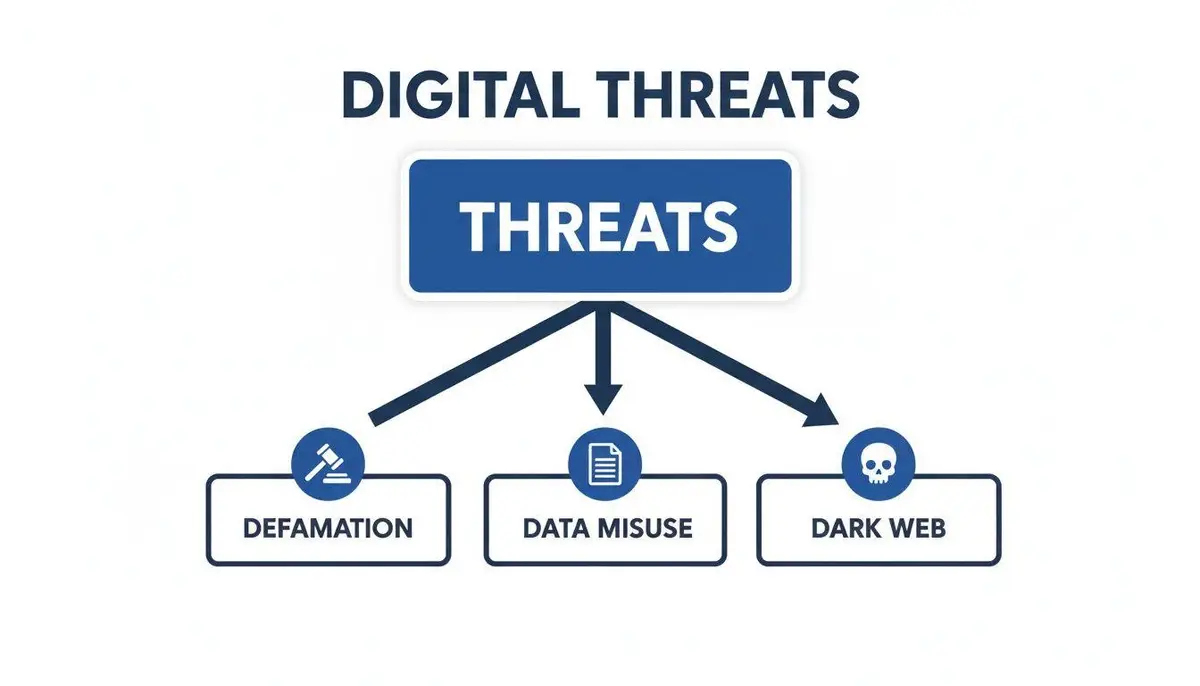
Each of these threats carries a distinct financial penalty. Defamation can lead to substantial legal costs, while data misuse or dark web activity can erode brand equity. The ROI of a proactive defense is therefore measured by calculating the cost of these disasters not occurring.
A Framework for Calculating Value
A true ROI calculation is a structured process, not guesswork. It begins by establishing a baseline of your current financial risk, against which we can measure the value created through our strategic interventions.
To build a clear picture of ROI, we have developed a framework that focuses on concrete, quantifiable metrics. This table breaks down how we connect our actions to real financial outcomes.
| ROI Framework for Reputation Management | ||
|---|---|---|
| Metric Category | Key Performance Indicator (KPI) | Method of Measurement |
| Revenue Protection | Preserved Deal Value / Customer Retention | Calculate the value of contracts, sales, or partnerships secured or saved after neutralizing a threat. |
| Crisis Aversion | Avoided Revenue Loss | Model the potential revenue decline based on industry data from similar public crises and compare it to the actual (minimal) impact. |
| Legal & Compliance | Reduced Litigation Costs | Estimate the avoided legal fees, settlement costs, and damages by removing defamatory content before it triggers litigation. |
| Market Capitalization | Stock Price Stability | Measure the delta between the company’s stock performance during a managed incident versus unmanaged industry comparables. |
| Brand Equity | Brand Valuation Maintenance | Use brand valuation models to assess the equity preserved by preventing or containing negative narratives that erode public trust. |
This framework is not merely theoretical; it is how we demonstrate tangible value in high-stakes situations.
In a recent case, we represented a private equity group whose portfolio company was targeted by a disinformation campaign immediately prior to a planned exit. A potential $50 million transaction was jeopardized. By swiftly removing the false content, we ensured the deal closed without incident, delivering an ROI that rendered the cost of our services negligible.
This is the core of how we measure the benefits of professional reputation management: a direct calculation of value preserved and risk annihilated. For a more detailed examination of the costs involved, our guide on the financial realities of online reputation management provides a thorough breakdown.
Ultimately, the analysis is straightforward. You weigh the cost of inaction (lost deals, litigation, a damaged brand) against the cost of decisive, professional intervention. When framed in these terms, the ROI of protecting your most valuable asset becomes unequivocally clear.
Your Pressing Reputation Questions, Answered
When your reputation is at risk, you require clear and immediate answers. This section addresses the most urgent questions we receive from executives, family offices, and high-profile individuals facing a reputational crisis.
How Is Professional Content Removal Different From PR?
The distinction is critical. Public relations attempts to shape public perception, often by creating a volume of positive content to overshadow a negative story. It is a narrative-building strategy.
Professional content removal, conversely, is not about managing a story; it is about eliminating the threat itself. Our work is a targeted fusion of legal and technical processes aimed at the permanent removal of harmful material from its source and from search engines. It is the difference between attempting to outshine a problem and making the problem cease to exist.
What’s the Timeline for Seeing Results?
The timeline is contingent on the specific threat. Our focus is on rapid intervention to contain the damage as quickly as possible, not on slow, long-term brand building.
Certain actions yield an immediate impact. For example, the de-indexing of a harmful link from Google search results can often be initiated within 24-48 hours, making the content almost immediately invisible to the public. Complete deletion of content from a source website can take from a few days to several weeks, depending on the site’s jurisdiction and cooperation.
During your confidential assessment, we will provide a clear action plan with realistic timelines tailored to your specific situation. Our objective is always to move decisively to protect your interests with speed and certainty.
Can Removed Content Reappear? How Is That Prevented?
This is a valid concern. Malicious actors may attempt to re-upload content after it has been taken down. A one-time removal is therefore insufficient. An effective defense must anticipate and counter repeat attacks.
Our strategy includes continuous, AI-driven monitoring to detect and neutralize any re-uploads across the web. Once we remove a piece of content, our systems learn its digital fingerprint. If it reappears elsewhere, we receive an instant alert, enabling us to initiate a new takedown immediately, often before the re-posted content gains any traction. This proactive monitoring is what makes your defense resilient.
Is It Truly Possible to Erase a Negative Online Presence?
While a “complete erasure” of one’s past is not a realistic objective, neutralizing a negative online presence and reclaiming control of your narrative absolutely is. The primary goal is to control the first few pages of search results for your name or brand, as over 90% of individuals never click past the first page.
We achieve this with a precise, two-part strategy. First, we conduct aggressive removal by surgically removing or de-indexing damaging, false, or defamatory content to render it inaccessible. Simultaneously, through strategic elevation, we promote authoritative and positive digital assets that you control, pushing them to the top of search results.
This process does not erase history, but it renders isolated negative items practically invisible and irrelevant. It ensures that what people find when they search for you is a fair and accurate reflection of your current reality. The true benefits of reputation management are found in this control, allowing you to define your future, unburdened by the past.
Managing a digital reputation is a complex challenge that demands specialized expertise. If your personal or professional standing is under threat, decisive action is critical. The team at ContentRemoval.com operates with the speed and discretion required for high-stakes situations. We invite you to schedule a confidential assessment to discuss your case and learn how we can restore your control. Learn more at ContentRemoval.com.
Frequently asked questions
What is a reputation reserve and why does it matter?
A reputation reserve is a strong, positive and authoritative digital history that absorbs the first shock when negative information surfaces. When stakeholders search during a crisis and find a consistent record of credible leadership, they are more likely to extend the benefit of the doubt, which buys time to respond.
How is the ROI of reputation management measured?
The article’s framework tracks preserved deal value, avoided revenue loss, reduced litigation costs, stock price stability and brand valuation maintenance. The return is the value of what was protected, such as a transaction contingent on a clean due diligence check, not the number of links removed.
Can content that was removed come back online?
Yes, malicious actors sometimes re-upload material after a takedown. The article describes continuous monitoring that recognizes the content’s digital fingerprint and triggers a new takedown quickly if it reappears elsewhere.