
Adult Friend Finder scams are best treated as a containment event: do not pay, stop replying from the compromised account, preserve every screenshot with timestamps, and report in parallel to the platform, your bank, the FBI’s IC3 and the FTC. Then remove the content at the source, de-index it from search, and monitor for re-uploads.
Key facts
- Five recurring patterns: bot farms, catfishing, romance-investment hybrids, sextortion operators and cloned identity accounts.
- A match pushing you off-platform quickly is the clearest warning sign that the aim is reduced traceability.
- Payment rarely ends an extortion demand and can mark you as a repeat target.
- Copyright claims are often the cleanest removal route when the scammer used your stolen photos.
Where ContentRemoval.com comes in. ContentRemoval.com takes on sextortion and impersonation cases that have already left the chat thread, where screenshots, cloned profiles or intimate images are sitting on third-party sites or surfacing under your name in Google. The person affected, or their lawyer, usually reaches out within hours of the threat. A free 15-minute Exposure Scan maps what is removable, and the report is yours to keep. Get a Free, Confidential Exposure Scan or read how our content removal work is done.
You’re probably reading this with your phone in one hand and a threat message in the other. Maybe the sender says they have screenshots, maybe they mention a spouse, a board, a client list, or a payment deadline that expires fast. The pressure is the same either way, and the first mistake is usually emotional, not technical.
Treat Adult Friend Finder scams as a containment event. The platform is only one surface; the risk is the spread, through messages, email, payment records, search results, and copied images. Your job in the first hour is to stop movement, lock the evidence, and prevent the material from getting a second life.
The First 60 Minutes After a Threat
A founder gets a message late at night from someone he met on Adult Friend Finder. The chat moved off-platform, the conversation turned sexual fast, and now the other party is demanding payment while attaching screenshots and a threat to expose the exchange. He wants to reply, explain, stall, and maybe buy time.
That instinct is expensive. It gives the other side more control, creates more logs outside the platform, and tells them they’ve reached someone who might negotiate. The better move is colder and faster. Stop the conversation, preserve what exists, and cut off every path that lets the scammer keep escalating.
What to do before you think about replying
First, do not pay. Payment rarely ends an extortion demand, and it can make you a repeat target. Second, stop using the compromised account to negotiate. The chat is already contaminated, and every new message can become another artifact the scammer uses later.
Third, preserve the threat exactly as received. Capture the screen with the sender name, timestamps, profile details, and any attached files visible. If the message arrived by email or through another app after the Adult Friend Finder handoff, save that trail too. The historical reality of the platform matters here, because public reviewers have noted for years that fake profiles, bot-like behavior, and pressure tactics continue despite verification features, which is why a long-lived service can still generate sustained abuse risk rather than a one-off incident (Mashable review of Adult Friend Finder).
Practical rule: evidence outranks emotion, and containment outranks denial.
If you’re a public figure, executive, or someone with a visible name, think one level deeper. Your goal isn’t just to survive the message, it’s to prevent the material from becoming searchable, shareable, and permanently attachable to your identity. That means you act first on preservation, then on removal, then on reputation control.
The Five Scam Archetypes on Adult Friend Finder
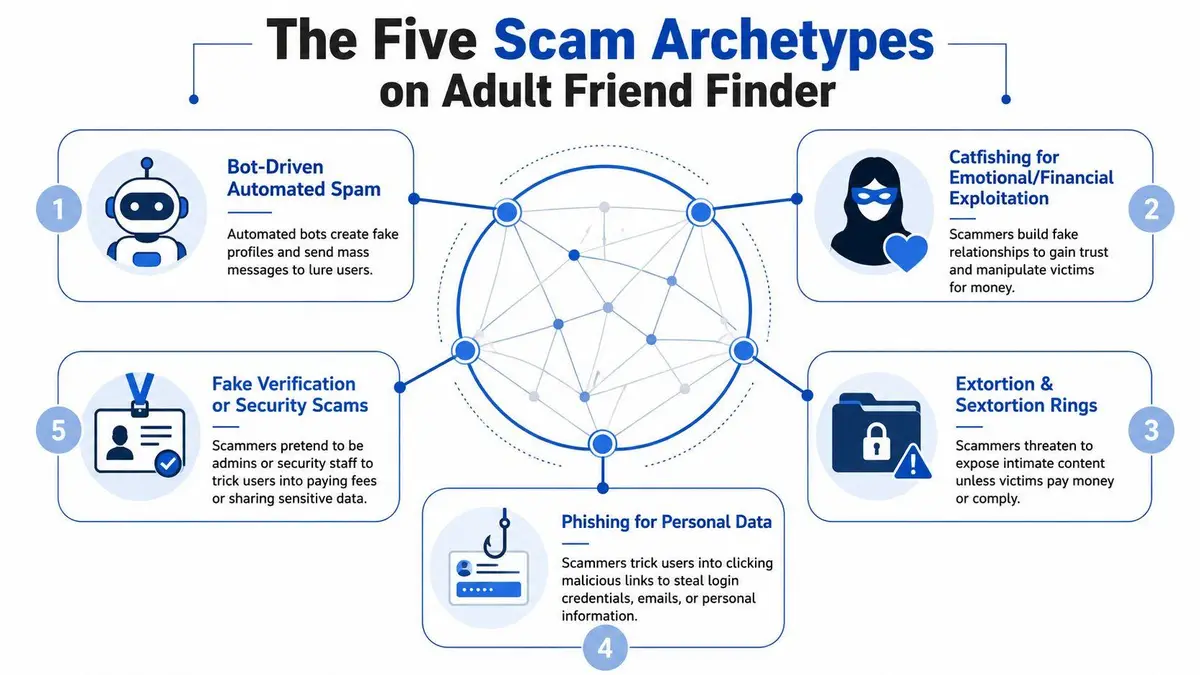
Adult Friend Finder scams don’t all behave the same way, but they do repeat a few patterns. Once you identify the category, the response gets sharper because each scam has a different objective, a different evidence trail, and a different removal path.
Bot farms and paid-feature traps
Some accounts exist to generate activity, not relationships. They use attractive profile photos, fast replies, and generic sexualized messages to drive users toward paid features or off-platform contact. The scammer wants clicks, subscriptions, or a move away from monitored systems, because that makes moderation harder and attribution thinner.
Catfishing for emotional or financial leverage
Catfish accounts use stolen photos and carefully chosen details to appear real enough for the first exchange. The hook is usually attention, urgency, or intimacy, then the payoff shifts toward money, gifts, or personal data. Reverse-image checks help here, but the tell is often the speed of trust building and the refusal to verify identity.
Romance-investment hybrids
These cases start like flirtation and end in a deposit request. The scammer gradually redirects the conversation toward crypto, trading, or some other “opportunity” tied to fake intimacy. The tactic works because the victim thinks the relationship is real before the request arrives.
Sextortion operators
This is the most damaging category tied to the site, and public coverage is blunt about that. The operator captures or manufactures intimate content, then threatens exposure unless the victim pays or keeps complying. The point is pressure, not connection, and the target is often rushed into a private channel where the evidence is easier to control for the scammer and harder to recover for the victim (Adult Friend Finder scam aftermath advice).
Impersonation and cloned identity accounts
These accounts copy a real person’s photos to defraud their network or to bait contacts into off-platform conversations. The harm here isn’t just financial, it’s reputational, because the fake profile can travel faster than the truth. In those cases, source removal and search de-indexing matter as much as platform reporting.
The anti-extortion guidance that is most useful is straightforward. A match moving you off-site very fast is a major warning sign, and so are generic messages, stolen images, sob stories, suspicious links, money requests, and refusal to video chat or speak by phone (anti-extortion guidance on Adult Friend Finder blackmail scams).
How The Escalation Actually Works
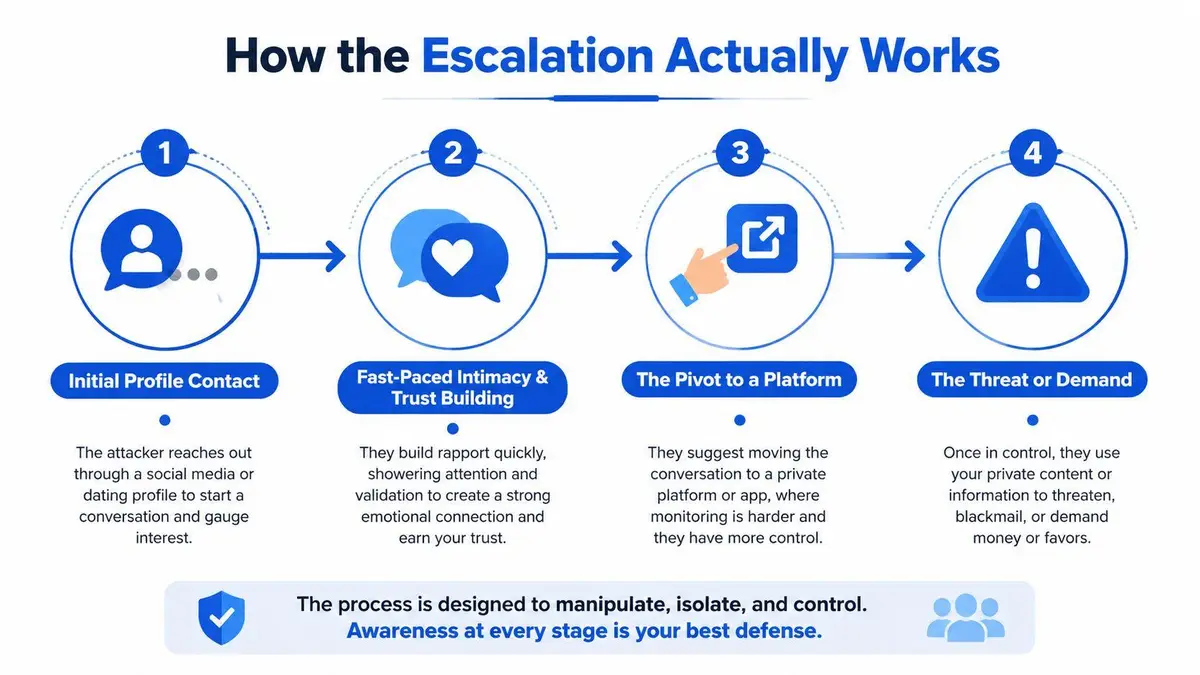
The mechanics are predictable. The scam starts as a profile contact, turns into speed and intimacy, then leaves the platform, where monitoring is weaker and recordkeeping becomes fragmented. That handoff is the critical point because it changes both the evidence value and the legal posture.
Stage one, contact
At the beginning, the profile itself is the evidence. Usernames, display photos, bio text, and message timestamps still sit inside the platform environment, which means reporting and preservation are easier. If the scammer stays in that channel, the platform has more to review and you have more to preserve.
Stage two, fast emotional escalation
The pressure rises. The scammer may send sexualized messages, lovebombing, or even manufactured intimate content to make the exchange feel urgent and personal. At this stage, the evidence is still there, but the victim often stops documenting because the conversation feels private or flattering.
Stage three, off-platform handoff
This is the most damaging shift. Once the scammer pushes you to encrypted messaging, email, or another private app, the platform loses visibility and moderation becomes harder. The same shift also weakens later claims because the most important abuse may now sit outside the original service, which means you need to chase logs across multiple systems instead of one.
Stage four, threat or demand
Now the conversation turns explicit. The scammer asks for money, crypto, gift cards, or continued control, then threatens exposure if the victim refuses. The legal question changes here too, because the facts start looking less like a bad dating interaction and more like coercion, extortion, and image abuse.
If you’re trying to diagnose your own situation, ask one blunt question. Did the other party rush you off-platform? If the answer is yes, the scam probably isn’t about romance at all, it’s about reducing traceability.
Capturing Evidence the Right Way
The first 24 hours should be spent building a clean record, not arguing with the scammer. You need usable evidence, not a messy folder full of partial screenshots and deleted threads. If this becomes a legal, platform, or reputational matter, the quality of that record will matter.
Lock the conversation before it disappears
Save complete screenshots that show the sender name, profile name, timestamps, and the full thread context. Capture the profile page, the URL, and any metadata visible on screen before blocking or deleting anything. If the exchange moved into email, preserve the original headers, not just the message body.
For image-related misuse, a reference response is useful if the scammer used your photos in a cloned or deceptive profile, and the same logic applies here when your own image set becomes part of the threat. The operational approach is documented in what to do if your photos are used in a catfishing scheme.
Preserve payments and device logs
If money was sent, record the transaction details immediately. That includes the payment rail, recipient handle, date, amount, and any reference numbers tied to the transfer. Do the same for wallet activity, card statements, and bank alerts if you used a card or account that can still be frozen.
Do not threaten the scammer, pay first and “deal with it later,” or continue negotiating from the compromised account.
Also document the device side. Keep notes on the phone, browser, app, and any login alerts that show where the account was accessed from. If a third-party app was used for the handoff, export the chat history without altering timestamps or trimming content.
A high-profile client should assume that anything handled sloppily may resurface later in litigation, media inquiries, or internal review. That means one secure folder, one chronology, and one person controlling the master copy. The goal is to make the record defensible before anyone else has a chance to shape it.
Reporting to Platforms, Payment Providers, and Law Enforcement
Reporting works only when you run the tracks in parallel. Adult Friend Finder, the app used for the handoff, the bank or card issuer, and law enforcement all need different information, and none of them is fast enough by itself to stop spread. Platform reports are necessary, but they’re not enough.
Start with the platform and the payment trail
File abuse reports on Adult Friend Finder and on any app, email service, or messaging platform the scammer pushed you toward. Use the preserved evidence, not a summary of it. In parallel, contact the bank, card issuer, or payment provider and dispute the transaction as fraud or coercion if any payment has already gone through.
If the demand involved crypto or a payment rail outside a bank card, record every address, transaction ID, and exchange reference before the trail cools. Then move to search-result containment, because if screenshots or profile images are already public, the issue has crossed from messaging into reputation.
File with the federal portals and keep counsel in the loop
Submit reports to the FBI’s Internet Crime Complaint Center and the FTC. Those filings won’t always produce immediate takedowns, but they create an official paper trail that can support later action. If the matter is cross-border, a specialist or counsel can also issue preservation letters and pursue subpoenas where jurisdiction allows.
For a closely documented personal case file, professionals often apply the same discipline used in other sensitive investigations, including the method explained in how to record CPS visits from Law Office of Bryan Fagan PLLC. The documentation principle is the same, record what happened, preserve it cleanly, and avoid freehand summaries that can be attacked later.
Search engines usually do not solve this on their own. They can de-index a URL, but they can’t remove what still lives at the source. That’s why reporting has to sit beside removal work, not replace it.
Legal Options and Their Realistic Limits
The legal tools exist, but they serve different purposes. Some shorten the exposure window, some build pressure, and some are mostly about establishing a record. A high-profile victim needs containment first, not a theoretical win.
What lawyers can move quickly
Civil harassment and extortion claims can sometimes create immediate pressure, especially when paired with preservation demands and takedown notices. Copyright can also matter if the scammer stole your photos, because that gives a cleaner path to removal from hosts and platforms. In impersonation cases, defamation and false-identity theories may help if the fake profile is using your name, brand, or likeness in a way that misleads the public.
The practical limit is speed and geography. Cross-border service of process takes time, and offshore sextortion operators often sit beyond the reach of the most efficient domestic remedies. Criminal prosecution can still matter, but if your immediate goal is containment, waiting for enforcement alone is a weak strategy.
What usually shortens the exposure window
De-indexing requests, source takedowns, and platform notices do the hard work first. Privacy-based removal tools can help where applicable, but they need a factual record and a coordinated filing strategy to be effective. Civil action is strongest when it supports removal, not when it replaces it.
When the material involves intimate imagery or fake identity exposure, specialist removal teams can run the legal and technical tracks together. One operational option in that category is professional revenge porn removal help protecting high-stakes reputations, which sits in the same containment lane as takedown work, de-indexing, and monitoring.
The right legal question isn’t “Can I sue?” It’s “Which action removes the exposure fastest, and which one creates the cleanest record if this spreads?”
De-Indexing, Source Removal, and Continuous Monitoring
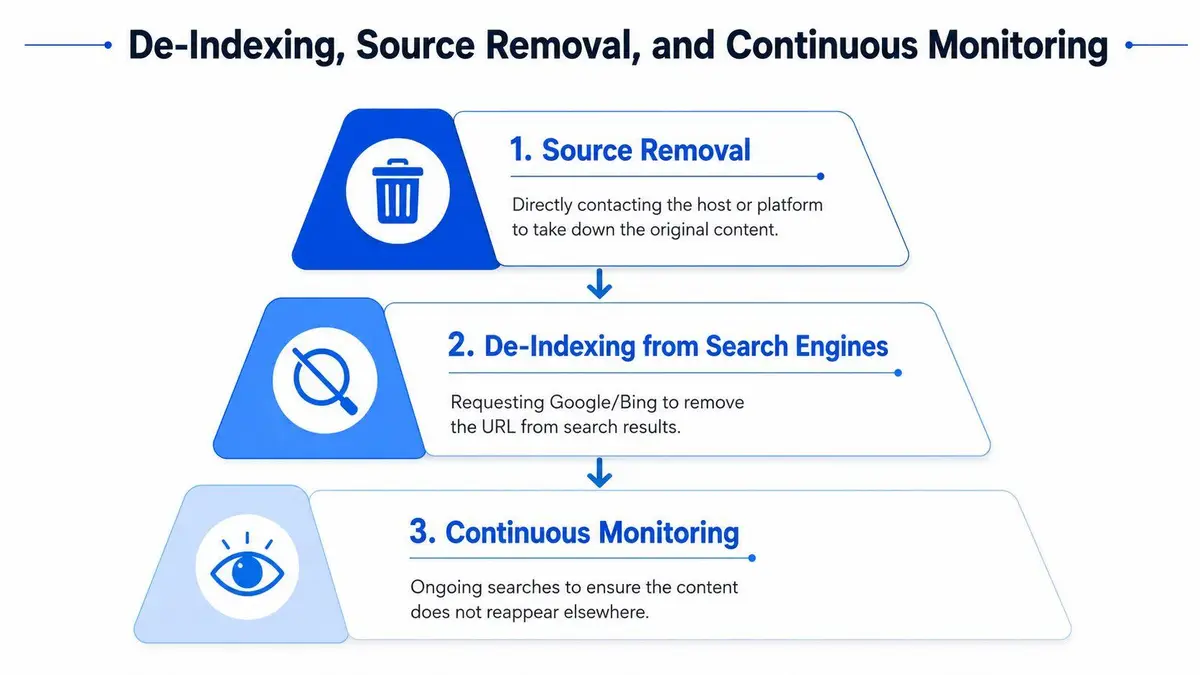
The original post is only the first layer. If a profile, image, or threat screenshot is still accessible at the source, de-indexing alone won’t protect you. If it’s de-indexed but still live, the material can still spread through direct links, mirrors, and reposts.
Remove at the source first
Source removal means getting the original content taken down where it sits. That might be the Adult Friend Finder profile, a mirror site, a cloud host, or a social platform that received a re-upload. For stolen images, copyright-based removals are often the cleanest route, while impersonation cases can also support trademark or identity-based takedowns depending on the facts.
Then de-index aggressively
Once the source is addressed, search engine de-indexing prevents casual discovery. That matters for executives, public figures, and anyone whose name is already searchable enough to surface old harm quickly. The point is simple, if someone types your name into Google and lands on the scam content, the damage is already multiplying.
Then monitor for reappearance
Re-uploads are common. That’s why continuous monitoring is not a luxury, it’s the part that stops a solved problem from returning under a new URL, new profile name, or different platform. A professional program watches for recirculation, flags new copies, and pushes repeat removals before the material becomes entrenched again.
The broader removal strategy is documented well in how to get your name off cheater websites, because the same layered logic applies here. One takedown is not enough. You need source removal, search suppression, and ongoing watchfulness in the same plan.
When to Escalate and What to Demand From a Specialist
If this involves your name, your image, your business, or your family, don’t run it as a DIY reputation problem. General counsel can help, but most internal teams don’t have the speed or the monitoring stack to contain multichannel abuse. A specialist should be able to move fast, keep the matter discreet, and work legal and technical channels at the same time.
Demand documented action windows, parallel legal and removal work, and continuous monitoring for re-uploads. Ask how they handle search de-indexing, source takedowns, and off-platform mirrors. If they can’t explain their jurisdictional reach and confidentiality controls in plain language, they’re not built for a crisis like this.
ContentRemoval.com handles online content removal and reputation protection for harmful material tied to scams, impersonation, and intimate-content abuse, with discreet case handling and continuous monitoring built into the process. If the material tied to Adult Friend Finder is already moving beyond a single chat thread, the right move is to contain it before it becomes permanent.
If you’re dealing with Adult Friend Finder blackmail, ContentRemoval.com can help you lock down evidence, remove exposed material, and reduce further spread across search engines and platforms. Visit ContentRemoval.com for a confidential assessment and a direct containment plan built around your situation.
Frequently asked questions
Should I pay someone blackmailing me from Adult Friend Finder?
No. The article is clear that payment rarely ends the demand and can make you a repeat target. Stop the conversation, preserve the evidence exactly as received, and move to reporting and removal instead.
Who do I report an Adult Friend Finder sextortion scam to?
File abuse reports with Adult Friend Finder and any app the scammer moved you to, dispute any payment with your bank or card issuer, and submit reports to the FBI Internet Crime Complaint Center and the FTC. Run these tracks at the same time, because none of them is fast enough alone.
Can Google remove Adult Friend Finder scam content about me?
Search engines can de-index a URL but cannot remove what still lives at the source. Source removal comes first, then de-indexing prevents casual discovery, and continuous monitoring catches re-uploads under new URLs or profile names.