
Reputation management for philanthropists addresses a truth that surprises nearly every major donor: giving money away is one of the most exposing acts a wealthy person can perform. A family that spends decades keeping its wealth private will, with a single named gift, announce that wealth to the world, with a number attached, a cause attached, and a permanent public record behind it. Foundation filings are public documents, searchable by anyone. Gift announcements are press releases. Galas are photographed. Buildings carry names. The generosity that defines a family’s best instincts simultaneously publishes its capacity, its convictions, its relationships, and, through the scrutiny that now follows all institutional giving, its vulnerabilities.
The modern environment has sharpened this exposure considerably. Philanthropy is no longer covered only by society pages; it is investigated, by journalists examining donor influence, activists mapping funding networks, critics on both sides of every cause, and researchers who treat foundation disclosures as a public database of the wealthy. At the same time, a named gift functions as a beacon for a less ideological audience: professional solicitors, fraud operators, litigants, and criminals who read philanthropic records for exactly what they are: verified evidence of liquidity, location, and family structure.
This guide defines the philanthropist’s distinct exposure surface (the disclosure trail, the scrutiny economy, the solicitation and targeting problem, and the family spillover) and describes what professional, discreet protection looks like for donors who intend to keep giving without surrendering their privacy, security, or legacy to the act.
Why giving attracts scrutiny: the philanthropist’s disclosure trail
Philanthropy generates public information in ways almost no other private activity does, and understanding the trail is the first step in managing it.
Foundation disclosures. Private foundations file detailed public returns: assets, grants and recipients, trustee and officer names, compensation, and, in many cases, addresses. These filings are digitized, aggregated, and made searchable by multiple databases, meaning anyone can reconstruct a family’s giving history, board composition, and financial scale in minutes, going back decades. Donor-advised funds offer more confidentiality at the donor level, but grants that families choose to name, and the sponsoring organizations’ own records, still leave threads.
Recipient publications. Universities, hospitals, and cultural institutions publicize gifts as a matter of institutional strategy: press releases with amounts, donor-wall listings, annual-report honor rolls, naming ceremonies with photographs of the family. Each recipient’s communications office is, in effect, publishing the family’s financial profile, with the family’s blessing but rarely with the family’s threat model in mind.
Event and social documentation. Galas, benefit committees, and campaign chairs generate photography, attendee lists, and coverage that place family members, including spouses and adult children, at named locations, in identifiable social circles, on recurring calendars.
The commentary layer. Around all of this sits the modern discourse: articles and threads scrutinizing donor influence, criticizing causes from every direction, questioning motives, and mapping funding networks. A donor to medical research, education reform, religious institutions, political causes, or environmental work (that is, to nearly anything) now acquires critics by virtue of the cause itself. The gift is generous; the record is permanent; the interpretation belongs to strangers.
Key takeaway: A major philanthropist’s financial capacity, convictions, relationships, and calendar are more publicly documented than those of almost any other private individual, assembled not by adversaries but by the ordinary machinery of giving itself.
From scrutiny to targeting: how philanthropic visibility becomes risk
The disclosure trail would matter less if its only audience were grateful institutions. It is not. Philanthropic visibility converts into concrete risk through several well-understood mechanisms.
Solicitation at industrial scale. A named gift reclassifies a family, permanently, as a verified prospect. Development offices maintain and share prospect research; wealth-screening services score donors from public records; and the family’s inboxes, mailboxes, and social calendars fill accordingly. This is the benign end of the spectrum, but its infrastructure (detailed prospect files on the family’s capacity, interests, and connections) is itself an exposure, held by dozens of organizations with varying security.
Fraud and impersonation. Charity fraud operators work philanthropic records deliberately: fake causes engineered to match a family’s documented giving pattern, impersonation of institutions the family actually supports, grant-scam approaches to the foundation, and, increasingly, social-engineering attacks on foundation staff using trustee details from public filings. A family’s giving history is, in the wrong hands, a psychological profile with a payment history attached.
Physical and family targeting. Public filings and gift announcements verify wealth in a way property speculation never can, and event calendars place the family in predictable locations. Trustee listings expose relatives, including family members who chose no public life, by name and role. For criminals assessing targets, a foundation’s public record answers the threshold questions; the remaining research is the kind our data broker removal and personal-data removal practices exist to frustrate: home addresses, phone numbers, family linkages, and routines.
Cause-based hostility. Donors to contested causes, and most causes are now contested, face activist campaigns, coordinated online hostility, and occasionally doxxing that publishes home addresses alongside calls to action. The family’s giving becomes the pretext; the family’s unmanaged personal exposure becomes the ammunition.
Reputational inversion. Perhaps the most painful mechanism: a controversy anywhere near a cause, an institution, or a co-donor can invert years of generosity into association risk. A scandal at a recipient organization, a fellow donor’s disgrace, a shift in public sentiment about a funding area, each can place a family’s name in coverage it never earned, where the search results then keep it.
Know exactly what's exposed, before someone else finds it.Free confidential Exposure Scan, live results on a 15-minute call, covered by strict confidentiality.
Book Your Confidential ScanThe family behind the foundation: spillover exposure
Philanthropy is a family activity, and its exposure is a family exposure, often concentrated on the members least equipped for it.
Spouses and co-founders of family foundations frequently carry the public-facing role: chairing benefits, sitting for profiles, accepting honors. Their visibility is real and chosen, but the personal-data layer beneath it (addresses, contact details, relatives, travel patterns) is rarely managed to match, leaving the family’s most photographed member also its most findable.
Adult children and next-generation trustees are commonly added to foundation boards as part of legacy planning, a sound governance instinct with an unexamined side effect: their names enter public filings, prospect databases, and press coverage, sometimes before they have begun their own careers. A twenty-something trustee inherits the family’s entire visibility profile at the moment their own digital footprint is least curated.
Family members outside the philanthropy are exposed by linkage: broker sites and prospect research connect them to the foundation’s documented wealth regardless of their involvement. The sibling who chose privacy is, to a researcher, one hop from the donor wall.
Household and foundation staff complete the surface: program officers whose profiles detail the family’s funding strategy, assistants whose information provides the access path that social engineers prefer over principals.
This is why serious philanthropic protection is structured as family protection. The engagement covers the donor couple, the trustee generation, linked relatives, and key staff, the same whole-household logic that governs our family office and private-client work, because solicitors, fraudsters, and hostile actors will route through whichever member is least defended.
Key takeaway: A foundation’s public record exposes every name in it and every relative linked to those names. Protecting the principal donor while trustees, spouses, and children remain findable protects no one.
What professional protection looks like for philanthropists
The objective of professional work in this space is precise: preserve the family’s ability to give (publicly where it chooses, anonymously where it prefers) while stripping away the exposure that giving does not actually require. That distinction, between the visibility a family intends and the visibility it merely accumulates, organizes the entire engagement.
A philanthropic exposure audit. The work begins by assembling what the giving trail has published: foundation-filing exposure across the aggregator databases, recipient-institution publications, event and photo documentation, press and commentary, the family-linkage map, broker and people-search profiles on every named member, leaked-data appearances, and how the whole reads to a journalist, a solicitor, a fraud operator, and a hostile actor respectively. Families are consistently startled by this document. Most have never seen their generosity rendered as an intelligence file.
Separation of intended from incidental visibility. With the audit in hand, the family decides what its public philanthropic presence should be, and the firm works to make everything outside that boundary quiet. Incidental exposure is addressed at the source where mechanisms exist: broker and people-search removal for every family member, filing-adjacent details minimized in coordination with the family’s counsel and foundation administrators, recipient-institution publications aligned with the family’s preferences going forward, leaked data pursued, and residual personal exposure suppressed through the disciplines of our online privacy service.
Search-layer and narrative proportion. The gifts the family is proud of should lead its results; the commentary, controversy-adjacency, and dated coverage should not define it. Where the search picture has inverted (a recipient scandal outranking a lifetime of giving, hostile commentary outranking the record) our search-result management practice works the visibility layer with the patience it requires, and without promising what no one controls.
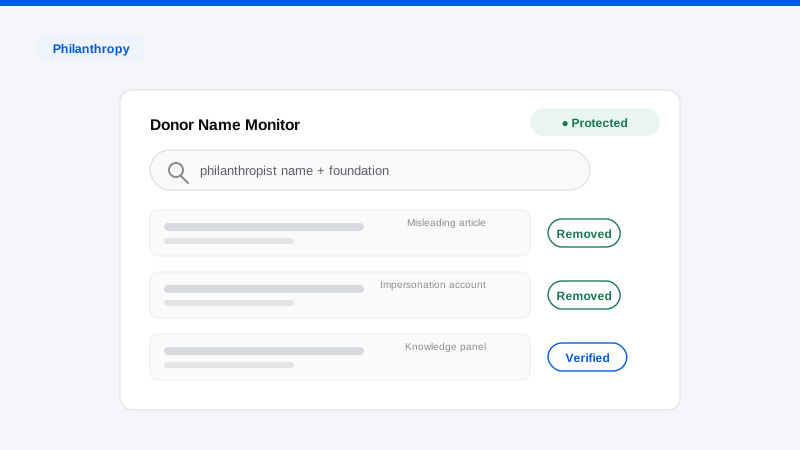
Standing monitoring, tuned to giving. The family’s names, the foundation, and key staff under continuous watch: new filings surfacing in aggregators, recipient announcements, emerging commentary around funded causes, impersonation and fraud signals, broker repopulation, and event documentation. Because philanthropy generates exposure on other institutions’ schedules (every recipient’s press office, every database’s refresh) ongoing monitoring is not optional infrastructure; it is the program.
Readiness for the hostile moment. Doxxing after a controversial grant, an activist campaign, a fraud incident, a story gathering around a recipient, families with standing protection plans meet these moments with a firm that already holds their baseline, under strict confidentiality, rather than beginning a vendor search mid-crisis.
Throughout, the boundaries of reputable practice hold. Public filings required by law are not removable, and no honest firm implies otherwise; the work is to minimize what feeds the aggregators, manage what surrounds the record, and harden everything the record points to. Nor is the work spin: a philanthropic reputation is defended by accuracy and proportion, not manufactured sentiment, donors’ credibility with institutions and press is an asset the engagement must never spend.
Know exactly what's exposed, before someone else finds it.Free confidential Exposure Scan, live results on a 15-minute call, covered by strict confidentiality.
Book Your Confidential ScanGiving as legacy: the long view
For most major donors, philanthropy is the intended legacy, the work the family name is meant to stand for after the operating businesses are sold and the headlines fade. That intention deserves protection on its own timescale. The foundation will outlive its founders; the filings will be read by researchers not yet born; the name on the building will be searched by generations of the family not yet involved. Decisions made now (which gifts are named, which members are listed, how the incidental exposure is managed, whether anyone is monitoring) compound across that entire horizon.
The philanthropists who handle this well treat reputation and exposure management as part of the philanthropy itself: a professional function alongside the foundation’s investment management and grant administration, quietly ensuring that the family’s generosity is what endures, rather than the vulnerabilities it happened to create. That is a specialist’s role (continuous, discreet, accountable) and it is precisely the role a firm dedicated to private-client exposure exists to fill.
Key takeaway: The goal is not less generosity or less recognition. It is intentionality. A family should be exactly as visible as its philanthropy requires, and not one database entry more.
Frequently asked questions
Can our foundation’s public filings be removed from the internet?
Required public disclosures cannot be unpublished, and a firm claiming otherwise is misrepresenting the landscape. What professional work addresses is everything around the filings: minimizing sensitive details in future filings in coordination with your counsel and administrators, addressing aggregator-level exposure where mechanisms exist, removing the broker and people-search records that turn a trustee’s name into a home address, and managing the search layer so the filing trail informs rather than defines the family’s public picture. The filings are the floor of your exposure; nearly everything built on top of them is manageable.
We want to keep giving publicly. Doesn’t that make privacy work pointless?
No: it makes it essential. Public giving and personal exposure are separable, and separating them is the core of the work. A family can accept a named gift, attend the ceremony, and appear in the announcement while its home addresses, phone numbers, family linkages, travel patterns, and minor children remain professionally suppressed. The families most in need of this discipline are precisely the visible ones: their philanthropy guarantees attention, so everything attention can pivot to must be hardened. Anonymous giving is a choice; undefended giving should not be the default alternative.
Our foundation has received hostile coverage over a cause we fund. What can be done?
First, an honest assessment: legitimate press and opinion generally cannot be removed, and attempting heavy-handed takedowns of criticism tends to amplify it. What can be done is substantial: removal of any policy-violating material (doxxing, threats, fabricated claims) through proper channels; hardening of the family’s personal exposure before hostility escalates to targeting; search-layer work so the controversy sits in proportion to the family’s fuller record; and monitoring so the next wave is seen forming rather than discovered breaking. Families who engage before the coverage peaks retain far more control over all four.
Should our children join the foundation board if it exposes them publicly?
That is a governance decision for the family, but it should be made with the exposure understood rather than discovered. Trusteeship places a name in permanent public filings and prospect databases; for a young adult, that is a meaningful change in findability. Families who proceed (and most do, for good reasons) typically pair the appointment with personal protection for the incoming trustee: a footprint audit, broker suppression, and monitoring from the day the filing publishes. The role is an honor; entering it undefended is simply unnecessary.
Your family’s generosity is already being read (by institutions, researchers, solicitors, and less benign audiences) and the record is more complete than most donors imagine. A confidential Exposure Scan shows you, live on a 15-minute call, exactly what your giving has published: the filings trail, the family linkages, the broker records, the pressure points. It is free, covered by strict confidentiality, and conducted by a firm that protects families who intend to keep giving. Book the scan, and make your visibility a choice again.