
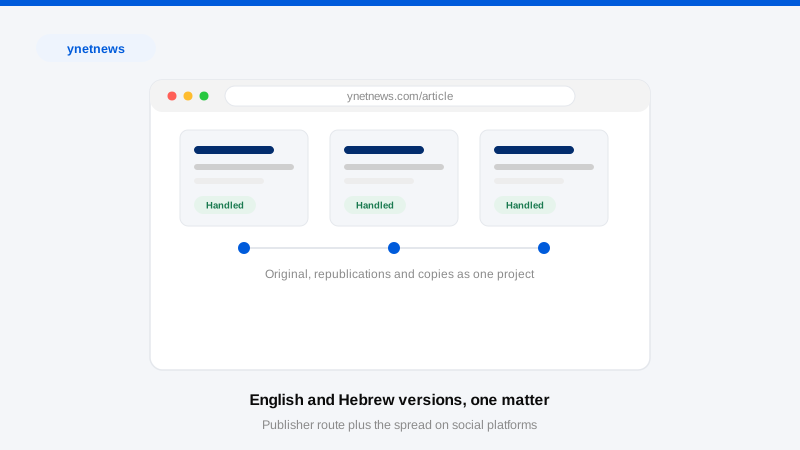
Removing a ynetnews article means asking the publisher to unpublish, correct or anonymize it, or removing the piece from the search results for the name. Israeli mastheads rarely delete archive material. Correction, name removal, de-indexing and containing the article’s spread on social platforms are the outcomes that usually decide these matters.
Key facts
- ynetnews.com is the English language edition of Ynet, the news site of the Yedioth Ahronoth group, one of Israel’s largest media companies.
- The Hebrew and English sites are related but distinct products with different audiences, different editing and different URLs, and they rank separately.
- Israel’s Prohibition of Defamation Law addresses publications that harm reputation and sets out defences including truth in a matter of public interest and good faith, and it recognises a correction or apology in mitigation.
- Israel’s Protection of Privacy Law addresses infringements of privacy including publication of private matters, and it is often the better instrument where material is accurate but intrusive.
- Israel does not operate a European style statutory right to erasure, so requests to search engines rest on Google’s own policies and its legal removal request process.
- Israeli press self regulation is voluntary and runs through the Israel Press Council and its ethics framework, whose remedies are corrective rather than deletive.
- English language Israeli coverage is quoted, screenshotted and reposted on X within hours, so the article is frequently the smallest part of the exposure.
- Google will consider taking a URL out of searches for a person’s name in defined circumstances, but it weighs each request against the public interest in the material staying findable.
What is ynetnews and who publishes it?
ynetnews.com is the English language edition of Ynet, the news site of the Yedioth Ahronoth group, one of Israel’s largest media companies. The Hebrew site and the English site are related but distinct products with different audiences, different editing and, importantly, different URLs.
This is the first practical point. An English article about a founder, an investor or a family is very often a translated or adapted version of a Hebrew original, and the two versions rank separately, are shared separately and are complained about separately. Working on the English URL and ignoring the Hebrew one leaves the source of the story untouched. Any credible plan starts by identifying both.
Why does the article spread so fast?
English language Israeli coverage travels. It is quoted, screenshotted and reposted on X within hours, picked up by aggregators and international outlets, translated back and forth, and threaded into arguments that have nothing to do with the person named. By the time a chief of staff calls us, the original article is frequently the smallest part of the exposure.
That changes the brief. Winning a correction at the publisher while thousands of screenshots of the original headline circulate on X is a partial result at best. We treat the article, its Hebrew counterpart, the reposts and the social spread as one project, and our X post removal page covers the platform side. The general principles are set out in our guide to removing news articles and to clearing press coverage from search.
What does Israeli law provide?
Israel has a developed framework in this area, and two statutes are usually relevant. The Prohibition of Defamation Law addresses publications that harm a person’s reputation and sets out defences including truth in a matter of public interest and good faith, and it recognises the significance of a correction or apology in mitigation. The Protection of Privacy Law addresses infringements of privacy, including publication of private matters, and is often the more useful instrument where the material is accurate but intrusive.
Israel does not operate a European style statutory right to erasure, so search level work here stands on narrower ground than it does in the United Kingdom, and our overview of legal removal requests explains how that layer is judged. Israeli press self regulation is voluntary and its remedies are corrective rather than deletive. So the routes exist. Which of them your facts can stand on is the question. We are not a law firm, and where a formal step is warranted we work alongside Israeli counsel, who are also best placed to advise on limitation periods and on which statute fits the facts.
What outcomes are realistic?
Correction or amendment. The strongest achievable result where a specific factual error can be documented, and it applies to the headline as well as the body.
Update on a resolved matter. Charges withdrawn, a case closed, a regulator’s finding reversed. The original becomes incomplete rather than untrue, which is something an editor can act on.
Name removal. Available more often for older coverage of private individuals than most people expect.
De-indexing. The article stays online and leaves search results for the name.
Suppression. Nothing changes at the source and the article stops leading the page.
Which route fits which problem?
That depends on the language version, on whether the concern is accuracy or privacy, and on how far the story has already travelled on X. Timelines depend on the route and the publisher, and they are set out in writing after the free Exposure Scan.
Get a Free, Confidential Exposure Scan
How the work runs
We identify every version that exists, in both languages, along with the reposts and the accounts driving them, because on this publisher the social spread is usually further along than the client realises. We tell you which outcomes your facts genuinely support before you commit, including when the honest answer is that the article stays. Then we pursue every ground that applies, at the publisher, at the platforms and in the search results, at the same time rather than one after another. You approve the approach before anything is sent, because Israeli media report on media and a clumsy complaint becomes the next story. What comes back is verified, evidenced to you and monitored.
What we need from you to start
We ask first for both language versions. The English URL, the Hebrew URL if you have found it, the dates of each, and the exact spelling of every name in both alphabets, including any transliteration variants, because a name that is clean in one script can be carrying the story in the other.
Then the documents, meaning anything official that establishes what actually happened. Where the concern is privacy rather than accuracy, we want to know what was published that was never public, how it was obtained, and whether family members or children are identifiable. In Israeli practice the privacy question is often the stronger one, and what supports it is different.
We also want the social picture: the posts, screenshots and quote posts you have already seen, and the accounts driving them. Finally we need written authority to act for the individual named. A chief of staff, in house counsel or an agency principal normally signs under a confidentiality agreement, and the individual never corresponds with the publisher directly.
Timelines and what usually happens first
The opening days are assessment in two languages and across platforms, not correspondence. You see the recommendation before anything is sent.
After that, timelines depend on the route and on the desk, and you get ranges in writing item by item rather than a single date. Suppression is different in kind, because it is continuous rather than complete. These decisions belong to editors and platforms, and no adviser controls their calendars.
Common mistakes that make it harder
- Working only on the English URL. The Hebrew article is usually the source, it often has the larger local readership, and leaving it live means the story stays fully available.
- Waiting for the publisher before dealing with the platforms. Reposts multiply while a newsroom decides, and a screenshot outlives the article it came from.
- Replying publicly. Israeli media report on media, and a public rebuttal or a heavy handed complaint becomes the next story.
- Sending an aggressive legal letter as the first move. It can be defended, publicised and used as evidence of pressure, and it closes the editorial route that would have produced a correction.
- Engaging the accounts driving the spread. Argument feeds volume, and volume is what keeps the story ranking.
- Deleting your own posts and pages. It removes evidence of context and takes down assets that were ranking usefully for the name.
How this works alongside your lawyer, PR team or security team
Israeli counsel decide which statute fits the facts, whether a claim is worth bringing and what the limitation position is, and they lead where a formal step is warranted. We work behind them on the editorial approach, the Hebrew desk, the translations, the platform work and the search applications, so the footprint is being reduced while any formal process runs at its own pace.
With PR advisers the boundary is straightforward. They own what is said publicly, in which language and to which outlet, and in these matters silence is frequently the correct choice. We own what is filed, to which desk or platform, on which ground, and what a name search returns afterwards in both languages.
With security teams the concern is usually specific detail rather than the article as a whole. Addresses, travel patterns, family members, schools and identifiable images are pursued first and separately, and publishers and platforms are often more responsive to a safety concern than to a reputational one.
Who normally instructs this
A chief of staff, a family office manager, in house counsel or the agency acting for the person named. The 15-minute call is short and practical. We look at both language versions and the social spread, say which outcomes are realistic, and tell you plainly when the article will stay and the work belongs elsewhere. Confidentiality and an NDA are standard, our involvement stays invisible unless strategy dictates otherwise, and we work alongside counsel, PR and security teams. The written report is yours to keep.
We do not promise outcomes. Some articles stay up, in both languages.
Frequently asked questions
Do we need to deal with the Hebrew version as well?
Almost always. The Hebrew article is usually the source, it often has the larger local audience, and a result on the English URL alone leaves the story fully available. They are separate requests to what may be separate desks.
Is a defamation claim in Israel the fastest route?
It is a decision for Israeli counsel and it is rarely the fastest. A documented editorial approach can produce a correction in days, while proceedings take far longer and carry the risk of drawing attention to the original coverage.
Can the article be removed from Google?
There is no Israeli equivalent of the European erasure right, so search level work here stands on narrower ground and it is not the near automatic thing clients expect. Whether your matter fits one of the narrower grounds is part of what the scan establishes. Where none of them applies, the honest option is suppression, and we say so.
The article is being used against our principal on X. What can be done there?
A good deal, and it runs independently of the publisher. Volume matters more than any single post, so the work is usually about the pattern rather than one account, and it starts on day one rather than after the newsroom has answered.
Will complaining make it worse?
It can. Israeli media report on media, and a heavy handed approach to a major masthead is itself a story. Assessing that risk before anything is sent is part of the engagement, and sometimes the recommendation is to leave the newsroom alone.
Which language version should be dealt with first?
Usually the Hebrew one, because it is normally the source and the local audience is larger, but the sequencing depends on where the search harm actually sits. If your principal’s exposure is with English speaking investors and counterparties, the English URL may be the priority even though the Hebrew article is the origin. That call is made at assessment.
Do we need Israeli lawyers to do anything at all?
Not for editorial requests, platform work or search applications, which proceed without them. Israeli counsel become necessary where a formal step under the defamation or privacy statutes is being considered, and we tell you when we think that point has been reached rather than encouraging it by default.
The story has been picked up by international outlets. Is that part of the same job?
Yes. International pickups, translations and aggregator copies are part of the same project, because a result at the Israeli publisher that leaves a dozen English language copies live has not changed what a searcher meets.
Start with a free, confidential Exposure Scan. It maps both language versions, the reposts and the search results for the name, and the report is yours to keep whether or not you engage us. Our process sets out what follows.