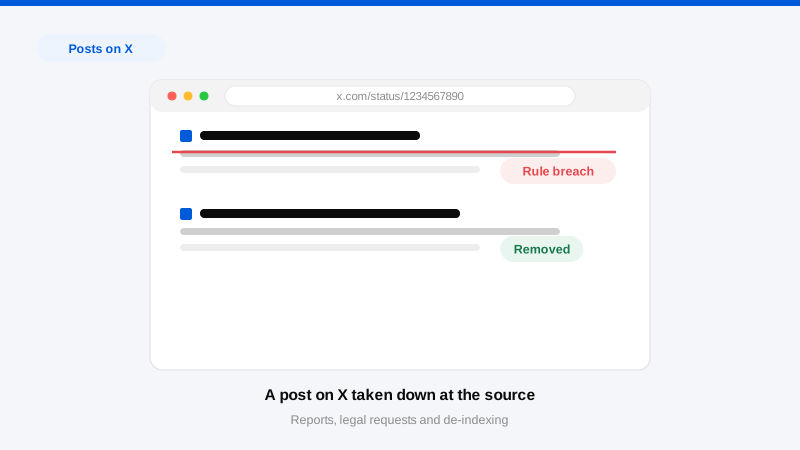
Removing a post from X means getting it deleted at the source under the platform’s rules, withheld in a country through a legal request, or removed from Google so it no longer appears when someone searches your name. Which of the three applies depends entirely on what the post actually says and who wrote it.
Key facts
- X removes content under its own written rules, so a complaint that does not match one of them is closed without a person reading it.
- The private information and media policy covers home addresses, phone numbers, financial account details, identity documents and images of you posted without consent, and it is the most under-used route on the platform.
- Your photograph, artwork or video is protected under Title 17 of the US Copyright Act wherever it has been reposted, whatever the post says about you.
- X can withhold a post inside one country while leaving it visible everywhere else, which is frequently the realistic outcome rather than global deletion.
- Section 230 of the US Communications Decency Act means X is not liable in the United States for what a user posts, so American cases run against the poster or through a court.
- Community Notes are written by contributors rather than by X staff and cannot be removed on request.
- Google indexes X posts and ranks them for personal names, so the search result and the post are two separate problems.
What X will and will not remove
X moderates against its own rules, not against your discomfort. Those rules are narrower than most people expect, and they cover conduct rather than truth: harassment aimed at a person, private information and images published without consent, impersonation, non-consensual intimate media, manipulated media, and material that belongs to someone else.
The private information route is the strongest and the most under-used of those, and copyright is often the fastest thing available because it does not require anybody to agree that the post is unfair. What X will not do is arbitrate whether a criticism of you is fair. An insult, a bad opinion of your business, or a claim you dispute is not, on its own, a rule breach, and no amount of persistence changes that.
Why most reports fail
Almost always for the same reasons, and almost never because the complaint was unjustified. The rule cited does not match the post, so a reviewer checking that rule finds no breach and closes it. The complaint comes from the wrong party, which matters more than people realise. The evidence is a cropped screenshot rather than the post in context. Or the same post is reported fifty times by supporters, which reads to the system as brigading and can protect the post rather than remove it.
A rejected complaint is worse than no complaint, because the item is now marked as reviewed and the next one has to overcome that. This is the main reason we ask clients not to report anything before we have looked.
The legal request route
Separate from the rules, X responds to law. A properly evidenced complaint that content is unlawful in a specific country can result in the post being withheld in that country while remaining visible elsewhere, and for most clients that is the outcome that actually matters, because the audience that damages them is in one or two markets rather than everywhere.
This is country by country work and it is not the same in any two jurisdictions. In the United States, Section 230 means X is not liable for a user’s post, so pressure sits on the poster rather than the platform. Timelines depend on the route and the jurisdiction, and are set out in writing after the free Exposure Scan.
Get a Free, Confidential Exposure Scan
Quote-posts, screenshots and Community Notes
Deleting the original post does not delete the conversation. Quote-posts carry the text of the original in the timeline. Screenshots survive deletion entirely and travel to Instagram, TikTok, Reddit and forums. A Community Note attached to a post is written by contributors, not by X staff, and cannot be removed by request. Where a Note repeats a false factual claim, the route is to address the underlying claim rather than the Note.
This is why the map comes first. The original is rarely the whole matter, and acting on it in isolation usually leaves the copies behind and draws attention to the items nobody can reach.
How we run an X case
We capture everything first, with timestamps, because accounts are deleted and evidence vanishes at exactly the moment it becomes valuable. Then we grade every item honestly, act on every ground that genuinely applies at the same time, and chase the copies rather than only the original: the screenshots on other platforms, the aggregator sites, and any article that has embedded the post.
Search is handled as a separate problem from the platform, because a post that survives but no longer ranks for your name stops being a business problem for most clients. You get the outcome verified in writing: source checked, caches cleared, Google and Bing rechecked. See remove search results.
Google and X posts
X posts are indexed and they rank, particularly for personal names with little other coverage. That is why the search result and the post are two different problems with two different decision makers.
When a post is deleted, the search result usually clears within days once the cache updates. When the post stays up, the URL can often still be taken out of results for a country even though the post itself remains on X. We normally work both, because clients feel the search result far more than they feel the post.
What the platform’s rules and the law actually say
Two systems run side by side and they answer to different things.
The first is the X Rules, a private contract between the platform and its users. Nothing in them obliges X to be fair to you, and nothing in them turns on whether a claim about you is true. They cover conduct, not accuracy, which is the single thing most people get wrong about this platform.
The second is the law of the country where the content does its damage. In England and Wales the Defamation Act 2013 serious harm test governs, and evidence of actual damage is part of any serious file. In the European Union, the Digital Services Act obliges platforms to act on content that is unlawful in a member state and to give reasons for their decisions, and GDPR Article 17 supports removal of personal data from search. Australia added a serious harm element in 2021. In the United States, Section 230 and the actual malice standard for public figures mean the platform is rarely the target at all. Court orders are the strongest instrument everywhere and the slowest.
What we need from you to start
Nothing is needed for the scan. To file, we work from a file rather than a description.
- Live links to the post, the account, the quote-posts and any thread that carries it, plus screenshots people have sent you privately.
- Originals of any photograph, video or written material of yours that has been used, with proof of authorship.
- Records that disprove a specific factual claim, whatever form they take.
- Where private information has been published, a note of exactly which details are yours and which belong to somebody else.
- Written authorization naming who instructs us, usually the principal, a chief of staff, general counsel or an agency partner.
- Anything already sent by anyone else on your behalf, so nothing is duplicated and no item is closed prematurely.
NDA is standard and can be in place before you send a single link.
Timelines and what usually happens first
The first thing that happens is capture, not action. Accounts get deleted, posts get edited, and a matter built on a cropped screenshot is a matter that fails later.
After that, some items resolve in days, country level legal routes run to weeks, and court orders run to months. Where a post is deleted, the search result normally clears within days once the cache refreshes. Those are ranges from experience, not commitments, and you get the realistic one for your matter in writing after the scan.
Common mistakes that make it harder
- Replying to the post. A reply lifts the post in the timeline, feeds the account, and gives a reporter a quote.
- Asking your followers to report it. Coordinated reporting reads as manipulation and can protect the post.
- Reporting it yourself in the first hour. A rejected complaint leaves the item marked as reviewed, which makes a better one harder to land afterwards.
- Deleting your own posts or account. It destroys the context that proves a clip was edited, and it removes your own record of the exchange.
- Paying the account. It confirms the model, funds the next one, and buys nothing you can verify.
- Sending a legal letter with no basis. Letters are routinely published, and the screenshot of your letter usually travels further than the post did.
Working alongside your lawyer, PR team and security team
We are not lawyers and we do not replace them. Where you have counsel, we file the platform, copyright and search routes and hand them the evidence file in a form they can use, so nothing we do cuts across a claim they are preparing. Where a story is forming, we work with your communications people rather than around them, because the decision to say anything in public is theirs and it changes what we should file first. Where there is a security or family office team, they normally hold the addresses, travel patterns and household details that make a private information report succeed. All of it runs under NDA.
Who usually makes first contact and what the 15-minute call covers
First contact is normally a chief of staff, a general counsel or the client’s agency, usually within hours of a post starting to move. The principal rarely makes the call and does not need to.
Fifteen minutes covers what is live, which items look removable and on which ground, what would be needed from you to file, and whether a scan is the right next step at all. Nothing is signed on the call. If your situation is two filings rather than a project, we will say so.
Frequently asked questions
Can I get an X account deleted, not just a post?
Sometimes. Accounts that exist to impersonate you, or whose whole timeline is targeted harassment of one person, do get suspended. A single bad post almost never costs an account, and the pattern is what makes the difference.
Someone posted a screenshot of my private messages. Is that removable?
Often yes. Private information published without consent is one of the stronger positions available on X, and screenshots of documents showing your address, account numbers or identity details are among the faster removals on the platform.
What if the post is true but old?
Truth is a complete defence to defamation almost everywhere, so removal at the source is unlikely and we will tell you so. Where the content is genuinely stale and no longer in the public interest, de-listing from search on your name may be available in Europe and the UK.
How do I handle a false accusation that has been quote-posted hundreds of times?
As a campaign, not as a list of posts. See remove false accusations, which covers the evidence, the sequence and how to handle the press if it follows.
Who normally contacts you about this?
A chief of staff, a general counsel, or the client’s agency, usually within hours of a post starting to move. Everything is under NDA, the 15-minute call can be taken by any of them, and the report is yours to keep.
What does it cost?
Quoted in writing after the free Exposure Scan, per item and per route. Most of what you pay is tied to content actually coming down: see success-based pricing. More on the platform generally at our X and Twitter removal page.
Can you deal with posts in another language or another country?
Yes. The platform’s rules are language neutral, and legal exposure is decided by the country where the damage is done, so a post withheld in one market is a normal outcome. We tell you which countries are worth pursuing rather than pursuing all of them by default.
The account has already deleted the post. Why is it still in Google?
Because the search index and the platform are separate systems with separate timetables. The result usually clears within days once the cache refreshes, and where it lingers there is more that can be done. See remove search results.
If a post about you is climbing, the first hour matters more than the next week. Start with a free, confidential exposure scan: we map the original, the quote-posts and the copies, tell you what is removable on which ground, and show you our process before you commit.