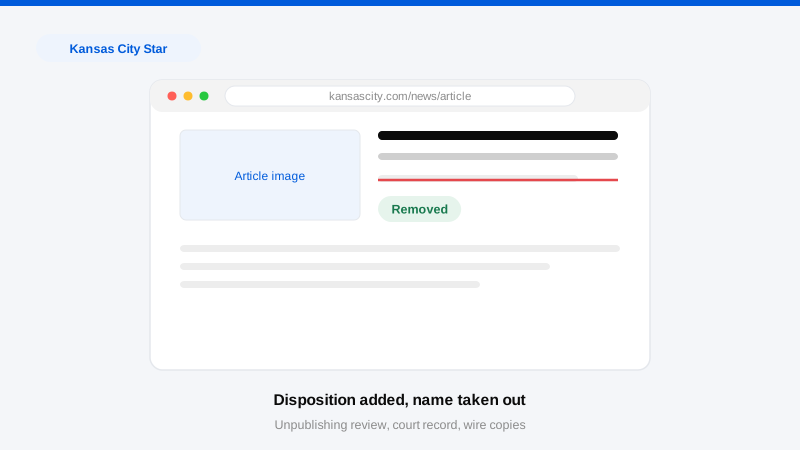
Removing a Kansas City Star article means asking the newspaper to unpublish, correct or update it, or removing the piece from the search results for the name. There is no right to be forgotten in the United States, so any removal is discretionary. Update, name removal, de-indexing and suppression are the realistic outcomes.
Key facts
- The Kansas City Star is the metropolitan daily for Kansas City, owned by McClatchy, one of the larger American newspaper groups.
- Its reporting is shared within that group and picked up by wire services, regional partners and aggregators, so a single court story can sit on several domains with separate search positions.
- The United States has no right to be forgotten, so any removal by an American newspaper is discretionary rather than compelled.
- A number of American newspaper groups have adopted written processes for reviewing requests about older coverage, particularly minor crime coverage, and some have published their thinking about when a name might be removed from an archived story.
- Arrest coverage is indexed permanently and rarely followed up, so the charge is on the record and the dismissal usually is not.
- Missouri and Kansas both provide statutory routes to expunge or seal certain records, and an order changes the official record rather than a newspaper’s archive.
- Section 230 of the Communications Decency Act concerns third party material such as reader comments rather than the newspaper’s own reporting.
- Google will consider removing certain results in defined circumstances, but it does not take down lawful American court reporting because the subject dislikes it.
Who publishes the Kansas City Star?
The Kansas City Star is the metropolitan daily for Kansas City, owned by McClatchy, one of the larger American newspaper groups. Its reporting is shared within that group and picked up by wire services, regional partners and aggregators, so a court story can appear on several domains with different headlines and separate search positions.
The ownership matters because chain owned newspapers tend to operate to written policies rather than to case by case instinct. A number of American newspaper groups have adopted formal processes for handling requests about older coverage, particularly minor crime coverage, and have published their thinking about when a name might be removed from an archived story. Whether and how a specific title applies such a process is something we establish before anything is written, rather than assuming.
Why arrest and court coverage causes the most harm
Arrest coverage is written fast, indexed permanently and almost never followed up. The charge is reported. The dismissal is not. A background check, a lender, a landlord or a board sees a headline about an accusation, and the disposition that cleared the person exists only in a court file nobody searches.
That asymmetry is the whole problem and it is also the opening. An article that reports a charge and never reports the outcome is not false, it is incomplete, and incompleteness is something an editor can act on without conceding that the newspaper did anything wrong. This is by some distance the most productive argument available with an American metropolitan daily.
What is an unpublishing request?
An unpublishing request asks a newspaper to take an article, or a name within an article, out of its live archive. American newsrooms treat their archives as a record of what was reported at the time, so blanket deletion is uncommon. What is available at some titles is a review, and a review can end with the story updated, with the name gone, with the page out of the search results, or with a reasoned refusal that is final for that title.
Which of those you get is decided by evidence rather than by tone, and the difference between a request that succeeds and one that closes the file permanently is judgment about what to ask for. That judgment is the thing worth buying.
Does an expungement force the paper to delete the article?
No. Missouri and Kansas both provide statutory routes to expunge or seal certain records, and an order affects the official record rather than a newspaper’s archive. A publisher is not required to delete a truthful contemporaneous report because a record was later sealed.
It is still one of the strongest documents you can put in front of an editor. It shows the record has formally changed, it establishes that the article no longer reflects the person’s legal position, and it is exactly the kind of evidence a review process is designed to weigh. We are not a law firm, and pursuing the underlying relief is work for your US counsel.
Which route fits which situation?
That depends on the court file, the age of the coverage and how far the story travelled through the wires. Timelines depend on the route and the title, and they are set out in writing after the free Exposure Scan.
Get a Free, Confidential Exposure Scan
How an engagement runs
We start with the record, because without documents this is a letter of complaint and letters of complaint do not move American newsrooms. We establish everything that exists, which in a crime matter usually means wire copies, aggregators and mugshot sites as well as the newspaper. We tell you what can honestly be asked for before you commit, including when the answer is that the article stays and the work belongs in search. Then we pursue every ground that applies, at the newspaper, at the copies and in the results, at the same time rather than one after another. You read the request before it goes, because with an American daily you get one credible approach. What comes back is verified, evidenced to you and monitored. Our overviews of legal removal requests and outdated content explain how that search layer is judged.
What we need from you to start
This route is decided by the court file, so the file is what we ask for first: the case number, the court and county, and whatever official document shows how the matter ended. Where the matter was civil or regulatory rather than criminal, the equivalent paperwork does the same job.
We then ask for the article URL and date, the exact spelling of every name and any variant the paper used, and the URLs of every wire, group and aggregator copy you have already found. Mugshot sites and true crime aggregators go on the same list, because in an American crime matter they frequently outrank the newspaper itself.
Finally we ask what has already been sent, including anything the individual sent personally, and we need written authority to act. A chief of staff, general counsel or agency principal normally signs under a confidentiality agreement, so the person named never has to correspond with the newsroom.
Timelines and what usually happens first
Nothing goes to the newspaper in the first few days. That time is spent on the record and the assessment, because with an American daily you get one credible request and a refusal is close to final for that title.
After that, timelines depend on the route and the title, and you get ranges in writing item by item rather than a single date. We are also explicit, from the start, about the possibility that the newspaper simply declines.
Common mistakes that make it harder
- Asking for deletion first. An unpublishing request refused on the papers ends the conversation, while an update request on the same facts is usually granted, and you cannot make the smaller ask afterwards with the same credibility.
- Sending a legal threat about an accurate court report. It closes the review process and gets the correspondence forwarded to a lawyer who will simply decline.
- Assuming an expungement compels deletion. It does not, and framing a request as though it does invites a refusal on a point of principle rather than a decision on the merits.
- Ignoring the mugshot and true crime copies. They usually rank, they are the ones a background check finds, and clearing the newspaper alone leaves the harm intact.
- Paying a mugshot site to take a listing down. It funds the model, it does not clear the copies elsewhere, and the same photograph reappears on the next site.
- Deleting your own profiles and pages. It removes the material that was ranking usefully and gives the article less competition.
How this works alongside your lawyer, PR team or security team
United States counsel handle the underlying relief. Pursuing an expungement or sealing order in Missouri or Kansas, obtaining certified copies of a disposition, or advising on whether any claim exists at all is their work, and it is often the thing that makes the newspaper request succeed. We run the newsroom request, the wire and aggregator copies, the mugshot sites and the search applications around it. Where the honest reading is that the report is accurate contemporaneous reporting and the paper will not move, we say so at assessment.
With PR advisers the boundary is simple. They own what is said publicly, and in an old criminal matter the right answer is almost always to say nothing. We own what is filed, to whom, on which ground, and what the first page of results shows afterwards, which is what a lender or a board is actually looking at.
With security or background screening advisers the work is complementary. They deal with what the official record shows and how it is reported by screening companies. We deal with what a search engine shows, which is increasingly the version that decides an outcome.
Who contacts us
Frequently a chief of staff, a family office, a founder’s general counsel or the agency handling the account, rather than the person named. The 15-minute call is a working conversation. We look at the article and the record, tell you which outcome is realistic, and say plainly when the answer is that the article will stay and the work belongs in search. Confidentiality and an NDA are standard, and we work alongside counsel, PR and security teams.
We do not promise outcomes. American newspapers are under no obligation to remove lawful reporting, and some requests are refused.
Frequently asked questions
Will the Kansas City Star remove an old arrest story?
Some American titles operate a review process for older coverage of minor matters and some do not, and any removal is discretionary rather than compelled. An update reflecting the disposition, or the removal of a name from an old story, is a far more likely result than deletion of the page.
The charges were dismissed years ago. Is it too late?
Age helps rather than hurts on this route. Older coverage of a matter that ended without conviction, involving someone who is not a public figure, is the strongest category of request there is.
Does Google have to remove it because the record was expunged?
No. There is no right to be forgotten in the United States, and an expungement changes the official record rather than what a search engine shows. There are narrow circumstances in which a result can still be dealt with, and whether yours is one of them is part of what the scan establishes. Beyond those, the search work is suppression.
The story is also on wire sites and mugshot pages. Are those included?
Yes, and they frequently matter more than the original, because they are what a background check finds. They are part of the same project rather than a separate job.
Should our lawyer write instead of you?
Sometimes, but not usually as a first move. A legal threat against an accurate contemporaneous court report tends to end the conversation, while a documented review request keeps it open. Where litigation is genuinely warranted we work alongside your counsel.
What does a name removal actually look like on the page?
Where a title agrees to it, the story normally stays online with the individual’s name and identifying details replaced or removed, so the reporting survives as a record and the page stops ranking for that person. Some titles also add a note explaining that the article was updated under their review process, which is a reasonable trade for ending the search harm.
The article is a wire story that ran in a dozen papers. Where do we start?
With whichever version is actually doing the damage, which is not always the one you were sent. Wire stories multiply, and the copy sitting at the top of a name search is often not the newspaper’s own. The scan establishes that before anything is drafted.
Can you deal with the background check companies as well?
Screening data is a separate discipline governed by its own rules, and where a report is inaccurate that is a matter for your United States counsel and a dispute with the screening company. What we handle is the public search layer: the article, its copies and what a lender, a board or a counterparty sees when they type the name into Google.
Start with a free, confidential Exposure Scan. It maps the article, the wire and aggregator copies, and the full first page for the name, and the report is yours to keep. Our process sets out how an engagement runs.