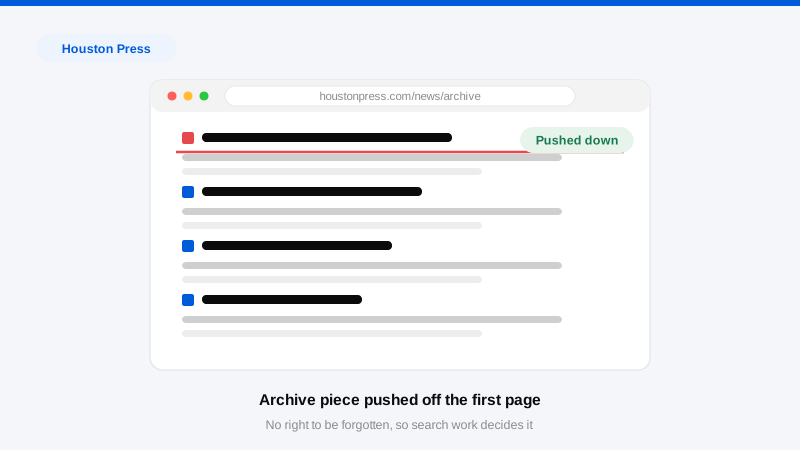
Removing a Houston Press article means persuading the publisher to unpublish, correct or anonymize it, or removing it from the search results for the name. In the United States there is no right to be forgotten, so deletion is discretionary. Correction, name removal, de-indexing and suppression are the realistic outcomes.
Key facts
- The Houston Press is a Houston alternative weekly that now operates as a digital publication, and it is part of Voice Media Group.
- The United States has no right to be forgotten, so there is no statute a private individual can use to compel an American publisher to delete a lawful article.
- The First Amendment protects truthful reporting and opinion, and American courts do not order lawful journalism taken down.
- Section 230 of the Communications Decency Act concerns liability for material posted by third parties, so it bears on reader comments and forum posts rather than on the publication’s own reporting.
- Texas law expects a person who intends to sue over a publication to make a timely request for a correction, clarification or retraction, which makes the correction route part of the legal architecture rather than a courtesy.
- Texas has a well developed statute protecting speech on matters of public concern from meritless litigation, which makes an aggressive opening letter a poor move against a publisher of this kind.
- Alt weekly writing is opinionated by design, and opinion is not correctable in the way a factual assertion is.
- Google will consider removing certain results in defined circumstances, but it does not remove lawful American journalism because the subject dislikes it.
What is the Houston Press today?
The Houston Press is a Houston alternative weekly that now operates as a digital publication rather than a printed paper, and it is part of Voice Media Group, the company that runs several American alt weeklies. Its archive stretches back decades and covers local politics, music, food, crime, courts, activism and the people around all of it.
Two features of an alt weekly matter here. The writing is opinionated by design, which changes what a complaint can realistically achieve, and the archive is deep, cheap to keep online and heavily indexed, so a piece from many years ago about a musician, a restaurateur, a campaigner or a local business owner can still be the first result for that person’s name today.
Why is the archive the actual problem?
An old alt weekly article is rarely read. It is found. A lender, an investor, a board, a school or a journalist searches a name, and a piece written in a completely different context appears above the person’s own website and professional profiles. The article has not changed. The search result has become the whole story.
This is why the honest brief for a US publication is usually about search position rather than deletion. The question is not whether the URL can be erased, but whether it still defines the first page of results in six months.
What does US law give you, and what does it not?
The United States has no right to be forgotten. There is no statute a private individual can use to compel an American publisher to delete a lawful article, and no equivalent of the European erasure right to support a delisting request to Google. The First Amendment protects truthful reporting and opinion, and courts do not order lawful journalism taken down.
Section 230 of the Communications Decency Act is often raised here. It bears on material posted by third parties, such as reader comments and forum posts, rather than on the publication’s own reporting, so it is relevant to what surrounds an article rather than to the article itself.
Texas adds two features worth understanding. State law expects a person who intends to sue over a publication to make a timely request for a correction, clarification or retraction, which means the correction route is not just a courtesy but part of the legal architecture. Texas also has a well developed statute protecting speech on matters of public concern from meritless litigation, which makes an aggressive letter a poor opening move against a publisher of this kind. We are not a law firm, and where litigation is genuinely warranted we work alongside your US counsel.
Which routes are available in practice?
Fewer than in the United Kingdom, and which of them your matter can stand on depends on what the article actually says and what the record shows. Timelines depend on the route and the publisher, and they are set out in writing after the free Exposure Scan.
Get a Free, Confidential Exposure Scan
How we approach a US publisher
We read the article properly first, because fact, opinion, quotation and characterisation are different things and only one of them is correctable. We assemble what the record actually shows, decide what can honestly be asked for, and tell you before you commit, including when the answer is that the piece will stay online. Then we pursue every ground that applies, at the publisher and in the search results, at the same time rather than one after another. You see the wording before anything is sent, because with an American publisher you get one credible approach. What comes back is verified, evidenced to you and monitored. Our overviews of legal removal requests and outdated content cover how the search layer is judged.
What we need from you to start
American editors respond to records, not to characterisations. We ask for the article URL and date, the exact spelling of every name involved, and then whatever documents change the picture the piece paints. If the article reported an accusation that later went nowhere, the paperwork proving that is the single most useful thing you can send us.
We also ask for a marked up copy of the article itself. In an alt weekly piece the distinction between a factual assertion, a quotation from a source, a characterisation and an opinion is the whole strategy, and a request that treats a columnist’s opinion as a correctable error will be refused in a sentence. Going through the piece line by line with you is normally part of the first week.
Where the concern is what surrounds the article rather than the article, we want the comment threads, the forum copies, the reposts and any related coverage. Finally we need written authority to act, normally signed by a chief of staff, general counsel or agency principal under a confidentiality agreement, so the individual never corresponds with the publisher directly.
Timelines and what usually happens first
Nothing is sent in the first few days. That time goes on assessment, because with an American publisher you get one credible approach and a refusal is close to final for that title.
After that, timelines depend on the route and the publisher, and you get ranges in writing item by item rather than a single date. With a United States publisher we are also more explicit than usual about the chance that the source will not move at all.
Common mistakes that make it harder
- Opening with a demand letter. In Texas that is close to the worst available move, given the state’s protections for speech on matters of public concern, and it converts a possible editorial conversation into a defended position.
- Asking for deletion when the facts support a footnote. A refusal sits on the file permanently and the smaller, achievable ask is gone with it.
- Treating opinion as error. A columnist’s characterisation is protected, and disputing it as though it were a factual claim signals that nobody read the piece carefully.
- Contacting the writer. In an alt weekly the writer is frequently a freelancer with no authority over the archive, and the approach reads as pressure.
- Publicly responding. A publication of this kind will write about the response, and the second article is usually worse than the first.
- Deleting your own pages and profiles. It removes evidence of context and takes down assets that were ranking usefully for the name.
- Paying a removal operator who promises deletion. Nobody can deliver deletion of a lawful American article on demand, and the payment buys a receipt.
How this works alongside your lawyer, PR team or security team
Where litigation is genuinely warranted, that is work for United States counsel and we run behind them. In Texas the correction request has a legal dimension as well as a practical one, so the sequencing of an editorial approach and any pre suit step should be agreed with your lawyers before either happens. Where the honest reading is that the article is protected reporting or opinion, we say so at assessment, because that answer is cheaper than a legal opinion that reaches the same conclusion.
With PR advisers the division is clear. They own what is said publicly, and with an alt weekly the right answer is very often to say nothing at all. We own what is filed, to whom, on which ground, and what the first page of results shows afterwards.
With security teams the priority is specific detail rather than the article as a whole. An address, an employer, a family member’s name or an image of a residence can sometimes be removed from a piece that is otherwise staying online, and those requests are made first and separately.
Who this is written for
Most enquiries about an American alt weekly come from a chief of staff, a family office, a founder’s general counsel or a PR agency acting for the person named. The 15-minute call is a working conversation. We look at the article, separate what is correctable from what is protected opinion, and tell you honestly when the answer is that the piece will stay online and the work belongs in search. Confidentiality and an NDA are standard, and we work alongside counsel, PR and security teams.
We do not promise outcomes. American publications are under no obligation to remove lawful articles, some will not engage at all, and any firm suggesting otherwise is describing suppression under a different name.
Frequently asked questions
Can a Houston Press article be deleted?
Only if the publisher chooses to delete it. There is no US legal mechanism to compel removal of lawful journalism, so an unpublication depends entirely on editorial discretion, usually where the piece was wrong or where the subject’s circumstances have changed materially.
The article is about charges that were dropped. Does that help?
It is the strongest realistic argument available in the United States. An article that reported an arrest and never reported the dismissal is incomplete, and many American newsrooms now review older crime coverage on exactly that basis. Court documents do the work.
What about the comments under the article?
Comments are third party content and are usually handled under the publisher’s own moderation policy rather than as part of the article. They are frequently more damaging than the piece itself and are often easier to get removed.
Can Google remove it if the publisher will not?
Not on right to be forgotten grounds, because that right does not exist in the United States. There are narrow circumstances in which a search result can be dealt with even though the article stays online, and whether yours is one of them is part of what the scan establishes. Beyond those, the search work is suppression, and we say so plainly.
Is suppression just hiding the problem?
It is changing what a searcher actually sees, which is the harm being complained of. We label it as suppression rather than removal, we say when it is the only honest option, and we never sell it as a takedown.
Does a Texas retraction request have to be sent before we do anything else?
It is a step the state’s framework expects of someone who intends to sue, and whether it applies to your situation is a question for your United States counsel. What matters practically is that a correction request is not merely polite in Texas, so it should be drafted properly and sequenced with any legal step rather than fired off first and repaired later.
The publisher has changed hands over the years. Does the old article still belong to them?
The current owner of the domain controls the live archive, whoever published the piece originally, so that is who the request goes to. Ownership history sometimes helps, because a newsroom that inherited an archive has less institutional attachment to a story written by people who left long ago.
Can anything be done about copies on other alt weeklies or aggregators?
Yes, and they are handled as part of the same project rather than as a separate job. Copies often clear faster than the original, because there is no editorial attachment sitting behind them.
Start with a free, confidential Exposure Scan. It maps the article, its copies and the full first page for the name, and the written report is yours to keep whether or not you engage us. Our process explains what happens next.