
To suppress negative brand content you have to treat it as a legal and search visibility problem at once: classify each item as defamation, leaked material, fake reviews or lawful criticism, pursue removal and de-indexing first where a legal route exists, then run a structured suppression campaign that replaces the weakest page-one results with credible assets while monitoring for reuploads.
Key facts
- 68% of brands using SEO-only methods saw negatives resurface within six months, versus 92% permanence for legal de-indexing.
- Rank the threat by host authority, backlink support and syndication before spending.
- Take the weakest page-one slot first, then publish on domains that already carry ranking power.
- Keep a case file per item: URL history, evidence package, action log and search status.
Where ContentRemoval.com comes in. ContentRemoval.com runs the integrated version of this work for companies and their leaders: source removal, search de-indexing, suppression against vulnerable page-one positions and monitoring for reposts under one command structure. Marketing directors, general counsel and the agencies already retained by the brand usually initiate contact. A free 15-minute Exposure Scan maps what is removable and what needs suppression, and the report is theirs to keep. Get a Free, Confidential Exposure Scan or read how our news article removal work is done.
A damaging article is ranking for your brand name. A former employee has posted allegations. A fake review campaign is spreading across search, maps, and niche directories. Investors, partners, candidates, and journalists are all doing the same thing first. They’re searching your name or company.
That’s the crisis.
Most clients reach out after trying the wrong fix first. They hired a PR shop to “shift the narrative.” They asked internal marketing to publish a few blog posts. They sent a takedown email with no legal theory behind it. None of that is enough when the content is indexed, syndicated, and attached to a branded search term that matters commercially.
If you need to suppress negative brand content, treat it as a legal and search visibility problem at the same time. Handle only one side and you leave the door open for the damage to return.
Understanding the urgency of negative brand content
The first mistake is assuming time will dilute the problem. It usually does the opposite.
When negative content starts ranking for a branded search, it becomes part of your due diligence file. Prospective investors see it. Lenders see it. Journalists see it. Opposing counsel sees it. So do spouses, board members, and family offices conducting discreet background checks.
Why delay makes the matter harder
Most reputation guides overstate the value of SEO “burying” and understate the need for permanent de-indexing where the facts allow it. That is backwards. A 2025 study cited by Entrepreneur says 68% of brands using SEO-only methods saw negatives resurface within 6 months, while legal de-indexing under GDPR and US right-to-be-forgotten laws achieved 92% permanence (Entrepreneur coverage of burying bad press tactics).
That single contrast should change how you think about response strategy. If your matter has a valid legal path, take it early. Don’t treat legal review as an optional add-on after months of failed content marketing.
Practical rule: If a harmful result is removable, pursue removal first. If it’s lawful but damaging, suppress it aggressively while building a record for future de-indexing options.
What high-stakes clients usually get wrong
Executives under pressure often focus on what upset them most, not what causes the most lasting harm. The ugly forum thread may feel personal. The trade publication article that ranks subtly may be far more dangerous because institutional readers trust it.
Prioritize based on exposure and permanence. Ask three questions immediately:
- Who sees it first: branded searchers, journalists, counterparties, regulators, or current customers.
- Where it sits: page one, image search, autosuggest, video results, or a low-visibility archive.
- Whether it can be removed: platform policy, privacy law, copyright, defamation, or search de-indexing rights.
A slow response signals weakness. A fragmented response wastes an advantage. The correct approach is immediate evidence preservation, legal assessment, and parallel suppression planning.
Assessing incidents and prioritizing responses
Not all negative content deserves the same response. Some material should trigger counsel and preservation notices within hours. Other items should be routed into structured suppression and monitoring without escalating publicly.
Sort the content by legal posture
Start with classification. Don’t begin with emotion.
Use this incident framework:
- Defamation and false factual claims: Statements presented as fact that are false and harmful. These need a legal review first, not a marketing reply.
- Leaked media or private material: Intimate content, internal recordings, private photos, identity documents, or doxxing. These often justify urgent platform escalation and search de-indexing requests.
- False reviews and impersonation: Reviews from non-customers, coordinated spam, fake executive accounts, cloned sites, or fraudulent profiles. These are platform and evidence cases.
- Editorial criticism and lawful commentary: Harsh opinion, investigative reporting, and unfavorable but lawful coverage. These usually require suppression, not removal, unless they cross into privacy or factual falsity.
Then assess ranking power
A negative result matters more when it has staying power. That staying power usually comes from one of three conditions: host authority, backlink support, or syndication.
A practical triage review should examine:
| Risk factor | What to check | Why it matters |
|---|---|---|
| Host authority | Is the content on a major news, government, review, or established industry domain? | Strong domains are harder to displace and often retain search visibility |
| Backlink profile | Are other sites linking to the negative page? | Links can keep weak content ranking longer than expected |
| Syndication | Has the same article, claim, or press item been copied elsewhere? | One incident can become many indexed problems |
Priority should follow consequence, not annoyance
A review with little visibility may be ugly but manageable. A leaked PDF indexed under an executive’s name is different. So is an article that appears during a financing process or active litigation.
Use a simple response hierarchy.
Tier one matters
These justify immediate action and a coordinated legal-search response:
- Active privacy exposure: home address, contact details, leaked media, family identifiers.
- Live transactional harm: content appearing in branded searches during fundraising, M&A, hiring, or customer procurement.
- Litigation sensitivity: publications that could affect settlement posture, witness credibility, or public narrative around an ongoing case.
Tier two matters
These require structured remediation but not always emergency escalation:
- High-ranking criticism on authority domains
- Review attacks concentrated on a key local or product page
- Outdated allegations that continue to rank because no stronger brand assets exist
Tier three matters
These still need tracking, but not every low-authority complaint deserves immediate spend. A mature operator distinguishes between searchable risk and mere irritation.
The best early decision is often negative triage, not action. If a page has little visibility, no syndication, and no legal angle, overreacting can give it oxygen.
Match the incident to the right lane
Once classified, route the item into one primary lane and one secondary lane.
- Primary legal lane: defamation, privacy, copyright, impersonation, extortionate removal practices.
- Primary suppression lane: lawful criticism, negative press, old commentary, weak but persistent search results.
- Secondary monitoring lane: anything likely to reappear, spread, or trigger follow-on posts.
For executives and family offices, discretion matters as much as speed. Loud complaints to publishers often harden positions. Better practice is to preserve evidence, assess jurisdiction, identify the strongest pressure point, and then act through the most effective channel first.
Executing removal and suppression tactics
A damaging result is ranking for your brand name. A journalist, investor, customer, or opposing counsel searches it before speaking to you. That is the moment this work becomes operational, not theoretical.
Run removal and suppression together, but do not treat them as equal tracks. If the content is legally vulnerable, lead with de-indexing and source removal because that is the only route that can produce lasting disappearance. If the content is lawful and likely to stay up, shift resources to suppression while legal review continues in the background.
Start with removal before you publish anything
Publishing first is a common mistake. It burns budget, signals panic, and leaves the harmful source intact.
If the page includes private data, impersonation, copyright infringement, fabricated claims presented as fact, or policy violations, move immediately through the removal channels that fit the record. The goal is to eliminate the source, cut it out of search where possible, and reduce replication risk before mirrors and summaries spread.
Typical channels include:
- Publisher outreach grounded in law or policy: a concise demand, clear exhibits, and a specific remedy
- Platform reports: fake profiles, review manipulation, impersonation, and non-consensual content
- DMCA notices: unauthorized use of protected text, images, video, or other original work
- Search engine legal requests: privacy removals, court-order support, and other qualified de-indexing grounds
If you need a practical sequence, this step-by-step guide to remove negative content from Google search is useful because it separates source removal from search de-indexing instead of blurring them into one bucket.
Treat page one as the actual battleground
Deletion is not always available. Search visibility still is.
Reputation X notes that users overwhelmingly stay on page one of Google results, which is why suppression succeeds or fails on ranking control, not on broad claims about “cleaning up the internet” (Reputation X on suppressing negative results).
That changes how you allocate effort. Legal work without search planning leaves copied versions, cached references, and secondary commentary in circulation. SEO work without a removability review leaves the strongest remedy untouched.
Use the right tactic for the right risk
The decision should turn on three factors. Can the content be removed. How much ranking authority does the negative URL have. How costly is resurfacing if it comes back later.
| Method | Durability | Resurfacing Risk | Typical Timeline |
|---|---|---|---|
| Legal de-indexing | High when supported by facts, policy, or court process | Lower than SEO-only campaigns because the result is removed from search rather than pushed down | Depends on platform response, jurisdiction, and evidence quality |
| SEO-only suppression | Moderate if the campaign is maintained | Higher, especially when the negative page sits on a strong domain or gains fresh links | Ongoing |
| Source takedown | Highest when granted and not mirrored elsewhere | Depends on reposting, syndication, and scraper activity | Varies by publisher, host, and policy basis |
| Hybrid removal plus suppression | Strongest practical approach in high-stakes matters | Lower because both visibility and source persistence are addressed at once | Fastest path to visible improvement |
The same cited data discussed earlier supports the core point. Legal de-indexing is more permanent than suppression alone. That should shape the order of operations, especially for executives, regulated businesses, and clients dealing with litigation exposure.
Suppression fails when marketing improvises
In-house marketing teams without search strategy experience often sabotage suppression by publishing thin press releases, generic “about” pages, and filler blog posts that have no ranking target.
Suppression should be built like a search campaign with legal constraints. Each asset needs a query target, a ranking reason, and a job to do on page one. Use different result types on purpose: corporate pages, executive bios, social profiles, interviews, contributed articles, videos, directory listings, and reference-style content that can win branded searches.
For teams that need a clearer model for how search intent, content format, and commercial priorities fit together, a revenue-driven playbook for SEO B2B marketing is a useful reference. The lesson here is not industry-specific. Search performance improves when each page is built for a defined query and a defined outcome.
Lead with suppression in the right cases
Some content is damaging, lawful, and slow to move. Major news coverage, archived commentary, and opinion pieces often fall into that category.
In those matters, stop trying to overpower the strongest negative result on day one. Push out the weakest page-one position first. Once a neutral or positive asset replaces that slot, the rest of the stack becomes easier to move.
Three rules usually decide whether suppression works:
Take the weakest page-one slot first
A thin directory result, an outdated article, or a low-value listing is often the first opening. Replace that result and you start shifting the entire branded SERP.
Publish on domains that already have ranking power
Third-party authority often outranks a new standalone microsite. Use outside platforms selectively, and only with material worth ranking.
Match the specificity of the attack
If the negative result alleges poor service, weak leadership, or questionable conduct, do not answer with slogans. Answer with named expertise, verified achievements, detailed service pages, interviews, speaking profiles, and fact-based articles.
Specific criticism beats generic praise. Your response has to be more useful than the negative result, not merely more flattering.
One command structure produces better outcomes
Fragmented response creates avoidable loss. Legal sends an aggressive notice. PR drafts a soft public statement. Marketing publishes unrelated SEO content. Nobody is working from the same search map.
Use one operating plan:
- Preserve the record: every harmful URL, screenshot, cache, image result, and syndicated copy
- Classify the remedy: takedown, de-indexing, suppression, or monitoring
- File removal requests first: with evidence attached and escalation paths ready
- Launch suppression assets against vulnerable page-one positions
- Track reposts, rank movement, and copied content so legal and search work reinforce each other
ContentRemoval.com handles source removal, de-indexing, and monitoring workflows for harmful material across search engines, websites, and social platforms. In high-risk matters, that integrated setup is more useful than splitting the job between a notice sender and a content vendor who never addresses permanence.
Creating positive assets to displace negatives
Suppression fails when the replacement content is weak. It succeeds when every positive or neutral asset is built to outrank, absorb branded searches, and hold position.

Build from ranking logic, not brand vanity
The most effective suppression campaigns follow a structured framework: analyze what gives the negative page ranking power, target weaker page-one results first, and then publish strategic content on high-authority platforms using Google’s E-E-A-T principles (Manchester Digital on suppressing negative Google content).
That means every asset should answer four questions before publication:
- Which branded query is this page targeting
- Why should Google trust this author or domain
- What search result is this asset intended to replace
- What evidence makes the page worth ranking
The asset stack that usually works
You need a portfolio, not one hero page.
Owned assets
These are controllable and should be strengthened first:
- Executive bio pages: not résumé fluff. Include board roles, media appearances, subject matter expertise, and clear authorship.
- Corporate leadership pages: useful when an executive and company name are searched together.
- Resource pages and FAQs: when the negative narrative has repeated accusations that can be answered factually and calmly.
Third-party assets
These are often necessary because trust is borrowed from the host domain:
- Contributed articles
- Expert interviews
- Podcast features
- Industry profiles and association pages
Rich media assets
Search results aren’t only text links. Use videos, executive interviews, image-rich explainers, and slide-style visual assets where the branded query can support them.
Match the content type to the attack
A weak response often comes from choosing the wrong format.
| Negative narrative | Better asset type | Why it helps |
|---|---|---|
| “The company mishandled clients” | Detailed case study or client outcome narrative | Specific proof beats generic claims |
| “The executive lacks credibility” | Expert interview, authored analysis, speaking profile | Establishes authority through visible expertise |
| “The brand is secretive or evasive” | Transparent FAQ, newsroom page, leadership statement | Gives searchers a controlled factual reference |
| “The incident defines the brand” | Broader body of brand and leadership content | Expands the searchable narrative beyond the incident |
Tone matters more than most teams realize
Many brands worsen suppression efforts by filling pages with defensive language. That tends to perform badly with both users and search engines.
A more effective approach is calm, factual, and positively framed. There’s a conversion reason for that. A 2021 Unbounce Conversion Benchmark Report discussed by Managing Editor found that negative language correlated with lower conversion rates despite higher traffic in several sectors (Managing Editor on positivity and conversion rates). The lesson for reputation work is straightforward. Don’t build your replacement narrative around outrage, fear, or attacks on others. Build it around evidence, credibility, and outcomes.
Strong suppression content doesn’t sound defensive. It sounds authoritative.
A practical publishing sequence
Use a sequence that compounds authority instead of scattering effort.
- Refresh what you already own. Fix title tags, authorship, page structure, and internal linking on executive and corporate pages.
- Publish one cornerstone branded asset. This could be a leadership profile or a detailed brand overview page.
- Add supporting third-party pieces. Interviews, contributed articles, and association listings.
- Layer in media formats. Video and image-bearing assets can occupy additional search surfaces.
- Support with links and citations. Relevant backlinks and interlinking help the new stack mature.
The point isn’t volume alone. The point is to create a credible search ecosystem that steadily pushes weaker page-one results out of position.
Setting up monitoring and preventing reuploads
Suppression without monitoring is temporary. Removal without monitoring is wishful thinking.
Once harmful content comes down or drops in rankings, assume someone may repost it, mirror it, or summarize it on another platform. That risk is highest when the original material was sensational, commercially motivated, or part of a coordinated attack.

Monitor the assets that actually matter
Start with a watchlist, not a vague brand alert.
Your watchlist should include:
- Branded search terms: company name, executive names, and the obvious negative variants.
- Exact-match URLs: every harmful page removed, de-indexed, or suppressed.
- Image and video fingerprints: especially for leaked media and reused screenshots.
- Known hostile domains and profiles: forums, review sites, social accounts, and copycat publishers.
The monitor should trigger action, not just notifications. That means routing findings to legal, communications, and search teams with a preset response path.
Build an escalation ladder
Not every alert deserves the same response.
Immediate escalation
Use this for privacy violations, reuploaded media, impersonation, and fresh indexing of previously removed material. The first response should be evidence capture, followed by platform action and, where appropriate, renewed search de-indexing.
Managed response
Use this for criticism, reposted commentary, or low-visibility forum mentions. These may not justify emergency legal effort, but they should feed into the suppression queue and be watched for ranking movement.
Archive only
Low-authority duplicates with no indexation and no traction can be logged and reviewed later.
Centralize evidence and history
If you don’t keep records, you lose speed on the second incident.
Maintain a clean case file for each harmful item:
| Record type | What to store | Why it matters |
|---|---|---|
| URL history | Original link, mirrors, archive copies, platform IDs | Helps detect repost patterns |
| Evidence package | Screenshots, dates, text captures, account details | Speeds repeat takedowns |
| Action log | Notices sent, responses received, deadlines, outcomes | Prevents duplicated effort |
| Search status | Indexed, de-indexed, suppressed, resurfaced | Supports search-side escalation |
A monitoring service should also identify unusual new mentions before they become page-one problems. That includes social reposts, review bursts, and repeated publication themes around the same allegation.
For teams that need a structured service layer rather than ad hoc alerts, this overview of reputation monitoring is the right kind of framework because it ties detection to response rather than stopping at “brand listening.”
A repost caught early is a nuisance. A repost left alone can become the next ranking problem.
Preventive controls reduce future cost
The cleanest reputation matters are the ones that never get traction.
That means reviewing who controls old brand profiles, consolidating dormant executive pages, tightening ownership of media libraries, and making sure official sites rank strongly for branded terms before the next incident hits. Prevention doesn’t eliminate attacks. It makes them less searchable and easier to neutralize.
Mapping timelines risks and action plans
Clients usually ask one question first. How long will this take?
The honest answer is that different parts of the campaign move at different speeds. A platform may remove an obvious impersonation profile quickly. A publisher may resist. A search engine may process a legal request on one timeline and a suppression campaign will mature on another.
What affects timing
Three variables decide most timelines.
Jurisdiction
Privacy and de-indexing rights differ by region. The legal basis that works in one market may not exist in another. Cross-border publication complicates service, enforcement, and search visibility.
Evidence quality
Weak screenshots, incomplete authorship records, and unsupported claims slow everything down. Strong proof speeds publisher review, platform action, and legal escalation.
Search volatility
Search rankings move. That can help or hurt. If your positive assets are stronger than the weak page-one results they target, volatility creates openings. If your suppression stack is thin, the negative result can rebound.
Compare the phases realistically
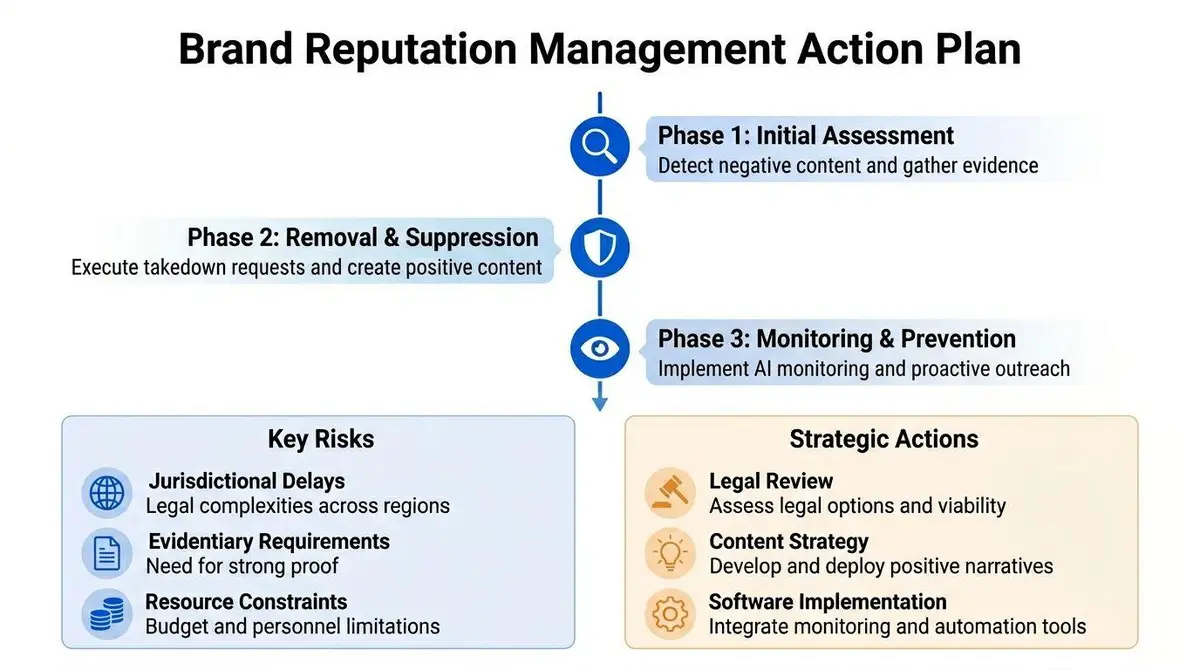
| Phase | Primary deliverables | Common risk | Likely pattern |
|---|---|---|---|
| Initial assessment | URL map, evidence pack, legal review, ranking analysis | Misclassification of the content | Fast if the client has records, slower if evidence is fragmented |
| Removal and suppression | Takedown notices, de-indexing requests, publication of replacement assets | Publisher refusal, weak legal basis, poor content quality | Mixed pace, some items move quickly while others require persistence |
| Monitoring and prevention | Alerts, reupload detection, response rules, asset maintenance | Complacency after initial wins | Ongoing and essential if the matter is adversarial |
Three action plans by client profile
Different clients need different sequencing. A public company executive should not respond the same way as a private family office principal or a consumer brand facing mass review abuse.
Public executive facing defamation
The first move is evidence preservation and outside legal review. Don’t let the executive post a personal rebuttal. Don’t let the PR team freelance.
Initial deliverables should include a complete URL and syndication map, a statement of factual falsity, search screenshots for branded queries, and a request strategy for publishers and platforms. Suppression starts immediately, but it should be built around executive credibility assets, not generic corporate pages.
Escalation triggers include continued republication, new journalist pickup, and use of the allegations in social clips or newsletters.
High-net-worth individual fighting leaked media
This is privacy-first, not PR-first.
Secure copies of the material, identify hosting infrastructure and social spread, and route the matter into urgent takedown and de-indexing channels. Simultaneously, harden branded search results with neutral and authoritative profile assets so searchers encounter controlled references rather than gossip surfaces.
Escalate if mirrors appear, if the material shifts into image search, or if family identifiers begin appearing with the content.
Brand under mass negative review attack
Begin with pattern analysis. Are the reviews fake, coordinated, geographically inconsistent, or tied to a triggering event? That determines whether you’re dealing with review fraud, a real service issue, or a blend of both.
The immediate plan should separate removable reviews from those requiring response. Then strengthen the review profile with lawful customer outreach, improve branded search assets, and suppress secondary complaint pages that are capitalizing on the review wave.
Escalate if fake reviewer accounts multiply, if the reviews migrate across platforms, or if journalists start citing the review pattern as evidence of business misconduct.
Risk management should be written down
Most reputation failures aren’t caused by bad intent. They’re caused by improvisation.
Write a response memo that assigns owners, response thresholds, approval rules, and escalation points. Decide in advance who approves legal notices, who speaks externally, who reviews new assets, and who has authority to act on nights and weekends when something resurfaces.
That discipline is what keeps a contained incident from turning into a recurring reputation problem.
Conclusion and next steps with a professional partner
To suppress negative brand content properly, you need five things working together: accurate triage, valid legal removal routes, disciplined search suppression, credible positive assets, and monitoring that catches reposts before they regain traction. Most internal teams can handle one or two of those. High-stakes matters require all five.
If you’re evaluating outside help, start with a framework built for executives and sensitive cases, not a generic marketing package. This guide to evaluating professional content removal services for executives is a practical starting point.
If harmful search results are affecting deals, reputation, privacy, or influence, act before the record hardens. ContentRemoval.com begins with a confidential assessment, builds a customized action plan, and can start initial action within 24 to 48 hours for qualifying matters.
Frequently asked questions
Should I remove or bury negative content about my brand?
Remove first if the content is legally vulnerable, since de-indexing and source takedown are the only routes that produce lasting disappearance. Bury lawful but damaging content with suppression while legal review continues. In high-stakes matters the hybrid approach gives the fastest visible improvement.
Why do negative search results come back after an SEO campaign?
SEO-only suppression leaves the source live, so fresh links, syndication or a lull in publishing can let the page rebound. The cited 2025 study found 68% of brands using SEO-only methods saw negatives resurface within six months.
What kind of content pushes down a negative article about a company?
Assets built for a specific branded query with a reason to rank: substantive executive bios, leadership pages, contributed articles, expert interviews, podcast features, association pages and video. Match the format to the allegation and keep the tone factual rather than defensive.