
Solicitor online reputation management is the governance of a law firm’s search results, reviews, profiles and hostile mentions under the constraints of confidentiality and professional duty. It starts with a footprint audit of firm and partner names, moves to a review protocol that never debates facts in public, builds owned assets to hold page one, and escalates false allegations.
Key facts
- 57% of law firm clients discover their solicitors through search engines.
- Firms with more than 50 Google reviews see a 50% ranking boost and 266% higher click-through rates.
- Audit firm names, individual solicitors and modifiers like complaint, negligence, scam and misconduct.
- Specialist firms can begin global de-indexing and source removal within 24 to 48 hours.
Where ContentRemoval.com comes in. ContentRemoval.com works with law firms on the matters a public reply cannot fix: fabricated reviews, anonymous allegation blogs, leaked documents, impersonation and content hosted outside the UK. The managing partner, COLP or the firm’s own litigation head usually makes the approach, often after evidence has already been preserved. A free 15-minute Exposure Scan maps what is removable across platforms and jurisdictions, and the report is theirs to keep. Get a Free, Confidential Exposure Scan or read how our reputation management work is done.
A managing partner usually notices the problem late. A prospective client says they “saw something online.” A recruit goes quiet after final interview. A long-settled complaint appears in search results beside your firm name. A hostile review accuses a solicitor of misconduct, and the instinctive reply would breach confidentiality if published.
That isn’t a marketing issue. It’s a risk issue.
Solicitor online reputation management sits at the junction of client acquisition, regulatory judgment, partner reputation, staff retention, and litigation exposure. If your firm still treats it as a matter for junior marketing staff or an outsourced SEO vendor, you’re leaving a professional vulnerability unguarded. The firms that manage this well build trust before the first call. The firms that ignore it end up responding under pressure, with fewer options and worse facts.
Your Digital Reputation is a Professional Liability
Clients don’t form their first impression in reception. They form it on Google.
That matters because 57% of law firm clients discover their solicitors through search engines, and the wider online reputation management market was valued at $175 million in 2022 and is projected to reach $585 million by 2030. Firms with more than 50 Google reviews also see a 50% boost in search rankings and a 266% increase in click-through rates, according to online reputation management statistics for legal services.
For a solicitor, those figures aren’t about vanity. They point to a hard commercial reality. Search visibility affects which firm gets shortlisted, which individual fee earner gets trusted, and which practice looks stable enough to handle sensitive work.
Why solicitors face a sharper problem
A restaurant can answer a bad review with a discount voucher and move on. A solicitor can’t. Your responses are constrained by professional duties, by confidentiality, by privilege concerns, and by the possibility that the reviewer is a former client, an opposing party, a vexatious complainant, or someone who was never a client at all.
That’s why generic reputation advice often fails legal practices. It assumes the target can respond freely, disclose context, and argue in public. You can’t do that safely.
Practical rule: If a public reply would make sense for a retail brand, it probably needs rewriting before a law firm publishes it.
The other problem is that legal professionals attract a particular kind of online hostility. Allegations are often framed to sound factual. Anonymous posters exploit forum threads, complaint sites, low-quality blogs, and social channels because they know solicitors are more cautious than most professionals about answering publicly. Silence then gets misread as admission.
Compliance sits underneath the reputational issue
For solicitors, reputation management also intersects with professional standards. A careless review response can expose client information. An overenthusiastic testimonial campaign can create avoidable compliance questions. An unmanaged staff profile can contain inaccurate practice claims, out-of-date role descriptions, or misleading historic content.
A managing partner should treat digital reputation the same way they treat conflicts, file security, and complaints handling. It needs policy, ownership, escalation, and audit.
Here’s the blunt position. If your firm only starts taking solicitor online reputation management seriously once a defamatory review ranks on page one, you’re already operating from a weakened position. Search results don’t just reflect reputation. They actively shape it.
Executing a Comprehensive Digital Footprint Audit
Most firms begin with an ego search. That’s insufficient.
A proper audit maps every asset you control, every profile you’ve neglected, and every hostile mention you don’t yet understand. The point isn’t to collect screenshots. The point is to identify where trust is being built, where it’s leaking away, and where an attacker would strike first.

Start with named entities, not just the firm homepage
Run the audit across these categories:
- Firm identities: Your firm name, trading names, historic names, merged firm names, and common misspellings.
- Individual solicitor identities: Partners, senior associates, practice heads, and any lawyer whose name is likely to be searched independently.
- Service-line searches: Terms such as family solicitor, commercial litigation solicitor, employment solicitor, and location-based combinations.
- Reputation-sensitive modifiers: Search combinations with words like review, complaint, negligence, scam, disciplinary, fraud, and misconduct.
Use Google in normal search, image search, news search, and video search. Then inspect Google Business Profile, LinkedIn, The Law Society listing, legal directories, review sites, company profiles, social platforms, and forum mentions. Include old microsites, event pages, webinar pages, and press release archives. Those often rank long after the firm has forgotten them.
Audit for inconsistency before you audit for attacks
In many firms, the first weakness isn’t defamation. It’s disorder.
A partner’s bio says one thing on the website, another on LinkedIn, and something outdated on a directory page. Office addresses differ. Old phone numbers remain indexed. Review profiles exist but aren’t claimed. Practice descriptions are thin, duplicated, or written without reference to how clients search.
That inconsistency creates two problems. It weakens trust with prospective clients, and it gives search engines mixed signals about which assets deserve visibility.
A serious audit should log:
- Ownership status of every listing and profile
- Accuracy of name, address, phone, website, and service information
- Review status including volume, recency, sentiment, and unresolved complaints
- Ranking position for branded and solicitor-specific searches
- Legal risk flags such as impersonation, false allegations, leaked personal data, or copied content
Don’t clean this up manually in scattered spreadsheets if the footprint is large. Centralise it and assign a responsible owner.
For firms dealing with legacy exposure, partner-level vulnerabilities, or inaccurate search results spread across multiple platforms, a structured digital footprint cleanup assessment is usually the fastest way to establish what’s live and what needs escalation.
Set monitoring before you start fixing
An audit without monitoring goes stale quickly.
Set up alerts for the firm name, partner names, office locations, and key complaint-related search strings. Track reviews and mentions across Google, major social channels, legal directories, and discussion boards. The goal is early warning. You want to know when a post appears, not after it’s indexed, copied, and discussed elsewhere.
A useful working document for the managing partner is a simple priority matrix:
| Issue type | Typical example | Risk level | Immediate action |
|---|---|---|---|
| Accuracy issue | Wrong office details on a directory | Medium | Correct and standardise |
| Reputation issue | Critical but genuine review | High | Respond under protocol |
| Legal issue | False allegation presented as fact | Severe | Preserve evidence and escalate |
| Privacy issue | Personal data leak or doxing | Severe | Takedown and containment |
In such situations, solicitor online reputation management becomes operational. You stop reacting to isolated incidents and start governing a digital estate.
The Playbook for Review and Feedback Management
Reviews are the most visible reputation layer for most firms, and the worst place to improvise.
A review profile full of silence, stale comments, and unanswered criticism signals neglect. A profile with disciplined responses and a steady flow of authentic feedback signals control. That difference shows up both in client perception and in search performance. According to guidance on how UK law firms can improve online visibility through review management, ethical review requests sent within 24 hours of a positive case milestone generate 3x higher response rates, and firms that respond to all feedback within 24 hours see 3x better sentiment recovery and 78% higher consumer trust. The same source notes that more than 50 Google reviews can lift search rankings by 50% and click-through rates by 266%.
Ask at the right moment or don’t ask at all
The worst review systems are clumsy, apologetic, and inconsistent. They ask every client at random, often long after the matter has ended, and they leave review generation to individual fee earners who already have too much to do.
Use a defined trigger. Good moments include successful completion of a transaction, conclusion of a dispute on favourable terms, or receipt of direct client thanks. The request should be short, neutral, and easy to complete. Email works. SMS often works better. What matters is timing and simplicity.
Use language that invites honest feedback without coaching the client. Don’t pressure. Don’t filter in a way that creates platform risk. Don’t ask a client to mention confidential facts.
Separate criticism from abuse
Not every negative review is defamatory. Some are legitimate dissatisfaction. Some are misunderstandings. Some are posted by non-clients. Your protocol must classify before it responds.
A practical internal triage looks like this:
- Service criticism: The reviewer appears genuine and describes dissatisfaction. Handle as a service response.
- Factually false allegation: The post makes a false factual claim likely to damage reputation. Preserve evidence and assess takedown options.
- Identity uncertainty: You can’t verify the reviewer as a client or contact. Respond carefully without confirming any relationship.
- Abusive or threatening content: Capture evidence and escalate quickly.
A bad review is not the emergency. An unmanaged bad review is.
Use response templates that protect the firm
Solicitors get into trouble when they try to “set the record straight” in public. You don’t need to win the argument. You need to show professionalism to everyone else reading.
For a genuine but negative review, a safe public structure is:
- Acknowledge the concern: “We’re sorry to read that you were unhappy with your experience.”
- Avoid factual debate in public: “We take client concerns seriously and don’t discuss matter details in a public forum.”
- Move the discussion offline: “Please contact our client care team so we can review your concerns directly.”
For a review from an unverified person:
- State the limitation calmly: “We can’t identify this reviewer from the information provided.”
- Preserve confidentiality: “For professional reasons, we won’t comment on any individual matter here.”
- Invite direct contact: “If this relates to a genuine interaction with the firm, please contact us so we can investigate.”
For positive reviews, don’t waste the opportunity. Thank the reviewer, stay concise, and avoid embellishment that could create confidentiality issues.
Governance matters more than tone
The system should sit with named owners, not goodwill. Marketing can coordinate. Client care can advise. Compliance should sign off templates. Fee earners should know when not to reply.
Use a short internal rule set:
- No solicitor replies from a personal account.
- No public discussion of facts, timelines, or advice given.
- All suspicious reviews are preserved by screenshot before any challenge is made.
- Reputationally serious posts are escalated, not argued with.
Review management is one of the few parts of solicitor online reputation management where speed and restraint have to coexist. Most firms are poor at one of those. The firms that protect themselves get both right.
Building a Proactive Digital Defense Strategy
If your first-page search results are weak, you’re inviting trouble.
A proactive defense strategy builds a controlled search environment around the firm, the brand, and key individuals. The right model here is PESO. Paid, Earned, Shared, and Owned media. Not because it sounds neat, but because it forces the firm to stop relying on one asset, usually the homepage, to carry the entire reputation burden.

According to analysis of advanced online reputation management using the PESO model, multi-platform monitoring can detect 90% of negative mentions before they go viral, while schema-enhanced listings and video testimonials can lift authenticity by 40%. The same source ties proactive management and review accumulation to a 266% gain in click-through rates and a 93% uplift in customer satisfaction.
Owned media must carry more of the load
Most firms underinvest in assets they fully control. Your website bios should be strong enough to rank for solicitor names. They should be written for search intent, not internal vanity. A bio should clearly state role, jurisdiction, services, recognitions, office location, and contact pathway. The same principle applies to service pages, office pages, FAQ pages, and author profiles.
LinkedIn also matters. So do claimed profiles on major legal and business directories. These aren’t side issues. They’re part of the first page.
Three owned assets deserve immediate attention:
- Partner bios: They should be current, substantial, and internally linked from relevant practice pages.
- Firm knowledge content: FAQs, commentary, and explainers help occupy branded search space with authoritative pages.
- Structured listings: Claimed and optimised profiles support trust signals and visibility.
If your team needs persistent visibility across reviews, mentions, and branded search volatility, use a dedicated reputation monitoring workflow rather than ad hoc checking.
Earned and shared media create insulation
A digital moat isn’t built by publishing more blog posts no one reads. It’s built by earning citations and mentions that carry authority.
That means placing partner commentary in credible publications, contributing informed legal insights, speaking on podcasts or panels that generate indexable profiles, and distributing commentary through channels where your clients and referrers focus their attention. Shared media then amplifies those assets. LinkedIn is often the obvious platform for solicitors, but its primary value comes from consistency and relevance, not volume.
A short explainer can strengthen the point:
Suppression is not deletion, but it works
Many managing partners ask the wrong question. They ask, “Can we remove it?” Sometimes the smarter question is, “Can we outrank it?”
Suppression works by building stronger, more relevant, more authoritative assets that occupy the search results where harmful content would otherwise sit. For branded queries, this can be highly effective when done systematically. It’s especially useful where the content is unpleasant but not clearly removable.
The first page of Google is contested space. If you don’t occupy it with your own assets, someone else will.
A good defense strategy doesn’t replace takedown work. It supports it. While legal and technical teams handle actionable content, your controlled assets should keep building. That’s how firms reduce exposure over time instead of living incident to incident.
Advanced Strategies for Content Takedown and Removal
Some content can be answered. Some can be outranked. Some needs removing.
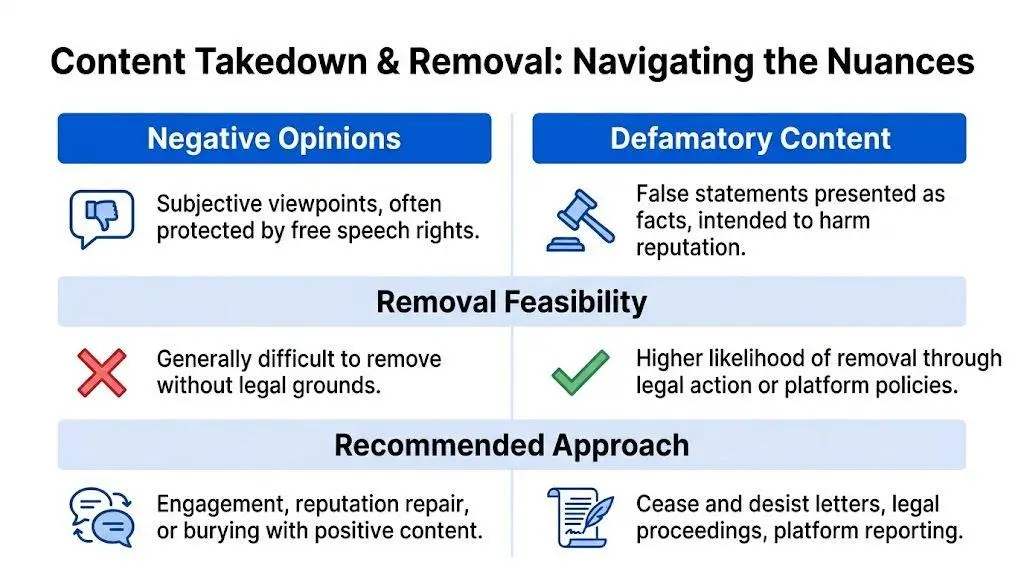
The mistake many firms make is treating all harmful content as one category. It isn’t. There’s a legal and practical difference between a negative opinion and a defamatory statement. There’s also a difference between a source removal, a search de-indexing request, a platform policy complaint, and a court-backed identification process.
The first question is whether the content is actionable
A harsh opinion is usually difficult to remove unless it crosses into another legal or policy breach. A false factual allegation, privacy breach, impersonation, doxing event, copyright violation, or unauthorised disclosure creates a different route.
Many SEO agencies and generalist PR firms often fail solicitors. They know how to encourage reviews and publish positive content. They don’t know how to preserve evidence, frame a legally coherent notice, approach a platform under the right policy basis, coordinate across jurisdictions, or decide whether a public response will prejudice later action.
A solicitor should assess harmful content under four headings:
- Truth status: Is it opinion, or a false statement presented as fact?
- Jurisdiction: Where is the publisher, host, platform, and affected firm?
- Policy basis: Does the content breach platform rules, privacy standards, copyright, or impersonation rules?
- Risk profile: Is this merely embarrassing, or does it threaten clients, staff, regulatory standing, or personal safety?
Conventional legal action is often too slow on its own
Domestic legal remedies remain important, especially where identification of an anonymous publisher is required or repeated publication continues. But court action isn’t always the fastest first move, particularly where the immediate priority is stopping indexing, limiting spread, and removing duplicated copies across platforms.
That’s why cross-border coordination matters. Legal commentary on reputation management for law firms highlights a major gap around defamatory content across international jurisdictions, notes that specialist firms can begin de-indexing and source removal actions globally within 24-48 hours, and refers to a 25% rise in dark web threats against legal professionals. For solicitors facing anonymous blogs, leaked documents, or coordinated attacks, speed and discretion matter more than theatre.
Preserve first, act second. Save URLs, screenshots, timestamps, account names, and cached versions before issuing complaints.
A useful escalation path may involve platform reporting, search de-indexing requests, solicitor-led legal correspondence, and targeted technical suppression running in parallel. In some matters, a specialist provider such as ContentRemoval.com’s strategic guide for victims of online defamation can support evidence-led removal workflows where standard PR activity won’t resolve the risk.
Content Removal Options Compared
| Approach | Speed | Cost | Success Rate (Defamation) | Best For |
|---|---|---|---|---|
| Public response only | Fast to publish | Low | Variable | Genuine criticism, visible professionalism |
| Platform complaint | Often relatively fast | Low to medium | Stronger when policy breach is clear | Fake reviews, impersonation, privacy breaches |
| Solicitor cease-and-desist letter | Moderate | Medium | Stronger where facts and rights are clear | Defamation, harassment, repeated publication |
| Court-backed action | Slower | High | Potentially strong in serious cases | Anonymous publishers, persistent campaigns |
| Search de-indexing and source removal strategy | Can begin quickly | Medium to high | Case-dependent | Cross-platform spread, urgent containment, international exposure |
Don’t confuse visibility reduction with resolution
Even where a page is de-indexed, the source may remain live. Even where a source is removed, copies may persist elsewhere. Even where one platform complies, another may not. That’s why serious solicitor online reputation management has to combine legal reasoning, platform process, and ongoing monitoring.
Removal is not a single act. It’s a sequence.
Establishing a Reputational Crisis Response Protocol
A reputational crisis is different from a bad review. It’s broader, faster, and more chaotic. Think data exposure, a coordinated online allegation campaign, viral press attention, leaked internal material, or a social media narrative that starts moving before the firm has checked the facts.
If you build the response plan during the incident, you’ve already lost time you won’t get back.
Decide who is in charge before the crisis starts
Every firm needs a small crisis cell with named authority. That usually includes managing partner, COLP or compliance lead, external or internal legal lead, communications lead, IT or security lead, and a decision-maker for client communications. One person must have final authority on public statements. If five people can approve a response, no one is in charge.
The protocol should define:
- Activation threshold: What kinds of events trigger the crisis process
- Chain of command: Who decides, who advises, who signs off
- Evidence handling: Who captures and stores digital evidence
- External coordination: Which outside counsel, forensic, PR, or takedown specialists are pre-cleared
Prepare language before you need it
You don’t need a full statement for every possible event. You do need approved holding language that buys time without sounding evasive. The first statement should usually confirm awareness, acknowledge seriousness, and avoid speculation.
You also need internal language. Staff will see the issue online and draw their own conclusions if leadership stays silent. A short internal briefing reduces panic and cuts the risk of freelancers, trainees, or administrators replying from personal accounts.

Rehearse the protocol like a live file risk
Most firms test cybersecurity. Very few test reputational response. They should.
Run scenarios. Anonymous allegation against a partner. Data leak affecting client confidentiality. A former employee posts documents on social media. A hostile article names the firm and begins ranking for branded searches. Test who gets called, who approves wording, how evidence is stored, and who monitors spread across search and social.
“We’ll deal with it if it happens” is not a plan. It’s a delay strategy.
A crisis protocol is only useful if it produces immediate action in the first hours. That requires pre-approved roles, pre-drafted language, and an external support list that doesn’t need to be assembled under fire.
Frequently Asked Questions for UK Solicitors
Can we respond to a negative review if the reviewer was a client
Yes, but the safer answer is that you should respond narrowly. Don’t confirm retainer details, don’t discuss advice, and don’t try to rebut allegations point by point in public. A restrained response that acknowledges the concern and invites offline contact usually protects the firm better than a detailed defence.
Should we threaten legal action against every false review
No. Overuse of legal threats creates its own reputational problem and can harden the position of a platform or publisher. First classify the content properly. If it’s unverified, abusive, fabricated, or part of a wider attack, preserve evidence and choose the route that fits the facts. Sometimes that’s a platform complaint. Sometimes it’s solicitor correspondence. Sometimes it’s a coordinated removal strategy.
What if the content is hosted outside the UK
That’s common, and it’s one reason generic domestic advice falls short. You may be dealing with a publisher in one country, hosting in another, and search visibility in the UK. The correct approach often combines jurisdiction-specific legal analysis with platform or search-engine process. Treat it as a cross-border matter from the outset, not a local complaint with a foreign address.
Are positive reviews enough to fix a damaged reputation
No. Reviews help. They don’t solve privacy breaches, anonymous smear sites, impersonation, leaked documents, or copied allegations across multiple domains. Review building is one layer of defence. It isn’t a substitute for monitoring, takedown capability, and crisis planning.
Should individual partners manage their own online reputation
Not independently. Partners can contribute to profile quality, thought leadership, and review requests, but the firm should govern the framework. Otherwise you get inconsistent messaging, unmanaged risk, and avoidable compliance mistakes.
When should a firm bring in outside help
Bring in outside help when the issue involves legal exposure, anonymity, international elements, sustained publication, privacy harm, or search visibility that ordinary marketing work can’t fix. Those cases need specialist handling. Delay usually means wider indexing, more screenshots, and more copies.
If your firm is dealing with false reviews, anonymous allegations, leaked material, impersonation, or cross-border reputational harm, ContentRemoval.com can assess the issue confidentially and map out a removal and containment strategy. The value is speed, evidence-led process, and coordination across platforms and jurisdictions when conventional PR or a standard legal letter won’t solve the problem.