
Restaurant online reputation management is asset protection rather than guest relations. It requires a single monitoring intake across Google, Yelp, TripAdvisor, OpenTable and social channels, triage by business risk rather than tone, a fixed response protocol that avoids public admissions, strong listings that crowd out hostile results, and an escalation ladder for defamatory, fake or coordinated content.
Key facts
- Critical-priority content includes defamation, impersonation, fake reviews, coordinated attacks, safety allegations and extortion.
- A cited analysis says Google and Yelp remove only 10 to 20% of user-flagged fake reviews.
- Collect shift logs, reservation records, POS data and staff statements the same day for any high-risk allegation.
- Never post guest records publicly to prove a reviewer wrong, and never threaten litigation without counsel’s approval.
Where ContentRemoval.com comes in. ContentRemoval.com steps in when a restaurant group’s own reporting has failed: fake review clusters, false contamination or discrimination allegations, impersonation and search results costing covers are handled through platform escalation, legal notices, DMCA requests for stolen images and de-indexing, with one spokesperson kept in place. Operations leaders, in-house counsel and franchise owners usually make contact. A free 15-minute Exposure Scan maps what is removable, and the report is yours to keep. Get a Free, Confidential Exposure Scan or read how our reputation management work is done.
You notice the problem in operations first. Covers are soft on a Friday. Direct bookings slow down. The dining room still looks sharp, the menu hasn’t changed, and your labor cost isn’t the culprit. Then someone checks Google, Yelp, TripAdvisor, OpenTable, Instagram comments, and a local food thread. A cluster of bad reviews has become the first thing customers see.
That isn’t a marketing annoyance. It’s a revenue event.
Most restaurant online reputation management advice is unserious. It treats public criticism as a tone problem. It tells you to be gracious, thank people for feedback, and move on. That helps with ordinary complaints. It does nothing when a false allegation starts ranking for your brand, a fake reviewer attacks multiple locations, or a defamatory post begins shaping search results before dinner service. At that point, you’re not managing sentiment. You’re protecting an asset.
Your Reputation Is Your Revenue
The executive mistake is simple. Operators still treat reviews as downstream noise, something for the GM or social media coordinator to handle after service. Customers don’t see it that way. They often make the decision before they ever speak to your staff, before they open Resy, and before they read your menu.

The financial consequences are blunt. Research summarized here states that a single one-star increase in a restaurant’s Yelp rating can generate a 5-9% increase in revenue. The same source notes that one negative article online can cause a restaurant to lose up to 22% of potential customers, and 94% of diners say an online review has convinced them to avoid a restaurant.
Why executives misread the threat
A bad quarter rarely arrives with a label saying “digital reputation failure.” It shows up as lower reservation velocity, weaker conversion from branded search, more price sensitivity, and reduced confidence from first-time diners. The internet has already judged you before your host stand gets a chance.
If you want a cleaner picture of how diners evaluate venues, publications that track destination dining trends such as Food Escapes are useful because they show how restaurants are filtered through discovery, aesthetics, and experience long before the guest arrives. That is exactly how reputational risk works. The public doesn’t separate food quality, search visibility, review sentiment, and brand trust into neat internal departments. They experience one composite signal.
Reputation sits on the income statement whether your finance team labels it there or not.
Treat it like asset protection
The practical implication is that restaurant online reputation management belongs in risk management, not just guest relations. A rating swing affects demand. A defamatory search result affects customer acquisition. A persistent false narrative affects enterprise value if you’re operating multiple locations, courting investors, or negotiating leases.
That is why cost discussions around online harm need to be strategic rather than cosmetic. A useful framework appears in this strategic cost analysis of online reputation management, which approaches the issue as a business exposure problem rather than a branding exercise.
Your task is not to “look responsive.” Your task is to control what prospective diners see, reduce exposure to false and harmful content, and make sure digital trust doesn’t become the hidden reason tables stay empty.
Establishing a Monitoring and Triage System
Friday, 7:12 p.m. A six-location group gets hit with three posts in 20 minutes. One Yelp review claims food poisoning. One Google review accuses a manager of discrimination. One Instagram story says your flagship is “unsafe” and tags a local reporter. If those alerts reach three different people, or worse, nobody with authority, you have already lost time you will not get back.
A monitoring system exists to reduce exposure, preserve evidence, and route decisions to the right level fast. Yelp checks and scattered platform logins do none of that. You need a single intake point, a named owner, documented severity rules, and an escalation path that reaches operations, legal, and leadership without delay.
Build the command center
Use one queue for reviews, listings activity, social mentions, and search-result alerts. Pull Google, Yelp, TripAdvisor, OpenTable, Instagram, Facebook, TikTok, Reddit, and local forum mentions into the same operating view. Separate inboxes create blind spots. Blind spots create slow, inconsistent decisions.
Monitoring tools should do four things well: collect mentions across platforms, flag defined risk terms, preserve screenshots and timestamps, and assign cases by severity. Fancy dashboards are irrelevant if a fabricated safety allegation sits untagged until morning. As noted earlier, InMoment’s methodology describes daily multi-platform monitoring and a triage model. The point is sound. Detection failures usually come first.
Set the ownership model before the next incident, not during it.
A monitoring operation should include:
- Unified intake: Route reviews, social posts, listing changes, and search-result anomalies into one queue so corporate sees the same issue the location sees.
- Risk-term alerts: Flag terms tied to legal and revenue exposure, including food poisoning claims, discrimination allegations, fraud accusations, hygiene complaints, wage issues, threats, and staff misconduct.
- Evidence capture: Save the original post, account name, URL, timestamp, screenshots, and any edits. If you need platform removal or legal escalation later, missing documentation will hurt you.
- Decision rights: Assign one person to triage, one person to approve public responses, and one senior owner for legal escalation. Shared ownership is delayed ownership.
- Local fact collection: Require the GM or area leader to gather shift logs, reservation records, POS data, camera availability, and staff statements on the same day for any high-risk allegation.
If your team does not yet have that structure, use a formal reputation monitoring workflow for high-risk review environments and adapt it to your operating chart.
Triage by threat, not tone
The hard rule is simple. Classify by business risk, not by how offensive the post feels.
A one-star review about slow service may sting, but it rarely creates legal exposure. A false accusation of assault, contamination, discrimination, wage theft, or criminal conduct is a different class of problem. It can trigger search visibility issues, regulator attention, press interest, copycat posts, and platform persistence long after the facts are disproven.
Use a triage model like this:
| Priority level | What it includes | Required action |
|---|---|---|
| Critical | Defamation, impersonation, fake reviews, coordinated attacks, safety allegations, extortion attempts | Freeze evidence, escalate immediately to legal or specialist review, restrict public reply until facts are confirmed |
| High | Detailed negative reviews on high-visibility platforms, media mentions, influencer complaints, repeated allegations across locations | Public holding response if needed, same-day internal fact check, leadership visibility |
| Moderate | Neutral reviews, vague dissatisfaction, service critiques, isolated complaints without serious allegations | Standard response workflow and local operational follow-up |
| Low | Positive reviews, duplicate praise, low-visibility mentions with no operational signal | Acknowledge selectively and track trend data |
Many restaurant groups get this wrong in predictable ways. They spend executive time arguing with rude reviewers, then treat a false criminal allegation like an ordinary service complaint. That is how a customer service issue turns into an asset protection failure.
Your system should also define trigger points that bypass normal review handling. Allegations involving health, discrimination, assault, extortion, employee misconduct, minors, or fabricated events belong in an escalation lane immediately. Those cases are not reputation “engagement.” They are risk events.
Executing a Strategic Review Response Protocol
Friday night. A one-star post goes live accusing your staff of discrimination, theft, and unsafe food handling. The GM wants to fire back. Corporate wants to offer a gift card. Both instincts are wrong. Public review responses are part of incident control, and a bad reply can create admissions, extend the life of a false claim, and make takedown efforts harder.
Speed matters, but discipline matters more. As noted earlier, top operators respond faster and more consistently than the average restaurant. That gap is not about courtesy. It is about controlling the public record before a complaint hardens into accepted fact.
Set a response protocol that your field teams cannot improvise around. Every review should move through a fixed decision path: verify the facts, classify the risk, choose the objective, approve the language, then post or escalate. If a location manager is writing emotional replies from a phone between service periods, you do not have a protocol. You have exposure.
What a good response actually does
A strong response does four things at once. It shows the business is attentive. It protects legal and operational flexibility. It avoids admissions before the facts are confirmed. It moves legitimate service recovery into a private channel where you can solve the problem without performing it in public.
Keep the public statement narrow. Confirm as little as possible. Promise a review of the issue, not a conclusion.
Use AI for drafting if you want speed and consistency. Do not let AI publish autonomously. Centralized review is the control point. Brand tone matters. Liability control matters more.
Strategic Review Response Matrix
| Review Type | Objective | Response Structure |
|---|---|---|
| Factually incorrect negative review | Preserve credibility without conceding false facts | Acknowledge the concern, state that the account does not match available records if true, invite direct contact, avoid debating point by point |
| Legitimate service failure | Contain damage and show corrective action | Thank them for raising it, apologize for the experience, note that the issue is under internal review, offer private follow-up |
| Neutral or mixed review | Convert uncertainty into trust | Acknowledge the positive point, address the weak point briefly, invite a return visit |
| Strong positive review | Reinforce loyalty and social proof | Thank them specifically, reference the dish or experience they mentioned, keep it short and human |
Language you should actually use
For a legitimate service issue:
“We’re sorry your visit fell short. This is below our operating standard. Please contact us directly so we can review the details and address it properly.”
For a review that appears false or misattributed:
“We take feedback seriously and reviewed your comments carefully. We have not been able to confirm the visit details described here. Please contact us directly so we can investigate further.”
For a mixed review:
“Thank you for the candid feedback. We’re glad you enjoyed the food and sorry service did not meet expectations. We’ve shared this with the team and welcome the chance to provide a better experience on your next visit.”
These examples do real work. They do not admit unverified facts. They do not offer compensation in public. They do not invite a long argument that keeps the allegation visible.
One more rule. Never let the reviewer set the frame if the accusation carries legal risk. A post alleging contamination, assault, discrimination, wage theft, or criminal conduct is not a standard review. It is a potential evidence issue. Your public response, if you issue one at all, should be drafted with the same care you would apply to a statement to a regulator, reporter, or plaintiff’s lawyer.
When not to respond
Some reviews should not receive a public reply at all. Abusive content, impersonation, fabricated events, extortion threats, and coordinated attacks often deserve evidence preservation and platform escalation first. A public response can validate the post, improve its visibility, and create language that will be used against you later.
Silence is sometimes the disciplined move. Document the content. Capture screenshots and URLs. Preserve timestamps. Route the matter to the escalation lane, then decide whether the right next step is a limited public statement, a platform report, counsel review, or all three.
Optimizing Digital Listings for Proactive Defense
A weak listing profile creates room for harmful content to dominate. A strong listing profile compresses that room. That is why local search hygiene is part of restaurant online reputation management, not a separate marketing project.
When a customer searches your restaurant, you want search results filled with assets you control or can influence. That means your Google Business Profile, your website, your menu pages, reservation profiles, high-quality imagery, and accurate directory entries should occupy as much branded search real estate as possible. If those assets are neglected, a negative review thread or hostile article can gain disproportionate prominence.
Defensive listing strategy
Start with consistency. Your name, address, phone number, hours, reservation links, and menu URL must match across every major platform. Inconsistency doesn’t just frustrate diners. It creates friction, and friction produces suspicion. Suspicion makes negative content more believable.
Then strengthen the profiles themselves:
- Complete every field: Incomplete profiles look abandoned. Abandoned profiles invite doubt.
- Use professional imagery: Guests judge the room, plating, and atmosphere before they judge the meal.
- Update hours and service modes: Wrong holiday hours generate avoidable anger and public complaints.
- Control reservation destinations: Make sure Google, Apple Maps, Yelp, and directory listings direct customers to the right booking path.
- Audit third-party data: Delivery apps, old directory entries, and stale menu pages often carry errors that customers blame on you.
Build a digital moat
This isn’t about vanity. It is about ranking pressure and narrative control. A complete digital footprint gives search engines and consumers more verified material to surface. That lowers the chance that one hostile result becomes the dominant brand story.
If your own listings are thin, the internet will fill the gap for you. Usually with content you don’t like.
The executive view should be simple. Every unmanaged listing is an unsecured entrance. Every incomplete profile is an invitation for confusion. Every outdated photo or broken link weakens credibility at the exact point a diner is deciding whether to trust you.
The restaurants that weather isolated criticism best are not always the ones with the fewest complaints. They are often the ones with the strongest controlled presence. Their digital assets are current, visually credible, and operationally precise. When criticism appears, it lands inside a larger ecosystem of trust instead of defining it.
Crisis Management and Defamation Escalation
Most advice fails here because most advisors stop at “flag the review and respond professionally.” That is inadequate when the content is false, malicious, or coordinated. A defamatory review is not a hospitality issue. It is a hostile publication event.
You need to distinguish protected opinion from actionable falsehood. “Service was slow” is opinion. “This restaurant gave me food poisoning and failed a health inspection last week” may be actionable if false. “The owner steals credit card data” is not a normal review dispute. It is a statement of alleged fact with serious consequences.
Why platform flagging often fails
The hard truth is that native platform processes are limited. This analysis of fake review vulnerabilities states that platforms such as Google and Yelp remove only 10-20% of user-flagged fakes. The same source says 15-30% of all restaurant reviews are suspected to be fraudulent, and that specialized services can achieve 70-90% removal rates for defamatory content by using legal channels and escalation methods that standard guides ignore.
That should reset your expectations. If your plan is “we reported it and now we wait,” your plan is weak.
Responding to a defamatory review is a tactical error; removing it is a strategic victory.
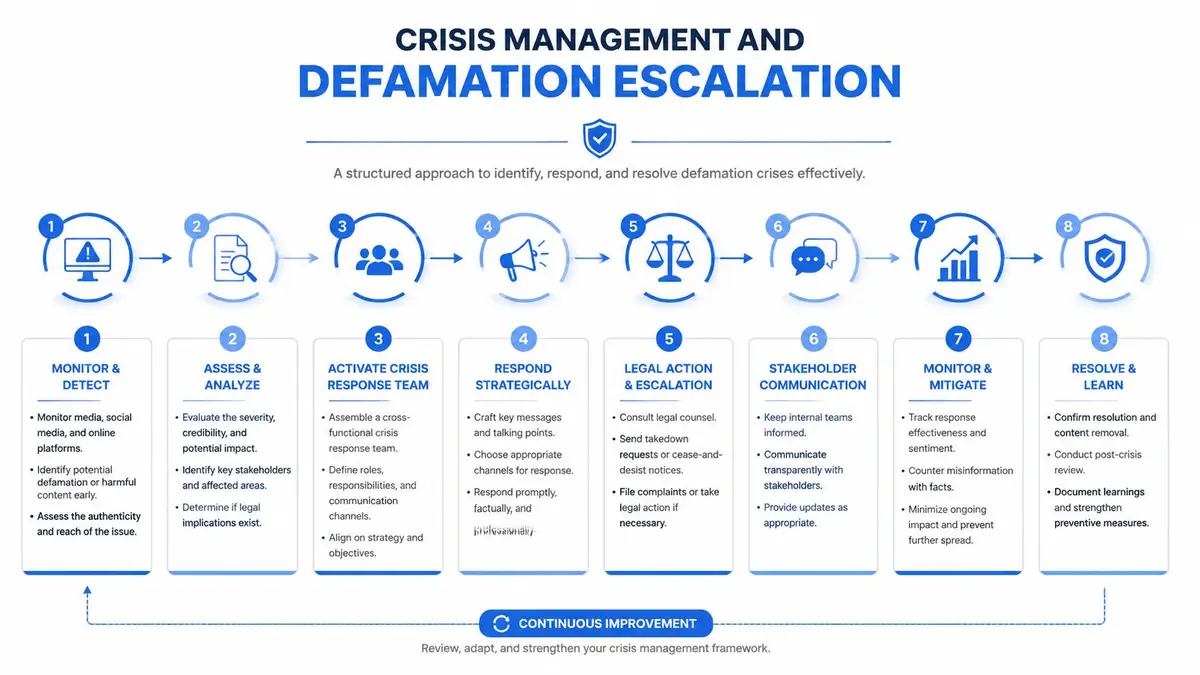
The escalation ladder
Use a structured decision process. Not every harmful review justifies outside intervention, but many deserve more than a canned reply.
- Preserve evidence first. Capture screenshots, URLs, timestamps, reviewer profiles, and any linked content before anything changes.
- Verify the factual record. Check POS data, reservation logs, staff schedules, CCTV retention rules, incident reports, and prior guest communications.
- Classify the content. Is it opinion, a factual error, impersonation, extortion, or coordinated abuse?
- Choose the remedy. Platform report, formal legal notice, defamation complaint, DMCA request for stolen images, de-indexing request, or direct publisher outreach.
- Control internal communication. One spokesperson. No freelance responses from managers or franchisees.
When legal escalation is justified
Escalation is warranted when the post alleges criminality, fraud, contamination, discrimination, abuse, or other concrete misconduct without factual basis. It is also justified when fake reviews appear in clusters, when a former employee or competitor is implicated, or when the content begins ranking prominently for your brand terms.
At that point, the issue has moved beyond review management into removal strategy. The relevant skill set is no longer hospitality etiquette. It is evidence handling, platform policy fluency, legal framing, and search result suppression when removal is delayed.
A practical reference for this posture appears in this guide to removing defamation from the internet, which approaches harmful content as a strategic threat requiring jurisdiction-specific tactics.
What not to do in a live attack
Do not threaten litigation publicly unless counsel has approved that step. Do not post guest records to “prove” the reviewer is lying. Do not let a junior social media manager engage in a factual argument about health, safety, or criminal allegations, and do not confuse visibility with validity. Harmful content can be false and still rank well.
A smart executive treats false online attacks the way they would treat theft, extortion, or brand sabotage. The issue is containment first, removal second, and prevention of recurrence after that.
Measuring Performance and Embedding Prevention
If your scorecard stops at average star rating, you’re under-managing the problem. Ratings matter, but they are lagging indicators. The stronger question is whether your reputation program is reducing volatility, improving conversion, and exposing operational weaknesses before customers turn them into public complaints.
What the leadership team should watch
The dashboard should combine public signals with internal operating data. Track review velocity by platform. Track recurring sentiment themes by location. Track branded search results manually so you know what a first-time diner sees. Track booking patterns after review spikes, especially after clusters of criticism.
Keep the dashboard tight:
- Review velocity: Are reviews arriving in a normal pattern, or did a sudden burst suggest an incident or attack?
- Theme concentration: Are multiple guests pointing to the same dish, shift, manager, or service bottleneck?
- Search result quality: What appears on page one for your brand, your chef, and your flagship locations?
- Resolution rate: Which complaints were solved privately, and which kept escalating publicly?
The best reputation metric is not praise. It’s fewer preventable surprises.
Turn feedback into operational prevention
Competent operators separate themselves from performative responders through these specific actions. Public reviews often expose internal process failures long before formal reporting does. If guests repeatedly mention delayed seating, indifferent hosts, billing confusion, or allergy handling concerns, don’t draft prettier responses. Fix the process.
Use review data in leadership meetings the same way you’d use labor variance or food cost exceptions. Assign ownership. Set a corrective action. Then audit whether the complaint category declines. When online feedback loops into training, staffing, menu execution, and service design, reputation management becomes prevention rather than cleanup.
A disciplined restaurant group will also maintain a standing escalation protocol for outlier events. The ordinary review workflow should exist alongside a crisis workflow. Different teams, different approvals, different response rules.
The point is straightforward. You are not trying to win the internet. You are trying to reduce reputational drag on revenue, defend the brand against false and damaging content, and build operations that generate fewer legitimate complaints in the first place.
If your restaurant group is dealing with fake reviews, defamatory allegations, impersonation, or search results that are actively costing you customers, ContentRemoval.com provides confidential, legally grounded intervention built for high-stakes reputation threats. The firm handles takedowns, de-indexing, defamation removal, and ongoing monitoring with the discretion executives need when standard platform reporting has failed.
Frequently asked questions
Why does flagging a fake review on Google or Yelp usually fail?
Native platform processes are limited, and the article cites removal of only 10 to 20% of user-flagged fakes. Reports that succeed are built on preserved evidence, verified records and the correct policy basis, and serious matters often need legal framing or specialist escalation beyond the standard form.
How should a restaurant respond to a review alleging food poisoning or discrimination?
Treat it as a risk event, not a review. Freeze evidence, pull records the same day, restrict any public reply until facts are confirmed, and draft whatever you do say with the care you would apply to a regulator or reporter. Confirm as little as possible and promise a review of the issue rather than a conclusion.
How can strong listings protect a restaurant from negative reviews?
When Google Business Profile, your website, menu pages, reservation profiles and directory entries are complete, consistent and current, they occupy branded search real estate and leave less room for a hostile thread or article to dominate. Thin or abandoned listings invite doubt and let the internet fill the gap.