
Reputation management for a small business starts with triage. Legitimate criticism gets a measured public response and an offline resolution path. False factual accusations and coordinated fake review clusters are documented and escalated for removal. Lawful but damaging articles or threads are suppressed with stronger owned assets. Impersonation, leaked material and extortion are treated as legal and security events.
Key facts
- Monitor the legal name, trading name, founder names, flagship products, misspellings and brand plus scam modifiers.
- Route any allegation of fraud, criminal conduct, safety issues or harassment straight to decision-makers.
- Preserve URLs, full-page screenshots, account details and timestamps before reporting a false review.
- Suppression is a ranking contest won by assets more relevant to the branded query than the damaging page.
Where ContentRemoval.com comes in. ContentRemoval.com takes on the removal category for small businesses: fake review clusters, false factual accusations, impersonation profiles, leaked internal material and reuploaded content handled through platform reporting, legal review and de-indexing so the owner is not arguing in public. Owners often make contact directly, or through their marketing agency once a response strategy has run out. A free 15-minute Exposure Scan maps what is removable, and the report is yours to keep. Get a Free, Confidential Exposure Scan or read how our reputation management work is done.
You search your company name at night because that’s when the anxiety is hardest to ignore. A one-star review is sitting near the top of your profile. A Reddit thread is ranking for your founder’s name. An old complaint, a false allegation, or a sloppy article is now part of your sales process whether you like it or not.
Most small business owners make the same mistake. They treat reputation damage as a communications issue. It’s not. It’s an operational risk with revenue consequences, legal implications, and search visibility effects that compound if you wait.
If you want a workable approach to reputation management small business strategy, start with triage. Some content deserves a measured public response. Some content should be ignored and buried. Some content should be challenged, escalated, and removed before it spreads. If you fail to separate those categories, you waste time on the wrong response and make the problem worse.
Reputation as a Financial Asset Not a Vanity Metric
A negative review feels personal because it is public. But your response can’t be emotional. It has to be financial.

The evidence is strong. Online reputation management explains 35% of the variance in small business performance, and 61% of small businesses report that positive online reputations directly contribute to improved cash flow. On the other side of the equation, 80% of consumers change their minds about a purchase after reading negative online reviews according to this small business performance research.
That should end the debate. Reputation isn’t cosmetic. It’s part of revenue control.
What founders usually misread
Owners often fixate on whether a review is fair. That’s the wrong first question. Key questions are whether it’s visible, whether it’s credible to a stranger, and whether it sits in a place that can intercept demand before a prospect contacts you.
A damaging result on Google, Yelp, Reddit, Facebook, or an industry review site changes buyer behavior long before your team gets a chance to explain anything. If you let those properties define your business, you have delegated part of your sales function to platforms that don’t care whether the content is true, current, or malicious.
Practical rule: If a digital asset can change buyer behavior before a call, quote request, or store visit, treat it like a financial asset or a financial liability.
That’s why smart operators stop treating ORM as “review cleanup” and start treating it as risk management. If you need a broad strategic primer, UFO Performance Marketing’s guide to brand reputation gives a useful overview of how reputation strategy supports business resilience.
What deserves budget and executive attention
Three things deserve immediate ownership. Search results for the company and founder names. Review platform profiles that influence local or category trust. Any third-party page that appears on page one for high-intent branded searches.
If you still view this as a soft function, you’re behind. A more sober breakdown of the cost side appears in this analysis of the financial realities of online reputation management, which is the right lens for any owner deciding where to allocate time and outside support.
The hard truth is simple. If reputation affects conversion, retention, and pricing power, then ignoring it is a management failure.
Establishing Your Digital Monitoring System
Most business owners discover reputation problems too late. A prospect mentions them. A vendor forwards a screenshot. An employee stumbles across a post after it has already been indexed, shared, and copied.
That delay is avoidable. You need a monitoring system that catches risk early enough for action.
What to monitor first
Start with Google Alerts. It’s basic, but it catches indexed mentions and gives you a baseline. Then add manual platform checks for Google Business Profile, Yelp, Facebook, Trustpilot if relevant, and any industry-specific review site that matters in your sector.
Your watchlist should include more than the company name:
- Legal business name so you catch formal mentions, filings, directory listings, and articles.
- Trading name and DBA versions because customers and bloggers often use the public-facing name, not the registered entity.
- Founder and executive names since reputation attacks often target individuals when the company name alone won’t gain traction.
- Flagship products and services because complaints frequently rank around product terms rather than brand terms.
- Common misspellings to catch bad actors, low-quality directories, and rushed social posts.
- Brand plus fraud or scam modifiers because these search combinations often reveal emerging problems before they become mainstream.
You’re not looking for vanity mentions. You’re building an early-warning net.
The baseline stack
Set up a simple system that someone on your team can maintain. Complexity kills consistency.
| Tool or channel | What to track | Why it matters |
|---|---|---|
| Google Alerts | Brand, founder, products, misspellings | Captures newly indexed mentions |
| Google Search | Brand and founder page-one results | Shows what prospects see first |
| Review platforms | New reviews and profile changes | Flags public trust shifts |
| Social platforms | Tagged posts, comments, fake profiles | Catches emerging attacks and impersonation |
| Internal incident log | Date, URL, platform, action taken | Preserves evidence and reveals patterns |
Use one owner for the process. Shared responsibility usually means no responsibility.
The first objective isn’t sophistication. It’s speed. You need to know about a problem while it is still containable.
How often to check
Google Alerts can run continuously. Review platforms should be checked weekly at minimum, and branded search results should be audited on a fixed schedule. If your business has a public-facing founder, active competitors, or a history of complaints, increase the cadence.
Build a simple escalation rule. If a mention alleges fraud, criminal conduct, safety issues, harassment, discrimination, or misconduct by a named individual, don’t leave it in a customer service queue. Route it to decision-makers immediately.
For businesses that need a stronger process, this reputation monitoring resource outlines the kind of structured oversight that turns scattered alerts into a real protection system.
Monitoring isn’t glamorous. It is decisive. You can’t contain what you don’t see.
Review Response Protocols for Public Platforms
A review response is not a private conversation. It’s a public exhibit for the next buyer. Write every reply for the silent audience reading the exchange, not for the reviewer alone.
That distinction matters because 53% of consumers expect brand responses to reviews, yet 63% report never receiving one, and 78% of consumers say management responses increase trust according to review response data compiled here. Most businesses are failing at a visible trust signal.

Positive reviews need strategy too
A good review isn’t self-executing. If you ignore it, you waste a public endorsement. If you answer with a generic “thank you,” you look automated.
Your reply should do three things. Acknowledge the specifics. Reinforce the service standard. Sound like a real person from a real business.
Thank you for taking the time to say this. We’re glad the team delivered what you needed and that the turnaround was smooth. We appreciate the trust and look forward to helping again.
That works because it confirms service quality without overselling. It also gives future readers a clearer picture of what the business did well.
Negative reviews require discipline
Not every bad review is a crisis. Many are legitimate complaints stated badly. Those deserve a controlled, professional answer. The response should acknowledge the concern, avoid admissions you don’t intend to make, and move the detailed discussion offline.
Use this sequence:
- Identify whether the reviewer appears real. Check name, timing, transaction records, and whether the complaint matches a known interaction.
- Respond briefly and publicly. Show accountability without arguing facts in detail.
- Invite offline resolution. Give a channel with a named role or monitored address.
- Document everything. Screenshots, timestamps, order records, and staff notes matter if the issue escalates.
- Reassess after the response. If the reviewer updates the post, great. If the post multiplies across platforms, the situation has changed.
A public reply can be concise:
We’re sorry to read this. We take concerns like this seriously and want to review what happened. Please contact our team at [contact channel] with your name and the date of service so we can investigate and address it directly.
That language shows control. It doesn’t concede legal points, insult the reviewer, or disclose private facts.
What never belongs in a public response
Some businesses sabotage themselves by replying as if the platform were a courtroom or a text thread. Don’t do that.
- No accusations against the reviewer unless you are certain and prepared to prove it.
- No personal data about the customer, employee, or transaction.
- No emotional language about being attacked, betrayed, or misunderstood.
- No copy-paste scripts that make every complaint look machine-generated.
- No incentives for review manipulation because platforms penalize artificial behavior.
If your social channels are attracting coordinated hostility alongside reviews, the moderation standards in these essential content moderation tactics are worth adapting to your internal workflow.
When the review appears false, extortionate, or posted by a competitor, a customer service response is no longer enough. The removal pathway matters. For a practical breakdown of that issue, see this professional guide to removing a bad business review.
The Triage Framework When to Remove vs Respond
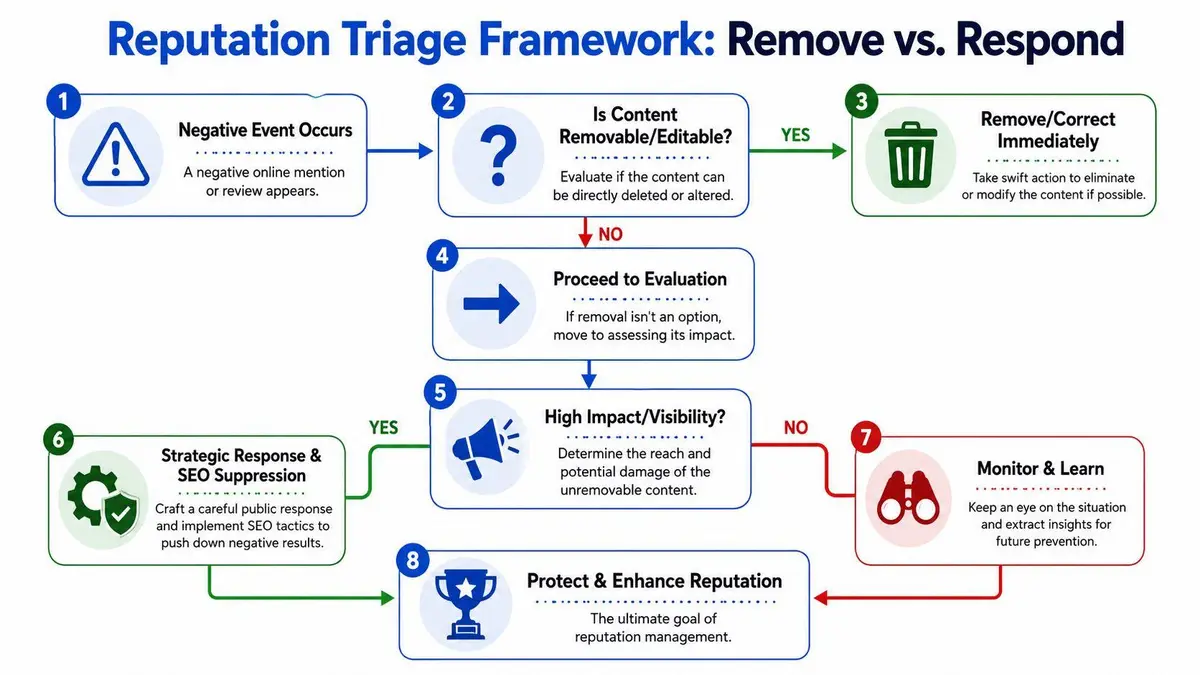
Most reputation damage gets worse because the business chooses the wrong tool. It responds to a fake review as if it were a service complaint. It threatens legal action over a harsh but lawful opinion. It ignores an impersonation profile because the first post looked trivial. Poor categorization is what creates expensive messes.
The central rule is simple. Not all negative content should be answered. Some content should be challenged, documented, and removed.
The urgency is obvious. While 57% of consumers require four or more stars to purchase, most reputation advice for small businesses focuses on review response, not crisis prevention through content removal. This leaves a blind spot for coordinated attacks, fake reviews, or defamatory content that needs rapid takedown according to the Wharton guidance referenced here.
Category one is legitimate criticism
A real customer says the service was slow, the invoice was wrong, or the product underperformed. The language may be unfair, but the underlying interaction happened.
This is a respond case.
You respond because the issue is part of normal business friction. You don’t try to “remove” every unhappy customer. You show professionalism, offer a path to resolution, and use the complaint to improve operations if the feedback is valid.
If the reviewer is real and the complaint concerns service quality, delay, communication, or expectations, answer it cleanly. Don’t litigate it in public.
Category two is false factual content
A post states something concrete that did not happen. It claims you committed fraud, never delivered work that records show was completed, or mistreated a person who never interacted with the company. It may also include fabricated photos, altered screenshots, or copied language posted across several accounts.
This is an escalate for removal case.
Do not get dragged into a back-and-forth. Preserve evidence first. Capture the URL, full-page screenshots, account details, and timestamps. Pull internal records that disprove the allegation. Then use platform reporting, legal review, and takedown procedures appropriate to the content type and jurisdiction.
Category three is competitor abuse or coordinated attack
You’ll recognize this pattern quickly if you look for it. Multiple reviews appear in a short window. The language is repetitive. The accounts lack real user history. The details are vague or impossible. In some cases, the same narrative appears on review sites, social platforms, and low-grade blogs.
This is also an escalate for removal case, sometimes paired with suppression if copies already rank in search.
The key mistake here is replying to each item as though it were isolated. It usually isn’t. Treat it as one incident with multiple artifacts. Build a file. Map all URLs. Identify whether the same text, image, or accusation is spreading from one source.
Category four is lawful but damaging commentary
Some content is real, critical, and hard to remove. A negative news article. A forum thread discussing a dispute. A former customer’s long post that expresses opinion more than provably false fact.
This is a suppress and contain case.
You may still send a correction request if there are errors. But if the publisher won’t amend or remove it, your energy is better spent building stronger digital assets that outrank it, while keeping your own public statements measured.
A simple decision table
| Content type | First move | Secondary move | Avoid |
|---|---|---|---|
| Legitimate unhappy customer review | Public response | Offline resolution | Threatening legal action |
| False factual accusation | Evidence preservation | Platform or legal removal | Public argument |
| Competitor or fake review cluster | Incident mapping | Coordinated takedown | Treating each post separately |
| Lawful but harmful article or thread | Correction request | SEO suppression | Endless rebuttal posts |
| Impersonation or leaked material | Immediate escalation | Account recovery or removal | Waiting to see if it spreads |
The red lines
Some content should trigger immediate outside help. Impersonation profiles. Leaked internal materials. Non-consensual intimate content. Employee doxxing. Fake criminal allegations. Extortion tied to review removal. Reuploaded content after prior takedown. Cross-platform attacks targeting your founder and brand at once.
Those situations are not reputation housekeeping. They are legal and security events.
For businesses facing that kind of pressure, one available option is ContentRemoval.com, which handles takedowns, de-indexing, and cross-platform removal workflows. That kind of service belongs in the conversation when the issue is false, malicious, persistent, or spreading faster than an internal team can manage.
Using SEO to Suppress Unremovable Content
Some content won’t come down. The platform won’t act. The publisher ignores you. The post is framed as opinion. The article is old but still indexed. That doesn’t mean you surrender page one.
You suppress it by giving Google better alternatives to rank.
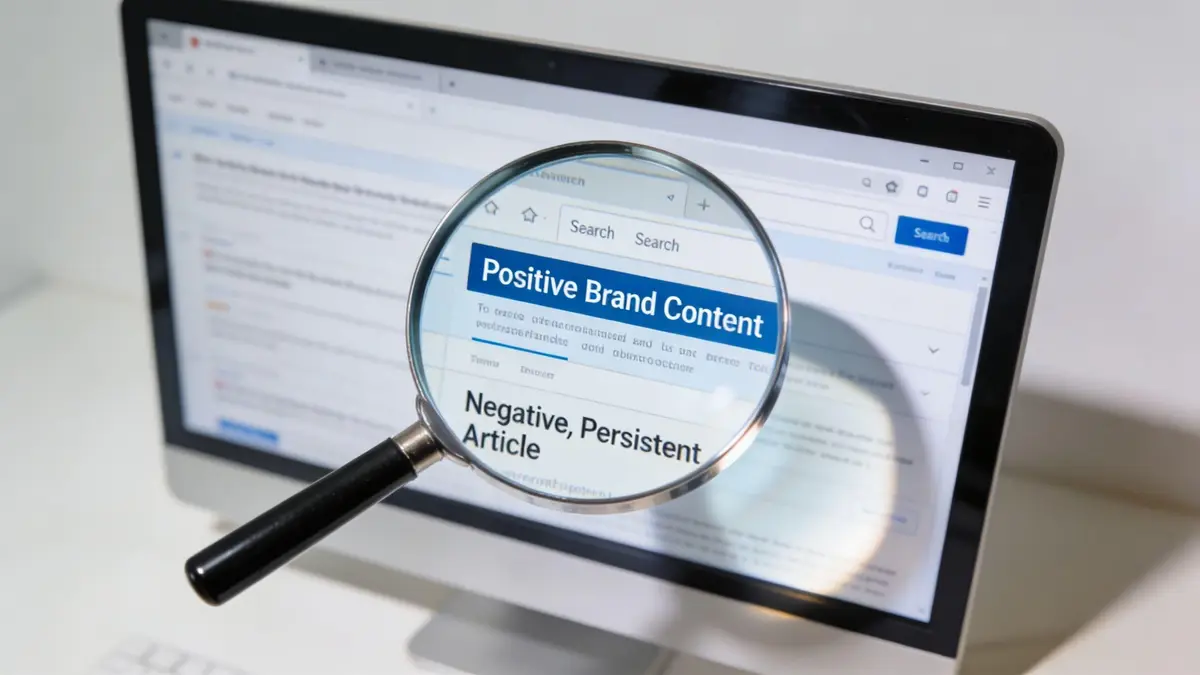
The stakes justify the effort. Approximately 57% of consumers will only choose a business with three stars or higher, and 40% will not consider a business with fewer than three stars, which is why visibility on page one directly affects consideration according to these consumer trust benchmarks.
Build assets Google can rank
Suppression works when you publish and strengthen assets that deserve visibility for your branded searches. The usual set is straightforward:
- Company site pages including the homepage, about page, leadership pages, and service pages.
- Founder and executive bios on the company site and credible third-party profiles.
- Owned social profiles on LinkedIn, Facebook, Instagram, YouTube, and other platforms relevant to your business.
- Press and announcements hosted on properties that can rank for your name.
- High-quality blog content tied to branded and service-intent queries.
The objective isn’t volume for its own sake. It’s relevance, authority, and consistency.
Match the asset to the search term
If the negative result ranks for the founder’s name, don’t only publish content about the company. Build out the founder’s digital footprint. If the problem ranks for “[brand] reviews” or “[brand] complaints,” create pages that address customer experience, policies, service process, and documented business credentials with enough substance to deserve ranking.
A weak asset won’t displace a strong negative result. Thin pages, abandoned profiles, and duplicate bios won’t do the job.
Search suppression is a ranking contest. You win it by publishing assets that are more relevant to the branded query than the damaging page.
Strengthen what you already own
Most businesses already have dormant assets that could help if someone bothered to maintain them. Update your business descriptions. Add leadership information. Align profile names and branding. Publish fresh material on your site. Link related pages together sensibly. Make sure your social and directory profiles point back to the main website.
If you have a lawful but damaging result that can’t be removed, suppression is the disciplined answer. It is slower than a takedown and less satisfying emotionally, but it works when pursued as a search strategy instead of a PR stunt.
Shifting to Proactive Reputation Defense
Reactive businesses live from alert to alert. Strategic businesses build a defensive system and review it like any other risk function.
That means assigning ownership, keeping records, and tracking a short list of KPIs that reflect reputation health. Review volume and review quality matter. So does response rate. So does branded search visibility. If you want a simple operating rule, track what buyers see first and how quickly your team acts when that picture changes.
The operating model that holds up
Use a monthly review cycle. Audit page-one branded search results. Review new ratings and recurring complaint themes. Check whether founder-name results are stable. Identify any content that has been reposted, copied, or translated to another platform.
Then ask three questions:
- What needs response because it reflects a real customer issue?
- What needs suppression because it is harmful but likely lawful?
- What needs removal because it is false, invasive, impersonating, or otherwise actionable?
That discipline keeps your team from overreacting to manageable criticism and underreacting to serious abuse.
International businesses face a harder version of this problem
If you operate across borders, generic advice becomes dangerous. Content removal rights, privacy remedies, and platform escalation paths vary by jurisdiction. For businesses operating internationally, reputation management is complicated by jurisdiction-specific content removal rights under laws like GDPR and CCPA, and standard advice often fails to address that complexity as discussed in this overview of cross-border reputation risk.
A contractor, clinic, law firm, exporter, or founder-led brand can have one reputation problem and several legal contexts at once. That changes how you document, escalate, and resolve the matter. Industry-specific operating advice can still be useful at the front line. For example, online reputation tips for contractors are a good reminder that service businesses need disciplined follow-up and consistency long before a crisis appears.
The larger point is this. Reputation management small business strategy should sit closer to legal, executive, and operational oversight than to casual marketing. If the issue can affect trust, pricing, hiring, partnerships, or financing, it deserves formal control.
If your business is dealing with false reviews, impersonation, defamatory posts, leaked material, or page-one search damage that your team can’t contain, ContentRemoval.com can assess the matter confidentially and map the right path: response, suppression, or removal. The fastest way to reduce damage is to stop guessing which category you’re in and get a clear action plan.
Frequently asked questions
Should I respond to every negative review of my business?
No. A genuine customer complaint about service, delay or expectations deserves a brief, professional public reply and an offline resolution channel. A post that states something concrete that never happened, or a cluster of repetitive reviews from accounts with no history, should be documented and escalated for removal rather than answered.
How can I tell if fake reviews are a coordinated attack?
Multiple reviews land in a short window, the language repeats, the accounts lack real user history and the details are vague or impossible. Often the same narrative appears across review sites, social platforms and low-grade blogs. Treat it as one incident with multiple artifacts, map every URL and identify the originating source.
What if a negative article about my business cannot be removed?
Send a correction request if there are errors, then shift to suppression. Build and strengthen company pages, founder bios, owned social profiles and substantive content matched to the exact branded query, such as brand plus reviews or complaints. Thin pages and abandoned profiles will not displace a strong negative result.