
Reputation management for barristers is controlled digital risk management under ethical constraint, not marketing. It rests on an accurate and restrained footprint anchored by the chambers profile and legal directories, a standing monitoring protocol, a triage model that separates protected opinion from defamation, privacy breach, impersonation and harassment, and surgical takedowns that match the decision-maker’s rules rather than public argument.
Key facts
- Barristers in England and Wales work under strict publicity and solicitation constraints that limit counter-marketing.
- Online abuse usually falls into five classes: opinion, factual allegation, privacy intrusion, impersonation or harassment.
- Platform rule complaints often remove impersonation, harassment, doxxing and manipulated media faster than formal legal process.
- Keep the crisis circle to the barrister, the clerk and one chambers decision-maker, with a single written chronology.
Where ContentRemoval.com comes in. ContentRemoval.com handles source removal, search de-indexing, false review action and impersonation takedowns for barristers whose names or chambers profiles are being distorted online, with the work kept dry, private and separate from any public argument. Contact usually comes from the barrister directly, the senior clerk or chambers management. A free 15-minute Exposure Scan maps which results are removable and by which route, and the report is yours to keep. Get a Free, Confidential Exposure Scan or read how our reputation management work is done.
A barrister rarely has the luxury of a slow reputational problem. It usually arrives mid-matter, mid-negotiation, or mid-application. A client forwards a search result. A solicitor asks an awkward question. A clerk mentions that a chambers profile is being outranked by a hostile post, a misleading directory entry, or a thread written by someone with an agenda.
That anxiety is rational. Your practice depends on judgment, discretion, and credibility. The Bar was built on reputation transmitted through clerks, solicitors, judicial confidence, and professional word of mouth. Search engines have not replaced that system, but they now sit in front of it. Someone forms an impression of you before a brief is sent, before a call is made, before anyone checks the underlying facts.
The Barrister’s Digital Dilemma
You may have experienced the specific kind of shock that only online reputational harm creates. You search your own name because a colleague mentions “something odd online,” and there it is: a hostile review, a forum accusation, a blog post dressed up as commentary, or a social post that turns a professional disagreement into an allegation about integrity. It may be false. It may be distorted. It may be legally actionable. None of that stops it from doing damage while it remains visible.

The usual advice you’ll find online is written for solicitors or American law firms. It tells you to “build your brand,” “post more on social,” “ask every client for reviews,” and “market your wins.” For a barrister, that advice is often useless and sometimes dangerous. It ignores the structure of chambers, the role of clerks, the referral economy, and the professional constraints that govern how you present yourself publicly.
That gap is real. Existing content on lawyer reputation management largely misses barrister-specific issues in jurisdictions such as England and Wales, where barristers are self-employed advocates working under strict publicity and solicitation constraints. It matters because a Q1 2026 Legal Futures survey found that 68% of potential clients now research barristers online first, while the same analysis says over-promotion is associated with a 22% higher risk of sanction for chambers, as summarised in this discussion of lawyer reputation management strategies and the barrister-specific gap.
Why barristers face a narrower path
A solicitor with a damaged profile can often counterpunch with marketing. A barrister usually can’t. Your public presence has to remain measured, accurate, and professionally proper. You are not selling trainers or software. You are presenting yourself as a serious officer of the court whose credibility must survive scrutiny from instructing solicitors, lay clients, opponents, regulators, and judges.
That makes reputation management for barristers a distinct discipline. It isn’t generic SEO. It isn’t publicity for publicity’s sake. It’s controlled digital risk management under ethical constraint.
Barristers don’t need louder online visibility. They need cleaner, more accurate, more defensible visibility.
The real risk isn’t vanity
The issue isn’t hurt feelings and it isn’t ego. The issue is whether misleading or malicious material becomes the first thing others see. Once that happens, you lose control of the frame. Every subsequent interaction starts with doubt. If you’re already dealing with the strain of being searched, assessed, and implicitly judged online, this perspective on the constant fear of being Googled will feel familiar.
A barrister’s reputation has always been built slowly and damaged quickly. Digital platforms accelerate the second part.
Building an Unimpeachable Digital Footprint
The first mistake barristers make is treating online reputation as a removal problem only. It isn’t. Removal matters, but a weak digital footprint invites damage because it leaves empty space for others to define you. If your chambers profile is thin, your directory entries are inconsistent, and your scholarly output is hard to find, hostile content has less competition.
A stronger approach is simple. Build a digital record that is accurate, restrained, and authoritative. Not flashy. Not promotional. Authoritative.
According to the 2023 Legal Trends Report, 84% of potential clients check online reviews before contacting a lawyer, and 47% will not consider a professional with less than a 4-star rating. The same source says firms that engage proactively online see 25% higher conversion rates from inquiries, which is why a polished digital presence now matters even for barristers working in a referral-led environment, as discussed in this legal reputation analysis.
Start with the assets you can defend
Your chambers website should be the anchor. Not a brochure. A record. It should contain a current biography, a disciplined list of practice areas, significant instructions where publication is appropriate, publications, speaking engagements, and media commentary that reflects expertise rather than self-advertisement.
Then look at the next layer. For most barristers, that includes:
- Chambers and set profile consistency. Your profile in chambers materials, directory submissions, and external listings must match on name style, call year, practice description, and contact route through clerks.
- Legal directory accuracy. Chambers & Partners and The Legal 500 matter because they often rank prominently and carry professional weight.
- Academic and professional publishing. University pages, alumni profiles, legal journal articles, and contributions to specialist publications create credible signals that are difficult for low-grade attacks to displace.
- LinkedIn with restraint. LinkedIn can be useful if it reads like a professional biography, not a sales page. Keep it factual.
Use clerks properly
Barristers shouldn’t improvise their own online positioning in isolation. Your clerk is often the operational centre of your market identity. If your profile is outdated, if published cases are missing, or if your expertise is described too vaguely, instructing solicitors may move on before they ever ask a question.
Give your clerks materials they can use safely:
| Asset | What it should do | What to avoid |
|---|---|---|
| Chambers profile | State expertise precisely | Inflated claims or loose superlatives |
| Directory submissions | Reinforce known strengths | Overwritten self-praise |
| Article placements | Demonstrate legal analysis | Client-facing marketing language |
| Speaker bios | Show standing in the field | Grandiose positioning |
Publish where seriousness lives
For barristers, authority comes from analysis, not slogans. A short article on a recent appellate decision, a note on procedural developments, or commentary in a respected legal publication does more for your digital footprint than a dozen generic “thought leadership” posts. The point is not volume. The point is indexed credibility.
Practical rule: If a page about you would look embarrassing in front of a judge, a silk, or your Head of Chambers, it shouldn’t go live.
There is also a negative discipline here. Don’t chase review volume in ways that look unmanaged or indiscriminate. Don’t push self-congratulatory updates after every hearing. Don’t let third parties publish exaggerated claims on your behalf. Reputation management for barristers is strongest when it looks almost understated. That restraint is not a weakness. It’s part of the signal.
Control the first page before you need it
Search results reward coherence. If your name appears consistently across chambers pages, reputable directories, legal commentary, and professional biographies, you make it harder for junk content to dominate. You also make your response options stronger later. Search engines and platforms are more receptive to correction when a credible, established identity already exists.
The best digital footprint for a barrister does three things at once. It reassures instructing solicitors. It gives potential lay clients a clear, proper impression, and it denies oxygen to material that never should have shaped your reputation in the first place.
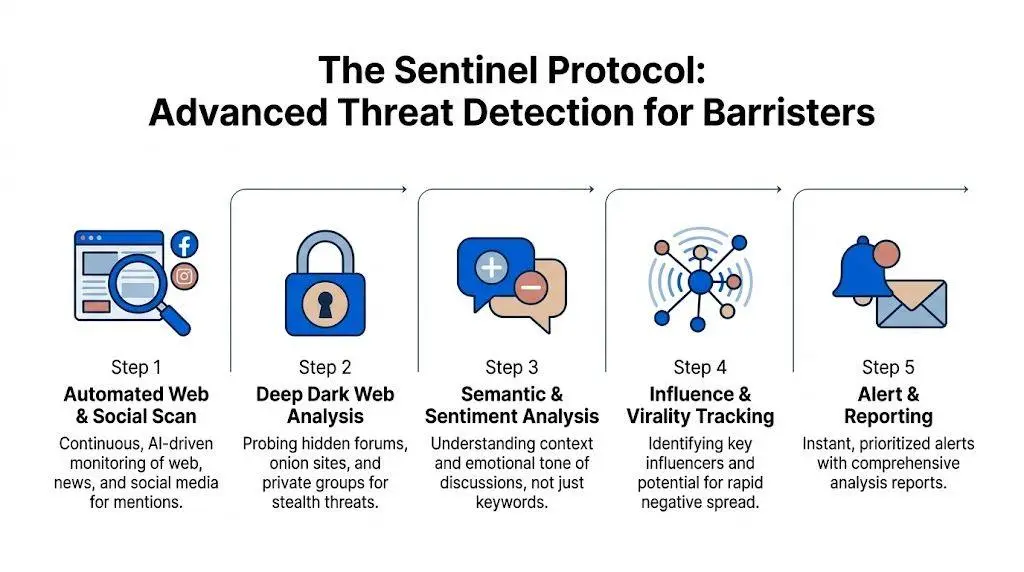
The Sentinel Protocol for Threat Detection
Most barristers monitor their reputation too casually. They search their name after something goes wrong, then promise themselves they’ll keep an eye on it. That isn’t monitoring. That’s delay.
You need a standing protocol. Not because every mention matters, but because the one that does usually spreads before anyone in chambers realises it has traction.
Watch more than your own name
A proper monitoring system tracks more than a direct name match. It should also watch variations of your name, common misspellings, your chambers name, key cases, recurring opponents, and loaded combinations such as your name plus “complaint,” “review,” “misconduct,” “conflict,” or “fraud.” Add major platforms, legal news sites, professional forums, and social channels where legal commentary tends to migrate.
The point is context. A barrister’s digital threat often starts sideways. A post about a case becomes a criticism of counsel. A disagreement on procedure becomes an allegation about competence. A chambers issue gets attached to an individual’s name.
Monitor on a schedule, not on instinct
An effective monitoring methodology requires monthly sentiment tracking because infrequent checks can miss 40% of sentiment shifts. The same analysis says firms that implement extensive brand analysis and respond to over 90% of online feedback achieve 25% higher inquiry-to-client conversion, and that automated feedback requests can support a move from 4.2 to 4.7 stars within six months, according to this breakdown of reputation ROI for modern law firms.
For barristers, the lesson isn’t “be more commercial.” It’s this: sporadic observation leaves blind spots, and blind spots are where reputational crises mature.
A practical monitoring stack
Use layers. One layer catches noise. Another catches risk.
- Baseline alerts. Google Alerts is still useful for broad web indexing and news mentions. Set separate alerts for your full name, chambers, and selected case combinations.
- Directory and review checks. Manually review Google Business Profile where relevant, legal directories, and any profile pages that allow public commentary.
- Social listening. Track X, LinkedIn, Reddit, specialist forums, and legal commentary pages where your name or matters may surface.
- Sentiment review. Someone should assess not just whether you’re mentioned, but whether the language suggests criticism, allegation, impersonation, or coordinated hostility.
- Escalation log. Every significant mention should be logged by date, URL, screenshot, platform, and risk rating.
If you want a more disciplined system, this guide to reputation monitoring outlines the sort of continuous tracking serious clients now use.
What deserves escalation
Not every negative statement is a crisis. Barristers who escalate everything waste time and lose credibility. Focus on a short set of trigger conditions:
- Allegation over opinion. “I didn’t like counsel’s style” is different from an assertion of dishonesty or misconduct.
- Search visibility. A minor post on an obscure forum matters less than a result appearing prominently against your name.
- Repeat publication. Repetition often indicates either coordination or persistence.
- Professional spillover. Anything likely to influence solicitors, clerks, chambers leadership, or regulators needs attention.
- Privacy exposure. Personal data, family references, addresses, photographs, or material about protected matters require immediate review.
Track online risk the way you track a live case file. Facts first, chronology second, action threshold third.
Reputation management for barristers functions not merely as a marketing exercise, but as an intelligence function.
Triaging Digital Threats and Legal Avenues
Once you’ve identified a threat, don’t lunge at it. Classify it. The wrong response can worsen the position, amplify a low-grade attack, or create a record that works against you later.
The first question is basic. What kind of problem is this? Online abuse against barristers usually falls into one of five categories: negative opinion, factual allegation, privacy intrusion, impersonation, or harassment. Those categories overlap, but your legal and strategic options differ sharply depending on which one you’re dealing with.
Separate insult from actionable harm
An angry opinion isn’t automatically unlawful. If someone writes that they found you abrupt, unhelpful, or unimpressive, you may dislike it but still have limited recourse. If they allege dishonesty, corruption, discrimination, or professional misconduct as fact, the position changes. If they publish personal data, confidential information, or intimate material, the analysis changes again.
A useful way to think about this is a risk matrix rather than a moral one. The issue isn’t only whether the material is unfair. The issue is whether it is false, identifiable, invasive, repeated, and influential.

A working triage model
| Threat type | Typical example | Primary response path |
|---|---|---|
| Protected opinion | Critical review of style or service | Careful reply or no reply |
| Defamatory statement | False allegation presented as fact | Preservation, legal review, takedown demand |
| Privacy breach | Personal data or confidential detail | Platform report, data rights route, urgent removal |
| Impersonation | Fake profile or false identity use | Platform enforcement, identity evidence |
| Harassment campaign | Repeated hostile posting across platforms | Evidence bundle, platform escalation, possible injunctive strategy |
At this stage, many barristers overcorrect. They either threaten defamation proceedings too early or try to ignore everything. Both are usually mistakes.
Response has to be strategic, not emotional
A 2023 study found that 98% of people consider online reviews highly influential, and it also found that a thoughtful response to negative feedback can improve reputation more effectively than a stack of generic positive reviews. Since 68% of client loss stems from perceived indifference, a swift and considered response protocol has real defensive value, as explained in this guide to online reputation management for lawyers.
That doesn’t mean every attack deserves a public answer. It means silence should be a decision, not a reflex.
Some online statements should be answered. Some should be removed. Some should be documented and ignored. The skill lies in knowing which is which.
When legal routes make sense
If the publication appears defamatory, the usual legal analysis applies. Is the statement one of fact? Is it false? Does it identify you? Has it caused or is it likely to cause serious harm? Are there viable defendants? Is the publisher inside the jurisdiction or effectively anonymous? Can platform action achieve the result faster?
For privacy and data issues, data protection and misuse of private information may offer more efficient routes than a pure defamation claim. Search engine de-indexing can also be relevant where the source remains live but discoverability is the main problem. If the material breaches platform rules, terms-based takedowns are often faster than formal litigation.
A barrister should also think like a risk manager. The legal profession often borrows usefully from broader incident frameworks. The Australian Risk Management Framework is a helpful external model for thinking in terms of identification, assessment, treatment, and ongoing control, even though the underlying legal remedies will differ by jurisdiction.
Litigation isn’t always the smart move
Court proceedings can vindicate a serious wrong. They can also entrench the story, increase search visibility, and consume time you don’t have. A pre-action letter may be enough. A platform complaint may be enough. A de-indexing request, source removal demand, and suppression strategy may solve the practical problem with less noise.
Barristers understand this instinctively in client work. The strongest remedy on paper isn’t always the best outcome in practice. Reputation management for barristers requires the same judgment. You are not trying to win an abstract argument. You are trying to reduce visible harm, preserve professional standing, and avoid feeding the attack.
Executing Takedowns and Managing Crisis Communications
At 7:15am, your clerk rings. A pseudonymous post accusing you of misconduct is ranking for your name, instructing solicitors not to brief you, and being passed around LinkedIn. By 8:00am, the problem is no longer legal theory. It is a live business and professional risk. You need a controlled response that removes the material, limits circulation, and keeps everyone at chambers aligned.

Start with proof. Preserve the page, full URL, username, timestamps, search appearance, cached versions, and any replies or reposts that extend the harm. If instructions, diary entries, or clerk enquiries have already been affected, record that as well. Barristers often focus too quickly on whether a statement is defamatory. The first operational question is simpler. What can be removed or suppressed fastest without creating more exposure?
That usually means parallel action. File the platform complaint. Send the publisher notice. Prepare the search de-indexing request. Draft legal correspondence if the facts justify it. Serial escalation wastes time, and hostile posters use delay to multiply copies across new domains and accounts.
Why surgical takedowns beat theatrical threats
Online material comes down when the complaint matches the decision-maker’s rules. Platforms want policy breaches identified with evidence. Search engines want a properly framed request. Site operators respond to legal risk, procedural failure, or hosting pressure. Outrage is irrelevant.
Precision also protects you. Barristers work under tighter professional and ethical constraints than the generic reputation advice written for US plaintiff firms ever acknowledges. You cannot afford public argument, careless denials, or online point-scoring. A badly judged rebuttal can expose confidential information, aggravate a complainant, unsettle solicitors who send work through clerks, and create avoidable BSB issues.
Keep the response dry, factual, and private.
The practical takedown sequence
- Use platform rules first where they fit. Impersonation, harassment, threats, doxxing, manipulated media, and abusive review conduct are often removed faster through platform reporting than through formal legal process.
- Press for source removal quickly. If the operator or publisher can be identified, send a short notice tied to the strongest ground available, whether falsity, privacy, data protection, misuse of private information, or breach of site rules.
- Cut visibility while removal is pending. Search suppression and de-indexing can reduce commercial harm while the source challenge is still being handled.
- Escalate on merit, not emotion. Serious allegations, repeated publication, or clear campaign conduct may justify solicitor correspondence, applications against anonymous posters, or proceedings.
For a focused example of one route, see this guide on how to get a website taken down for slander through a strategic process.
Crisis communications at the Bar require discipline
A barrister’s communications plan is narrower than a firm’s marketing response. That is the point. You are protecting professional standing, referral relationships, and regulatory position, not trying to win a public contest.
Set the chain of communication immediately. In most cases that means you, your clerk, and one chambers decision-maker if the issue is serious enough to affect instructions or press risk. Keep a single written chronology. No speculation. No adjectives. No internal freelancing by colleagues who want to defend you online. Supporters often make the problem worse.
If a holding statement is needed, keep it short and sterile. Say the material is disputed or improper, confirm that it has been referred through the appropriate channels, and stop there. Do not argue facts in public. Do not threaten proceedings on social media. Do not disclose anything that touches client confidentiality, ongoing proceedings, or another person’s private information.
This short video gives useful context on how professionals approach high-stakes online reputational pressure without overexposure:
> **Operational point:** The objective in a barrister's crisis is to look controlled.Clerks, solicitors, and chambers leadership notice tone as much as substance. So do regulators, journalists, and opponents. Controlled execution protects your position. Noise rarely does.
From Crisis Response to Lasting Resilience
The barristers who handle digital threats best are not the ones who never attract criticism. They are the ones who build a system before they need one. They maintain accurate public records. They monitor intelligently. They classify threats correctly. They respond without drama.
That is the shape of reputation management for barristers. It isn’t marketing varnish. It’s a practice protection function. It sits alongside diary control, conflict checks, fee discipline, and case preparation because the commercial and professional consequences are now too immediate to treat as peripheral.
What lasting resilience actually looks like
A resilient barrister does not rely on a single chambers page and occasional vanity searches. A resilient barrister has a defensible digital footprint, a monitoring routine, a triage model, and a removal strategy that can be activated quickly. Equally, they understand the boundaries imposed by professional rules and never let online anxiety push them into overstatement or self-inflicted regulatory trouble.
The work is cumulative. A corrected directory entry here. A stronger chambers profile there. A proper article under your name. A dormant fake profile removed before it gains traction. A search result displaced without fanfare rather than argued with publicly. None of it feels dramatic. That is why it works.
The professional standard is higher for barristers
Solicitors can often absorb a degree of digital noise through firm branding and wider institutional presence. Barristers trade more directly on individual standing. Your name is the asset. Your judgment is the product. Your credibility is the market signal. That makes neglect more dangerous and overreaction more costly.
A single takedown solves an incident. A sustained reputation system protects a career.
If you’re under pressure now, treat the issue as both urgent and structural. Resolve the immediate publication, certainly. But also correct the conditions that allowed it to matter so much. That usually means stronger profiles, better monitoring, cleaner evidence handling, and a clear escalation pathway that doesn’t depend on panic.
If your name, chambers profile, or case history is being distorted online, ContentRemoval.com can assess the issue confidentially and map the practical response, whether that means source removal, de-indexing, false review action, impersonation takedowns, or continuous monitoring. For barristers, the value isn’t noise. It’s a discreet plan that reduces visibility of harmful material while protecting professional standing.
Frequently asked questions
Can a barrister sue over a bad online review?
An opinion about style or service is usually protected, however unwelcome. The position changes when the post alleges dishonesty, corruption or professional misconduct as fact, publishes personal data or confidential detail, or impersonates you. Even then, a pre-action letter, platform complaint or de-indexing request may solve the practical problem with less noise than proceedings.
How should a barrister respond to a false allegation online?
Preserve the page, URL, username, timestamps and cached versions first. Then act in parallel: file the platform complaint, send the publisher notice, prepare a de-indexing request and draft legal correspondence if the facts justify it. Keep any holding statement short and sterile, and never argue facts or threaten proceedings on social media.
What should a barrister monitor online?
More than an exact name match. Track name variations and misspellings, the chambers name, key cases, and loaded combinations such as your name with complaint, misconduct or fraud, across search, legal directories, review pages, X, LinkedIn, Reddit and legal forums. Log every significant mention with date, URL, screenshot and a risk rating.