
The benefits of reputation management for executives, investors and family offices are concrete: protection of financial assets and expansion of enterprise value. A clean digital profile de-risks capital raises, acquisitions and partnerships, shortens executive recruitment, and can shape regulatory interactions. Proactive monitoring, content removal, de-indexing and suppression neutralize threats such as smear campaigns, impersonation and leaks before they reach stakeholders.
Key facts
- One study cited found companies prioritizing reputation management delivered a 4.78% increase in annual shareholder returns.
- Lenders, investors and partners run online reconnaissance during due diligence, so negative content affects deal terms.
- Clear-cut violations such as copyright or non-consensual imagery can often be taken down within 24 to 72 hours.
- A governance framework needs a senior owner, triage protocols, escalation paths and board-level reporting.
Where ContentRemoval.com comes in. ContentRemoval.com does the removal side of this work: defamatory articles, fraudulent review clusters, impersonation accounts and leaked material taken down at source or de-indexed from search, then monitored for reuploads. Family office managers, general counsel and chiefs of staff usually make the first call ahead of a transaction or fundraise. A free 15-minute Exposure Scan maps what is removable, and the report is yours to keep. Get a Free, Confidential Exposure Scan or read how our reputation management work is done.
Discussions of reputation management benefits often devolve into vague notions of brand image or public perception. For high-net-worth individuals, executives, and family offices, such ambiguity is a liability. The value of professional reputation management lies in two concrete outcomes: the quantifiable protection of financial assets and the strategic expansion of personal and corporate enterprise value.
This is not an exercise in public relations; it is a discipline of asset protection. It involves safeguarding shareholder value, securing access to capital, and neutralizing digital threats before they inflict irreversible financial and legal damage. Engaging in reputation management is an investment in financial resilience and strategic advantage.
Translating Reputation Into a Measurable Asset
For a leader operating under intense public and financial scrutiny, reputation is not a soft metric. It is a hard asset with a direct, measurable impact on enterprise valuation, M&A outcomes, and capital access. Viewing your digital presence as a matter of public relations is a critical error in judgment.
A more precise framework is “reputation equity”: a tangible asset class that directly influences your company’s market value, your ability to attract elite talent, and your negotiating leverage.
This reframing moves the practice from reactive damage control to proactive value creation. The anxiety that accompanies the discovery of a misleading article or a defamatory online comment is a direct signal of a threat to your reputation equity. Left unaddressed, these digital liabilities erode trust, deter investors, and terminate strategic partnerships before they can materialize.
The Financial Reality Behind Reputation Equity
Market data validates this perspective. The global online reputation management services market is projected to reach USD 1.30 billion by 2032, expanding at a compound annual growth rate of 17.27%, according to analysis from ResearchAndMarkets.com.
This significant growth is not speculative. It confirms a fundamental principle: control over one’s digital narrative is a core driver of business continuity and value preservation. For an executive, a proactive strategy is the barrier between a stable stock price and a viral event that erodes billions in market capitalization overnight.
Your reputation is the invisible force multiplier behind every transaction, recruitment, and valuation. Its professional management is not a defensive measure but a core component of asset protection and growth strategy.
The process is cyclical: delivering value generates a strong reputation. That reputation, when professionally managed and protected, becomes a durable asset that, in turn, creates greater value.
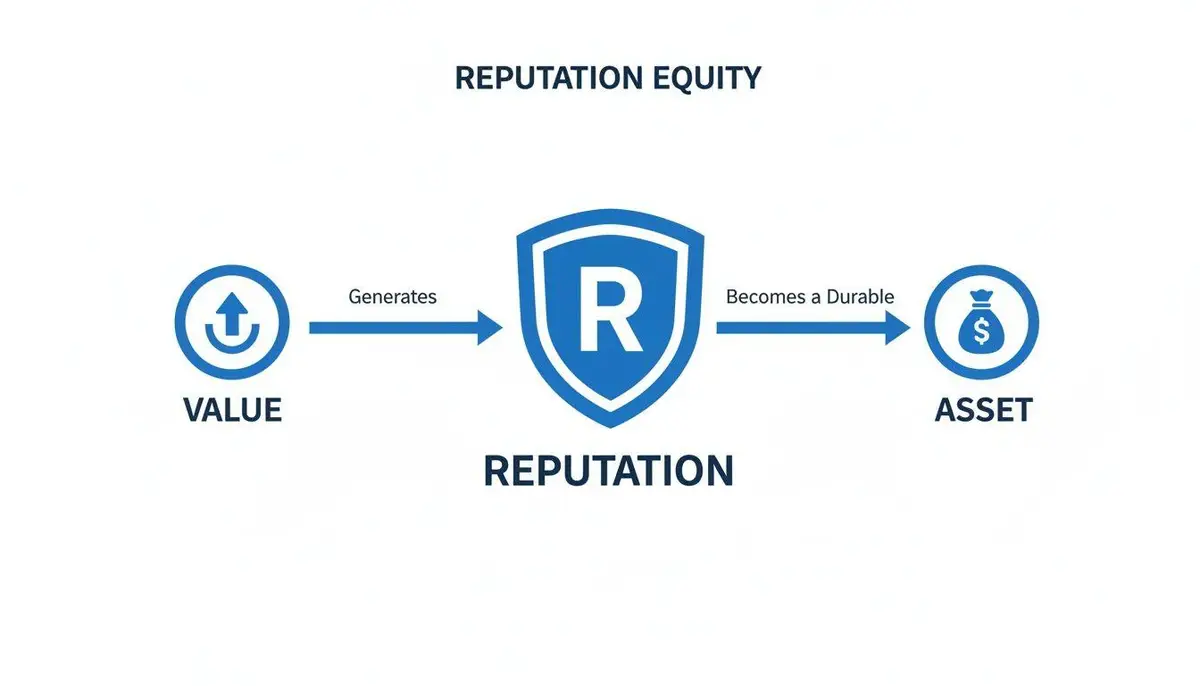
What begins as a protective mandate evolves into a powerful engine for financial growth and strategic opportunity.
From Reactive Damage Control to Proactive Value Creation
The conventional method of crisis response, reacting after damage is manifest, is obsolete and financially punishing. The correct approach treats reputation as a strategic asset requiring constant, proactive management, analogous to a financial portfolio. This shift in methodology fundamentally alters potential outcomes.
The table below contrasts these two distinct approaches.
| Metric | Reactive Crisis Response (Outdated Approach) | Proactive Reputation Management (Strategic Imperative) |
|---|---|---|
| Timing | Post-incident, after damage has occurred | Continuous, pre-emptive monitoring and action |
| Focus | Damage control, apologies, and short-term fixes | Asset protection, value creation, and long-term resilience |
| Tools | Public relations statements, press releases | Content removal, de-indexing, suppression, sentiment analysis |
| Outcome | Lingering negative search results, eroded trust, high recovery cost | A clean digital footprint, enhanced credibility, protected enterprise value |
| Cost | Unpredictable and often catastrophic financial and brand impact | A predictable, strategic investment with a clear ROI |
This comparison clarifies why an ongoing, strategic approach is non-negotiable for serious leaders and their enterprises. The objective is to construct a fortress, not merely to clean a battlefield.
From Cost Center to Strategic Investment
Engaging a specialist firm is a strategic financial decision, not an operational expense. The goal is to move beyond generic PR advice and execute a disciplined plan to build and defend reputation equity. This requires precise instruments (content removal, de-indexing, and search result suppression) to achieve specific, measurable outcomes.
Effective reputation management, however, extends beyond deleting negative content. It involves actively cultivating a digital narrative that supports strategic objectives. This demands a foundation of continuous intelligence and a pre-determined crisis response capability.
Our advanced reputation monitoring services provide that foundation, delivering the intelligence necessary for a formidable defense. Viewing reputation as a critical investment is the first, essential step toward achieving control over your digital destiny.
The Financial Upside of a Fortified Reputation

A sterling digital reputation is not a corporate vanity project; it is an engine for financial growth. For executives, investors, and family offices, this connection is paramount. Every major decision, from securing a funding round to closing a merger, is influenced by due diligence findings, a process that now begins online.
By proactively managing your digital presence, you directly influence financial outcomes. Removing a defamatory article, fraudulent reviews, or a damaging data leak is not merely a defensive action. It is a calculated move to protect revenue, prevent client attrition, and fortify investor confidence. These are not abstract benefits; they have a direct and material impact on the bottom line.
The alternative, allowing negative content to persist and propagate, creates a measurable drag on financial performance. It invites unwanted scrutiny, erodes trust, and cedes a competitive advantage that was not earned.
Driving Tangible Shareholder Value
Reputation has transcended its former status as a “soft” PR metric to become a hard, quantifiable asset class. One landmark study revealed that companies prioritizing reputation management delivered a 4.78% increase in annual shareholder returns. This represents a significant portion of a global reputation economy now valued at $7 trillion. These figures are not abstract; they demonstrate precisely why astute executives engage specialized firms.
This financial reality is driven by modern decision-making processes. A staggering 90% of consumers use search results to guide their purchasing choices, rendering a single negative event potentially disastrous. The same research indicates that 70% would defect to a competitor after one bad experience, contributing to $3.7 trillion in annual global losses attributable to poor customer service amplified online.
The data paints an unambiguous picture: a strong reputation is not a luxury but a core element of financial stewardship. It is a lever for increasing enterprise value and delivering superior shareholder returns.
Protecting Enterprise Valuation and Capital Access
During any high-stakes transaction (a capital raise, an acquisition, a strategic partnership) your digital footprint is subjected to intense scrutiny. Lenders, investors, and prospective partners conduct deep online reconnaissance to assess risk. The discovery of litigation records, critical news coverage, or accusations of misconduct can derail a deal entirely or, at best, result in significantly less favorable terms.
A clean digital profile acts as a powerful de-risking signal to the market. It accelerates due diligence, commands higher valuations, and ensures smoother access to capital by eliminating the perceived liabilities that negative online content creates.
Consider it a reinforcement of your enterprise’s financial foundation. A single, unresolved reputation issue can cast a shadow of uncertainty that financial partners will not risk entering. By methodically removing or suppressing these digital liabilities, professional reputation management becomes a direct instrument for protecting and enhancing the valuation of your enterprise. This translates to higher valuations as lower-risk investments, improved loan terms from more willing lenders, and faster deal closures due to streamlined due diligence.
Cultivating a Pro-Growth Digital Environment
Ultimately, the most powerful financial benefit of reputation management is its capacity to create a digital environment that actively fuels growth. A positive online narrative does more than prevent damage; it generates new opportunities. It builds a foundation of trust that attracts high-value clients, opens doors for strategic alliances, and supports expansion into new markets. For a comprehensive look at the investment involved, review our strategic cost analysis of online reputation management.
This proactive approach transforms your online presence from a potential liability into a strategic asset. It ensures that when stakeholders search for you or your business, they find a narrative of competence, integrity, and success, a narrative that drives real financial results.
Gaining Strategic and Operational Advantages
While the financial upside is a primary driver, the operational benefits of reputation management are equally compelling. A clean online reputation is not an aesthetic concern; it is a practical tool that actively reduces friction across the entire enterprise. It can fundamentally alter how an organization functions, from attracting elite talent to engaging with regulators.
A well-managed reputation acts as an operational tailwind, propelling the business forward with less resistance. Conversely, a neglected one becomes a constant headwind, making every initiative more difficult, more expensive, and slower to execute. The objective is to secure a smoother operational path where strategic opportunities are more readily accessible.
The War for Executive Talent
Top-tier professionals, particularly at the C-suite level, conduct exhaustive due diligence before considering a new position. They scrutinize not just compensation but the integrity and stability of the enterprise and its leadership. The discovery of past litigation, leadership scandals, or a pattern of negative press is a significant deterrent.
A pristine reputation, conversely, is a powerful recruiting magnet. It signals stability, ethical leadership, and a professional culture that attracts A-players. This facilitates the rapid assembly of stronger teams and improves retention, as elite talent seeks association with respected leaders and successful brands.
A clean digital slate is a core component of your employer value proposition. It reduces hiring friction, shortens recruitment cycles, and gives you a decisive edge in securing the best talent in a competitive market.
Neutralizing digital liabilities is not an act of tidying up search results. It is a direct investment in human capital, the ultimate driver of long-term success.
Facilitating Strategic Partnerships and Alliances
Every significant business relationship, from a joint venture to a critical supplier agreement, is predicated on trust. Potential allies, distributors, and key vendors will vet you and your leadership thoroughly before committing. Their online discoveries directly shape their perception of risk and their willingness to engage.
A professionally managed reputation streamlines these critical negotiations. It removes doubt and builds immediate confidence, allowing the conversation to focus on mutual growth rather than on addressing past issues. This leads to smoother negotiations, access to more desirable partners who seek alignment with sterling public images, and enhanced supply chain stability as a solid reputation builds loyalty with suppliers.
For businesses aiming to integrate reputation management into their broader growth strategy, exploring comprehensive law firm marketing strategies that include reputation management is advantageous. This integrated approach ensures that reputation actively supports strategic business development goals.
Earning Regulatory Goodwill
While goodwill is no substitute for legal compliance, a positive public perception can influence outcomes during regulatory scrutiny. Officials at government agencies are not immune to public sentiment. An organization or individual known for integrity is often viewed more favorably than one beset by online controversy.
This “regulatory goodwill” can be pivotal during an audit, compliance review, or legal dispute. It can mean the difference between a minor inquiry resolved quickly and a protracted investigation. It can lead to a negotiated settlement instead of a punitive fine.
By proactively managing your reputation, you ensure that when regulators conduct their own due diligence, they find a record of credibility and public trust. This creates a more favorable context for any interaction and is a strategic method for de-escalating potential conflicts before they begin.
Mitigating Risk and Preempting Digital Crises

The digital threats that inflict the most damage are rarely the ones you anticipate. The real danger lies in the unforeseen: a coordinated smear campaign, a convincing impersonation account, or a sudden data leak that causes irreversible harm before you are even aware of the attack.
This is the scenario that troubles executives and public figures: being ambushed by a digital crisis that spirals out of control with alarming speed.
Effective reputation management is not simply damage control; it is preemption. It functions as a form of crisis insurance, providing the 24/7 surveillance and rapid-response capabilities required to neutralize threats before they escalate. Our function is to serve as your digital sentinel, continuously scanning the horizon for risks so they can be dismantled with precision, often before they reach public awareness.
The Power of Early Detection and Neutralization
A digital threat is analogous to a small fire. As a spark, a single defamatory post or a newly registered fraudulent domain, it can be extinguished quietly and effectively. If ignored, that spark can erupt into a conflagration that consumes your brand, credibility, and financial standing.
AI-driven monitoring provides a decisive advantage. These are not simple keyword alerts but sophisticated systems that analyze context, sentiment, and hidden networks to pinpoint emerging threats with surgical accuracy. Through early detection, we can neutralize threats such as impersonation accounts on social media, dark web chatter planning data leaks or smear campaigns, coordinated negative “astroturfing” attacks, and leaked confidential information on public forums.
When a digital crisis hits, speed is the critical variable. The ability to move from detection to takedown within 24-48 hours is often what separates a minor disruption from a catastrophic, value-destroying event.
This rapid-response capability transforms reputation management from a reactive cleanup service into a proactive security detail.
Averting Catastrophic Financial and Brand Damage
The financial stakes are immense. Fraudulent reviews and malicious content are not mere annoyances; they are a direct threat to economic stability. The global economic damage from misled purchases alone is projected to surpass $787 billion by 2026. As documented in these online reputation management statistics on WiserReview.com, this data affirms a simple truth: public belief directly controls financial reality.
Consider a real-world (anonymized) case. A private equity firm was targeted by a disgruntled former employee who began posting false, damaging information on niche financial forums and anonymous blogs. Our monitoring systems flagged the anomalous activity almost immediately.
Instead of waiting for the narrative to gain traction with the financial press, we executed a multi-pronged counter-strategy. This involved issuing legal takedown notices to hosting platforms and launching a targeted campaign to ensure the negative content was suppressed in search results. The entire threat was neutralized in under 72 hours, averting a crisis of confidence among the firm’s investors during a crucial fundraising cycle.
This is the tangible return on investment in a proactive defense. Treating your reputation as a critical asset that requires constant protection builds a powerful shield against the chaotic nature of the online environment. It provides the security that comes from knowing an expert is standing guard.
Proven Case Studies in Digital Remediation

When your reputation is under assault, theoretical discussions are insufficient. Executives, investors, and public figures facing a crisis require evidence of efficacy. Tangible results are the only metric that matters.
The true test of a specialist firm lies not in its promises, but in its documented accomplishments. Each situation is unique and demands a specific, strategic approach that transcends simple public relations tactics.
The following narratives, based on actual cases, illustrate how digital remediation tactics (including legal action, source content removal, and search engine de-indexing) resolve severe threats. These are not merely success stories; they are demonstrations of how professional intervention protects careers, restores confidence, and neutralizes financial and personal risks.
Restoring Investor Confidence for a Targeted CEO
A competitor initiated a sophisticated smear campaign against the CEO of a publicly traded technology company. A series of professionally written but entirely false articles began appearing on obscure financial blogs, accusing him of corporate malfeasance and personal misconduct. Within days, these articles dominated the first page of Google for the CEO’s name, causing significant concern among the board and investors.
The problem was not just the defamatory content, but its visibility. The perpetrators understood that even baseless claims can depress a stock price if they are prominent enough. Our mandate was to excise this digital poison before it metastasized.
A targeted digital attack is not a PR problem; it is a direct assault on financial stability. The solution is not a press release, but the surgical removal of the offending material to restore market confidence.
We executed a rapid, multi-front response. We initiated immediate legal action against the websites hosting the defamatory content, citing clear violations of their terms of service and defamation laws. Concurrently, we employed advanced search engine strategies to de-index the URLs, rendering them invisible to the public while we pursued source content removal.
The result: within weeks, the first two pages of search results were entirely clear of the hostile content. The company’s stock, which had begun to falter, stabilized as investor confidence was restored. This case exemplifies a key benefit: the ability to surgically remove a threat and preempt quantifiable financial damage.
Protecting a Public Figure from Exploitation
A prominent public figure became the victim of a major privacy violation. Private images were distributed without consent and propagated across dozens of websites, from major social media platforms to clandestine forums on the dark web. The client faced not only immense personal distress but the imminent risk of permanently losing control of their personal narrative.
The challenge was twofold: removing the existing content at scale and preventing its immediate re-upload. This required a combination of legal authority, proprietary technology, and relentless monitoring. Our large-scale takedown operation involved issuing immediate DMCA and legal demands, using AI-powered image-matching to constantly scan for new copies, and filing requests with all major search engines to de-index the links.
Within the first 72 hours, we achieved removal of the content from over 95% of the initial sites. Our ongoing monitoring system detected re-uploads, often triggering a new takedown request within an hour of their appearance. This prevented the material from regaining a foothold. The outcome was the restoration of our client’s privacy and personal security, an invaluable benefit.
To see more examples of how these interventions work, you are invited to review the outcomes in our collection of case studies.
Neutralizing a Coordinated Fake Review Attack
A luxury hotel brand was suddenly inundated by a coordinated attack. Hundreds of one-star reviews appeared almost overnight across TripAdvisor, Google, and other major booking platforms. The identical phrasing and timing made it clear this was an organized campaign. The brand’s bookings plummeted immediately.
This was a direct assault on the company’s revenue. In the hospitality sector, where 95% of travelers read reviews before booking, a sudden drop in ratings is a critical emergency. Our objective was to prove the fraudulent nature of the reviews and compel the platforms to remove them.
Our team conducted a forensic analysis, identifying clear patterns in language, timing, and user account origins that built an irrefutable case for a coordinated, fraudulent attack. We compiled this evidence into detailed reports and presented them directly to the legal and trust-and-safety teams at each review platform.
The result was the removal of the vast majority of the fraudulent reviews. The brand’s star ratings returned to their previous levels, and booking rates recovered. This intervention demonstrates how reputation management can directly protect a company’s sales channels and preserve the trust built with customers over years.
Building a Governance Framework for Your Reputation
While expert intervention can resolve a crisis, the true power of reputation management is realized by transitioning from a reactive, crisis-response mode to a proactive, strategic discipline integrated into the organization’s core. This is achieved through a formal governance framework.
A governance structure transforms reputation from an abstract concern into a tangible asset that can be actively managed and protected. For executives and family offices, it establishes clear lines of ownership, defines rules of engagement, and ensures reputation is considered during high-level strategic decisions. Without this framework, you are merely reacting to threats as they emerge, awaiting the next inevitable attack.
The objective is to establish reputation management as a permanent, ongoing function that methodically defends and enhances your most critical intangible asset. This is how you move from a defensive posture to one of genuine, long-term resilience.
Who’s on Point? Establishing Your Internal Team and Protocols
A robust governance model begins with designating clear authority. This responsibility cannot be delegated to a junior marketing assistant; it demands senior leadership and oversight. A designated individual or a small committee (typically comprising legal counsel, a senior executive, and a communications lead) must have explicit ownership of this domain.
This team’s primary function is to create and enforce a formal set of protocols. These are not vague guidelines but concrete, actionable rules dictating precisely how the organization will manage its digital footprint. Key protocols must cover monitoring procedures, threat triage systems, clear escalation pathways, and pre-approved response playbooks for common scenarios.
A formal governance structure is your organization’s immune system for its reputation. It ensures threats are spotted, assessed, and neutralized with speed and precision, stopping small problems before they can morph into full-blown crises.
This systematic approach removes emotion and panic from the response process, replacing them with a disciplined, predictable methodology designed to protect value.
Making Reputation a Boardroom Conversation
For reputation to be treated with the seriousness it warrants, it must be measured and reported with the same rigor applied to financial performance. The critical next step is to integrate reputation metrics into executive dashboards and board-level presentations. These reports must provide a concise, clear snapshot of the digital health of the company or family office.
Key metrics to track and present should include:
- Sentiment Analysis: Quantify the ratio of positive, neutral, and negative online mentions to establish a clear trend line of public perception.
- Search Result Integrity: Report on the status of the first two pages of Google results for key names and brands, which account for over 90% of user clicks.
- Threat Volume and Type: Provide a summary of digital threats identified and neutralized during the reporting period as proof of the governance framework’s efficacy.
Placing this data alongside financial KPIs draws an undeniable link between reputation and enterprise value. It ensures reputation management receives the senior-level attention and strategic resources it requires, cementing its role as a core pillar of modern leadership and risk management.
Answering Your Pressing Questions
In confidential consultations with executives, legal teams, and family office managers, several critical questions consistently arise. The following are direct answers to these primary concerns.
How Quickly Can Negative Content Be Removed?
The timeline for removal is contingent on the specific circumstances.
For clear-cut violations, such as copyright infringement or the distribution of non-consensual imagery, takedown can often be secured within 24-72 hours. For more complex matters involving nuanced legal arguments or strategic de-indexing campaigns, the process is phased and is more accurately measured in weeks. The immediate priority is always to contain the damage and mitigate the most acute risks.
Can You Completely Erase a Negative Event from the Internet?
Attempting to achieve complete erasure is often an ineffective strategy. A more pragmatic and potent objective is to render the damaging content practically invisible to key stakeholders: investors, clients, and business partners.
The strategy concentrates on controlling the narrative presented on the first few pages of Google search results, where over 90% of user engagement occurs. By suppressing negative items beyond this critical threshold, we effectively neutralize their threat.
For a deeper analysis of the core principles, this guide explaining what is reputation management provides valuable background.
How Do You Measure the ROI of Reputation Management?
Success is measured using the same hard business metrics you employ. The focus is on quantifiable results, not abstract sentiment.
We directly correlate our actions to tangible outcomes, including:
- Stabilization of a falling stock price
- Measurable reductions in customer churn
- Improved lead conversion rates
- A quantifiable decrease in negative online sentiment
These key performance indicators are tracked with the same discipline applied to any other critical business investment.
When your reputation is at stake, you require swift, expert action. Contact ContentRemoval.com for a confidential assessment and learn how our specialized services can protect your assets and restore your good name.
Start your defense today at ContentRemoval.com.
Frequently asked questions
Is reputation management worth it for a private company or family office?
Yes where transactions, capital access or recruitment depend on due diligence findings. Negative search results invite scrutiny, erode trust and can derail a deal or lead to worse terms. Treating reputation as an asset class with a governance owner turns unpredictable crisis spend into a planned investment.
How do you measure the return on reputation management?
Use hard business metrics rather than sentiment alone: stabilization of a falling stock price, reductions in customer churn, improved lead conversion, and a measurable decrease in negative online mentions. Report search result integrity for the first two pages of Google alongside financial KPIs so the board sees the link.
Can a negative event be erased from the internet completely?
Complete erasure is rarely a realistic objective. The practical goal is to make damaging content invisible to the stakeholders who matter by removing what can be removed, de-indexing what cannot, and pushing residual items beyond the first few pages of search results where most engagement occurs.