
Reputation management before IPO is liability containment, not PR. It means auditing the company, founders and executives for any digital artifact that could question judgment, culture or controls, ranking each item as removable, containable or disclosable, removing or de-indexing what can be removed, and building monitoring that stays in place after filing. Starting 18 months out keeps the timetable yours.
Key facts
- Audit founder and executive digital profiles 18 to 24 months before the IPO, separately from the company file.
- Intervene in order: source removal first, de-indexing second, suppression with high-authority assets third.
- Classify every finding as removable, containable, or disclosable but manageable, then build a ranked threat register.
- Run a small command group with general counsel, securities counsel, comms, security and a CEO delegate.
Where ContentRemoval.com comes in. ContentRemoval.com handles the removal, de-indexing and suppression phase of pre-IPO readiness for founders, executives and the companies they lead, working alongside general counsel and the communications lead so that the searchable record matches the deal story. Contact usually comes from the general counsel, the CFO’s office or the founder’s chief of staff. A free 15-minute Exposure Scan maps what is removable across company and executive names, and the report is yours to keep. Get a Free, Confidential Exposure Scan or read how our reputation management work is done.
You are probably in one of two rooms when this becomes real.
In the first, your CFO is walking through readiness. Audit timeline. governance. underwriters. draft disclosures. In the second, somebody younger on the team has your name open in a browser and is scrolling through search results you have not looked at in years.
That is the moment founders understand what reputation management before IPO means. It is not press coverage. It is not thought leadership. It is not a polished LinkedIn profile. It is the hard task of finding every digital artifact that can be used to question judgment, culture, controls, or credibility when the market is deciding what your company is worth.
A forgotten interview. An old complaint thread. Screenshots from a departed executive. A lawsuit summary that ranks well long after the matter was resolved. A review pattern that suggests internal dysfunction. A founder’s social history that no longer matches the boardroom version of the story.
None of this stays trivial once you enter IPO preparation. Underwriters review it. Journalists look for it. plaintiffs’ lawyers archive it. competitors amplify it. Employees share it. Investors use it to decide whether a risk is isolated or systemic.
Treating that exposure as a branding problem is a mistake. Pre-IPO reputation work is a liability containment function with direct valuation consequences. It belongs beside legal diligence, governance remediation, and financial controls. If you are 18 months out, you still have time. If you are waiting for the roadshow, you are late.
When Billions Are on the Line Reputation Is Not PR
A founder once believes the dangerous material is obvious. It rarely is.
They expect the risk to be a major article or a public lawsuit. Instead, the primary exposure often sits in the connective tissue of the internet. A cached page. a Reddit thread. an old conference clip. a former employee’s post that sounds anecdotal until somebody cross-references it with a review site and a local business journal mention. By the time counsel sees it, the issue is no longer the content itself. The issue is what the pattern implies.
That is why I separate public relations from pre-IPO reputation defense.
PR tries to shape perception. Pre-IPO reputation defense identifies attack surfaces, tests whether they can be weaponized, and removes or contains them before they affect diligence, pricing, or confidence. The difference matters. PR asks, “How do we tell the story?” A reputation advisor working at IPO distance asks, “What can be used against the company, who can use it, what is removable, what is suppressible, and what must be disclosed and managed instead?”
Scrutiny changes the meaning of old content
A founder can live for years with messy search results and suffer no real consequence. Then the company begins the path to listing and every loose thread gets a new audience.
Underwriters are not reading your digital footprint the way customers do. They are testing for judgment. Journalists are not looking for balance. They are looking for tension. Investors are not assessing whether criticism is fair. They are assessing whether it can spread.
A post that looked irrelevant at Series B can look like a governance issue at IPO. An unresolved review pattern can be framed as culture risk. A founder’s archived opinion can become a proxy for future controversy in a regulated or consumer-facing market.
Practical rule: If a piece of content could force your CEO, general counsel, or lead banker into an awkward explanation, it is already a material reputation issue for IPO preparation.
Sanitization is part of readiness
Financial audits tell the market whether the numbers can be trusted. Digital sanitization tells the market whether the narrative can hold under pressure.
The mistake I see often is sequencing. Founders assume reputation cleanup happens after filing, or after the first negative article, or after investor questions start coming in. That is backward. Search results, executive histories, leaked internal documents, and hostile review ecosystems need attention before they become attached to the formal IPO story.
This work is not glamorous. It is methodical. It is closer to litigation support than media relations. That is exactly why it works.
The Pre-IPO Digital Liability Audit
Start with one assumption. Whatever your internal team can find in a quick search, an underwriter, investigator, journalist, or activist can find faster and use better.
The audit must cover the company, the founders, and the executives who will be associated with the listing. It must also cover assets you do not control but that shape first-page perception.

Audit the company like opposing counsel would
Many teams begin with Google. That is fine for orientation and useless for diligence.
A proper audit checks current search results, cached versions, image search, video search, news archives, business databases, review platforms, forums, employee review sites, app store comments, and breach or leak references. It also checks whether old claims remain indexed after corrections, settlements, policy changes, or leadership transitions.
Use a working matrix that records four things for each item.
| Item | Why it matters | Removal path | IPO risk level |
|---|---|---|---|
| Negative article or blog post | Shapes first-page narrative | Source challenge, de-indexing, suppression | High if it questions controls, culture, legality |
| Review cluster or employee complaint pattern | Suggests systemic issues | Platform reporting, rebuttal strategy, content balancing | Medium to high |
| Leaked or archived internal material | Implies weak governance and security | Legal intervention, takedown, monitoring for reposts | High |
| Executive social post or old interview | Personalizes controversy | Context building, suppression, selective removal | High if founder-led story |
Do not only flag what is false. Flag what is misleading, stale, decontextualized, or easily weaponized.
Audit the founder and executive layer separately
The absence of separate auditing often exposes most IPO teams in this area. Corporate counsel often has a clean file on the company and almost no disciplined record of what lives online under the founder’s name.
Research in this area is clear on the blind spot. Extensive work has examined investment banker reputation and IPO pricing, but there is a gap around the CEO’s personal online reputation. Founders are often not preparing their digital presence before underwriter pitches, even though a single unflattering article or archived post can influence underwriter confidence. The need to audit founder and executive digital profiles 18 to 24 months pre-IPO is laid out in the Pepperdine analysis on founder reputation and underwriter confidence at digitalcommons.pepperdine.edu.
That means searching names, aliases, handles, prior companies, old domains, podcasts, guest posts, board affiliations, litigation mentions, charitable links, political references, and social fragments that survive in screenshots or third-party republications.
A useful parallel is the discipline used in a formal legal due diligence checklist. The underlying logic is the same. Inventory risk first. classify it second. remediate on a timeline that matches deal pressure, not internal convenience.
Look for subtle signals, not only obvious attacks
The most damaging material is not always the loudest. It is often the content that lets someone argue a broader thesis.
Use this lens during review:
- Governance signals: Old statements that contradict current compliance posture, ethics claims, AI disclosures, employment policies, or product safety positions.
- Culture signals: Review clusters, whistleblower style posts, executive comments, and archived media suggesting favoritism, retaliation, discrimination, or chaos.
- Financial trust signals: Aggressive founder commentary, exaggerated projections in old interviews, or public statements that conflict with later disclosures.
- Security signals: Paste sites, dark web mentions, leaked decks, customer lists, access screenshots, or credential references that indicate operational weakness.
Build a ranked threat register
The audit is not complete until you force prioritization.
Use three categories. Removable, containable, and disclosable but manageable. Some content can be taken down directly. Some can be de-indexed or buried under stronger assets. Some will survive and must be matched with a disciplined explanation, legal framing, and executive preparation.
Key takeaway: Your first objective is not to clean everything. It is to identify what can disrupt the deal if surfaced at the wrong time.
A weak audit produces a long spreadsheet. A useful audit produces a kill list.
Executing Takedown and Suppression Strategies
Once the audit is done, speed matters. Delay turns a solvable problem into a discovery record.
Most companies reach for a PR firm at this point. That is usually the wrong first move. PR can help you build visible positives. It cannot reliably remove leaked material, de-index hostile pages, or stop a defamatory post from replicating across platforms and aggregators. The execution phase requires legal analysis, platform procedure, search strategy, and persistent monitoring.

Mission North’s guidance identifies a real gap in IPO preparation. Existing IPO advice often misses reputational crises triggered by leaked documents or negative content surfacing during the 12 to 18 month pre-filing window, and it argues that a proactive content-removal strategy must sit inside execution readiness because viral negative content can suppress offer prices or trigger SEC delays, as explained in its article on pre-IPO reputation risk.
Use a hierarchy of intervention
You do not attack every item the same way. The correct order is simple.
- Source removal first
If content violates platform rules, privacy standards, copyright rules, court orders, settlement terms, impersonation policies, or defamation standards, go directly at the source. Removing the original asset is the cleanest win. - De-indexing second
If removal is blocked or delayed, reduce discoverability. Search visibility drives reputational harm. A page that exists but stops ranking is often operationally contained. - Suppression third
Build and optimize high-authority assets that push harmful material down and reframe the search environment. Suppression is useful, but it is not a substitute for source work where source work is available.
If your team needs a reference point for what direct intervention can look like, review a specialist service page for removing online content. The lesson is not promotional. It is structural. Takedown work succeeds when it is treated as a process, not a press exercise.
Match strategy to content type
A leaked employee memo is not handled like a review cluster. A hostile article is not handled like an impersonation profile.
Here is the operating logic.
| Threat type | Primary response | Secondary response | What not to do |
|---|---|---|---|
| Defamatory article or false post | Legal review and source challenge | De-indexing and suppression | Publicly arguing with the publisher |
| Negative reviews | Platform rule analysis and pattern review | Response framework and reputation balancing | Mass generic replies from marketing |
| Leaked internal document | Immediate takedown demands and forensic spread check | Search cleanup and repost monitoring | Hoping it dies on its own |
| Executive social history | Targeted deletion where possible, contextual assets | Search suppression and briefing prep | Pretending underwriters will miss it |
| Impersonation or fake accounts | Platform escalation and identity verification | Monitoring for reappearance | Leaving it to junior social staff |
Jurisdiction decides what is realistic
You cannot run a single global playbook.
In the EU, privacy and data protection arguments can create stronger pathways in some cases. In the US, copyright, impersonation, terms-of-service violations, and defamation analysis often shape the route. Search engines, social platforms, forums, and publishers each have their own procedural standards. The same asset may be removable in one country, suppressible in another, and effectively permanent in a third unless there is a strong legal trigger.
That is why founders should stop asking, “Can this be removed?” and start asking, “What is the best available intervention in the relevant jurisdiction?”
Suppression works best when it is disciplined
Suppression has a bad reputation because most firms do it badly. They flood the web with thin content and call it strategy. That approach rarely survives serious scrutiny.
Real suppression builds a controlled search architecture. executive bios, authoritative interviews, board profiles, thought leadership, philanthropic affiliations, controlled press pages, legal clarifications where appropriate, and high-trust corporate assets. Every asset should answer a specific problem. If the risk is culture, produce credible leadership and governance visibility. If the risk is founder maturity, publish evidence of evolution and operating discipline. If the risk is stale controversy, create current, indexable, accurate material that outranks it.
Practical rule: Suppression should not create a new story. It should strengthen the true one until weak content loses oxygen.
Do not confuse rebuttal with remediation
Founders often want to “set the record straight.” That instinct creates records you may regret.
A public rebuttal can revive old allegations, trigger fresh coverage, or make a low-visibility post newsworthy. In many cases the strongest move is silent removal, followed by quiet search cleanup and internal briefing. When a response is necessary, legal and communications must shape it together so the response narrows the issue rather than broadens it.
This phase rewards precision. Every unnecessary word is exposure.
Coordinating Legal Communications and Executive Readiness
Once removal work begins, reputation defense becomes a command problem.
The company cannot have legal saying one thing, investor relations saying another, and the founder improvising a third version in a background conversation. That is how minor issues become credibility problems. A pre-IPO reputation operation works only when legal, communications, HR, security, and leadership are running from the same fact pattern and the same escalation rules.
One command structure, not five opinions
Create a small working group with decision rights. It should include general counsel, outside securities counsel where relevant, a senior communications lead, the executive responsible for security or digital risk, and one person with authority from the CEO. If the founder is the central reputational asset and risk, include the founder only where necessary. Do not make them the traffic controller.
The group needs a clear protocol for three decisions:
- What must be removed immediately
- What can be tolerated but prepared for
- Who approves any external statement or outreach
Without this structure, a junior comms response can undercut a legal position, or legal caution can stop a necessary reputational intervention.
Align the executive story with the capital story
Teams with a mature approach separate themselves in this area.
A 2022 study of top VC firms found that VC reputation significantly influences a company’s pre-IPO performance and that firms backed by high-reputation VCs show stronger earnings, growth, and market positioning before listing, reinforcing the signal value of credible backers in reducing information asymmetry, according to the SAGE study on VC reputation and pre-IPO performance.
Founders miss the implication. If your company is being validated by elite investors, underwriters, or board members, your executive digital footprint cannot contradict that signal. A founder with visible baggage weakens the transfer of trust from those institutions to the market.
That is why executive readiness is not media training in the usual sense. It is alignment work. The company says it has matured. The board says controls are strong. The investors say the company is institutionally credible. The founder’s digital history must not undercut those claims.
For teams formalizing that alignment, specialist executive programs such as strategic corporate reputation management services for executives reflect the right model. The point is integrated management of personal and corporate exposure, not isolated messaging exercises.
Prepare answers for issues that may still surface
Even after cleanup, some issues remain discoverable to determined reporters or skeptical investors. That does not mean you failed. It means you need discipline.
Use a response book. Not a generic Q&A deck. A legally reviewed, issue-specific document covering what happened, what is inaccurate, what changed, what the company can say, what it cannot say, and who says it.
Executive rule: If a founder cannot answer a difficult question in two clean sentences without adding legal risk, they are not ready.
Run live drills. One founder interview. one banker diligence session. one hostile media scenario. one employee leak scenario. Keep the sessions small and serious. The right answer is often shorter than the founder wants and narrower than the communications team would prefer.
Quiet period discipline starts early
The quiet period does not create reputational pressure. It exposes weak control over it.
By the time external communications tighten, your internal process should already be stable. No freelance posting. no reactive comments. no vanity interviews. no “off the record” venting. Executives must understand that silence is sometimes the strongest reputational position available.
Building Your Post-Filing Monitoring Fortress
Most companies think cleanup is the project. It is not. Cleanup buys you a cleaner starting point. Monitoring protects it.
The filing period and the months around listing are when incentives shift against you. Competitors notice visibility. journalists revisit history. former employees become louder. online impersonators exploit attention. old content gets reposted by people who know exactly when the company is least able to absorb distraction.

Advanced pre-IPO reputation governance goes further than a one-time scrub. BPM states that 85% of successful IPOs conducted exhaustive audits, associates those efforts with a 10 to 15% valuation uplift, notes 40% reupload risk without ongoing surveillance, and references AI-driven leak detection at 99% accuracy in its guidance on IPO process readiness.
What a real monitoring system watches
A proper monitoring stack should track branded search terms, founder names, executive names, review platforms, major social channels, news mentions, image search, video reposts, dark web references, breach chatter, app store commentary, and known hostile forums.
That does not require a bloated dashboard culture. It requires focused coverage and escalation logic.
A complete setup includes:
- Search monitoring: Changes in first-page results for company and executive queries.
- Platform monitoring: New posts, impersonation accounts, edited profiles, and coordinated commentary.
- Review monitoring: Sudden clusters on employee, customer, or app platforms.
- Leak monitoring: Mentions of internal terms, document titles, credentials, or proprietary assets across open and closed channels.
- Reupload detection: Tracking known harmful assets after removal so reposts are caught quickly.
If you want to see how monitoring systems are implemented in adjacent communications environments, the Looqme PR Monitoring case study is useful because it shows how detection infrastructure supports response speed and signal visibility.
Build a response system, not just alerts
Alerts without action rules create panic and inbox clutter.
Every alert stream should map to one of three statuses: observe, investigate, act. The company must know who receives the alert, who checks validity, who decides on intervention, and what the time threshold is for escalation. If a founder impersonation account appears at night before an investor meeting, your team should not be debating ownership.
A dedicated reputation monitoring framework is useful because it forces this operational design. Monitoring is only valuable when it triggers repeatable action.
Quarterly reporting matters after filing
The monitoring function should report upward, not remain buried in marketing or social.
Boards and senior leadership need a concise quarterly view of reputation threats, removals achieved, recurring attack vectors, executive exposure, and unresolved items that may affect shareholder communication or litigation risk. This is governance, not cosmetics.
Board-level takeaway: If the company can report cyber incidents and compliance findings, it can report digital reputation threats with the same seriousness.
The danger period is after success
A clean filing and a strong debut often create complacency. That is when repost risk, narrative attacks, and opportunistic media resurfacing become more likely.
The public company environment rewards consistency. The best monitoring programs do not get more theatrical after listing. They get quieter, tighter, and harder to surprise.
The 18-Month IPO Reputation Roadmap
A company that starts this work 18 months out can still control the timetable. A company that waits until filing lets the timetable control them.
Industry guidance argues that proactive reputation management, including thought leadership launched at least 24 months before an IPO, is critical to investor confidence, and it points to post-pandemic scrutiny and cases like Uber as proof that delayed reputation work can turn into crisis, as discussed in Avaans Media’s piece on PR components for a successful IPO.
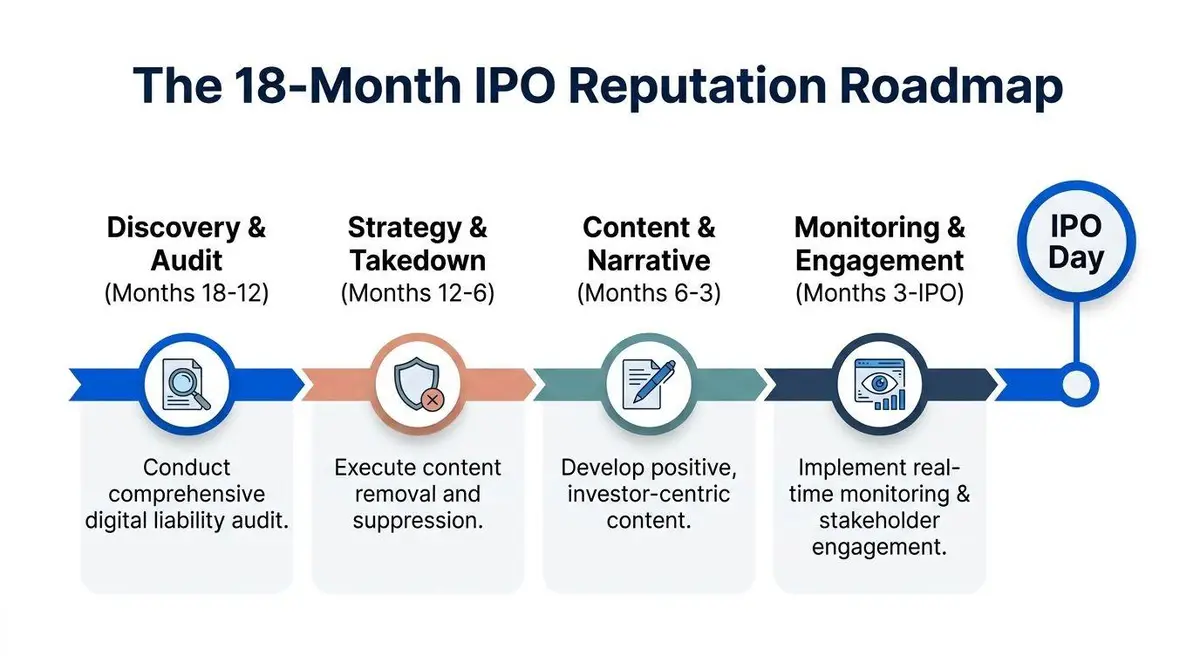
Months 18 to 12
At this stage, do not talk publicly more. Investigate more.
The work is forensic. Run the full digital liability audit across company, founders, senior executives, brands, products, and prior affiliations. Classify findings by severity, removability, and likely use case during diligence or media review. Freeze vanity activity that adds noise. Start building a confidential issue register.
This is also the right window to identify founder-specific exposure that may affect underwriter confidence before formal conversations intensify. If there are old posts, outdated narratives, or third-party content likely to create friction, put them on a legal and reputational track now.
Months 12 to 6
This is the heavy remediation period.
Use this window for direct takedown requests, jurisdiction-specific legal challenges, de-indexing submissions where available, platform escalations, and removal of impersonation, leaks, and privacy-invasive content. Where source removal is unlikely, begin suppression with high-authority assets that support the investor-facing narrative.
The company should also finalize internal escalation procedures. Who handles a leak. who approves outreach. who briefs executives. who tracks reposts. The mistake here is splitting ownership between legal and communications without a single operating lead.
Months 6 to 3
By now, the visible digital environment should already look materially better.
Shift effort toward controlled content and executive readiness. Refine executive bios, board-facing narratives, thought leadership, and corporate pages that strengthen search results. Prepare issue briefs for any controversy that cannot be removed. Run founder drills for media, banker, and investor questions.
This is also when you tighten account security, archive review, and access control around sensitive documents. A late-stage leak during this period is more damaging because it collides with growing external attention.
Months 3 to filing
The emphasis changes from cleanup to defense.
Move into real-time monitoring across search, social, review platforms, media, and dark web references. Watch for coordinated attacks, reposts of removed content, journalist interest patterns, and founder impersonation. Keep the working group active and small.
Use a short operating table so every team knows its role:
| Window | Main objective | Lead owner |
|---|---|---|
| 18 to 12 months | Audit and threat ranking | Legal plus reputation lead |
| 12 to 6 months | Removal and suppression | Legal, specialist takedown team, comms |
| 6 to 3 months | Executive prep and narrative control | Comms, legal, CEO office |
| 3 months to filing | Monitoring and rapid response | Cross-functional command group |
Quiet period behavior
This is not the moment for experimentation.
Keep communications narrow, approved, and consistent with securities counsel guidance. Maintain active monitoring. Escalate quickly. Respond only when a response reduces risk. Many companies create reputational damage in the quiet period not by being attacked, but by speaking carelessly while trying to look calm.
Operating principle: The roadmap works only if every month has an owner, every threat has a status, and every executive knows what not to say.
Securing Your Legacy Beyond the Bell
A listing does not erase your internet history. It raises the price of ignoring it.
That is the core point. Reputation management before IPO is not an image exercise. It is a governance discipline that protects valuation, underwriter confidence, executive credibility, and post-listing stability. If your team treats it as a side project for marketing, you will discover the mistake when scrutiny is highest and room for error is lowest.
The correct sequence is straightforward. Run a forensic audit. Rank the liabilities. Remove what can be removed. suppress what can be contained. prepare for what must still be answered. Then build monitoring that stays in place after filing, because public attention does not decline when the bell rings. It changes shape.
Founders often spend enormous energy perfecting the numbers and surprisingly little controlling the searchable record that surrounds those numbers. Well-informed investors notice both. So do reporters. So do opponents.
If you are 18 months out, act now. If you are inside that window, act faster. The market rewards companies that look governable under pressure. Digital disorder suggests the opposite.
If you need a confidential assessment of corporate and executive exposure before filing, ContentRemoval.com handles litigation-grade content removal, de-indexing, suppression, and ongoing monitoring for founders, executives, and high-stakes companies preparing for scrutiny. The right time to start is before the problem becomes part of the deal file.
Frequently asked questions
When should a company start reputation cleanup before an IPO?
Ideally 18 months out, with founder and executive profile audits beginning 18 to 24 months before listing. Months 18 to 12 are for the audit and threat ranking, months 12 to 6 for heavy remediation, months 6 to 3 for executive readiness and controlled content, and the final three months for monitoring and rapid response.
What kind of online content can hurt an IPO?
Not only major articles or lawsuits. Old interviews, review clusters, leaked internal documents, a founder’s archived social posts, cached pages and forum threads can all be used to argue a broader thesis about governance, culture, financial trust or security. The test is whether the content could force the CEO, general counsel or lead banker into an awkward explanation.
Should a founder publicly rebut negative content before an IPO?
Usually not. A public rebuttal can revive old allegations, trigger fresh coverage or make a low-visibility post newsworthy. The stronger move is often silent removal, quiet search cleanup and internal briefing, with any necessary response shaped jointly by legal and communications so it narrows the issue.