

Removing online content comes down to two outcomes: deleting it at the source, or de-indexing it from search engines so it cannot be found. Impersonation, non-consensual imagery and threats are reported as terms of service violations; stolen documents go through DMCA; false statements of fact through defamation claims; and old news articles through de-indexing or suppression.
Key facts
- An impersonation report needs the fake profile link, your authentic profile and government ID or business registration.
- A DMCA notice needs the exact URLs, proof of ownership and a sworn statement under penalty of perjury.
- Clear terms of service violations such as impersonation are often resolved within 24 to 48 hours.
- A US court order is often ignored by hosts abroad; pressure on registrars or data centers may work instead.
Where ContentRemoval.com comes in. ContentRemoval.com works alongside your counsel rather than in place of them, using platform relationships and technical methods to secure removal or de-indexing, often without public court filings, and monitoring for re-uploads by digital signature afterward. Executives, brands and family offices usually reach us through general counsel, a chief of staff or a PR agency. A free 15-minute Exposure Scan maps what is removable and by which route, and the report is yours to keep. Get a Free, Confidential Exposure Scan or read how our reputation management work is done.
When the need to remove online content arises, success is a function of a precise, surgical approach. It requires a combination of technical execution and legal strategy, tailored to each specific platform and circumstance. Whether confronting a defamatory review or a significant data breach, decisive action is paramount. The objective is constant: either compel the deletion of the content at the source or secure its de-indexing from search engines, rendering it undiscoverable.
Why Removing Online Content Is a Strategic Necessity

Harmful online content is not a mere annoyance; it is an active threat with measurable, detrimental effects on personal reputation, corporate stability, and financial standing. For high-net-worth individuals, executives, and their enterprises, ignoring a digital attack is a forfeiture of control. Falsehoods and leaked data propagate with extreme velocity, and a delayed response can inflict devastating and often irreversible damage.
Consider the tangible impact. A single, strategically placed false review can erode consumer trust and cripple revenue. An impersonation account of an executive can disseminate fraudulent directives, severing key partnerships. The unauthorized disclosure of proprietary data can obliterate a competitive advantage cultivated over years. Each scenario represents not merely a public relations issue, but a full-fledged crisis with severe financial consequences.
Understanding the Spectrum of Digital Threats
The initial step in any content removal campaign is an accurate diagnosis of the threat. The strategy for removing a fabricated review is fundamentally different from that required to address a damaging news article. A precise classification of the problem is essential.
Most damaging content falls into several distinct categories:
- Defamation and Libel: These are false statements of fact presented as truth, engineered to destroy a reputation. This includes fabricated reviews, malicious blog posts, or deceptively edited social media content.
- Leaked Data and Confidential Information: This encompasses the unauthorized release of any information intended to be private, from internal corporate documents and client lists to personal photographs and contact details.
- Executive or Brand Impersonation: Malicious actors create fraudulent social media profiles, websites, or email addresses to deceive customers, employees, or business partners. This constitutes a direct assault on credibility.
- Damaging News Articles: Old, inaccurate, or irrelevant news coverage that persists in search results can create a sustained drag on reputation.
When under digital attack, a passive posture cedes control of the narrative to the aggressor. Regaining the upper hand, mitigating damage, and demonstrating resilience requires decisive, strategic action.
When Professional Intervention Beodes Essential
For minor issues, such as reporting a clear violation of a social network’s policies, a direct, personal approach may suffice. However, this path is fraught with risk. Engaging directly with an antagonist can escalate the situation, and a poorly drafted takedown request will be summarily rejected, squandering critical time.
The threshold for professional intervention is crossed when the content poses a material threat to one’s finances, personal security, or corporate reputation. At this juncture, a specialized firm becomes necessary. We operate with a focus and discretion that an in-house team or a general-practice law firm cannot replicate. The reasons businesses should remove online content are often complex, intertwining technical and legal challenges.
Our established relationships with hosting companies, platform administrators, and search engine teams are critical for swift and effective execution. In the face of a serious online threat, a specialist firm is not a vendor; it is a vital strategic asset.
Navigating Platform Policies and Legal Pathways

To remove online content, the initial and most critical decision is the selection of the appropriate battleground. Every platform, from global social networks to niche forums, operates under its own set of rules. An incorrect initial strategy not only wastes time but may also alert the content publisher, significantly complicating subsequent removal efforts.
The two primary avenues of action are leveraging a platform’s internal policies or initiating formal legal action. The most expedient path is often reporting a violation of a site’s Terms of Service (ToS). Most platforms prohibit harassment, impersonation, or the disclosure of private information, providing a direct channel for a takedown request without immediate legal counsel.
However, relying on platform moderators presents a significant gamble. Enforcement is notoriously inconsistent, contingent upon internal priorities, the subjective judgment of individual moderators, or their current caseload.
A 2025 analysis of major social media platforms highlights this disparity. The overall removal rate for reported antisemitic content was a mere 52.53%. While TikTok demonstrated high responsiveness at 88.81%, X (formerly Twitter) lagged significantly, removing only 29.46% of reported posts. This variance underscores a critical reality: platform assistance is not guaranteed.
The Platform Policy Pathway
In ideal circumstances, the damaging content is a clear-cut violation of a platform’s published rules. In these instances, filing a direct report through their designated system is the optimal first move. This method is most effective for obvious infractions that require minimal interpretation.
This approach is highly effective in scenarios such as:
- Impersonation: An individual creates a fraudulent profile using a CEO’s name and photograph to spread disinformation. Nearly every social platform has a specific policy against this, making it a strong candidate for swift removal.
- Non-Consensual Imagery: Private, intimate photographs or videos are disseminated without consent. Platforms classify this as NCII (Non-Consensual Intimate Imagery) and typically act with urgency.
- Direct Threats or Harassment: A user directs explicit threats of violence toward a company’s social media account. This is a blatant breach of community standards that usually elicits a rapid response.
A common error is submitting a vague complaint. A report stating only “this is unfair” will be disregarded. Success requires identifying the specific rule being violated and providing clear, incontrovertible evidence.
When to Escalate to Legal Action
When content is damaging but does not explicitly violate a platform’s ToS, the policy-based approach is exhausted. A scathing one-star review, for instance, is unlikely to be removed unless it contains provably false statements of fact. This is the demarcation point where the strategy must shift from platform policy to legal enforcement.
Legal claims are not requests; they are demands backed by the force of law, compelling platforms and web hosts to act.
A formal legal claim elevates a removal effort from a user complaint to a non-negotiable legal demand. It bypasses the subjective judgment of a content moderator and compels action based on established law, not internal policy.
The most common legal instruments for compelling removals are:
- Copyright Infringement (DMCA): The Digital Millennium Copyright Act is a powerful tool when your original content (photographs, videos, text, or even logos) has been used without authorization. A properly executed DMCA notice legally obligates the hosting provider to remove the infringing material.
- Defamation (Libel): This applies when a false statement of fact is published that damages a reputation. A successful defamation claim requires proving the statement’s falsity, its publication to a third party, and the resulting harm. A court order declaring content defamatory is one of the most definitive methods to remove online content.
- Right to be Forgotten (RTBF): For individuals and entities in the EU or UK, this right is a significant strategic advantage. RTBF allows individuals to request that search engines delist links to information that is outdated, irrelevant, or no longer serves a public interest. It is exceptionally useful for managing old, negative news articles. Our guide to Google’s removal policy details this process.
Determining whether to begin with a policy report or proceed directly to a legal strategy is a critical judgment. The assessment must weigh the probability of success against the risk of escalating the situation. An incorrect first step can lead to a dead end, prolonging the exposure to the harmful content.
Executing Takedowns in Common Scenarios
When under digital attack, theoretical knowledge is insufficient. A clear, decisive action plan is required. Successful content removal depends on a prepared playbook, tailored to the specific nature of the content in question. The approach for a fraudulent review is distinct from that for a copyright violation. Knowing which instrument to employ, and when, is paramount.
The following are battle-tested strategies for neutralizing the most common and damaging forms of online attacks.
Addressing Defamatory Business Reviews
A sudden influx of negative reviews, particularly those containing falsehoods, can devastate a business’s reputation. The initial impulse to engage and defend is a mistake. The first action must be documentation. Capture clean, full-page screenshots of the reviews, ensuring the URL, date, and reviewer’s profile are clearly visible.
With evidence secured, consult the review platform’s rules. If the review contains hate speech, direct threats, or private information, it is a clear violation of the Terms of Service. The most effective course of action is to report it directly through the platform’s system, citing the specific rule it infringes.
If the review is malicious and contains false claims but does not cross a clear policy line, a direct report is likely to be ignored. At this point, the strategy must transition from a platform-based to a legal approach. An attorney must be consulted to determine if the review meets the legal standard for libel, a false statement of fact causing material harm. A formal legal demand letter or a court order becomes the most powerful weapon.
Engaging in a public back-and-forth to debunk a false review is a common but critical error. This engagement only amplifies the content’s visibility to search engines and potential customers. A discreet, targeted removal strategy is the superior course of action.
Neutralizing Leaked Documents or Intellectual Property
When private corporate documents, client lists, or copyrighted materials appear online without authorization, speed is of the essence. The primary legal instrument for this scenario is the Digital Millennium Copyright Act (DMCA) takedown notice. A properly filed DMCA notice creates a legal obligation for any U.S.-based hosting provider to remove the infringing content.
Before issuing the notice, crucial information must be compiled:
- The exact URLs where the stolen content is published.
- Proof of ownership of the material (e.g., copyright registrations, original file creation metadata).
- A sworn statement, under penalty of perjury, confirming ownership or authorization to act on the owner’s behalf.
Our detailed guide on how to write and file a DMCA takedown notice provides precise instructions. An improperly drafted notice can be rejected or, in a worst-case scenario, expose the filer to legal liability for misrepresentation. In some cases, the issue is not just copyright but brand misuse. Understanding the nuances of what is trademark infringement provides another powerful angle for compelling removal.
To facilitate strategic decision-making, the following matrix outlines common scenarios and the most effective initial actions.
Threat Assessment and Initial Action Matrix
| Content Type | Primary Threat | Initial Action Pathway | Recommended First Contact |
|---|---|---|---|
| Defamatory Review | Reputation Damage | Terms of Service Violation Report | Review Platform (e.g., Yelp, Google) |
| Leaked IP / Copyright | Financial Loss, Piracy | DMCA Takedown Notice | Website Hosting Provider |
| Impersonation Account | Fraud, Brand Damage | Impersonation Report | Social Media Platform’s Safety Team |
| Negative News Article | Reputation Damage | Suppression, De-indexing Request | SEO Professional or Legal Counsel |
This matrix serves as a quick-reference guide. While the specific strategy will be dictated by the nuances of each case, this provides a solid foundation for taking control.
This flowchart illustrates the decision-making process, clarifying whether to prioritize removal at the source or de-indexing from search engines.
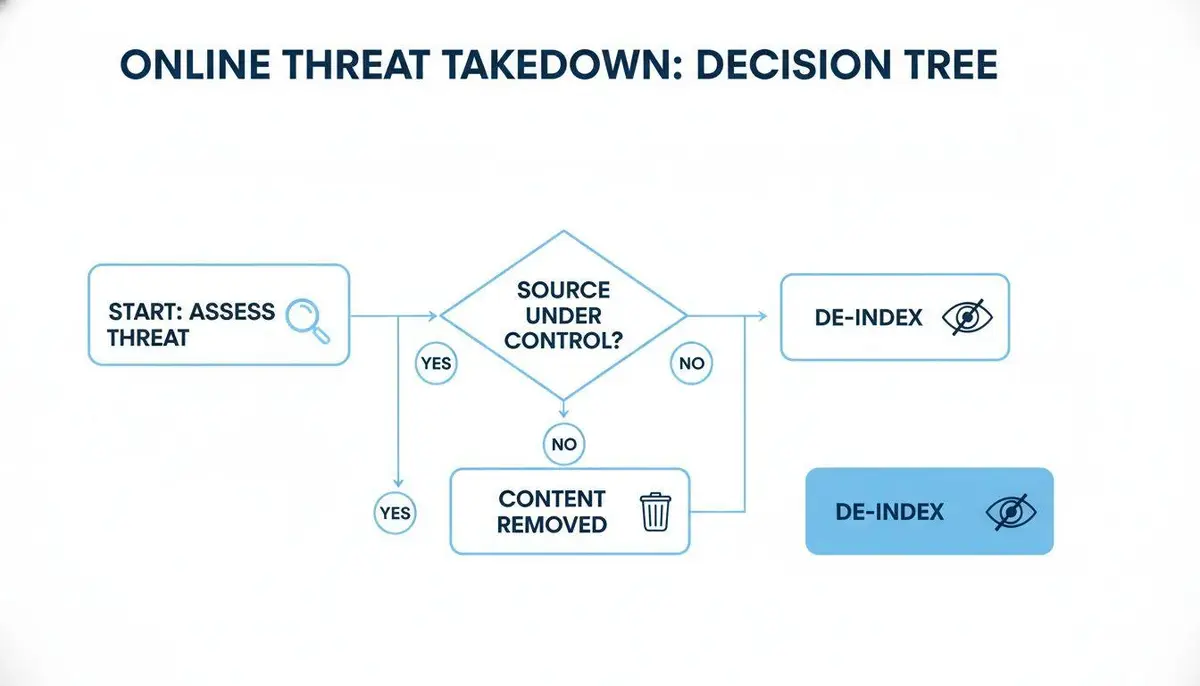
The critical takeaway is that the initial action depends on the leverage one holds over the publisher. If the publisher is uncooperative, the primary objective shifts to erasing the content’s visibility on Google.
Handling Executive and Brand Impersonation
A fraudulent social media profile or website leveraging your name or brand is a direct threat. These are tools used by malicious actors to defraud clients, disseminate misinformation, and erode hard-won credibility.
The immediate action is to utilize the platform’s dedicated impersonation reporting feature. Social media companies tend to treat these reports with gravity due to the high potential for fraud. To substantiate the claim, you will need to provide:
- A link to the fraudulent profile or website.
- A link to your official, authentic profile or website.
- A copy of a government-issued photo ID (for an individual) or official business registration documents (for a corporation).
If the platform’s response is delayed, escalation is necessary. This typically involves contacting their legal department directly with a formal letter. This communication should clearly articulate the potential for brand damage, fraud, and trademark violations, signaling that the matter is serious and will be pursued relentlessly.
Suppressing Damaging News Articles
Realistically, compelling a reputable news organization to retract a legitimate article is exceptionally difficult due to robust press freedom laws. Unless the article contains significant, provable factual errors, a direct removal request will almost certainly be denied.
Therefore, the strategy must pivot from source removal to suppression and de-indexing. Suppression is an SEO-driven methodology involving the creation and promotion of positive, authoritative content designed to outrank the negative article in search results. While the article still exists, it is relegated to the later pages of Google, where it is effectively invisible.
De-indexing is a more direct tactic. For individuals in the EU or UK, the Right to be Forgotten (RTBF) provides a mechanism to request that search engines remove links to outdated or irrelevant articles from searches for one’s name. In the U.S., a court order declaring the article’s content defamatory is typically required to force a search engine to de-index the link. Each situation demands a nuanced approach, meticulous documentation, and precise execution to achieve the desired outcome.
Dealing with Attacks from Across the Border
When harmful content originates outside one’s own country, the effort to remove online content transforms from a domestic legal issue into a complex international challenge. A legal strategy that is perfectly effective in the United States or the European Union can be rendered impotent when the website is hosted in a jurisdiction with different laws, or one that simply ignores foreign legal demands.
This is a stark reality of the modern internet. No global enforcement body exists to compel a website in one country to adhere to a court order from another. A U.S. defamation judgment, for example, is meaningless to a web operator in a jurisdiction that provides a haven for anonymous publishers.
The Problem of “Digital Walls”
This challenge is intensifying as more governments erect digital barriers. These measures not only control what citizens can access but also create safe harbors for malicious actors targeting individuals and businesses in other nations. A U.S.-based executive can be defamed on a website hosted in a country where local authorities have no interest in providing assistance.
The data confirms this trend. Global internet restrictions surged in 2025, with 81 new measures implemented across 21 countries. This represents a 29% increase from 2024, affecting an estimated 2.54 billion people. Social media was a primary target, with platforms blocked in 21 of those 81 restrictions. This rise in state control exponentially complicates reputation management, as government blocks can override a platform’s own policies. Further data on these internet shutdown trends can be explored at Surfshark.com.
When facing an attack from a hostile foreign jurisdiction, your domestic legal team is often powerless. The conflict shifts from the courtroom to a technical and logistical battle across borders, demanding specialized expertise that most law firms do not possess.
Why Standard Legal Tactics Fail
Consider a common scenario: A series of defamatory blog posts about a company’s leadership is published on a site hosted in a country with weak defamation laws. A U.S. lawyer dispatches a strongly worded cease-and-desist letter. The response is silence. The web host ignores the demand, aware that enforcing a U.S. court order internationally would be prohibitively expensive and likely futile.
This is a frequent and frustrating dead end. Any strategy to remove online content that depends on a single nation’s legal framework is destined to fail on the global stage. Success requires a more sophisticated, multi-layered approach.
- Know the Terrain: This involves a deep understanding not only of local laws but also of the political climate and practical realities of enforcement in the host country.
- Find a Technical Angle: When a direct legal approach is blocked, a technical one may succeed. This involves applying pressure to upstream providers, such as data centers or domain registrars, who may be more susceptible to their own legal exposure.
- Make It Disappear: If source removal is impossible, the next objective is to erase the content from search engines. An aggressive de-indexing campaign on Google and other platforms renders it practically invisible to the public.
For any individual or brand with a global presence, assuming a one-size-fits-all legal threat will be effective is a fundamental error. The internet is fragmented. Without a team possessing global reach and technical acumen, the battle is lost before it begins. A specialized firm with established processes for these hostile environments is not a luxury. It is a core component of any serious cross-border reputation defense.
Building a Long-Term Digital Reputation Defense

Achieving the removal of a harmful piece of content provides immediate relief, but it is rarely the final chapter. A purely reactive posture to online threats is a losing strategy, leaving one perpetually vulnerable to the next attack, which is almost certain to come.
The only viable long-term solution is a strategic shift from reaction to proactive defense. This involves constructing a digital fortress designed not only to withstand attacks but to deter them. This is not a one-time fix but an ongoing commitment to controlling the narrative and securing one’s online presence.
Continuous Threat Intelligence and Monitoring
The foundation of a robust reputation defense is a sophisticated monitoring system. This extends far beyond simple Google Alerts. It requires a professional-grade, AI-powered operation that scans the entire digital landscape, from public social media to the dark web, for any mention of key names, executives, and brands.
This level of monitoring provides a critical advantage by flagging genuine threats in real-time. It is engineered to detect:
- Impersonation Accounts: Identifying newly created social media profiles or domains attempting to mimic you or your business.
- Leaked Data: Discovering if personal information, login credentials, or internal documents have been exposed on paste sites or hacker forums.
- Negative Sentiment Spikes: Recognizing a sudden, coordinated influx of negative reviews or defamatory posts that indicate an organized attack.
Identifying these issues within hours, rather than weeks, is often the difference between a minor incident and a full-blown crisis.
This proactive stance is more critical than ever. The environment for open online discourse is deteriorating; internet freedom has declined for 15 consecutive years. Currently, 81% of the world’s internet users reside in countries where online expression can lead to arrest. As detailed on TechRadar.com, state and non-state actors increasingly deploy bot networks and AI-driven disinformation to manipulate public opinion, making it dangerously easy for attacks to propagate.
Proactive SEO as a Digital Shield
An effective defense incorporates a strong offense. By strategically publishing and promoting positive, authoritative content, you can build a formidable buffer that insulates your reputation. This practice is known as “proactive SEO” or building “digital armor.”
The methodology involves creating and controlling high-value digital assets, such as a personal website, comprehensive executive biographies, and insightful articles on reputable platforms. The objective is to dominate the entire first page of Google search results for your name.
When you control this prime digital real estate, any new negative content faces an immense challenge in gaining visibility. It is suppressed to the second or third page of search results, where it is effectively invisible to the vast majority of searchers.
A reputation built upon a foundation of strong, positive digital assets is far more resilient. When you control the narrative across multiple high-authority domains, a single piece of negative content is stripped of its power to define you.
Preventing Re-Uploads: The Achilles’ Heel of DIY Removal
One of the most common frustrations is the re-emergence of removed content on a different website. This is a standard tactic employed by persistent attackers, and it is a problem that general PR firms and most law firms are ill-equipped to combat.
Preventing re-uploads requires a specific, technology-driven process. After the original harmful content is removed, we capture its unique digital signature, or “hash.” Our monitoring systems then continuously scan the web for this exact signature.
This enables the automatic detection and issuance of takedown notices for re-uploads, often before search engines have the opportunity to index them. This relentless, automated follow-through is what transforms a temporary fix into a permanent solution. For any public figure or prominent brand, this level of specialized monitoring is a mandatory component of personal and professional security.
Frequently Asked Questions About Content Removal
When dealing with harmful online content, clients require clear, direct answers. Based on our experience across thousands of cases, we provide direct responses to the most pressing questions from clients and their legal counsel.
How Long Does It Typically Take to Remove Online Content?
This is a critical question, and the answer is that the timeline is entirely dependent on the specifics of the case.
For a straightforward violation of a platform’s Terms of Service, such as an impersonation account, removal can often be achieved within 24-48 hours. Platform safety teams are equipped to act quickly on such clear-cut infractions.
However, more complex scenarios, like a defamatory blog post on an uncooperative website, can extend into weeks or months, particularly if they necessitate legal notices or a court order. We initiate action immediately, but the final timeline is often contingent on the cooperation of the web host or publisher. We provide a realistic timeline assessment at the outset of every engagement.
Is It Possible to Permanently Remove Something from the Internet?
Yes, deleting content from its original source website is achievable. Once removed from the server, that specific file and its corresponding URL are permanently gone.
The true challenge lies in the content’s potential replication and dissemination across the web. Eradicating every single copy from the entire internet is a practical impossibility.
Our strategy is engineered around this reality. We focus on what can be controlled: aggressive removal at the source and a comprehensive de-indexing campaign to render the content invisible on search engines. The goal is to make the content so difficult to find that, for all practical purposes, it ceases to exist.
This two-pronged approach ensures that even if an errant copy persists on an obscure website, it lacks an audience and the power to inflict harm. We then implement continuous monitoring to detect and eliminate any new uploads before they can propagate.
What Is the Difference Between De-Indexing and Source Removal?
Understanding this distinction is fundamental to grasping our strategic approach.
- Source Removal: This is the primary objective. It signifies the complete deletion of the content from the website where it was published. The image, article, or video is irretrievably gone. This is the optimal outcome.
- De-Indexing: This is a tactical maneuver to remove a URL from search engine results. The content may still exist on the original website, but it becomes undiscoverable through Google, Bing, or other search engines.
We always pursue source removal as the first course of action. However, when a publisher is uncooperative, de-indexing becomes an exceptionally powerful tool. It eliminates over 99% of the content’s visibility, effectively starving it of an audience.
When Should I Engage a Professional Firm Instead of Handling It Myself?
A specialist should be engaged at the moment the problem exceeds the scope of a simple “report post” function. If the content poses a material threat to your reputation, finances, or personal safety, it is time for professional intervention.
Many individuals initially ask, ‘How Do I Delete My Digital Footprint?’ when confronted with a problem. While self-help guides can be useful for basic online hygiene, they are insufficient for complex and contentious situations.
Your legal counsel is indispensable for any legal proceedings, but our role is distinct. We leverage established relationships with hosts and administrators, along with proprietary technical methodologies, to secure results, often without the need for public court filings. We work in tandem with your legal team to deliver a faster, more private resolution.
When your reputation is at stake, you require a specialist with expertise in this specific domain. ContentRemoval.com combines technical proficiency with strategic negotiation to ensure harmful content is removed. Contact us for a confidential evaluation of your situation at ContentRemoval.com.