
Legal practitioner online reputation management in the UK runs inside SRA conduct and confidentiality duties, so a solicitor cannot reply to a false review with matter details, offer inducements for deletion or ask staff to post reviews. The workable sequence is an evidence file, severity triage, policy-specific platform reports, precise letters to editors, then de-indexing, suppression or legal unmasking.
Key facts
- A cited 2025 SRA report stated 28 percent of complaints against solicitors originated online.
- Public replies should acknowledge concern, state professional limits and invite direct contact, confirming nothing.
- Escalate on platform refusal, anonymous publication, branded search prominence, replication or jurisdictional overlap.
- Norwich Pharmacal relief can identify anonymous posters; the Online Safety Act 2023 adds platform pressure.
Where ContentRemoval.com comes in. ContentRemoval.com works with UK solicitors, barristers and their compliance partners when a fake review, impersonation profile, forum thread or misleading article is sitting above the firm’s own profile and the platform has declined to act. The senior partner or practice manager usually gets in touch once a well-supported complaint has been refused. A free 15-minute Exposure Scan maps what can be removed, de-indexed or suppressed within professional rules, and the report is yours to keep. Get a Free, Confidential Exposure Scan or read how our reputation management work is done.
A partner forwards the screenshot at 6:12 a.m. A one-star review accuses the firm of dishonesty. A forum thread repeats a distorted version of a client dispute. A directory still shows an old office address, and a search for your name now surfaces the wrong material before your profile, rankings, and published work. You already know the instinctive response is dangerous. A solicitor can’t handle an online attack the way a retailer, influencer, or startup founder might.
That is the core problem with legal practitioner online reputation uk advice. Most of it is written for ordinary businesses. UK lawyers operate inside a tighter frame. You have confidentiality duties, conduct obligations, and a regulator that will take a dim view of the wrong public reply, the wrong incentive, or the wrong attempt to bury criticism. A rushed response can turn a reputational attack into a conduct issue.
The commercial damage is immediate. A 2023 Yell study reported that 94% of UK solicitors had incorrect or inconsistent online information across listings, causing over 90% to miss potential business opportunities. That is not a branding nuisance. It means basic digital disorder already puts firms at a disadvantage before a hostile review, false allegation, or impersonation profile enters the picture.
Introduction The Reputational Attack Vector for UK Lawyers

When a lawyer’s online reputation comes under attack, the damage spreads along three lines at once. First, prospective clients see it. Second, existing clients begin to question judgment and stability. Third, the practitioner now has to respond under professional rules that limit what can be said, offered, challenged, or published.
That mix makes legal-sector reputation crises structurally different from normal review disputes. If the criticism is false, you still can’t disclose confidential facts to defend yourself. If the post is anonymous, you may need a technical and legal pathway to identify the publisher. If the platform refuses removal, the issue becomes one of search visibility, legal pressure, and evidence preservation.
Why generic reputation advice fails lawyers
A generic consultant will often tell you to reply fast, ask for removal, and generate fresh positive content. Parts of that are sensible. Parts of it are reckless for a regulated professional.
A solicitor or barrister has to ask different questions. Does a response imply a retainer existed? Does it disclose enough context to identify a matter? Does a direct message to the reviewer create a record that can later be mischaracterised? Does a push for deletion cross into conduct risk? The legal profession doesn’t get the luxury of improvisation.
Practical rule: If your first instinct is to “set the record straight” publicly, stop. Accuracy doesn’t protect you if the response breaches confidentiality or professional standards.
What the attack is really targeting
Most lawyers treat online reputation as a surface issue until the first real hit lands. That is a mistake. The attack vector isn’t only your name. It is your intake pipeline, your referral confidence, your chambers or firm standing, and your ability to convert a search into an enquiry without hidden friction.
A misleading article, a malicious review, or stale directory data all create the same downstream effect. A prospective client hesitates. A referrer checks another firm. An opponent’s client sees material that should never have gained prominence. By the time the issue feels serious internally, it has usually already shaped outside perception.
That is why a proper response starts with triage, not outrage.
Conducting an Urgent Reputation Damage Assessment
Panic leads lawyers to search their own name once, see the obvious result, and focus on the loudest problem. That is too narrow. You need an inventory. Not a feeling. Not a screenshot folder with no structure. A proper inventory.
The right assessment looks at content type, visibility, credibility signal, and client interpretation. That last point matters most. The SRA’s consumer research found that clients judge lawyers using specific quality indicators, with reviews cited by 60 to 70% of consumers and success rates by 50%+ in their trust assessment, as set out in the SRA consumer research on quality indicators. So don’t ask whether a post is unfair. Ask what a prospective client infers when they see it.
Map every hostile or misleading asset
Start by separating the material into categories. Different content requires different remedies, and if you mix them together you’ll waste time.
- Review platform content
Check Google Reviews, ReviewSolicitors, Trustpilot, and any niche directory where your firm or your own name appears. Distinguish between genuine but harsh criticism, likely fake reviews, and posts by non-clients. - Search engine results
Search your full name, common name variations, your firm name, office location, and core practice descriptors. Review the first page carefully. If a damaging result sits high, it has operational significance even if the underlying claim is weak. - Directory and listing inaccuracies
Old addresses, wrong phone numbers, and outdated service descriptions look administrative, but they erode trust fast. They also reinforce the impression that the firm is inattentive. - News, blogs, forums, and complaint threads
These carry a different kind of risk because they can be copied, indexed, and quoted elsewhere. A minor forum allegation can become a search problem if a higher-authority site republishes it.
Judge severity by visibility and credibility
Not every negative item deserves the same response. A buried comment on an obscure page isn’t equivalent to a Google result that appears above your biography. Likewise, a fake review on a low-trust platform isn’t the same as a mainstream article containing factual inaccuracies.
Use a simple working model:
| Factor | Low concern | Serious concern | Critical concern |
|---|---|---|---|
| Placement | Hard to find | Visible after deliberate search | First-page branded result |
| Format | Opinionated comment | Review or forum allegation | Indexed article, review cluster, impersonation |
| Perceived legitimacy | Anonymous and erratic | Plausible but weakly sourced | Published on trusted platform or major directory |
| Business effect | Irritating | Likely to deter enquiries | Directly damages intake and referrals |
This keeps you from overreacting to noise and underreacting to conversion-killing results.
Review content should be assessed the way a cautious client reads it. The question isn’t whether you know it’s false. The question is whether an outsider thinks it’s credible enough to walk away.
Build an evidence file before you touch anything
Many practitioners make the same mistake. They report a review, write an angry response, or call a platform before preserving evidence. Don’t do that.
Create a time-stamped file for each item and preserve:
- Full-page screenshots showing the URL, date, profile name, and visible context
- Search result captures showing ranking position for the relevant query
- Platform details such as account names, review dates, and whether the poster appears linked to any real matter
- Business impact notes including client comments, cancelled calls, or referral concerns
Short notes matter. If a receptionist says a caller mentioned “the review they saw online,” record it. If a referrer asks whether an article is true, preserve that email. Reputation cases become easier to handle when the operational consequences are documented early.
Identify the danger category
Once you’ve mapped the material, classify it by response path.
- Defamation risk involves false factual allegations that can damage professional standing.
- Platform abuse covers impersonation, fake reviews, manipulated profiles, and terms-of-service breaches.
- Privacy or data misuse may involve outdated personal data, unauthorised images, or disclosure of private material.
- Regulatory exposure arises when your own response could create confidentiality or conduct problems.
That final category is the one lawyers often ignore. You may be the target, but you can still become the second problem if you respond badly.
Immediate Containment Legal and Technical First Steps
The first two days matter because they shape every later option. Your job in that window is not to win the whole dispute. It is to contain spread, maintain your advantage, and avoid self-inflicted mistakes.
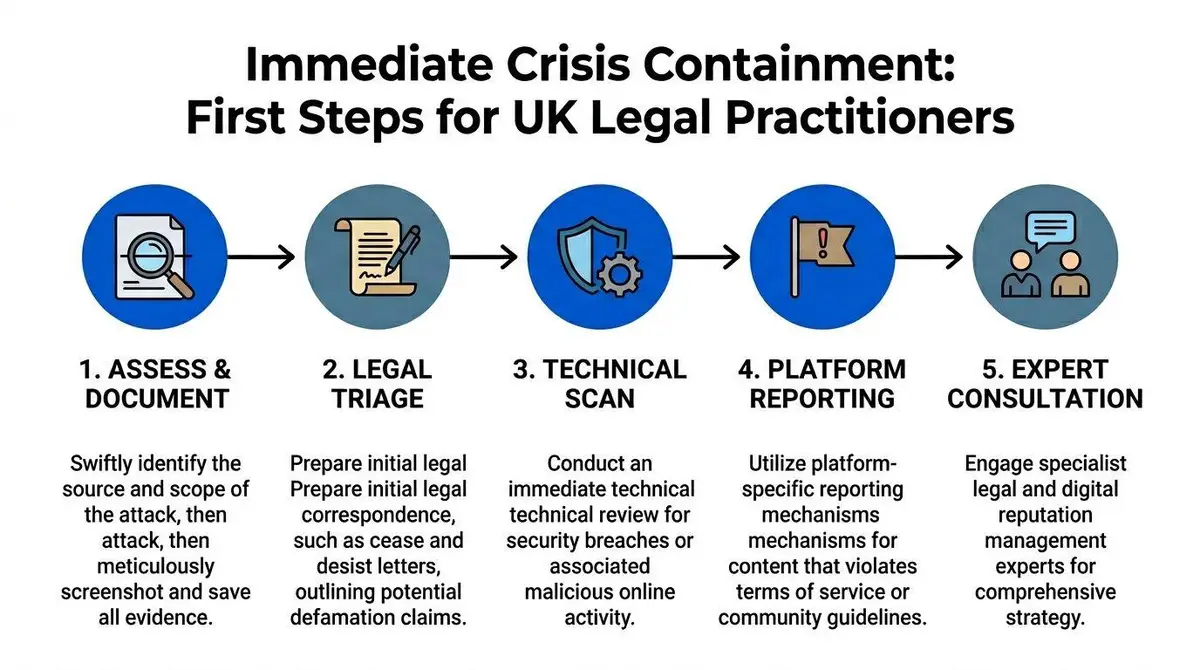
The compliance risk is real. Carter-Ruck’s overview notes that SRA guidelines prevent aggressive tactics such as pay-for-delete schemes, and a 2025 SRA report stated that 28% of complaints against solicitors originated online. So your first move cannot be improvisation, inducement, or online sparring.
For fake or abusive reviews
Start with the platform’s own rules, not your outrage. Google, Trustpilot, and legal review platforms all have policy pathways for impersonation, conflict of interest, non-client reviews, harassment, and false identity use. The report should be specific and evidence-based. “This is defamatory” is usually less effective than “this review appears to have been posted by a non-client and includes unverifiable allegations that breach the platform’s authenticity standards.”
If you need to post a public reply, make it sterile and brief. Confirm nothing. Deny nothing in detail. Invite an offline resolution channel. Never reveal matter history, billing facts, identities, or chronology.
A safe structure often looks like this:
- Acknowledge concern without accepting the factual premise.
- State professional limits on discussing client matters publicly.
- Invite direct contact through a designated compliance or client-care channel.
Never trade specifics in public. A solicitor who “wins” the comment thread can still lose the regulatory argument.
For inaccurate articles and publisher content
Where a news item, blog, or local outlet has published inaccuracies, write to the editor with precision. Identify the exact statements complained of. Distinguish fact from comment. Attach supporting material. Request correction, clarification, takedown, or amendment depending on the defect.
Keep the letter narrow. Broad, emotional complaints are easy to ignore. Editors respond more seriously when the complaint is itemised and evidenced. If the publisher sits under a recognised standards framework, preserve that route from the outset.
For impersonation or profile abuse
If a false profile exists on a directory, social platform, or review site, move quickly. Impersonation compounds because other users treat the account as a legitimate source. Report the profile through the platform channel and include proof of identity, official profile links, and any discrepancy between the fake account and real professional records.
At the same time, secure your own perimeter. Check administrative access to your firm website, business profile, and public bios. A reputation incident sometimes sits alongside a simple account compromise or unauthorised listing edit.
What you must not do
These are the mistakes that create lasting damage:
- Don’t offer inducements for deletion. Payment, discounts, reciprocal statements, or informal “fixes” are obvious risk points.
- Don’t publish client facts to defend yourself. Even where the reviewer is dishonest, your duties don’t disappear.
- Don’t instruct juniors to astroturf. Manufactured positive reviews are easy to spot and harder to explain later.
- Don’t threaten proceedings casually. Empty legal threats weaken your position with platforms and publishers.
If the issue is plainly defamatory and the facts justify a stronger response, use a structured escalation path. A practical reference point is this strategic guide for victims of online defamation, which outlines how evidence preservation, platform reporting, and legal positioning fit together. Use it as a framework, not as a substitute for matter-specific advice.
Write one internal record before anyone speaks publicly
Before the firm posts, calls, or emails externally, create a short internal note covering:
- what appeared
- where it appeared
- why it is false, abusive, or misleading
- who is authorised to respond
- which facts must not be disclosed under any circumstances
This stops well-meaning colleagues from freelancing. In reputation crises, internal message discipline is as important as external takedown work.
The Escalation Matrix DIY vs Professional Intervention
Some matters can be stabilised in-house. Many cannot. The dividing line isn’t how upset you feel. It is whether the problem has moved beyond platform reporting and ordinary correspondence into search visibility, anonymity, repeat publication, or cross-platform spread.
That distinction matters commercially. Reputation.com reports that 57% of UK law firm clients find solicitors through search engines, and that professional review management can produce a 266% CTR boost in Google’s Local 3-Pack. If a damaging result is sitting in branded search, delay has a measurable intake cost even before any formal complaint or claim is considered.
When in-house action is still rational
DIY or in-house handling is usually still viable where the issue is isolated, clearly policy-violative, and easy to evidence. A single fake review from an obviously unrelated account can often be handled through the platform route. So can an outdated listing or a mistaken directory entry.
It is also reasonable to keep matters in-house when the negative content isn’t ranking prominently, hasn’t been copied elsewhere, and doesn’t involve anonymity, extortion, impersonation, or private material. In those cases, discipline and speed matter more than specialist infrastructure.
The threshold for escalation
Escalate when one of these conditions appears:
- Platform refusal after a well-supported complaint
- Anonymous publication where the speaker’s identity matters to the remedy
- Search prominence on branded queries or service-based queries
- Replication across blogs, directories, forums, and social accounts
- Technical complexity involving de-indexing, suppression, or identity abuse
- Jurisdictional overlap where publisher, host, author, and target sit in different places
A senior partner should treat these as operational triggers, not optional warning signs.
If the content remains visible after your first formal attempt, the problem is no longer just “bad content.” It is now a systems problem involving search, platform process, evidence, and timing.
Decision Matrix DIY vs Specialist Intervention
| Metric | DIY / In-House | Specialist Firm (e.g., ContentRemoval.com) |
|---|---|---|
| Speed of initial response | Depends on internal availability and confidence | Structured triage and coordinated action across platforms, search, and evidence |
| Platform fluency | Usually limited to standard complaint forms | Repeated use of platform-specific reporting logic and escalation patterns |
| Confidentiality control | Risk of over-disclosure by fee earners or staff | Deliberate separation between legal facts, public messaging, and technical action |
| Search result strategy | Often limited to basic profile updates | Coordinated suppression, de-indexing requests, and asset promotion |
| Anonymous attacker cases | Difficult to progress without specialist input | Better alignment of legal, investigative, and digital pathways |
| Repeat reuploads | Handled reactively | Monitoring-led response with preventative follow-up |
| Partner time cost | High and distracting | Externalises execution while preserving internal control |
| Outcome certainty | Variable | More disciplined process where publisher, platform, and search routes must work together |
The point isn’t that every negative item needs outside intervention. It doesn’t. The point is that lawyers routinely wait too long to escalate because they assume the matter is still “just a review issue” long after it has become a search and credibility issue.
What specialist intervention changes
A specialist approach changes three things. First, it compresses time. Second, it separates legal risk from emotional reaction. Third, it opens technical routes that normal public relations advisers and general litigators often don’t run well.
That matters when the publisher won’t cooperate, the material cannot be removed at source immediately, or the objective is to stop damaging material from dominating search. Once the issue reaches that level, controlled intervention is usually cheaper than allowing the problem to sit in branded search while the firm debates optics.
Advanced Suppression and De-Indexing Strategies
When source removal fails, the strategy changes. You stop asking only, “Can this be deleted?” and start asking, “Can this be lawfully de-indexed, suppressed, displaced, or stripped of visibility?” That is where most non-specialists run out of road.

The legal and technical toolkit is broader than many UK practitioners realise. Addleshaw Goddard notes that the UK’s Online Safety Act 2023, fully effective in 2025, creates new duty-of-care obligations and that Ofcom fines in February 2026 totalled £12.7m against non-compliant sites. That matters because platform incentives have changed. In the right case, the route to rapid action may be regulatory and procedural rather than purely adversarial.
De-indexing is not the same as deletion
Lawyers often use “remove it from Google” as a catch-all phrase. That is imprecise. Source removal takes content off the originating site. De-indexing seeks to stop search engines from returning that URL for relevant queries. The page may still exist, but visibility is cut sharply.
That distinction matters in legal practitioner online reputation uk work because source publishers sometimes resist removal even where search visibility can still be challenged. Personal data arguments, outdated relevance, and disproportionate harm all belong in the analysis, but they must be framed accurately and supported with evidence. A useful technical primer is this strategic guide to de-indexing and search result removal.
Suppression requires architecture, not random content
Suppression is where firms often waste money. Publishing a few blog posts and refreshing a LinkedIn profile isn’t a suppression strategy. It is administrative tidying.
Effective suppression uses a coordinated asset set. That can include professional biographies, controlled firm commentary, third-party profiles, case commentary, media contributions, and authority pages that are technically optimised to rank for the right branded and practice-related searches. The objective isn’t vanity publishing. It is to build a stronger search environment so weak or outdated negative results lose prominence.
Removal is ideal. Suppression is often the practical second line. Both fail if the underlying digital estate is thin, inconsistent, or unmanaged.
Anonymous attacks and legal unmasking
Some of the worst reputational attacks come from posters who hide behind throwaway accounts, complaint sites, or forum aliases. In those cases, the issue is no longer merely content quality. It is attribution.
That is where legal mechanisms such as Norwich Pharmacal relief may become relevant, depending on the facts, platform data, and proportionality. Used properly, those tools can shift the case from speculative complaint to evidence-led pursuit. Used badly, they waste time and alert the attacker.
A short explainer is useful here before the technical discussion continues:
Online Safety Act leverage
The Online Safety Act is still underused in reputation strategy for professionals. Many lawyers still think in terms of defamation letters, platform forms, and long-tail PR cleanup. That misses a newer tactical advantage. Where content falls within platform safety duties or harassment-related concerns, the reporting posture changes. The platform’s own regulatory exposure becomes part of your strategy.
This doesn’t replace privacy law, defamation law, or internal platform policy. It adds pressure from another angle. For serious attacks involving threats, targeted harassment, impersonation, or certain forms of abusive material, that can materially improve response speed compared with a narrow “please take this down” request.
Proactive Monitoring and Reputation Fortification
Most firms don’t build a reputation defence system until after the first serious hit. That is backwards. A law firm should treat digital reputation the same way it treats conflicts, file security, and client complaints. It needs process, ownership, and regular review.
The preventive model is simple. Monitor early, correct fast, publish deliberately, and keep your listings and profiles under disciplined control. That creates a stronger digital estate, and it gives any future falsehood less room to dominate.
Build a standing monitoring routine
Someone in the firm should own branded search checks, review monitoring, listing accuracy, and escalation logs. Not ad hoc. Not “when someone remembers.” Weekly visibility checks are more useful than dramatic clean-up exercises every six months.
Use alerting tools and a dedicated review process. A structured service such as reputation monitoring for ongoing digital threat detection can sit alongside internal oversight where the firm needs discretion and continuity. The point is continuity. If no one is watching, attackers get a head start.
Publish authority, not fluff
Reputation fortification is not about flooding the internet with marketing copy. It is about increasing the visibility of trustworthy assets that deserve to rank. That means accurate lawyer bios, current directory profiles, serious commentary on your practice area, and verified professional information across the web.
A resilient digital footprint should do two things at once. It should convert prospective clients, and it should create friction against future attacks. Thin firms are easy to destabilise online. Well-built firms are harder to displace.
The best time to strengthen your search estate is before a crisis. The second-best time is immediately after containment.
Treat reviews as a regulated process
Review generation needs compliance discipline. Ask genuine clients at the right point, through a consistent process, and never in a way that pressures outcome or manipulates the platform. A clean, ethical review programme doesn’t just improve perception. It gives isolated malicious reviews less power to define the picture.
That is the long game. The firms that handle legal practitioner online reputation uk well are not the ones that panic better. They are the ones that build systems before panic becomes necessary.
Frequently Asked Questions for UK Legal Practitioners
Can I reply publicly to a false review if I know the client is lying
Yes, but only with restraint. Your response should not confirm the person is a client, disclose matter details, discuss fees, or reveal chronology that identifies the case. Keep it procedural and move the conversation offline. If a proper rebuttal would require confidential facts, don’t post it.
Can I sue an anonymous poster
Sometimes, yes. But the immediate question is usually whether you can identify them and preserve the evidence first. Anonymous attacks often require a sequence of platform requests, legal notices, and in some cases court-backed disclosure steps. If the post is spreading, focus first on preservation and visibility control rather than announcing proceedings.
What is the practical difference between removal and suppression
Removal targets the source. Suppression targets visibility. If a publisher deletes the page, that is source removal. If the page remains online but becomes difficult to find because search engines de-index it or stronger positive assets outrank it, that is suppression. In many solicitor reputation matters, the final strategy uses both.
Should I ask staff to post positive reviews to balance a bad one
No. That creates a credibility problem and can create a compliance problem. Reviews should come from real clients through a controlled and ethical process. Staff, friends, and informal supporters are not a substitute for genuine third-party feedback.
If you’re dealing with a live issue involving false reviews, defamatory content, impersonation, leaked material, or damaging search results, ContentRemoval.com can assess the matter confidentially and outline a precise action plan covering source removal, de-indexing, suppression, and monitoring. For a senior partner under pressure, the value isn’t noise. It’s controlled execution.