
Cleaning an online reputation follows three stages: triage, remediation and defense. Triage means auditing the first two pages of Google, Bing and Yahoo for every name variant and hostile modifier. Remediation means removing content through platform policy, legal process or publisher outreach, then suppressing the rest with stronger assets. Defense means monitoring so the problem does not return.
Key facts
- Audit the first two pages of Google, Bing and Yahoo, including misspellings and modifiers like lawsuit or scam.
- Three removal avenues exist: platform policy requests, legal action or lawyer letters, and direct webmaster outreach.
- Suppression only works when replacement assets carry stronger authority and relevance than the harmful page.
- Ongoing monitoring should cover search, news, social, review sites, employee forums and people-search listings.
Where ContentRemoval.com comes in. ContentRemoval.com runs source removal, de-indexing and suppression as one coordinated workflow for executives, founders and public figures whose name now returns a damaging result. Contact usually comes from the individual, their communications lead or their lawyer once a journalist or counterparty has noticed. A free, confidential 15-minute Exposure Scan maps what is removable and what must be suppressed, and the report is yours to keep. Get a Free, Confidential Exposure Scan or read how our reputation management work is done.
A client usually calls at one of two moments. They’ve just seen a damaging result appear on page one for their name or company, or a journalist has asked for comment on material they didn’t know was ranking. In both cases, the emotional reaction is the same. Loss of control. That reaction is rational.
Search results are where people make fast decisions about credibility. One industry roundup reports that 91% of adults use search engines to gather information, only 5% of internet users look beyond the first page, and 90% of customers read reviews before visiting a business. The same source says a single bad article on page one can cause a 22% loss of customers, according to 2024 online reputation management statistics. That is why reputation damage can’t be treated as a branding inconvenience.
For individuals, the consequences are just as direct. A widely cited business article reported that 70% of U.S. recruiters rejected candidates based on online reputation, as discussed in Entrepreneur’s guidance on cleaning up an online reputation. If you’re an executive, founder, investor, or public-facing professional, the issue isn’t abstract sentiment. It’s whether the wrong result becomes the first thing a counterparty sees when deciding whether to trust you.
The Critical First Hours of a Reputation Crisis
The first mistake is improvisation. Clients under pressure often start emailing publishers, posting defensive replies, calling colleagues, or threatening lawsuits before anyone has established what is visible, where it originated, and whether the content violates any platform rule. That usually makes the problem harder to solve.
Your first job is to stop adding oxygen. Don’t respond publicly out of anger. Don’t contact a hostile poster from your personal email. Don’t ask employees or friends to argue with strangers online. Every unplanned reaction creates more text, more screenshots, and more searchable material.
What matters immediately
The right question in the first hours isn’t “How do I fix this fast?” It’s “What exactly is ranking, who controls it, and what removal path exists?” That distinction matters because different assets require different treatment. A newspaper archive, a Reddit thread, a Glassdoor post, a YouTube video, and a data broker profile are not the same problem.
Practical rule: If you haven’t mapped the search landscape yet, you’re not in remediation. You’re still in discovery.
The second priority is internal discipline. One person should control outbound communications. Counsel, communications staff, executive assistants, and security personnel all need the same holding line and the same instruction set. If a media inquiry is active, preserve evidence and keep a clean chronology of events.
High-profile clients should also assume the issue may spread before it resolves. The right response is a contained protocol, not panic. If you need a structured starting point, this post-crisis online reputation repair checklist for executives is the correct model. Use it to impose order quickly.
The wrong instinct is PR first
Traditional public relations can help later. It is not the first tool. If harmful content is indexed, syndicated, reposted, or copied into forums and aggregators, media outreach alone won’t solve the immediate search problem. You need removal analysis, de-indexing analysis, suppression planning, and monitoring started in parallel.
That’s how to clean online reputation problems under pressure. Treat them as operational incidents with legal, technical, and search components. Sentiment can wait. Control comes first.
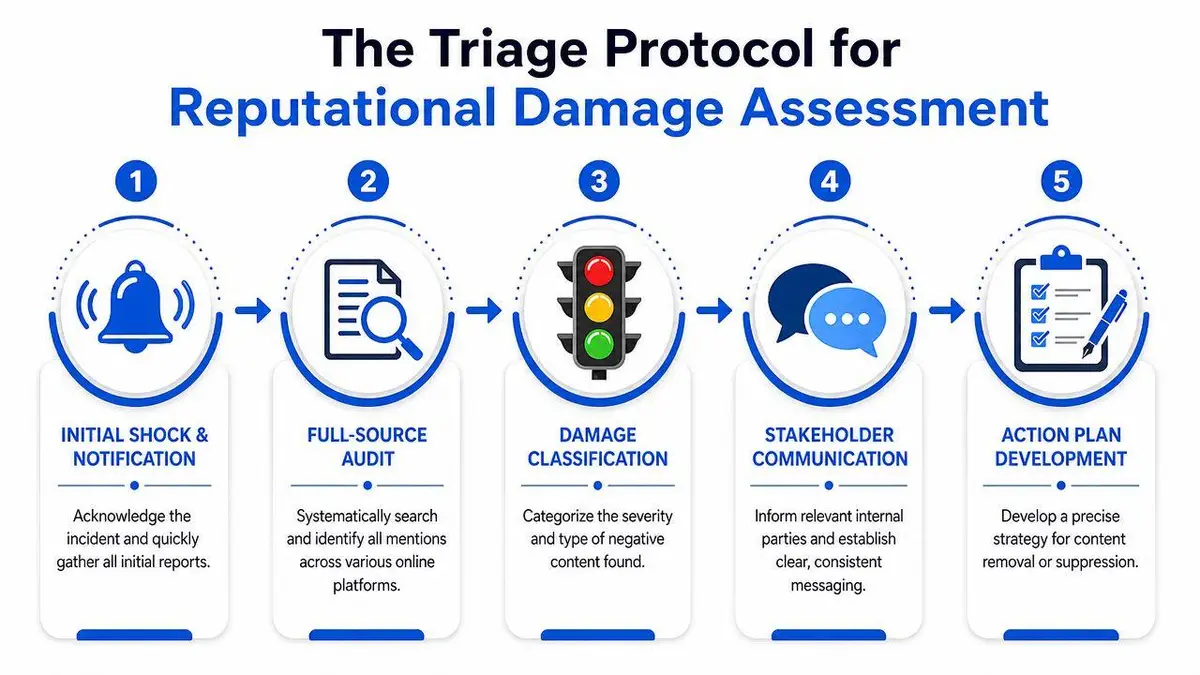
The Triage Protocol for Assessing Reputational Damage
It’s common to search once, see the obvious problem, and assume the whole issue has been found. This assumption is mistaken. Professional triage starts with a full-source audit across search engines, social platforms, review sites, employee-feedback forums, and people-search aggregators. The aim is simple. Build a complete map before touching anything.
Run the audit properly
A professional reputation audit requires documenting every mention on the first two pages of Google, Bing, and Yahoo, including variations like misspellings and keyword combinations such as “name + lawsuit,” and categorizing each as removable, suppressible, or requiring a response, according to Spin Sucks’ audit guidance.
That means you should search:
- Exact-name queries such as your personal name, brand name, and executive name.
- High-intent modifiers such as review, complaint, fraud, lawsuit, scam, fired, arrest, controversy, or whistleblower.
- Misspellings and abbreviations because attackers, forums, and scraped pages often rank on imperfect variants.
- Image and video surfaces because visual results can carry reputational damage even when web results look manageable.
Run those searches in logged-out or incognito sessions. Personalized results distort judgment. If you’re evaluating a serious matter, also compare devices and locations where possible because search presentation can differ.
Build a real triage sheet
Do not rely on memory and do not keep this in email. Use a spreadsheet or case log with fields that allow decisions to be made quickly.
At minimum, track:
- URL and platform
Record the exact page, not just the domain. - Search query that triggered it
This tells you how people are likely finding it. - Sentiment and severity
Separate inconvenient content from harmful content. - Control pathway
Mark each result as removable, suppressible, or response-required. - Evidence status
Save screenshots, timestamps, author details, and any policy violations.
This process turns chaos into a queue. You stop reacting to a vague “reputation issue” and start handling a finite set of assets with clear owners and next actions.
A weak audit leads to a weak strategy. You can’t suppress what you haven’t identified, and you can’t remove what you haven’t preserved.
Include adjacent attack surfaces
Search results are only part of the exposure. If the issue involves impersonation, phishing, or false outreach, check the operational perimeter as well. For example, if recipients are receiving suspicious messages from a lookalike domain or spoofed sender, verify whether your mail domain appears on public blacklists. A tool like this email blacklist checker can help determine whether the reputational issue has crossed into deliverability and trust problems.
Also review old microsites, dormant social accounts, and data broker listings. These are often neglected, and that neglect makes them easy for bad actors to exploit. In executive matters, a stale profile can become the path through which defamatory commentary or private information gets indexed.
Classify before acting
Not every negative result deserves the same urgency. Some assets should be attacked immediately because they are false, invasive, or policy-violating. Others should be deprioritized because they are low-visibility, low-authority, or easier to bury later. Good triage is judgment, not just inventory.
A disciplined assessment provides an advantage. It shows where to spend legal effort, where to push platform policy, where to create replacement content, and where silence is smarter than engagement.
Executing Takedown and De-Indexing Procedures
Removal is the cleanest outcome because it attacks the source of the problem. But “removal” is not one method. It is a set of pathways, each with different evidence standards, timelines, and risks. The common mistake is choosing a tactic based on frustration rather than fit.
Three removal avenues
The three main avenues are platform policy, legal process, and direct outreach to the site owner or publisher. Each works in the right circumstances. None works universally.
| Removal Avenue | Best For | Success Likelihood | Key Requirement |
|---|---|---|---|
| Platform policy request | Privacy violations, harassment, impersonation, non-consensual intimate material, copyright issues, rule-breaking reviews or posts | Often strongest when the content clearly breaches written policy | Precise policy match and complete supporting evidence |
| Legal action or lawyer letter | Defamation, stolen intellectual property, false allegations, coercive extortion, serious business harm | Strong when facts, jurisdiction, and evidence align | A legally supportable claim and disciplined documentation |
| Direct webmaster outreach | Outdated posts, factual errors, unnecessarily vindictive content, smaller blogs, niche forums | Variable, depends heavily on publisher incentives | A concise, credible request and a practical reason to cooperate |
Platform policy is usually the first test
Most major platforms publish rules around harassment, privacy, impersonation, copyright infringement, and other prohibited categories. If the content fits the policy, use that route first. It can be faster, cheaper, and less escalatory than a legal threat.
The key is precision. Don’t file a generic complaint saying the content is “unfair” or “hurting my reputation.” Point to the exact policy category, identify the exact offending passage, image, or account behavior, and attach supporting proof. Moderation teams respond better to rule-based submissions than emotional narratives.
Legal routes need discipline
Legal escalation is effective when the facts justify it. It is not a theatrical device. If you send a weak cease and desist letter, you may educate the other side, provoke republication, or invite ridicule. If you send a strong one, grounded in actual evidence and the right legal theory, it can move a publisher or platform that would otherwise ignore you.
Use legal process when the issue is false factual assertion, copyright theft, invasive disclosure, impersonation, or another claim your counsel can support. Preserve records before you send anything. Archive the page, capture source code when appropriate, save dates, and identify the operator if possible.
Weak legal threats are reputational self-harm. The other side only needs to expose one bad argument to undermine your position.
Direct outreach still matters
A surprising amount of harmful content sits on smaller sites operated by individuals who aren’t ideologues. They may be careless, spiteful, outdated, or inattentive. A professional removal request can work if it is restrained, factual, and specific.
What usually works:
- Pointing out inaccuracies with documentary support.
- Showing policy exposure such as unauthorized private information or copied material.
- Offering an efficient correction path so the publisher can resolve the matter without a prolonged exchange.
What usually fails is bluster. Aggressive personal emails, threats sent without counsel, or rambling explanations create resistance.
De-indexing is not source removal
Even when a page stays live, there may be options to reduce its search visibility. That is where de-indexing analysis becomes useful. The question is whether the result can be excluded from search presentation even if the underlying page remains online. If you need a precise explanation of that distinction, this guide on what de-indexing means in search result removal lays it out correctly.
Choose the path by evidence, not emotion
When clients ask which route has the highest probability of success, the answer is always conditional. Policy works best when the violation is plain. Legal works best when the claim is real and documented. Outreach works best when the operator is reachable and rational enough to care.
A specialist firm will often run more than one path in parallel. That is sensible. A policy request can be filed while legal review proceeds and while suppression assets are built in reserve. ContentRemoval.com is one example of a service that handles source removal, de-indexing, and monitoring in a coordinated workflow. The important point is not the vendor. It is the sequencing.
If removal is available, pursue it first and do it cleanly. If it isn’t, move to suppression without delay.
Winning the SEO Battle Through Strategic Suppression
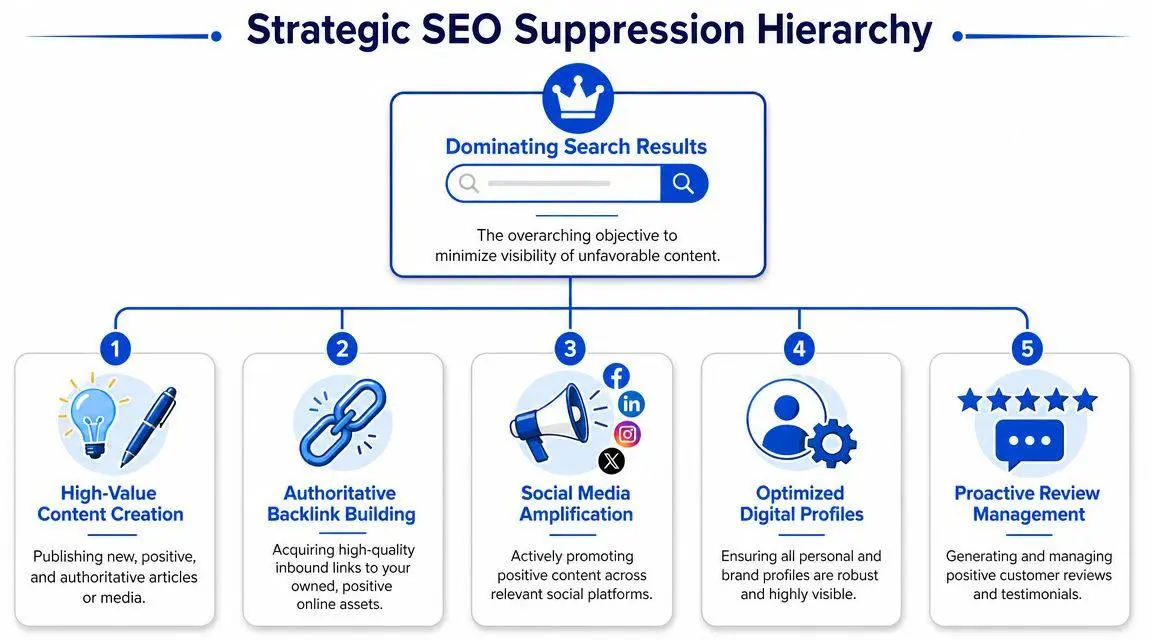
When a harmful result can’t be removed, you stop arguing with the page and start outranking it. That is the discipline commonly misunderstood. Suppression is not “posting more positive things.” It is a controlled search campaign built to displace specific negative assets from page one.
The most effective remediation workflow combines policy-based removals with the creation of fresh, positive content, supplemented by continuous monitoring through tools like Google Alerts to ensure rapid response to new mentions, as noted in this reputation remediation workflow.
Build assets you control
The objective is to create a digital fortress around the branded search terms that matter most. For an executive, that usually means name-based queries. For a company, it may be brand-plus-review, brand-plus-complaint, product names, and founder names.
Start with assets you directly control:
- A personal or corporate site with indexed pages built around branded search terms.
- LinkedIn and executive bios that are complete, current, and internally consistent.
- Author pages, interview pages, and newsroom content that establish authority.
- Professional social profiles that are public enough to rank and coherent enough to trust.
These assets must be optimized deliberately. Title tags, on-page language, internal linking, publishing cadence, and off-site references all matter. A weak profile won’t outrank a strong negative article merely because it exists.
Match the target query
Suppression fails when teams create generic positive content untethered to the search term causing damage. If the harmful page ranks for “Jane Doe lawsuit,” then a vague leadership post titled “My career journey” won’t solve the problem. You need adjacent, credible, search-relevant content that can compete in that branded environment.
That may include biography pages, speaking appearances, trade publication commentary, company announcements, podcasts, philanthropy pages, or press profiles. The mix depends on the search environment. A professional campaign studies which domains already rank for your name and then places stronger material into the same ecosystem.
Search engines don’t reward optimism. They reward relevance, authority, and technical execution.
Authority beats volume
Clients often assume the answer is to publish a flood of content. Usually it isn’t. Ten weak pages on low-trust domains won’t beat one strong result on a respected publication. Suppression works when the replacement assets have better signals than the harmful asset.
That means focusing on:
- Authoritative domains
A credible media mention or institutional profile often carries more weight than a self-published blog. - Strong entity consistency
Use the same professional name, title, headshot, and bio language across platforms. - Backlink support
New pages need references, citations, and distribution if they’re going to climb. - Freshness with purpose
Publish on a schedule, but only where the asset can plausibly rank.
A disciplined explanation of that method appears in these strategic methods to suppress negative content and restore digital authority. The framework is useful because it treats search control as infrastructure, not spin.
Reviews and response strategy
For businesses, reviews are part of suppression because they occupy branded search space and influence click behavior. Solicit legitimate feedback from satisfied customers. Do it consistently and ethically. Never buy reviews, script fake testimonials, or ask staff to manufacture sentiment. Those shortcuts create a second crisis.
Response strategy matters too. Some negative review pages should be answered publicly with restraint and then taken offline into private resolution. Others should be left untouched while stronger assets are built elsewhere. The deciding factor is whether engagement improves your position or feeds the page.
Think in portfolios, not pages
The right mental model is a portfolio of ranking assets. Your site, social profiles, bios, interviews, review profiles, and reputable mentions should reinforce each other until the first page is dominated by properties that are accurate, controlled, and commercially useful.
That’s how to clean online reputation issues when removal is unavailable. You don’t ask search engines for mercy. You give them better options.
Building Long-Term Digital Defenses
The clean-up phase ends. The defense phase doesn’t. Reputational security is a standing function, especially for executives, family offices, litigants, and public figures who attract recurring scrutiny.

Set up a live monitoring regime
Basic alerts are better than nothing, but they are not enough for a high-risk profile. You need a monitoring stack that checks search, news, social mentions, review platforms, employee forums, people-search sites, and impersonation surfaces on a continuing basis.
At minimum, establish:
- Search alerts for exact names, brand variants, and hostile modifiers.
- Platform reviews on a recurring schedule for major social and review sites.
- Evidence capture rules so any new item is preserved before someone edits or deletes it.
- Escalation criteria that determine what goes to legal, communications, security, or executive staff.
The point is speed. Harmful content is easier to contain when you catch it early, before mirrors, reposts, and commentary proliferate.
Close the easy gaps
Most repeat crises exploit neglected assets. Register obvious domain variations tied to your name or brand. Secure social handles even if you won’t use every platform. Lock down privacy settings on personal accounts and review old posts with current risk in mind.
For executives, profile hygiene is also defensive SEO. A strong professional footprint gives you more control when something adverse surfaces. If LinkedIn is part of your visibility strategy, practical guidance on LinkedIn personal branding can help shape a profile that ranks cleanly and reads credibly under scrutiny.
Here is a useful overview of the broader discipline and why it requires active management:
Create a response protocol before you need it
Most organizations lose time because they decide roles during the crisis. Don’t do that. Assign ownership now. Decide who preserves evidence, who approves statements, who contacts counsel, who manages platform submissions, and who has authority to stay silent.
The strongest defense is not constant talking. It is fast detection, clean evidence, and controlled escalation.
Long-term defense also means resisting vanity metrics. You do not need to monitor everything equally. You need to monitor the surfaces that can affect trust, hiring, deal flow, press coverage, and personal safety. Focus there and maintain the discipline.
Your Confidential Action Plan for Reputation Recovery
If the issue is active, your action plan has three pillars. Triage, remediate, defend. In that order.
Triage means building the complete map. Identify every ranking asset, every variant query, every publisher, and every pathway for action. Without that inventory, you are guessing. Guessing is expensive.
Remediation means choosing the correct mechanism for each asset. Some pages should be removed through platform policy. Some require legal pressure. Others aren’t worth fighting at the source and should be displaced through search suppression instead. Experience is paramount, for the wrong move can entrench the result.
Defense means you don’t let the same problem regenerate under a new URL, a copied post, a data broker listing, or an impersonation account. Monitoring, defensive registrations, profile control, and response discipline are what keep a one-time clean-up from becoming a permanent operating burden.
For clients whose reputational exposure also intersects with email trust, sender credibility becomes part of the same risk picture. If you need to understand that layer, learn about email reputation with Breaker. It’s a useful reminder that credibility problems rarely stay confined to one channel.
High-stakes matters demand discretion. They also demand realism. Some content can be removed quickly. Some can be de-indexed. Some has to be buried under a stronger search architecture. What matters is that you stop treating the problem as public relations and start treating it as a controlled intervention.
If you need a discreet assessment, ContentRemoval.com can review the search environment, identify the most viable removal and suppression paths, and outline a confidential action plan specific to the assets, platforms, and jurisdictions involved.
Frequently asked questions
What should I do first when a negative result appears for my name?
Stop adding material. Do not reply publicly, email the poster from a personal account or threaten a lawsuit before you have mapped what is ranking and who controls it. Preserve screenshots, timestamps and URLs, and put one person in charge of outbound communication.
Can a bad search result be removed or only buried?
It depends on the content. Privacy violations, harassment, impersonation and rule-breaking posts can often be removed through platform policy, while false factual claims may justify legal pressure. Content that cannot be removed at the source is displaced by building stronger assets that outrank it.
Why does posting positive content not fix my search results?
Search engines reward relevance, authority and technical execution, not volume. Ten weak pages on low-trust domains will not outrank one strong negative article, and generic content untethered to the damaging query will not compete for it.