
To delete information from Google, match the content to the right pathway: the Results About You tool for personal details, the DMCA form for copyrighted material, the NCII form for intimate images, legal removal requests for court orders, and outdated content requests for stale pages. Removing content at the source is more permanent than de-indexing, so address the host first.
Key facts
- Google removes financial details, government ID numbers, login credentials, explicit images and malicious contact information.
- Public records, legitimate news articles and your own public posts rarely qualify through standard channels.
- DMCA requests typically resolve in 2 to 4 days, personal information requests in 1 to 2 weeks.
- Removal from one country’s Google domain under GDPR does not automatically clear Google.com.
Where ContentRemoval.com comes in. Self-service forms work when the content fits Google’s categories neatly. When it does not, when the publisher refuses, or when the same material sits across several sites and search engines, ContentRemoval.com runs source removal, de-indexing and monitoring as one managed case, with the discretion sensitive matters need. Individuals, their assistants and their lawyers all make contact. A free 15-minute Exposure Scan maps what is removable, and the report is yours to keep. Get a Free, Confidential Exposure Scan or read how our search result removal work is done.
Your personal information, professional reputation, and digital privacy are constantly at risk when unwanted content appears in Google search results. Whether it’s outdated articles, inaccurate information, private details, or damaging content, understanding how to delete information from Google has become an essential skill for protecting your online presence. This comprehensive guide walks through the available methods, legal frameworks, strategic approaches, and professional solutions for removing unwanted information from the world’s most powerful search engine.
Understanding What Information Google Will Remove
Google maintains specific policies governing what types of content qualify for removal from search results. Not all information is eligible for deletion, and understanding these distinctions is critical before initiating any removal request.
Eligible Content Categories
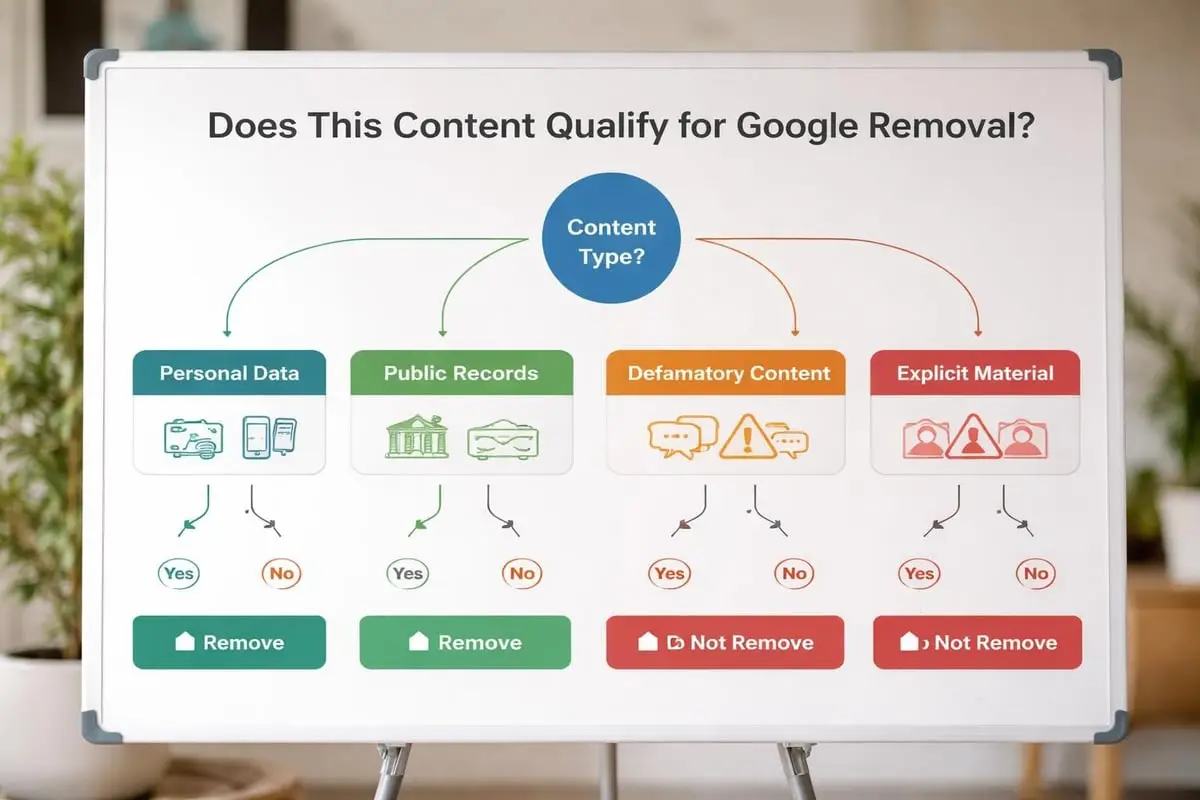
Google has expanded its removal policies significantly in recent years. The platform now considers removal requests for several categories of personal information:
- Financial information including bank account numbers, credit card details, and signatures on financial documents
- Government-issued identification numbers such as Social Security numbers, passport numbers, and driver’s license information
- Confidential contact information including phone numbers, email addresses, and physical addresses when used maliciously
- Login credentials and passwords exposed publicly
- Explicit personal images shared without consent, including revenge pornography
- Medical records and health information protected under privacy laws
- Minor’s personal information when it poses safety or privacy risks
According to WIRED’s coverage of Google’s expanded policies, the company has made significant updates to accommodate growing privacy concerns and regulatory requirements worldwide.
Non-Eligible Content
Certain categories rarely qualify for removal through standard channels:
- Public records and court documents already in the public domain
- News articles from legitimate publications, even if unfavorable
- Social media posts you published yourself on public profiles
- Business reviews on third-party platforms
- Information repeated across multiple authoritative sources
Direct Removal Methods Through Google
The most straightforward approach to delete information from Google involves using the company’s official removal request tools. These methods work best when your situation aligns with Google’s established policies.
Using the Results About You Tool
Google’s “Results About You” feature allows individuals to monitor and request removal of personal information appearing in search results. This tool represents Google’s most user-friendly approach to content management.
Step-by-step process:
- Visit the Results About You dashboard while signed into your Google account
- Enter your name and other identifying information you want to monitor
- Review flagged results containing your personal information
- Select specific search results containing eligible content
- Submit removal requests with required documentation
- Monitor request status through the dashboard
The tool automatically scans for new instances of your information and sends alerts when potentially removable content appears. MakeUseOf provides detailed guidance on maximizing the effectiveness of this feature.
Submitting Legal Removal Requests
For content involving legal violations, Google offers specialized removal pathways:
| Violation Type | Request Form | Processing Time | Success Rate |
|---|---|---|---|
| Copyright infringement | DMCA takedown | 24-48 hours | Very High |
| Doxxing/Personal information | Personal info request | 3-7 days | High |
| Non-consensual explicit imagery | NCII form | 24-72 hours | Very High |
| Court-ordered removals | Legal removal request | 1-3 weeks | Guaranteed |
Each removal type requires specific documentation. Copyright claims need proof of ownership, while doxxing complaints require evidence of malicious intent. The Android Central guide offers practical advice on gathering necessary documentation.
Outdated Content Removal Requests
Information that was once accurate but is now outdated may qualify for removal, particularly when it causes ongoing harm. Google evaluates these requests based on several factors:
- Time elapsed since the information was accurate
- Public interest in the historical information
- Harm caused by continued visibility
- Source authority and whether the original site updated or removed content
For outdated content that violates your privacy or contains false information, removing outdated content through professional channels often proves more effective than self-service requests.
Legal Frameworks Supporting Information Removal
Understanding your legal rights significantly strengthens removal efforts. Different jurisdictions provide varying levels of protection for individuals seeking to delete information from Google.
Right to Be Forgotten (GDPR)
The European Union’s General Data Protection Regulation grants EU citizens substantial rights to request removal of personal information from search results. This framework extends beyond Google’s standard policies.
GDPR removal criteria:
- Information is inaccurate or no longer relevant
- Data was processed unlawfully
- Individual withdraws consent for processing
- No overriding legitimate grounds for continued processing exist
GDPR requests require specific documentation proving EU residency and explaining why the information meets removal criteria. Success rates exceed 60% for properly documented requests.
California Consumer Privacy Act (CCPA)
California residents benefit from similar protections under CCPA, though enforcement mechanisms differ from GDPR. The law grants deletion rights for personal information collected by businesses, including search engines operating in California.
Digital Millennium Copyright Act (DMCA)
Copyright holders can delete information from Google when search results link to content that infringes their intellectual property rights. DMCA takedowns represent one of the most effective removal methods, with processing typically completed within 48 hours.
The process requires:
- Identification of copyrighted work
- Location of infringing material (URLs)
- Sworn statement of good faith belief
- Authorization to act on copyright holder’s behalf
- Contact information and signature
For businesses protecting branded content, copyright infringement removal services streamline this process and ensure proper legal documentation.
Source Removal vs. De-indexing Strategies
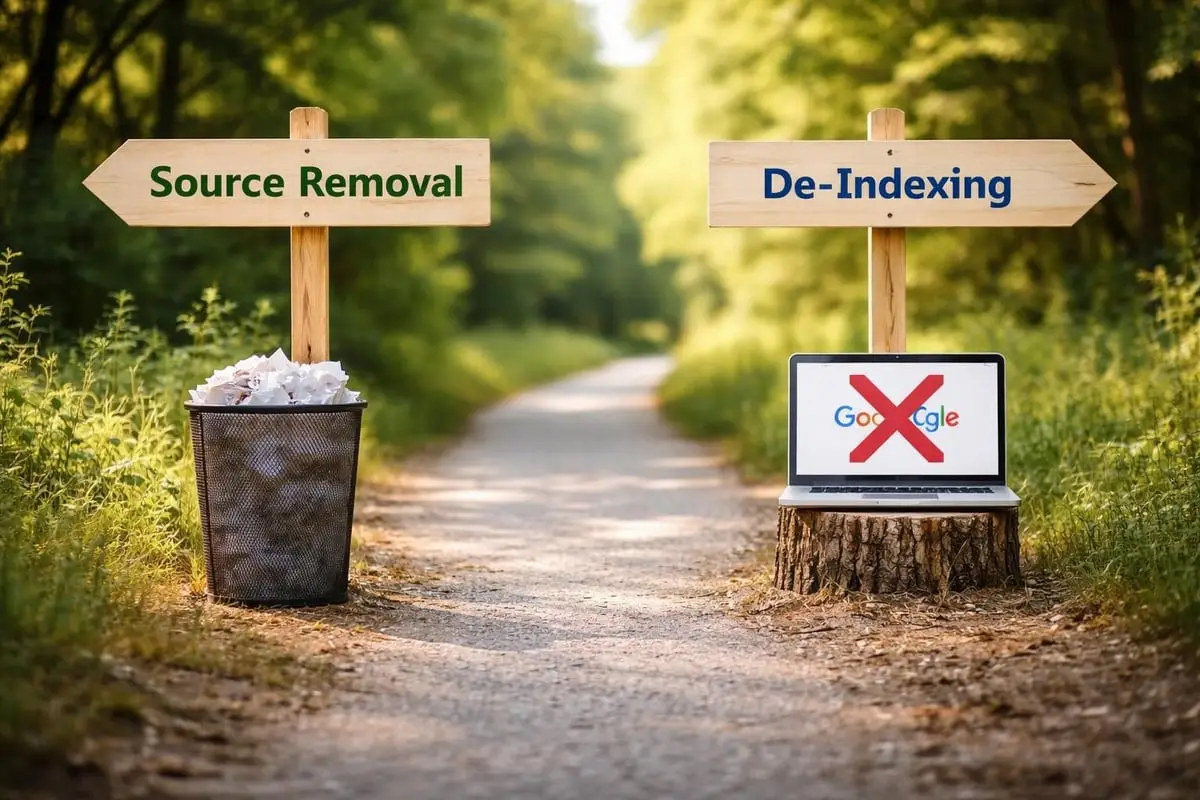
Two fundamental approaches exist when you need to delete information from Google: removing content at its source or de-indexing it from search results. Each strategy has distinct advantages and appropriate use cases.
Direct Source Removal
Removing content directly from the hosting website represents the most permanent solution. When successful, the information disappears entirely from the internet, not just from Google’s index.
Source removal advantages:
- Permanent deletion prevents re-indexing
- Cross-platform impact removes content from all search engines
- Stronger legal standing in future disputes
- Reputation repair addresses the root problem
Source removal requires cooperation from website owners, platform administrators, or hosting providers. Legal justification, policy violations, or mutual agreement typically drive successful source removals.
Search Engine De-indexing
When source removal proves impossible, de-indexing removes the content from Google’s search results while leaving it on the original website. This approach works when:
- Website owners refuse removal requests
- Content doesn’t violate hosting platform policies
- Legal action against the source isn’t viable
- Rapid results are needed for damage control
De-indexing through Google’s official removal request tools focuses on suppressing visibility rather than eliminating content. The information may still appear in direct site searches or alternative search engines.
Advanced Strategies for Difficult Removals
Standard removal requests sometimes fail, particularly for content that doesn’t clearly violate Google’s policies or involves non-cooperative publishers. Advanced strategies address these challenging scenarios.
Multi-jurisdictional Requests
Content appearing in Google’s search results across different countries can be approached through region-specific removal requests. Information removed from Google.co.uk under GDPR may still appear on Google.com, requiring separate requests for each jurisdiction.
Strategic considerations:
- Primary market focus on regions where the content causes most damage
- Regulatory advantages leveraging stronger privacy laws in specific jurisdictions
- Cascading effects as some regional removals influence global visibility
- Compliance variations as Google applies different standards across regions
Legal Demand Letters and Takedown Notices
Formal legal communications escalate removal requests beyond self-service tools. Attorney-drafted demand letters cite specific legal violations and potential consequences for non-compliance.
Effective legal demands include:
- Clear identification of harmful content with URLs
- Specific legal violations (defamation, privacy invasion, copyright)
- Evidence supporting claims of harm or illegality
- Timeline for compliance before escalation
- Consequences for failure to remove content
NotebookCheck’s guide emphasizes the importance of documented harm when pursuing legal removal pathways.
Court Orders and Subpoenas
The most powerful method to delete information from Google involves obtaining court orders mandating removal. Judges issue these orders when plaintiffs demonstrate clear legal violations and irreparable harm.
Types of court-ordered removals:
- Preliminary injunctions for urgent situations requiring immediate action
- Permanent injunctions following successful defamation or privacy lawsuits
- Sealed court records automatically qualifying for removal
- Judgments against publishers requiring content deletion
Court orders guarantee compliance but involve significant time and expense. Success requires strong legal representation and clear evidence of damages.
Professional Content Removal Services
Complex removal scenarios often exceed individual capabilities, particularly when dealing with multiple platforms, uncooperative publishers, or legally ambiguous situations. Professional services bring specialized expertise and established relationships that accelerate results.
When to Engage Professional Help
Certain situations warrant professional intervention from the outset:
- Multiple platforms hosting the same harmful content
- High-stakes reputation damage affecting business operations or personal safety
- Legal complexity requiring coordination between attorneys and technical specialists
- Time sensitivity when rapid removal is critical
- Failed DIY attempts where self-service requests were denied
Services like Content Removal specialize in direct takedown and de-indexing strategies, combining legal expertise with technical implementation to achieve results that individual efforts cannot match.
Case-Managed Approach Advantages
Premium removal services employ dedicated case managers who oversee every aspect of content elimination:
| Service Component | DIY Approach | Professional Service |
|---|---|---|
| Legal research | Self-guided | Expert analysis |
| Platform negotiation | Limited access | Established relationships |
| Documentation | Individual effort | Comprehensive support |
| Follow-up | Manual tracking | Automated monitoring |
| Success rate | 30-40% | 75-90% |
Professional services also provide discretion that matters in sensitive cases. High-profile individuals, executives, and businesses benefit from confidential handling that protects privacy throughout the removal process.
Global Removal Capabilities
Content appearing across international platforms requires coordinated global strategies. Professional services maintain relationships with platforms, publishers, and legal representatives worldwide, enabling comprehensive removal campaigns.
Platforms requiring specialized expertise:
- International news organizations with editorial independence
- Social media networks with varying regional policies
- Web archives preserving historical snapshots
- Data broker sites aggregating public records
- Forums and discussion boards with anonymous administrators
Monitoring and Preventing Future Issues
Successfully removing information represents only half the battle. Ongoing monitoring and proactive prevention protect against new harmful content appearing in search results.
Setting Up Automated Monitoring
Several tools and services track new mentions of your name, brand, or specific search terms:
- Google Alerts for basic keyword monitoring (free but limited)
- Brand monitoring platforms offering comprehensive tracking (Mention, Brand24)
- Specialized reputation monitoring with removal integration (professional services)
- Social listening tools capturing cross-platform mentions (Brandwatch, Talkwalker)
WRDW’s reporting highlights the importance of continuous vigilance as new content constantly emerges online.
Proactive Reputation Management
Prevention proves more effective than remediation. Strategic content creation and digital presence management reduce the likelihood that harmful information ranks prominently.
Proactive strategies include:
- Positive content development creating authoritative profiles and articles
- SEO optimization ensuring favorable content outranks negative results
- Social media management maintaining active, professional presences
- Privacy settings audit restricting public access to personal information
- Regular search result reviews identifying issues before they escalate
For comprehensive protection, digital footprint cleanup services systematically reduce your vulnerability to future incidents.
Privacy Hygiene Best Practices
Minimizing your digital footprint reduces the volume of information available for Google to index. Implementing privacy hygiene practices creates long-term protection:
- Review and adjust privacy settings across all platforms quarterly
- Remove inactive accounts from services you no longer use
- Limit personal information sharing on public forums and social media
- Use separate email addresses for public and private communications
- Enable two-factor authentication to prevent account compromises
- Regularly search for your own information to identify new exposures

Platform-Specific Removal Procedures
Different platforms hosting content that appears in Google search results have unique removal procedures. Understanding platform-specific processes increases success rates when attempting to delete information from Google.
Social Media Platforms
Major social networks maintain dedicated reporting systems for policy violations:
Facebook/Instagram removal process:
- Navigate to the specific post or profile
- Select “Report” from the options menu
- Choose violation category (harassment, privacy, impersonation)
- Provide required documentation
- Monitor decision through platform notifications
Appeals are available when initial requests are denied. Professional services often achieve better results through platform relationships that bypass standard queues.
News and Publishing Platforms
Legitimate news organizations rarely remove published articles, but corrections, updates, or de-indexing may be negotiable:
- Contact the author or editorial team directly
- Present evidence of factual errors or privacy violations
- Request corrections, updates, or robot.txt exclusions
- Escalate through editorial hierarchy if necessary
- Consider legal action only for clear defamation or privacy violations
Major publications typically require compelling legal justification before removing indexed content. How to remove negative content from Google search provides detailed strategies for dealing with publisher resistance.
Review Sites and Complaint Platforms
Consumer review sites like Ripoff Report, Glassdoor, and Trustpilot present unique challenges. These platforms claim legal protections under Section 230 of the Communications Decency Act.
Approach strategies:
- Flag violations of platform terms of service (fake reviews, prohibited content)
- Request arbitration through platform-specific programs when available
- Pursue legal action against review authors for demonstrable falsehoods
- Focus on suppression when removal proves impossible
Professional removal services specialize in navigating the legal complexities these platforms present, often achieving results through strategic litigation or platform relationships.
Common Removal Request Mistakes
Understanding frequent errors helps you avoid rejection when attempting to delete information from Google. Many requests fail due to preventable mistakes rather than ineligible content.
Insufficient Documentation
Google requires specific evidence supporting removal requests. Vague complaints or unsupported claims result in automatic denials.
Common documentation failures:
- Failing to provide direct URLs to problematic content
- Omitting evidence of policy violations or legal rights
- Submitting generic requests without case-specific details
- Missing required identification or authorization documents
- Incomplete explanation of harm caused by the content
Successful requests include comprehensive documentation that clearly demonstrates eligibility under Google’s policies or applicable laws.
Wrong Removal Pathway Selection
Google offers multiple removal request forms, each designed for specific violation types. Submitting requests through inappropriate channels guarantees rejection.
Match your content to the correct form:
- Personal information removal for doxxing, contact details, financial data
- DMCA takedown exclusively for copyright violations
- Legal removal request for court orders or regulatory compliance
- Outdated information for previously accurate but now incorrect content
- NCII removal specifically for non-consensual intimate images
Premature Google Requests
Attempting to delete information from Google before addressing source content often proves counterproductive. Google re-indexes removed content if it remains on the original website.
Correct sequencing:
- Secure removal or modification at the source website first
- Request immediate Google cache clearing
- Monitor re-crawling to ensure changes are reflected
- Submit de-indexing requests only when source removal fails
This approach prevents the frustration of successfully removing search results only to watch them reappear during Google’s next crawl.
Timeline Expectations for Different Removal Methods
Understanding realistic timeframes helps set appropriate expectations and plan comprehensive removal strategies. Different approaches require varying durations for successful completion.
Self-Service Google Requests
Standard removal requests through Google’s forms typically process according to these timeframes:
| Request Type | Initial Review | Final Decision | Total Duration |
|---|---|---|---|
| Personal information | 1-3 days | 5-7 days | 1-2 weeks |
| Copyright (DMCA) | 24 hours | 48-72 hours | 2-4 days |
| NCII | 12-24 hours | 24-72 hours | 1-3 days |
| Outdated content | 3-5 days | 1-2 weeks | 2-3 weeks |
| Legal requests | 1 week | 2-4 weeks | 3-6 weeks |
Processing times vary based on request complexity, documentation quality, and current volume. Holiday periods and staffing constraints may extend these timeframes.
Source Content Removal
Removing content from original websites depends heavily on platform policies, website responsiveness, and legal leverage:
- Compliant platforms (social media, forums): 3-7 days
- Cooperative websites (willing to remove): 1-2 weeks
- Resistant publishers (requiring negotiation): 2-8 weeks
- Legal enforcement (demand letters to litigation): 2-6 months
- Court-ordered removals (from filing to compliance): 4-12 months
Professional services accelerate these timelines through established relationships and legal resources that individual requesters lack.
Re-indexing and Cache Clearing
Even after successful removal, outdated information may persist in Google’s cache. Complete disappearance from search results requires:
- Immediate cache clearing through Google Search Console (same day)
- Natural re-crawl allowing Google to discover removed content (1-4 weeks)
- Forced re-indexing through URL inspection tool (2-7 days)
- Complete removal verification ensuring no cached versions remain (2-4 weeks)
Total timeline from initial removal to complete search result elimination typically spans 4-6 weeks even for successful requests.
Measuring Removal Success and Effectiveness
Determining whether your efforts to delete information from Google succeeded requires systematic verification across multiple dimensions. Incomplete removal often leaves damaging content visible through alternative pathways.
Comprehensive Search Result Verification
Thorough checking ensures content disappears from all relevant searches:
- Name searches in various formats (full name, nicknames, professional names)
- Quote searches using specific phrases from removed content
- Image searches for visual content that may persist separately
- Different Google domains (.com, country-specific versions, mobile)
- Incognito/private browsing to bypass personalized search results
- Various devices and locations as results vary by geography
Testing from multiple IP addresses and devices provides the most accurate assessment of removal completeness.
Alternative Search Engine Checks
Successful Google removal doesn’t guarantee disappearance from other search engines:
- Bing maintains independent indexing and removal policies
- DuckDuckGo aggregates from multiple sources
- Yahoo uses Bing’s index but may show different results
- International engines like Baidu, Yandex require separate removal
- Specialized search engines (image search, people finders) need individual attention
Comprehensive removal strategies address all search engines where harmful content appears, not just Google. Removing content from Bing follows similar but distinct procedures from Google removal.
Long-term Monitoring Verification
Initial removal success doesn’t guarantee permanent disappearance. Ongoing monitoring confirms content remains removed:
Monitoring frequency recommendations:
- First month after removal: weekly searches
- Months 2-6: biweekly verification
- Ongoing: monthly maintenance searches
- Alert-based: immediate checks when monitoring tools flag new mentions
Automated monitoring through reputation monitoring services provides consistent verification without manual effort, alerting you immediately if removed content reappears.
Alternative Approaches When Removal Fails
Some content resists all removal attempts due to legal protections, public interest considerations, or platform policies. When you cannot delete information from Google directly, alternative strategies minimize its impact.
Search Result Suppression
Creating and optimizing positive content pushes negative results to later pages where few searchers venture. Statistics show 75% of users never scroll past the first page of results.
Suppression tactics:
- Develop high-authority content targeting your name as the primary keyword
- Optimize professional profiles on LinkedIn, company websites, industry directories
- Create thought leadership content (articles, interviews, speaking engagements)
- Build backlinks to positive content from authoritative sources
- Leverage social media profiles that rank well organically
Effective suppression requires sustained effort over 3-6 months but provides long-term reputation protection.
Right of Reply and Corrections
When removal proves impossible, demanding corrections, updates, or opportunities to respond can neutralize harmful content. Many jurisdictions recognize legal rights to reply to damaging statements.
Publishers may agree to:
- Add corrections or updates noting inaccuracies
- Include your response or statement within the article
- Append editor’s notes providing context
- Update headlines or summaries to reduce inflammatory language
These modifications don’t remove content but significantly reduce reputational damage by providing balance and context.
Strategic Litigation Considerations
Legal action sometimes represents the only path forward for truly damaging content that violates laws but resists removal. However, litigation carries significant risks:
Pros:
- Court orders guarantee removal compliance
- Establishes legal precedent protecting against future violations
- Awards damages compensating for harm suffered
- Sends strong message deterring similar future incidents
Cons:
- Expensive, typically requiring $50,000-$200,000+ investment
- Time-consuming, often requiring 1-3 years for resolution
- Public, potentially creating Streisand Effect where litigation increases visibility
- Uncertain, as legal outcomes are never guaranteed
Consulting with specialists in reputation law and removal strategies helps determine when litigation makes strategic sense versus when alternative approaches prove more effective.
Successfully managing your online presence requires understanding the multiple pathways to delete information from Google, from self-service removal requests to professional intervention and strategic content suppression. While many removals can be accomplished through direct requests, complex situations involving resistant publishers, legally ambiguous content, or high-stakes reputation damage benefit from specialized expertise. Content Removal provides comprehensive removal and reputation management services for individuals and businesses facing challenging content situations, combining legal knowledge, technical capabilities, and platform relationships to achieve results efficiently and discreetly.
Frequently asked questions
What personal information will Google remove from search results?
Google’s policies cover bank and card numbers, Social Security and passport numbers, login credentials, medical records, explicit images shared without consent, a minor’s personal details and contact information published with malicious intent. Public records, legitimate news coverage and posts you published yourself on public profiles are generally not eligible.
How long does it take Google to remove information?
According to the article, DMCA requests usually complete within 2 to 4 days, NCII requests within 1 to 3 days, personal information requests in 1 to 2 weeks, outdated content requests in 2 to 3 weeks and legal requests in 3 to 6 weeks. Full disappearance from cached results can add another 4 to 6 weeks.
Should I remove content from the website or from Google first?
From the website first where possible. If content stays on the source site, Google can re-index it on the next crawl even after a successful de-indexing request. Secure removal or changes at the source, clear the cache, then submit de-indexing requests only for content the publisher will not take down.