
A data brokers opt out is the process of demanding that people-search sites and data aggregators delete your profile. It works by auditing where you appear, ranking sites by risk, sending each broker a formal deletion request, tracking every submission, and citing CCPA or GDPR when a broker ignores you. Records reappear, so monitoring has to continue.
Key facts
- Two layers exist: primary aggregators like LexisNexis and Acxiom, and people-search retailers like Spokeo and Whitepages.
- Use a dedicated anonymous email for opt-outs and provide the bare minimum to identify your profile.
- Under CCPA a broker is typically on a 45 day clock once you cite Cal. Civ. Code 1798.105.
- California’s DROP platform opens 1 January 2026, with brokers required to honor requests from 1 August 2026.
Where ContentRemoval.com comes in. Manual opt-outs stall when brokers demand ID scans, ignore requests or quietly republish the record months later. ContentRemoval.com runs data broker removal for executives and families as a managed campaign, with formal legal demands, aggregator-level removal and continuous re-checks. A chief of staff, family office or security lead usually reaches out first. A free 15-minute Exposure Scan maps what is removable, and the report is yours to keep. Get a Free, Confidential Exposure Scan or read how our data broker removal work is done.
Your personal information is not merely accessible online; it is a commodity, actively packaged and sold by hundreds of data brokers. Before commencing a data brokers opt out campaign, it is critical to grasp the tangible dangers this industry creates, particularly for high-profile individuals and their enterprises. This is not a theoretical problem. It is an active vulnerability requiring a direct, strategic response.
The High Stakes of Your Exposed Digital Footprint

For an executive, entrepreneur, or public figure, the exposure of your private life transcends simple privacy concerns. It constitutes a direct threat to your personal safety, corporate stability, and financial security. Data brokers construct detailed dossiers (compiling your home address, family members’ names, financial details, and online habits) and sell this intelligence to nearly any party willing to pay.
This accessible information fuels sophisticated, targeted attacks. The issue is not generic spam but high-stakes risks that can impact your entire life and career.
From Data Points to Direct Threats
The profiles these firms create form a detailed blueprint of your life, which hostile actors can weaponize with precision. The risks are specific and severe.
Corporate Espionage: Competitors can acquire your data to map professional and personal networks, seeking organizational weaknesses for targeted infiltration or to poach key talent.
Spear Phishing and Social Engineering: Armed with details of your travel schedule, family, and personal interests, a criminal can craft a hyper-realistic communication to you or a colleague. A single click on a link within an email that references your daughter’s school or a recent vacation may be all that is required to authorize a fraudulent wire transfer or grant access to your entire network.
Physical Security Risks: The public availability of your home address, and the addresses of your family, presents a direct physical security liability. It invites actions ranging from harassment and stalking to direct personal harm.
Reputational Assaults: Adversaries can leverage your personal data to power smear campaigns, create convincing deepfakes, or invent damaging narratives designed to destroy shareholder confidence and torpedo your public image.
The financial fallout from this industry is substantial. A congressional investigation found that data broker breaches led to over $20 billion in losses for American consumers from identity theft in just four major incidents. For high-profile individuals, this data also fuels targeted scams and reputational attacks that can derail a career.
The core problem with the data brokerage ecosystem is that seemingly innocuous information, once aggregated and interconnected, becomes a weapon. A list of your past addresses combined with your estimated net worth is not just marketing data; it is a targeting package for criminals.
Understanding this reality is the first step in constructing an effective defense. A comprehensive digital footprint cleanup is not a passive chore; it is a critical component of modern risk management. The “data brokers opt out” process is your primary tool for dismantling this exposure and reclaiming control over your personal and professional security.
Identifying and Prioritizing Major Data Broker Threats
Attempting to remove your information from every data broker simultaneously is an inefficient and unsustainable strategy. The only effective approach is triage: identify the brokers that pose the greatest, most immediate threat to you and address them first.
To do so, one must understand the two primary layers of the data broker industry. First are the large, behind-the-scenes primary aggregators like LexisNexis and Acxiom. These firms are the wholesalers, acquiring immense volumes of data from public records, credit bureaus, and purchasing histories. While you rarely interact with them directly, they are the source of the problem.
Second are the people-search sites: the retailers. Names such as Spokeo, Whitepages, and Nuwber are common. They purchase data in bulk from aggregators, package it into searchable profiles, and sell it to anyone with an internet connection. These sites often represent your most glaring and urgent vulnerability because they place your private life on public display.
Conducting a Targeted Self-Audit
Before any removal action can be taken, you must ascertain the full extent of your exposure. This requires a methodical self-audit. Begin by searching your full name in Google and other search engines.
Employ several search combinations to reveal what is publicly available:
"Your Full Name" + "City""Your Full Name" + "previous addresses""Your Full Name" + "phone number"
Analyze the websites appearing on the initial pages of search results. People-search sites are adept at search engine optimization and will almost invariably rank near the top. Your objective is to document every site that hosts a profile on you. A spreadsheet is recommended to log the website URL and the specific personal data exposed.
The purpose of this audit extends beyond locating your online presence; it is to build a hit list. You are creating a personal threat matrix, determining which platforms expose your most sensitive information (such as your home address, mobile number, or family members’ names) and therefore require immediate action.
If the number of profiles you discover feels overwhelming, this is a common experience. A recent study found that only 6% of American adults have ever used a data removal service, and a staggering 37% do not know what a data broker is.
This widespread inaction is what brokers depend upon. They design their opt-out processes to be intentionally convoluted, often requiring multiple submissions, only for your profile to quietly reappear months later. The reasons why so few people successfully fight back are detailed in this Fox News report.
Data brokers fall into several key categories, each with its own specific risk profile. Understanding these categories is crucial for prioritizing your removal efforts, especially for executives and high-net-worth individuals (HNWIs) who face heightened threats from this exposure.
The table below breaks down the major types of brokers, the data they traffic in, and the unique dangers they present.
Major Data Broker Categories and Associated Risks
| Broker Category | Example Brokers | Primary Data Types | Specific Risk to Executives/HNWIs |
|---|---|---|---|
| People-Search Sites | Spokeo, Whitepages, MyLife | Names, addresses (current/past), phone numbers, relatives, age, social profiles | Physical security risks (stalking, harassment), doxxing, reputational attacks. |
| Marketing & Advertising Brokers | Acxiom, Epsilon | Purchase history, income level, interests, online behavior, lifestyle attributes | Sophisticated spear-phishing campaigns, social engineering, identity theft for financial fraud. |
| Financial & Risk Mitigation Brokers | LexisNexis, CoreLogic | Credit information, public records (liens, judgments), property records, criminal history | Blackmail, targeted financial scams, reputational damage affecting business or credit. |
| Health Information Brokers | IQVIA, Ciox Health | Prescription history, health conditions, insurance claims, doctor visits | Insurance discrimination, blackmail over sensitive health issues, highly personal phishing attacks. |
By mapping the brokers you find during your self-audit to this table, you can quickly assess the severity of each exposure and determine which ones to attack first.
A Framework for Risk-Based Prioritization
With your list of exposed profiles compiled, you must rank them. Not all data exposure carries equal weight. A site showing only your name and city is far less dangerous than one broadcasting your home address and your children’s names.
A three-tier system is effective for prioritizing targets:
- High-Risk Targets: These are your top priority. Any site exposing your current home address, personal phone numbers, family members’ names, or specific financial details. This information poses a direct threat to your physical safety and financial security. Address these first.
- Medium-Risk Targets: Next are sites publishing old addresses, email accounts, past employers, or links to your social media profiles. While not an immediate physical threat, this data is invaluable for planning a sophisticated phishing or social engineering attack against you or your company.
- Low-Risk Targets: Finally, platforms showing only basic information like your name, age, and a general location (e.g., city/state). While still an invasion of privacy, the immediate danger is much lower. These can be addressed after more serious threats are neutralized.
This risk-based approach ensures your initial data brokers opt out efforts yield the maximum impact on your security. By systematically removing high-risk profiles first, you begin to shrink your public attack surface and regain control of your identity.
Executing Manual Data Broker Opt Out Requests
You have your prioritized list. The next phase is compelling these data brokers to delete your information. A manual data brokers opt out campaign is an exercise in persistence against an industry that intentionally complicates this process, hoping you will abandon the effort.
There is no universal “opt-out” button. Each broker has its own unique and often frustrating procedures. Some may provide a straightforward online form, but many will force you to search through dense privacy policies or even resort to sending faxes or physical mail. The key is a methodical approach, treating each removal as a discrete project.
Navigating the Verification Trap
You will almost immediately encounter the primary roadblock: identity verification. While framed as a security measure, it is another layer of friction. They may request anything from an email address to a scan of a government-issued ID.
Prudence is required. Providing an email address is usually unavoidable; never use your personal or work email. Establish a new, anonymous email account solely for this purpose. This is your best defense against them connecting your request to other profiles and will shield your primary inbox from the inevitable spam that follows.
Exercise extreme caution if a broker demands a copy of your driver’s license or passport. For most people-search sites, this is a significant red flag. You would be handing over a highly sensitive document to a company whose business model is selling personal data. It is often better to refuse and explore legal escalation strategies, which we will cover later.
The golden rule for this entire process: provide the absolute bare minimum of information required to identify your profile and nothing more. Their objective is to collect more data, even as you attempt to have existing data deleted. Do not assist them.
Think of your strategy as a focused mission, moving from a wide-angle audit to a targeted takedown of the biggest threats first.
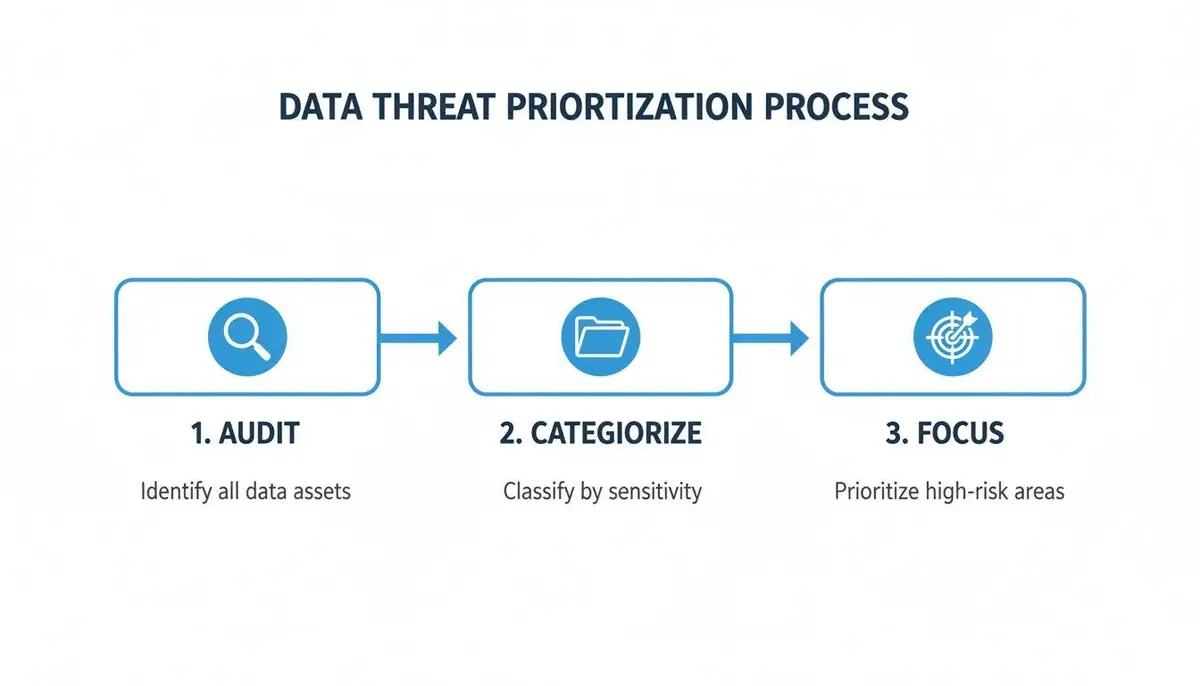
This diagram breaks down that workflow, illustrating how you can achieve the greatest impact by concentrating your energy on the highest-risk brokers.
How to Word Your Removal Request
The phrasing of your request is important. A simple “please delete my profile” may suffice for some, but a more formal, legally-informed request carries more weight, particularly with more obstinate brokers. You must make a clear, firm demand that leaves no room for misinterpretation.
Here is a template you can adapt for emails or web forms. It is professional, references your privacy rights without being overly aggressive, and creates a paper trail.
Subject: Formal Data Deletion Request
To Whom It May Concern,
I am formally requesting the complete and permanent deletion of any and all personal information associated with me from your databases and any public-facing websites you operate.
The profile I am requesting to be removed can be found at the following URL:
[Insert the direct URL to your profile here]
This information includes, but is not limited to, my name, addresses, phone numbers, email addresses, relatives, and any other associated personal data points.
This request is made pursuant to my right to privacy and data deletion rights. Please process this request promptly and provide written confirmation once the deletion is complete.
Sincerely,
[Your Name]
Using such a template demonstrates that you are serious and clearly identifies the specific record you want removed. For a deeper analysis of addressing different kinds of data exposure, our guide on how to remove yourself from data collection sites provides more detailed strategies that build on these steps.
Keeping Track of Your Progress
This is not a “fire and forget” operation. You must maintain meticulous records of every request. A spreadsheet is recommended to track all actions.
For each broker, log the following details:
- Broker Name: The company you contacted (e.g., Spokeo, Whitepages).
- Profile URL: The direct link to your listing.
- Date of Request: The exact day you sent the opt-out request.
- Method Used: The communication channel (webform, email, mail).
- Confirmation Received: Note the date and any confirmation number provided.
- Follow-Up Date: Set a calendar reminder to check the site again in 30-45 days.
This spreadsheet is not merely for organizational purposes. It is your evidence. If a broker is non-responsive or your data reappears, this log serves as proof when you escalate the issue. A clear history of your actions is the only way to hold these companies accountable and ensure your data brokers opt out efforts are effective.
Using Legal Muscle to Force Compliance
You have submitted an opt-out request and received no response. You are not out of options. Your removal request is not a polite suggestion; it is a legal demand backed by significant privacy laws. When a data broker ignores you, it is time to cease asking and begin compelling action.
At this stage, your mindset must shift. You are no longer a consumer requesting a favor; you are an individual asserting legal rights. Your most effective weapons are powerful legal frameworks like the California Consumer Privacy Act (CCPA) and Europe’s General Data Protection Regulation (GDPR). These statutes give your deletion requests legal force.
Citing CCPA and GDPR in Your Follow-Ups
If a broker is non-responsive, your subsequent communication must escalate the matter. You must explicitly reference the law that grants you the right to demand deletion. This simple act creates a formal legal paper trail and signals your preparedness to escalate further if they remain non-compliant.
For example, when dealing with a company subject to California’s jurisdiction, your follow-up should clearly state: “This is a formal request for the deletion of my personal information pursuant to my rights under the California Consumer Privacy Act (Cal. Civ. Code § 1798.105).”
If the broker processes data for individuals in Europe, you would adjust it accordingly: “This is a formal request for the erasure of my personal data under Article 17 of the General Data Protection Regulation (GDPR).”
Adding this single sentence fundamentally changes the dynamic. You transition from being another name on a list to a legally protected resident. The broker is now on a legal timeline to respond, typically within 45 days under CCPA.
A data broker’s failure to comply with a legally grounded deletion request is not merely poor customer service; it is a direct violation of the law. This non-compliance is the basis for filing a formal complaint with regulators, a step that carries significant weight and potential penalties for the company.
Familiarity with the specifics of these laws is a significant advantage. The GDPR, for instance, is notoriously strict, and companies handling data on EU citizens face massive fines for non-compliance. If you are dealing with international brokers, this practical AI GDPR compliance guide can help you understand the applicable regulations.
The Coming Wave of Universal Opt-Outs
For Californians, the process is set to become more streamlined. The state has raised the stakes with the Delete Act, a law introducing a centralized, universal opt-out system. This is a game-changer for the entire data brokers opt out process.
This law established the Delete Request and Opt-Out Platform, or DROP. Starting January 1, 2026, California residents will be able to use this free, state-run portal to send a single, verified deletion request to every registered data broker in the state simultaneously.
Brokers are required to honor these requests beginning August 1, 2026. Furthermore, they must re-process these mass deletions every 45 days to capture and remove any new data they may have collected.
The penalties for ignoring a DROP request are substantial: $200 per user, per cycle. For a broker with a million user profiles, this penalty could reach $200 million for every 45-day period of non-compliance. A late-2025 Strike Force from the California Privacy Protection Agency has already begun fining non-compliant brokers, signaling serious enforcement intentions. More details can be found in a detailed report from the U.S. Congress Joint Economic Committee.
Filing Formal Complaints with Regulators
When a broker remains defiant even after you have cited the law, your final recourse is to file a formal complaint. This is where the meticulous records you have maintained become critical evidence.
Key regulatory bodies to contact include:
- California Privacy Protection Agency (CPPA): If the broker is subject to California law, a complaint can be filed directly with the CPPA, whose mandate is to investigate and enforce the CCPA.
- Data Protection Authorities (DPAs): For brokers under GDPR’s jurisdiction, file a complaint with the DPA in the EU country where you reside or where the violation occurred.
- State Attorneys General: Many states have consumer protection laws applicable to data brokers. A complaint to your state’s Attorney General can trigger an official investigation.
Filing a complaint elevates your personal issue to an official regulatory matter. It brings the full weight of government oversight to bear on these companies, compelling action where they previously refused. This is the ultimate step in leveraging legal authority to reclaim your digital identity.
Moving Beyond Manual: Automation and Professional Help

Manual opt-out is a crucial first step, but it is not a permanent solution. Data brokers continuously gather data. A successful removal today is often a temporary victory. Your information will reappear when they acquire a new marketing list or scrape fresh public records.
Attempting to manage this process manually is an exhausting, Sisyphean task. For anyone whose personal safety or professional reputation is at risk, this DIY approach is inadequate for long-term security. It is at this juncture that one must transition from a personal project to a formal security strategy, which necessitates automated services or the engagement of a professional firm.
What to Expect from Automated Removal Services
The first level of escalation is a consumer-grade subscription service. These platforms offer a significant advantage over manual efforts. For a recurring fee, they automate the cycle of sending initial data brokers opt out requests and monitoring those sites to ensure your data remains removed.
This approach is effective for reducing spam and decreasing visibility to casual observers. It provides a solid layer of defense but has limitations, particularly for individuals with a high public profile.
- A Standardized Process: These services apply a one-size-fits-all removal process, which can overlook complex or unique data exposures that demand a bespoke solution.
- Surface-Level Removal: They are effective at targeting public-facing people-search sites but often fail to address the root of the problem, the major data aggregators that supply the smaller sites.
- Limited Enforcement: If a data broker ignores an automated request, these systems lack a meaningful recourse. They cannot engage in legal battles or high-level negotiations.
For the average individual, these services can reduce daily annoyances. However, for an executive concerned about corporate espionage, a public figure facing threats, or anyone worried about significant fraud, a standardized service is insufficient.
When to Call in a Professional Remediation Firm
When risks are high and consequences are severe, a custom, hands-on solution is required. This is the domain of specialist online reputation and content removal firms. They do not operate like a simple subscription; they function as a dedicated legal or security team focused exclusively on your case.
Their methodology is entirely different. They combine proprietary technology with human expertise to construct a comprehensive defense that extends far beyond basic data brokers opt out requests. A firm like ContentRemoval.com, for example, utilizes its own monitoring tools alongside deep legal knowledge to operate on multiple fronts. For more information on their toolset, our strategic guide to a personal information removal tool provides a deeper analysis.
A professional firm does not just click an “opt-out” button. It launches a full-scale campaign. This involves dispatching formal legal demands, negotiating directly with data brokers’ legal counsel, suppressing related negative content, and conducting continuous surveillance across both the public and dark web. This is a transition from basic privacy hygiene to active threat defense.
This level of service is designed for situations where your exposed data creates a direct, tangible risk. The work is forensic, beginning with a deep investigation to map not just where your data is, but how it is interconnected and potentially being weaponized against you. Regarding the physical security of data, top-tier professional services often hold credentials like the NAID AAA Certification for secure data destruction.
Key Differentiators of a Specialist Firm
The true value of a specialist firm lies in its ability to resolve complex cases that automated systems cannot. They possess capabilities that are critical for protecting high-profile clients.
Specialist Capabilities:
| Capability | Automated Service Limitation | Professional Firm Advantage |
|---|---|---|
| Legal Escalation | Limited to sending automated follow-ups. | Engages directly with broker legal departments, using specific laws and legal precedent. |
| Complex Cases | Often stalls when brokers require notarized forms or complex ID checks. | Manages all complex verification securely and navigates bureaucratic roadblocks. |
| Scope of Removal | Primarily focused on consumer-facing people-search sites. | Targets the source by pursuing primary data aggregators. |
| Associated Content | Incapable of addressing negative articles, false reviews, or damaging narratives. | Blends data removal with a broader strategy to suppress harmful content and manage search results. |
| Dark Web Monitoring | Typically does not scan criminal forums or dark web markets. | Actively hunts for credentials or leaked data being sold or traded on the dark web. |
The decision between an automated tool and a professional firm depends on your personal risk assessment. While automated services provide a valuable privacy baseline, they are not a substitute for a robust, tailored defense when your reputation, finances, and safety are genuinely at risk. For individuals under significant pressure, professional assistance is not a luxury. It is a core component of modern security.
Common Questions About Data Broker Removals
Dealing with the removal of sensitive personal information naturally raises many questions. Below are some of the most common inquiries we receive from clients, with direct answers based on our professional experience.
How Long Does a Data Broker Opt-Out Really Take?
The timeline varies significantly depending on the broker. Some may offer a near-instantaneous removal via a simple online form. More commonly, the process can extend over days or weeks, involving notarized documents, ID verification, and extensive email correspondence.
A manual effort to clear your name from 50-100 brokers can easily become a full-time commitment for a week or more. In contrast, a professional service can initiate the removal process across hundreds of sites within 24-48 hours. Achieving a stable, comprehensive removal is a longer-term endeavor, typically requiring several weeks to a few months for initial results, followed by continuous monitoring.
Will My Data Just Reappear After I Opt Out?
Yes, this is a persistent challenge. Data brokers are constantly acquiring new data to update their records. Your profile can be reactivated the moment your information appears in a new public record, a purchased marketing list, or another data stream they monitor.
This is precisely why a one-time removal effort is ineffective. It is a temporary measure at best.
An effective privacy strategy is not a singular task. It must be a continuous cycle of monitoring your online footprint and immediately re-submitting opt-out requests whenever your data reappears. This ongoing vigilance is the core value proposition of a professional removal service.
Are Data Removal Services Really Worth the Money?
For most individuals, this is a personal decision balancing the value of privacy against the cost. However, for an executive, public figure, or anyone with significant assets, it is not a matter of convenience. It is a critical component of risk management.
Consider the cost-benefit analysis: the financial and reputational damage from a single doxxing incident, a successful spear-phishing attack, or a smear campaign built on your leaked personal data will invariably exceed the cost of a professional removal service. For clients facing real-world threats, this is not about saving time; it is about deploying a proactive defense.
What’s the Difference Between Data Removal and Content Suppression?
These are two distinct strategies for managing your online presence.
- Data Removal: This focuses on scrubbing your raw personal information (name, address, phone number, family members) from the databases of data brokers and people-search sites. The objective is to remove the foundational elements used to target you.
- Content Suppression: This is a broader effort to manage your public narrative. It concentrates on demoting harmful content that already exists online, such as negative news articles, unfavorable reviews, leaked files, or defamatory blog posts that appear in search results.
While data removal helps prevent the creation of new negative content, it will not erase existing articles or damaging search results. A comprehensive defense often requires both: removing your private data to secure your personal information and employing content suppression to control your public narrative.
When a DIY approach is no longer sufficient to protect your reputation and security, professional intervention is necessary. ContentRemoval.com offers a discreet, comprehensive solution that leverages legal expertise and advanced technology to erase your exposed data and shield you from digital threats. To understand how we can secure your online presence, schedule a confidential consultation.
Frequently asked questions
How do I find out which data brokers have my information?
Search your full name in Google combined with your city, previous addresses and phone number, then log every site that returns a profile in a spreadsheet with the URL and data exposed. People-search sites rank well, so they will appear quickly. Rank them by risk, with home address, personal numbers and family names at the top.
What happens if a data broker ignores my opt-out request?
Escalate in writing by citing the law that applies, such as CCPA Cal. Civ. Code 1798.105 or GDPR Article 17, which puts the broker on a legal timeline. If they still refuse, file a complaint with the California Privacy Protection Agency, the relevant EU data protection authority or your state attorney general, using your request log as evidence.
Should I send a data broker a copy of my driver’s license to opt out?
The article treats that demand as a red flag for most people-search sites, since you would be handing a sensitive document to a company that sells personal data. It is usually better to refuse and pursue legal escalation instead. Provide only the minimum needed to identify the profile.