
A content removal service for businesses runs source takedowns, search de-indexing, rights enforcement, platform escalation and reappearance monitoring as one coordinated operation against defamatory articles, fake reviews, leaked media, impersonation and exposed data. It belongs in crisis governance rather than marketing, and it works by sorting each harmful item by content type, platform rules, legal posture and replication risk.
Key facts
- Technical remedies are faster and discreet; legal remedies add authority when publishers refuse or actors are anonymous.
- StopNCII lets participants hash intimate images so participating platforms block matching uploads.
- Google’s Remove Outdated Content tool handles cache issues; copyright matters need a documented DMCA rights assertion.
- Boards should assign one owner across legal, communications, security and outside specialists.
Where ContentRemoval.com comes in. ContentRemoval.com is the specialist a board brings in when the attack spans a search result, a fake account and a copied image set at once, running each through its own removal channel with milestone reporting back to counsel. General counsel, a communications lead or the company’s agency typically make the approach. A free 15-minute Exposure Scan maps what is removable and what must be suppressed, and the report is yours to keep. Get a Free, Confidential Exposure Scan or read how our content removal work is done.
The message usually reaches the boardroom through a private text, a forwarded email, or a screenshot from a worried colleague. A false accusation is ranking on Google. A review campaign has started. A leaked image, internal document, or impersonation account is circulating before legal has even identified the source.
By the time leadership sees the link, the incident is already operational. Sales teams start fielding objections they can’t answer. Partners go quiet. Recruiters hear questions from candidates. Directors begin asking whether this is a communications problem, a legal problem, or a security problem.
It’s all three. That’s why a content removal service for businesses shouldn’t sit in a miscellaneous vendor bucket beside routine marketing tools. It belongs in crisis governance, executive protection, and enterprise risk management.
Your Digital Crisis Is Already Happening
The first mistake boards make is treating harmful online content as a visibility issue. It isn’t. It’s a control issue.
If a defamatory article, fabricated review, leaked asset, or impersonation page remains accessible, the company is allowing an outside actor to define part of its market identity. That affects customer trust, investor confidence, hiring power, counterparties, and executive authority.
The attack rarely looks dramatic at first
Most digital crises start small. One URL. One review thread. One copied image. One fake account using an executive’s name. Leadership dismisses it because the original post seems obscure.
That’s the wrong instinct.
Search engines, social platforms, aggregators, and reposting networks turn a single hostile artifact into a discovery layer for everyone else. Once that happens, the issue stops being reputational theater and becomes a business process failure. No serious company would ignore a systems breach solely because it began with one compromised credential. Harmful content should be treated the same way.
Practical rule: If a harmful result can be found by customers, employees, investors, regulators, journalists, or family members of executives, it has already crossed into enterprise risk.
Boards are late to this category
The market itself tells you that awareness has lagged. Only 6% of U.S. adults have used data removal services, yet 12% of non-users, around 28 million people, are highly likely to adopt such services in the next 12 months, which could expand the market by nearly 90% according to Security.org’s data removal service usage study. That gap matters.
It means most organizations are still underprepared while demand for professional intervention is rising. The issue isn’t whether digital attacks exist. The issue is whether your company has a disciplined response model before the next one escalates.
For boards that still see removal as cosmetic cleanup, this is the correction. A removal campaign protects decision-making conditions. It preserves negotiating posture. It limits the life of false narratives before they harden into search history, screenshot archives, and recurring media references.
Leadership teams that need the strategic case in blunt terms should review 6 reasons businesses should remove online content. The basic premise is simple. If a third party can publish damaging material faster than your organization can neutralize it, you don’t fully control your brand.
What to decide immediately
Directors should force three questions right away:
- What is the asset under attack: Is this revenue, executive credibility, customer trust, private data, or all of them at once?
- What is the objective: Source removal, de-indexing, account takedown, reupload prevention, or identity verification across platforms?
- Who owns command: Legal, communications, security, and outside specialists need one decision-maker. Committee management slows response and increases exposure.
That’s why retention of a content removal service for businesses is a board-level act. The wrong partner wastes time. The right one shortens the life of the incident and prevents recurrence.
Understanding The Modern Threat Landscape
A hostile post about your company rarely stays in one place. It appears in search results, gets screenshotted into investor chats, shows up in customer due diligence, and is repackaged on social platforms by accounts you do not control. Executives who treat this as a reputational nuisance misread the problem. It is an operational threat with multiple distribution channels and different removal standards.
The practical mistake is classification failure. Boards label everything as “bad press” and hand it to communications. That delays action and often forfeits the fastest remedy. Harmful content needs to be sorted by content type, platform rules, legal posture, and replication risk within hours, not days.

Defamation and false reviews
This category gets mishandled because internal teams default to rebuttal. That is usually the wrong first move.
A malicious review campaign, a fabricated complaint thread, or a false allegation page can damage revenue long before a public response is drafted. The executive question is narrower and more useful. Is the content false, does it violate platform policy, can it be removed at the source, and if not, can its visibility be reduced fast enough to contain commercial harm?
False reviews distort purchase decisions because they sit inside systems buyers already trust. Defamatory posts create a second problem. They become persistent search associations attached to the company name, the CEO, or a product line. Once that happens, every lender, partner, recruit, and journalist starts from a polluted record.
Search visibility determines how far the harm spreads
Search is a distribution engine. If damaging material remains easy to find, the incident stays alive even when the original publisher has little audience of their own.
Google provides removal and de-indexing mechanisms for specific categories, including outdated cache issues and copyright claims, through tools such as its Remove Outdated Content process. For copyright-based matters, the right move is a documented rights assertion, not a generic complaint. Executives who need the operational logic behind that process should review this guide to strategic DMCA takedowns for content removal.
This distinction matters at board level. “Still online somewhere” and “still prominent in branded search” are different risk states. A company that cannot secure immediate source removal can still cut exposure by suppressing discoverability and stopping the content from dominating diligence.
NCII, leaked imagery, and personal exposure
Image-based abuse creates the fastest escalation curve. It hits the individual, the employer, and the market at the same time.
For founders and senior executives, stolen images, manipulated media, intimate content, and extortion-driven leaks can trigger reputational damage, employee confusion, and legal exposure in a single cycle. Delay is expensive because every repost turns a clean takedown into a containment campaign. The objective is not one deletion. It is preventing replication across platforms and search surfaces.
StopNCII is one of the few mechanisms built for that problem. The program allows participants to create hashes of intimate images so participating platforms can detect and block matching uploads without the files being shared directly, as explained by StopNCII.org.
A useful briefing for leadership teams appears below.
AI impersonation is an executive risk
Boards that still define impersonation as a fake social profile are behind.
Current attacks include cloned executive voices, fabricated video statements, counterfeit recruiter outreach, fake journalist inquiries, and coordinated account networks built to manufacture legitimacy. The danger is speed. These attacks can move employees, customers, and counterparties before legal review or platform moderation catches up.
The FBI has warned that criminals are using AI-generated text, images, audio, and video in fraud and social engineering schemes that increase the scale and believability of impersonation attacks, according to its public service announcement on criminal use of generative artificial intelligence. That should settle the policy question for any board. Standard social reporting queues are not an incident-response plan.
What executives should classify immediately
When harmful content appears, sort it into operational buckets that dictate remedy and tempo:
- Search-led harm: Defamatory articles, complaint pages, false reviews, or forum posts ranking for the company or executive name.
- Platform abuse: Fake social accounts, counterfeit business pages, impersonation campaigns, and manipulated user-generated content.
- Image and media exploitation: Stolen photos, leaked videos, intimate imagery, edited visuals, and repost networks.
- Data exposure: Internal files, personal information, customer records, or dark web references that create extortion and compliance exposure.
- Legacy material with current impact: Mugshots, old allegations, archived accusations, or outdated records still shaping market perception.
The strategic error to avoid
Many companies assign response by function instead of harm type. Communications handles press. Legal handles threats. Security handles leaks. That structure is neat on an org chart and weak in a real incident.
A professional content removal service for businesses runs source takedown, de-indexing, rights enforcement, platform escalation, and reappearance monitoring as one coordinated operation. That is the standard executives should demand. If your teams split the problem by department, the attacker keeps the initiative.
The Takedown Arsenal Technical Versus Legal Remedies
Executives need a clean distinction between technical remedies and legal remedies. Most failures happen because companies choose one when the case requires both.
Technical action is faster. Legal action is heavier. Neither is sufficient as a universal answer.
Technical remedies win on speed and discretion
A technical removal strategy uses the architecture of the internet and the enforcement systems of platforms. That includes search engine de-indexing, platform Terms of Service reporting, account impersonation claims, rights-based takedown requests, direct webmaster outreach, and structured escalation through trust and safety channels.
The best use case is straightforward. The content is harmful, the platform has a removal basis, and the business needs speed without public litigation.
This route also minimizes collateral noise. There’s no public filing, no searchable complaint docket, and no unnecessary invitation for the publisher to dramatize the dispute. For many executive matters, that discretion is worth as much as the takedown itself.
Legal remedies matter when authority must be formal
Some publishers won’t cooperate. Some platforms need stronger evidence. Some cases involve anonymous actors, repeated defamation, extortion, or material that sits in the gray area between platform abuse and legal violation.
That’s where legal pressure changes the equation.
A legal strategy can involve cease-and-desist letters, preservation demands, subpoenas, negotiated settlements, court orders, and cross-border counsel where jurisdiction complicates enforcement. The purpose isn’t to threaten for appearance’s sake. It’s to establish consequences, compel production, and create an enforceable path when technical requests stall.
Leaders who need a grounded explanation of rights-based removals should review strategic DMCA takedowns and a professional guide to content removal. Copyright claims are not the answer in every matter, but when they fit, they can be efficient and highly effective.
Side by side comparison
| Remedy type | Best for | Main advantage | Main limitation |
|---|---|---|---|
| Technical takedown | Clear platform violations, impersonation, search de-indexing, leaked media, rapid containment | Speed, privacy, operational flexibility | Depends on platform cooperation and eligibility |
| Legal remedy | Anonymous actors, repeated abuse, disputed facts, formal enforcement, precedent-setting matters | Authority, permanence, evidentiary leverage | Slower, more visible, often more expensive in time and attention |
| Blended strategy | High-stakes business attacks with multiple publication points | Balances urgency with permanence | Requires tight coordination and experienced judgment |
Fast action is useful. Binding action is useful. Sophisticated firms know when to use each and when to sequence them together.
The right order of operations
In most board-relevant matters, the sequence should be practical.
Start with quiet technical containment where a valid path exists. Escalate to legal force where the content persists, multiplies, or implicates deeper misconduct. Keep PR in support, not in command, unless the issue has already become a public narrative contest.
A content removal service for businesses earns its fee by choosing the shortest credible path to outcome. Not the loudest one.
Anatomy of a Professional Removal Engagement
A serious engagement shouldn’t feel vague, theatrical, or improvised. It should feel like a controlled operation with clear stages, tight confidentiality, and a disciplined reporting rhythm.
If you hire outside help and they can’t explain the workflow in plain language, stop there.
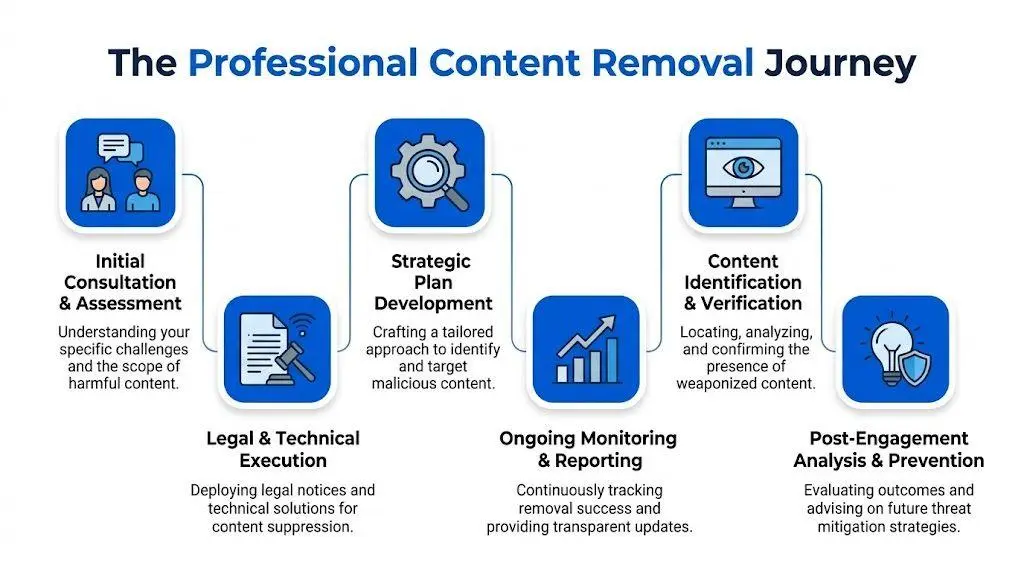
Intake begins with triage, not storytelling
The first phase is confidential intake. The client provides URLs, screenshots, account identifiers, publication dates, known actors, prior outreach, and any litigation or HR context already in motion.
The point of early intake isn’t to relive the incident. It’s to determine three things quickly: what can be removed, what can only be suppressed or de-indexed, and what requires legal escalation.
This stage also establishes the evidence record. If the content disappears temporarily and resurfaces later, poor evidence handling becomes a real liability.
Strategy is built around pathways, not wishes
Clients often start with a preferred outcome that isn’t operationally realistic. They want total deletion across the internet by the end of the week. Sometimes that’s possible. Often it isn’t.
A professional team maps the attack surface into practical pathways:
- Immediate source removal opportunities through platform abuse rules, webmaster cooperation, rights claims, or impersonation procedures.
- Search suppression or de-indexing options where visibility can be reduced even if full source deletion takes longer.
- Legal opportunities if the actor is identifiable, the publication is repeated, or a court-backed route is necessary.
- Monitoring requirements where reposting, account recreation, or indexing recurrence is likely.
This is also where a provider should explain trade-offs. Executives don’t need a lecture. They need a decision memo.
Execution runs on parallel tracks
Competent firms don’t work one URL at a time in a slow queue. They run coordinated tracks.
One team may prepare platform submissions while another handles rights notices or publisher outreach. If the incident involves a search result, a fake account, and a copied image set, each element moves through its own removal channel. The client should receive concise updates tied to milestones, not a stream of anxiety-inducing noise.
At this stage, one provider worth noting is ContentRemoval.com, which offers de-indexing, source removal, impersonation takedowns, leaked image and video removal, and monitoring across search engines, websites, and social platforms. That’s the kind of cross-channel scope businesses should expect when the attack isn’t confined to one website.
Reporting should be disciplined
The board doesn’t need a blow-by-blow transcript of every email sent to a webmaster. It needs visibility into status, risk, and next moves.
A useful reporting cadence usually includes:
- What has been removed
- What remains live
- What has been de-indexed
- What is pending with platforms or counsel
- What is likely to recur
- What internal controls need to change
The best engagements reduce uncertainty. They don’t just “work on it.” They tell leadership what has changed, what hasn’t, and what decision is needed next.
Post-removal is where most companies get careless
A takedown is not the end of the matter. It’s the start of the next one.
After removal, the firm should monitor for reuploads, copied text, new impersonation accounts, and search reappearance. Internal teams should also review who had access to the leaked material, which executive identities are easiest to spoof, and which public-facing profiles remain unsecured or inconsistent.
This is the difference between a one-off cleanup and a real protective program. A content removal service for businesses should leave the client with lower future exposure, not just fewer current URLs.
How To Vet Your Content Removal Partner
This industry attracts two very different kinds of operators. Real specialists who understand platform mechanics, legal strategies, and confidentiality, and vendors who sell confidence, broad promises, and opaque reporting.
Boards need to separate them quickly.
Brand recognition proves very little
An established name is not a proxy for outcome. A Consumer Reports study on DeleteMe found that it removed only 27% of listings within three months on a plan covering over 84 data brokers, as summarized by Aura’s analysis of data broker removal services. That should reset expectations.
Longevity, ad spend, and polished branding do not guarantee effective execution. If a vendor can’t show how it handles difficult removals, recurring reposts, and executive-grade confidentiality, it isn’t a serious option for a business crisis.
Ask questions that expose capability
Don’t ask whether they “can help.” Every vendor says yes.
Ask how they classify removability versus suppressibility. Ask which matters they decline. Ask what evidence they require. Ask who handles legal coordination. Ask how they prevent the client from causing a Streisand event through clumsy outreach. Ask what reporting looks like after the first week, not just on day one.
Then ask what they won’t promise.
A professional provider will be precise about constraints. That’s a good sign. False certainty is usually sold by people who won’t be accountable when the content is still live a month later.
Provider Vetting Checklist
| Criterion | What to Look For | Red Flag |
|---|---|---|
| Removability assessment | Clear distinction between source removal, de-indexing, suppression, and monitoring | “We remove anything” |
| Evidence handling | Structured intake for URLs, screenshots, timestamps, and prior actions | Casual requests with no chain of documentation |
| Platform expertise | Specific familiarity with Google, Meta, review sites, forums, and impersonation workflows | Generic claims about “online cleanup” |
| Legal coordination | Ability to work with internal or outside counsel when technical requests fail | No legal pathway, or immediate threats of litigation in every case |
| Confidentiality | NDAs, restricted access, discreet communications, executive-safe workflows | Informal email chains and vague privacy language |
| Reporting discipline | Milestone-based updates and a clear action log | No measurable status reporting |
| Reappearance control | Monitoring after takedown and a plan for recurring abuse | “Once it’s gone, the job is done” |
| Pricing logic | Transparent scope, clear triggers for extra work, and realistic expectations | Large upfront fee with no explanation of workstreams |
A more detailed due diligence framework appears in evaluating professional content removal services and a guide for executives. Use it the way you’d evaluate outside counsel or a crisis investigator. This is not a commodity purchase.
What a board should require
At minimum, require these standards:
- Confidential operating model: The firm should act like it handles sensitive legal matters, not routine customer support tickets.
- Cross-functional fluency: Platform tactics alone aren’t enough. Neither is litigation alone.
- Evidence of hard-case work: Easy removals are common. Your concern is the difficult matter that persists.
- Realistic language: If they promise guaranteed deletion of everything, they’re selling fantasy.
- Executive-safe communications: Your CEO should never worry that the vendor itself will create exposure.
Hire for judgment under pressure, not for marketing polish.
Navigating Risks and Regulatory Guardrails
The instinct to “just get it taken down” creates as many mistakes as delays do. Removal work has its own risk profile, and poorly managed intervention can amplify the problem.
The most obvious danger is the Streisand Effect. If the target contacts the wrong publisher aggressively, files a public complaint too early, or uses heavy-handed language where discretion would have worked better, the content can spread further because the takedown attempt becomes a new story.
Not all harmful content is removable
Executives need to accept a hard truth. Some content is damaging but still difficult to remove because it falls into opinion, public interest reporting, or lawful archival publication. That doesn’t mean the business is powerless. It means the strategy must be narrower and smarter.
In those cases, the wrong move is often overreach. Demanding deletion where no legal or platform basis exists can turn a manageable issue into a broader editorial fight. Skilled operators know when to pursue correction, de-indexing, geo-limited relief, suppression, or negotiated edits instead of demanding impossible outcomes.
Jurisdiction changes the answer
Cross-border publication complicates everything. A post may be lawful in one country, actionable in another, and visible globally through search. Platforms often apply territorial rules, and counsel may need to evaluate whether relief should be sought locally, contractually, or through platform policy.
Boards don’t need to master speech law. They do need to understand that a takedown plan built for one jurisdiction can misfire badly in another. That is why legal review and technical action should be coordinated from the start, not bolted together after a failed outreach attempt.
Public interest and censorship claims
Some removal campaigns trigger a second-order reputational issue. The company gets portrayed as trying to silence criticism.
That’s why precision matters. A business should be able to explain, if ever required, that it acted against false statements, impersonation, stolen content, privacy violations, or unlawful exposure. Not against legitimate criticism.
A premier firm protects the client by narrowing the ask, documenting the basis, choosing the right channel, and avoiding performative aggression. The objective isn’t just to remove content. It’s to do so without creating a larger narrative of overreach.
The Executive Playbook for Digital Sovereignty
At 6:30 a.m., your general counsel is on the phone, your communications lead is drafting statements, and a director has forwarded a search result that should never have existed. By then, the issue is no longer a marketing problem. It is a control failure.
Digital sovereignty means treating online identity, search visibility, executive authenticity, and owned content as governed assets. Boards already demand control over cash, facilities, IP, and privileged information. Apply that same discipline here, or an anonymous actor, a hostile publisher, or a platform algorithm will set the terms for you.
What boards should institutionalize
Do not bury this inside marketing. Build an operating protocol.
- Monitor named assets: Track the company name, core products, directors, and senior executives across search, social platforms, review sites, and known repost channels.
- Set hard escalation triggers: Fraud allegations, impersonation, leaked media, exposed personal data, extortion, and repeated false claims should go straight to a crisis workflow.
- Assign one owner: Put one executive in charge of coordination across legal, communications, security, and outside specialists.
- Capture evidence before anyone reacts: Secure screenshots, URLs, timestamps, account details, and copies of the material before employees start replying or reporting.
- Keep rights records clean: Ownership files, licenses, brand assets, and publication dates need to be current. If your company relies on copyright claims, leadership should understand basics such as understanding the duration of copyright protection, because weak records break otherwise valid enforcement efforts.
Good boards make this a standing discipline, not a one-time cleanup project.
When to bring in professionals
Use a simple rule. If the matter can affect enterprise value, executive safety, financing, regulatory posture, or trust with customers and counterparties, bring in specialists early.
Outside help is warranted when any of the following is true:
- A senior executive or family member is being targeted.
- The issue appears across several platforms or search results.
- The publisher, account owner, or source is anonymous, coordinated, or persistent.
- Internal outreach has failed or made the situation worse.
- The material creates legal, regulatory, investor, or lender exposure.
- The content includes images, video, impersonation, or leaked internal data.
Delay helps the other side. Harmful material spreads, gets indexed, and spawns copies. Recovery gets harder and more expensive.
The board-level conclusion
A content removal service for businesses belongs in the same category as crisis counsel and forensic response. It is part of enterprise defense.
Judge providers by decision quality, speed, discretion, and outcome. Require clear reporting. Demand a defined escalation path. Expect a plan that covers immediate containment, source removal where possible, search-result impact, and prevention.
If your leadership team is facing a digital threat, act before the problem hardens into a permanent record. ContentRemoval.com provides the confidential assessment and rapid action plan required for high-stakes situations involving defamatory content, fake reviews, impersonation, leaked images, and damaging search results.
Frequently asked questions
When should a company hire a content removal service instead of handling it in-house?
When a senior executive or family member is targeted, the issue spans several platforms, the source is anonymous or persistent, internal outreach has failed, or the material creates legal, investor or lender exposure. Images, impersonation and leaked internal data also warrant specialists early.
Can a business remove a negative review that is not fake?
Not usually. Genuine criticism, opinion and public interest reporting are often lawful, and overreaching can turn a manageable issue into an editorial fight. The strategy narrows to correction, de-indexing where eligible, negotiated edits or suppression instead.
What is the Streisand Effect and how do I avoid it?
It is when a clumsy takedown attempt becomes a bigger story than the content itself. Avoid aggressive contact with the wrong publisher, early public complaints and heavy-handed language; narrow the ask, document the basis and choose the right channel.