
Competitive intelligence monitoring for reputation defense is an operational discipline that detects, classifies and neutralizes hostile digital activity before it hardens into search visibility or press pickup. It combines automated collection across search, social, reviews and forums with human legal review, a three-tier severity model, and pre-built response trees for defamation, impersonation, leaks and review clusters.
Key facts
- Every monitored signal is classified as noise, exposure or actionable threat, and threats go to legal review immediately.
- Threat actors include rivals, former insiders, activists, fraudsters and domestic adversaries, each with different attack patterns.
- Tier three threats such as leaks, impersonation and false criminal allegations need same-day escalation to legal and security.
- Measure time to detection, time to remediation, harmful search reduction and re-upload control, not mention volume.
Where ContentRemoval.com comes in. Most monitoring programs stop at detection. ContentRemoval.com handles the part that follows: legally grounded source removal, de-indexing, impersonation takedowns and the surveillance that keeps material from resurfacing. Heads of security, general counsel and family office principals tend to make contact once an alert turns into a live threat. A free 15-minute Exposure Scan maps what is removable now, and the report is yours to keep. Get a Free, Confidential Exposure Scan or read how our reputation management work is done.
You search your name, your company, or your family office, and the problem is already public. A false review cluster appears on page one. An impersonation profile is collecting messages from investors. A leaked document is circulating in private channels before your communications team has even seen it. At that point, ordinary competitor tracking is useless. You don’t need a market update. You need a defense protocol.
That’s how I advise high-profile clients to think about competitive intelligence monitoring. Not as a marketing exercise. Not as a quarterly slide deck. As an operational discipline for detecting, classifying, and neutralizing hostile digital activity before it hardens into search visibility, press pickup, regulatory friction, or personal reputational harm.
From Monitoring to Actionable Defense
Most competitive intelligence programs were built to answer commercial questions. Who changed pricing. Who hired a new product lead. Who launched a feature. That work matters, but it doesn’t solve the problem facing an executive who wakes up to defamatory content, a cloned social profile, or a coordinated whisper campaign.

The baseline is clear. 90% of Fortune 500 companies use competitive intelligence to secure a competitive advantage, according to research published by Emerald. That matters for one reason. Serious organizations already accept that external monitoring is standard operating procedure. If you’re a public figure, founder, CEO, or family office principal, your exposure is often broader and more personal than theirs.
Why standard CI fails under pressure
Traditional monitoring tells you what happened. Defensive monitoring has to tell you what happens next, who needs to know, and what can be removed or contained immediately. If your system ends at “mention detected,” you don’t have protection. You have surveillance without remedy.
A defensive model treats every monitored signal as one of three things:
- Noise: irrelevant chatter, routine references, or low-risk commentary.
- Exposure: material that could become harmful if it gains traction, such as a new allegation on a low-authority site or a suspicious post from an anonymous account.
- Actionable threat: defamation, impersonation, leaked private material, false review manipulation, trademark abuse, or coordinated content seeding.
Practical rule: If a monitored item can affect search results, stakeholder confidence, platform trust, or personal safety, classify it for legal and operational review immediately.
This is also where many reputation programs break. They spend heavily on listening tools and almost nothing on response design. That’s backwards. Monitoring is only the intake valve.
What a defense-first model looks like
The right framework combines watchfulness with intervention. You monitor search, social, review platforms, websites, forums, messaging surfaces, and relevant private channels where lawful monitoring is possible. Then you route findings into a response tree that includes preservation of evidence, legal assessment, platform escalation, de-indexing strategy, source removal options, and reupload prevention.
Clients often ask whether they should start with brand-building content while a threat is active. Sometimes yes, but not as a substitute for removal. For broader context on effective online reputation building, there’s value in strengthening your public footprint. But if harmful material remains live, amplification work only competes with damage that should have been challenged directly.
A standing monitoring layer also matters before a crisis. Public clients should already have a confidential reputation monitoring protocol that covers executive names, spouse and family references where appropriate, company trademarks, product names, known aliases, and recurring hostile narratives. Waiting until publication is late. The work starts when the first weak signal appears.
Defining Your Digital Threat Landscape
You can’t defend everything equally. You need to know what matters, who is most likely to target it, and where the attack will surface first. That means building a threat map, not a generic watchlist.
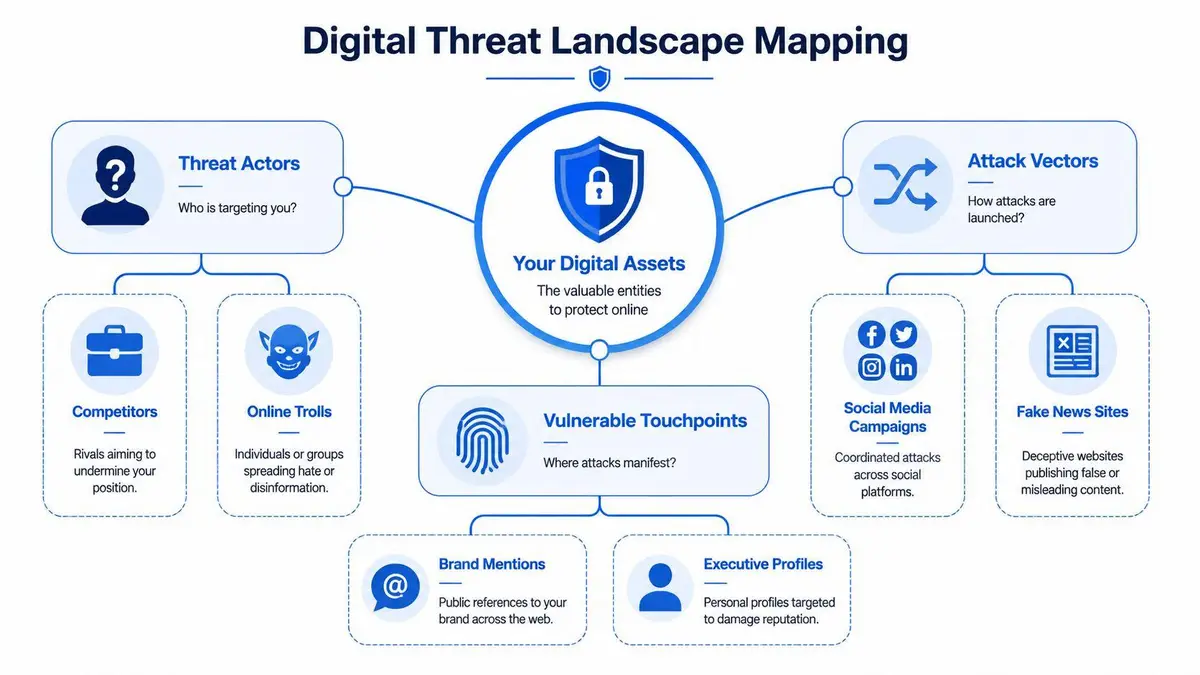
Start with assets. For a high-profile client, that usually includes executive and company search terms, official websites, social handles, board affiliations, media profiles, trademarks, key employee bios, investor-facing materials, and any family-linked exposure that could be exploited to force attention.
Threat actors are rarely just “competitors”
A proper matrix names the likely sources of harm. In practice, these groups behave differently and require different monitoring logic.
| Threat actor | Typical motive | Common attack pattern |
|---|---|---|
| Commercial rival | Pressure, leverage, narrative distortion | Anonymous seeding, false comparison pages, rumor spread |
| Former insider | Retaliation or grievance | Leaks, selective screenshots, hostile posts |
| Activist or ideological critic | Public pressure | Campaign hashtags, press outreach, coordinated social posting |
| Fraudster or impersonator | Financial gain | Fake profiles, cloned websites, phishing-style outreach |
| Domestic adversary | Control, harassment, reputational coercion | Doxxing, fabricated allegations, private image misuse |
A lot of clients underestimate one category: non-commercial adversaries who use business visibility as a pressure point. A hostile former partner or private antagonist can create as much reputational damage as a direct competitor, sometimes more, because the content looks personal and draws curiosity.
For readers who want a practical primer on how to understand your competition effectively, that foundation is useful. But for defense, your map has to go beyond market players and include anyone with motive, access, and a channel.
Precision matters more than volume
Professional monitoring isn’t about collecting broad impressions. It requires tracking granular strategic moves and investments, including exact dates of acquisitions, funding rounds, leadership changes, and layoffs, because those events can signal pressure campaigns, opportunistic attacks, or shifts in where a rival may strike next, as outlined in Contify’s guidance on competitive intelligence reports with AI.
That precision applies to reputational threats too. You don’t just track “negative commentary.” You track first appearance date, domain authority context, author identity if known, syndication risk, platform policy category, and whether the material ties back to a competitor narrative, a custody dispute, a securities issue, or a former employment matter.
A weak signal becomes expensive when no one records where it started, who amplified it, and which platform rules actually apply.
Later in the cycle, you need evidence. Screenshots alone aren’t enough. Preserve timestamps, URLs, account identifiers, changes over time, and any pattern showing coordination. If a competitor starts spreading rumors, your legal and response options improve when the record is organized from day one. That’s exactly why a targeted strategic response to a competitor spreading rumours online should sit inside the threat map, not outside it.
A brief visual model helps internal teams align on what they’re protecting.
Building the Monitoring and Analysis Engine
Most organizations don’t suffer from a lack of data. They suffer from a lack of disciplined interpretation. Companies analyze only about 12% of the data they collect, leaving 88% of potential insights, opportunities, and threats unnoticed, according to Leftronic’s competitive intelligence statistics. For reputation defense, that failure isn’t inefficient. It’s dangerous.
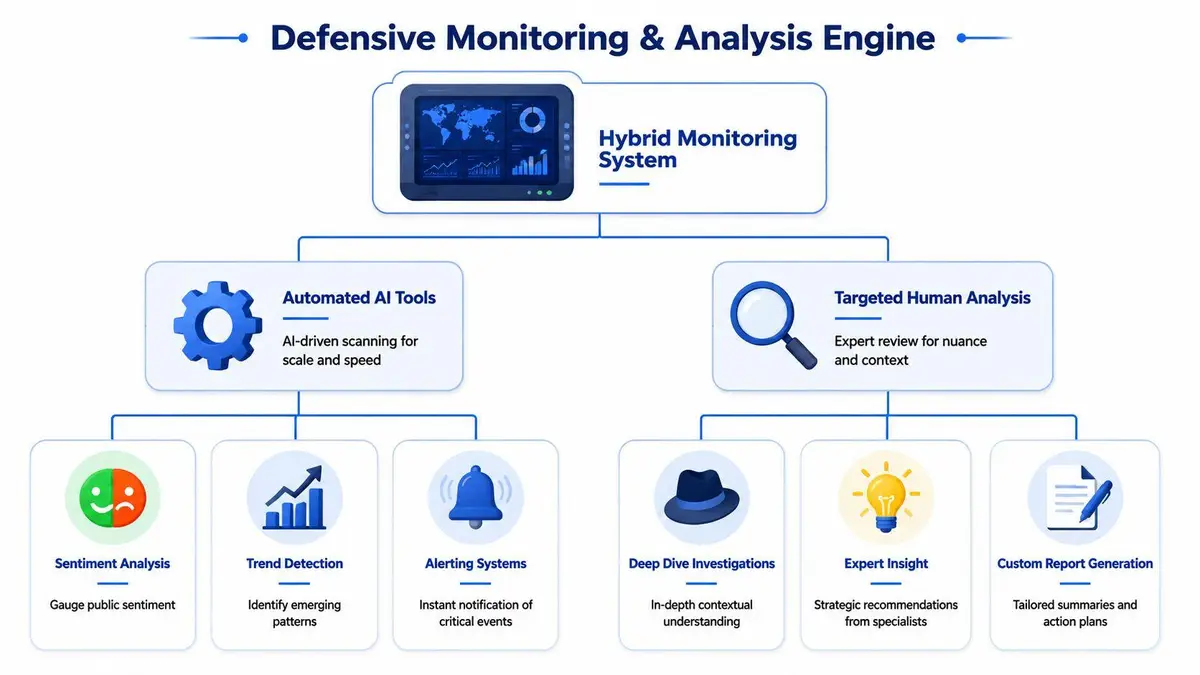
A defensive engine needs two layers running together. The first is automated collection at scale. The second is human review with legal and reputational judgment.
What automation should handle
Use automation for breadth, speed, and repetition. That includes search result monitoring, social listening, review tracking, page-change detection, brand mention alerts, and monitoring for name variations, misspellings, and executive-plus-allegation combinations.
Automated tools are useful when configured narrowly. They become a liability when they flood counsel, security staff, or executive offices with irrelevant chatter. Good configuration means:
- Name logic: track legal names, common short forms, and likely impersonation variants.
- Narrative logic: combine names with accusation terms, leak terms, fraud references, or other threat language relevant to the client.
- Asset logic: monitor domains, subdomains, social handles, app listings, and review profiles tied to the brand.
- Jurisdiction logic: separate issues by platform and geography, because legal remedies differ.
Where human review earns its keep
Machines can flag a surge in mentions. They can’t reliably tell you whether a post is defamatory, whether a review pattern suggests orchestration, whether a leak is authentic, or whether a platform complaint should be framed as impersonation, privacy violation, copyright misuse, trademark abuse, or harassment.
That’s why human analysts and legal specialists have to review context, not just counts. They should answer a short set of questions every time:
- Is the content lawful opinion, or does it move into false factual assertion?
- Is the account authentic, affiliated, automated, or deceptive?
- Is the publication isolated, or is it part of a seeded narrative?
- Which remedy is strongest first: source removal, de-indexing, platform escalation, suppression, or evidence preservation pending litigation?
Counsel’s view: A monitoring tool that can’t distinguish insult from actionable falsehood is a sensor, not a defense system.
What to monitor beyond the obvious
Executives often focus on Google and major social platforms. That’s too narrow. Defensive competitive intelligence monitoring should extend across:
- Public web surfaces: news sites, blogs, review platforms, forums, complaint sites, public filings.
- Social ecosystems: major platforms, video platforms, creator channels, repost accounts, comment sections.
- Technical and hidden surfaces: cloned domains, metadata changes, referral spikes, and relevant dark web references where lawful monitoring applies.
- Commercial pressure points: investor communities, employee-review environments, niche industry forums, and comparison pages.
The analysis layer should also group signals into themes. One review doesn’t matter much. Ten reviews using the same language pattern might. A lone blog post may be trivial. The same allegation repeated across social, search snippets, and a low-grade “news” domain is often an engineered campaign.
For clients needing a practical framework that combines monitoring with direct defensive action, one option in this category is online brand protection services. The useful point isn’t the label. It’s the architecture: continuous monitoring, evidence capture, and a removal path attached to the same workflow.
Establishing Alerting and Triage Protocols
An alert without triage creates panic. A triage protocol without ownership creates delay. Your system should do neither.
The cleanest way to run competitive intelligence monitoring for defense is to classify incoming signals by consequence, not by volume. Senior clients don’t need a dashboard full of chatter. They need routing logic that tells the right people what to do, fast.
A workable severity model
Use three tiers.
Tier one covers routine references, ordinary criticism, neutral press mentions, and low-risk social chatter. These should go to the monitoring team for logging and pattern review, not to legal counsel.
Tier two covers developing exposures. Think suspicious review clustering, early impersonation indicators, coordinated reposting of an allegation, or a low-visibility article that could rise in search. These should trigger analyst review and a short legal check.
Tier three covers immediate threats. That includes leaks, extortion-adjacent publication threats, impersonation of an executive or family member, false criminal allegations, fake investor communications, or defamatory material with search traction. These require same-day escalation to legal, communications, and security leadership as appropriate.
The operating loop has to be continuous
A solid CI function follows a five-step loop: define signals, gather data, analyze patterns, distribute insights, and measure outcomes. Organizations that embed that ongoing discipline are 33% more likely to outperform peers in revenue growth, according to Lucidya’s analysis of competitive intelligence practice. For reputation defense, the business lesson is simple. Repeatable process beats ad hoc reaction.
A concise routing table keeps teams disciplined:
| Alert type | Primary owner | Secondary owner | Immediate action |
|---|---|---|---|
| Routine mention | Monitoring analyst | None | Log and watch |
| Suspicious narrative pattern | Analyst lead | Legal reviewer | Validate evidence and map spread |
| Impersonation or leak | Legal | Security / Comms | Preserve, report, escalate |
| Defamatory publication | Legal | Comms | Assess removal and search impact |
Keep executives out of the noise
Many internal systems fail because they over-notify principals. That creates fatigue, and then the one alert that matters gets ignored. Executives should receive only material that changes decision-making, creates personal exposure, or requires authorization.
Send fewer alerts. Make each one decision-ready.
A proper alert should include the content type, where it appeared, the legal or platform issue category, likely spread risk, proposed action, and owner. Nothing else. If your alert reads like a transcript of everything the monitoring tool scraped overnight, it isn’t triage. It’s outsourced chaos.
The Remediation and Escalation Playbook
Monitoring without removal strategy is failed design. It produces awareness without control, which is exactly what skilled attackers want. They don’t need the falsehood to convince everyone. They need it to remain visible long enough to create doubt.
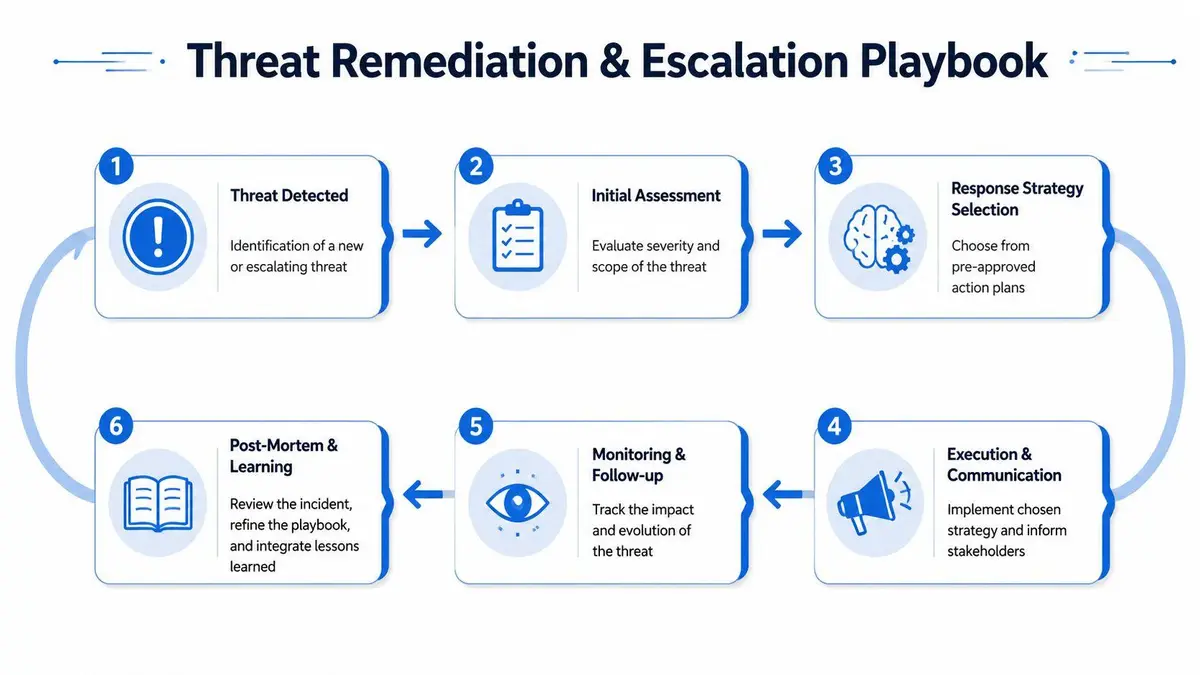
The industry gap is already obvious. 68% of reputation crises begin with unmonitored or unremovable content, yet only 12% of CI frameworks include a legal takedown or remediation protocol, according to Valona Intelligence’s discussion of competitive intelligence monitoring blind spots. If your current program ends at detection, you’re in the majority. That’s not a compliment.
Build response trees before you need them
Every high-risk client should have pre-approved if-then playbooks. Not broad principles. Actual action trees.
If a defamatory article appears on a low-quality publisher, the first questions aren’t philosophical. Are the statements factual assertions or opinion. Who controls the domain. Is there a hosting route. Does the platform have a defamation, privacy, impersonation, or abuse channel. Is de-indexing viable while source removal is pursued. Do we preserve evidence first because litigation is likely.
If an impersonation account appears, the sequence is different. Preserve the profile, archive communications if available, identify whether the account is infringing name rights, trademark rights, privacy rights, or platform authenticity rules, then file the correct notice. A weak complaint framed under the wrong policy often delays removal.
A practical if-then matrix
-
If defamatory content is published
- Preserve the page and publication details.
- Assess falsity, identifiability, and measurable harm.
- Initiate source-removal outreach or legal demand where justified.
- File platform or search-based complaints if policy grounds exist.
- Start suppression only as support, never as the only remedy.
-
If an impersonation profile appears
- Capture profile URLs, handles, messages, and follower patterns.
- Confirm whether the profile targets customers, investors, media, or personal contacts.
- Use platform authenticity and impersonation mechanisms first.
- Escalate quickly if financial solicitation or fraud signals appear.
-
If sensitive material leaks
- Identify the content category immediately. Confidential business material, private imagery, family data, internal communications, or forged material all require different handling.
- Limit circulation by pursuing source removal and de-indexing in parallel.
- Coordinate internal communications tightly. Loose internal forwarding expands the footprint.
-
If false reviews or complaint clusters emerge
- Compare timing, language repetition, reviewer history, and account behavior.
- Preserve the pattern, not just individual reviews.
- Challenge under platform manipulation rules where available.
- Prepare a separate response script for legitimate customer concerns so the legal complaint remains credible.
Legal boundaries matter
Defensive intelligence must stay lawful. Review public websites, public profiles, public records, public filings, public job posts, and publicly accessible content. Don’t access private systems without authorization. Don’t induce breaches of confidentiality. Don’t misrepresent identity to obtain restricted information. Those shortcuts create liability and weaken your position when you later demand action from a platform, publisher, host, or court.
The strongest playbooks are conservative on collection and aggressive on remedy. They preserve admissible evidence, use the right policy channel first, and escalate only when the record supports it.
The objective isn’t to “win the internet.” It’s to remove or contain the exact content creating legal and reputational exposure, then stop it from returning.
Speed matters because the first publication is rarely the final one. Harmful content gets recopied, indexed, reposted, summarized, and discussed. Your playbook should therefore include follow-up monitoring for mirror posts, quote-posts, stitched video clips, search snippet persistence, and derivative commentary. A takedown that isn’t followed by reupload surveillance is incomplete.
This is also where specialist execution counts. General PR firms know how to message. General litigators know how to threaten. Crisis defense requires someone who can align evidence capture, platform process, removal theory, search strategy, and confidentiality from the first hour.
Measuring Performance and Proving Value
If you judge a defensive monitoring program by mention volume, you’ll fund the wrong work. High-risk clients should measure protection by speed, containment, and reduction of harmful visibility.
The metrics that actually matter
Track time to detection first. How quickly did the team identify the threat after first publication or first appearance. Then track time to remediation. How long did it take to remove, de-index, suppress, or otherwise contain the material.
You should also measure outcome quality:
- Harmful search reduction: whether negative or false material lost visibility for the key names and terms that matter.
- Reupload control: whether removed material reappeared, where, and how quickly it was addressed.
- Escalation accuracy: whether alerts reached the correct owner without delay or over-notification.
- Narrative containment: whether a single hostile post remained isolated or spread into a broader storyline.
Proof comes from trend lines, not vanity dashboards
A disciplined program should show fewer unresolved threats, cleaner escalation logs, faster evidence preservation, and stronger alignment between monitoring and legal action. That’s what boards, principals, and family offices should care about. They aren’t buying software outputs. They’re preserving enterprise value, transaction readiness, and personal credibility.
The biggest shift for most clients is mental. They stop viewing competitive intelligence monitoring as a research function and start treating it as part of risk control. That’s the correct view. When your name carries commercial value, any hostile digital surface can become a negotiation weapon. The answer isn’t passive awareness. It’s a repeatable system that detects early, routes cleanly, removes aggressively, and documents everything.
If you’re dealing with defamatory content, impersonation, leaks, false reviews, or coordinated brand abuse, ContentRemoval.com handles the part most monitoring programs never solve: legally grounded removal, de-indexing, and ongoing surveillance to prevent the material from resurfacing. The work begins with a confidential assessment, followed by a precise action plan built around the specific platforms, jurisdictions, and risks involved.
Frequently asked questions
What is the difference between competitive intelligence and reputation monitoring?
Traditional competitive intelligence answers commercial questions about pricing, hires and launches. Defensive monitoring tells you what happens next, who needs to know and what can be removed or contained, routing each finding into evidence preservation, legal assessment and platform escalation.
How should reputation alerts be prioritized?
Use three tiers. Routine mentions and ordinary criticism go to the monitoring team for logging. Developing exposures such as review clustering or early impersonation signs get analyst review and a short legal check. Leaks, impersonation and defamatory material with search traction escalate the same day.
Is it legal to monitor competitors and critics online?
Yes, when the work stays on public websites, profiles, records, filings and content. Accessing private systems, inducing confidentiality breaches or misrepresenting identity to obtain restricted information creates liability and weakens later demands to platforms, publishers or courts.