
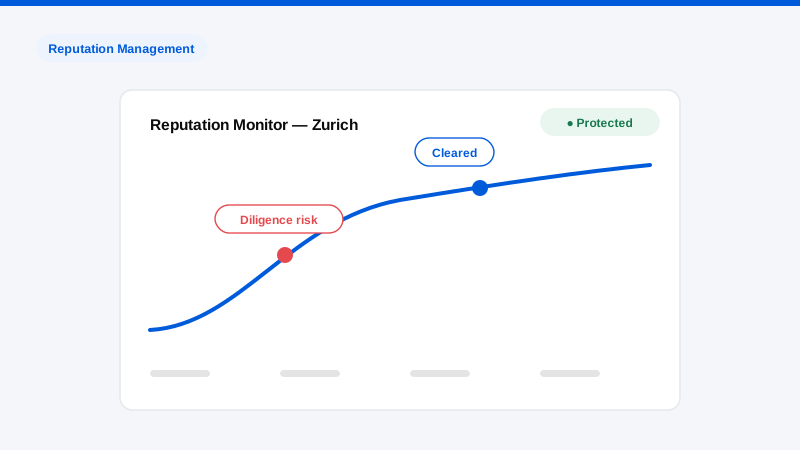
Reputation management in Zurich is the ongoing discipline of controlling what the internet (and increasingly, what AI assistants) say about a name that matters in this city: the private banker whose career depends on a clean fit-and-proper record, the executive whose employer’s crises become searches for their own name, the family office principal whose discretion is a professional asset, the entrepreneur whose next raise begins with an investor typing their name into Google. It is not a one-time cleanup and it is not public relations. It is a standing operational function with three moving parts (remove what is harmful, monitor what appears, strengthen what you control) run continuously, because the threat is continuous.
The distinction between removal and reputation management is worth being precise about, since this firm does both. Content removal is surgical: a specific article, thread, or listing is identified and taken down. We cover that work in detail in our guide to content removal in Zurich. Reputation management is the surrounding system, the discipline that decides what should be removed, catches new threats while they are still small, and builds a searchable record strong enough that the next attack lands on defended ground instead of empty ground. Zurich professionals tend to grasp this distinction faster than most markets, because they already live inside an equivalent discipline: risk management. Nobody on Paradeplatz believes that closing one bad position is the same thing as having a risk function.
The Zurich paradox: maximum discretion, maximum scrutiny
Zurich’s professional culture is built on discretion, and that culture creates a paradox that defines reputation work here. On one hand, the people this city produces (bankers, insurers, asset managers, industrial executives, family principals) publish almost nothing about themselves. Personal websites are rare, social media presence is thin, interviews are declined. On the other hand, no professional population on earth is screened more systematically. Adverse-media checks run on every onboarding. Fit-and-proper assessments attach to every regulated appointment. Counterparties, private-client lawyers, journalists, and family offices all run their own searches. The world’s most scrutinized names have voluntarily built the world’s thinnest public records.
The consequence is structural fragility. When a name has almost no online substance, whatever does exist carries total weight. A single hostile forum thread on a finance gossip board, one ambiguous paragraph in a decade-old article, one data-broker listing with a home address, on an otherwise empty search page, that item is not one result among many; it is the record. Adversaries understand this. So do the automated screening systems that summarize “what we found” for a compliance committee: they report the negative item because there is nothing else to report.
Classical Swiss discretion (say nothing, publish nothing, wait for things to pass) was a rational strategy when records faded. The internet does not fade, and AI systems now actively synthesize whatever fragments exist into confident summaries. The modern version of discretion is not absence; it is a deliberately thin, deliberately controlled record: accurate professional facts you chose, in sources you influence, occupying the surface that screeners and machines read, and nothing else. Building and holding that position is what reputation management in Zurich actually means.
What the discipline consists of
A properly run program for a Zurich client has four workstreams, running simultaneously rather than in sequence.
Removal, continuously applied. The removal work never fully ends, because the internet keeps producing. Data brokers repopulate from new sources. Scrapers republish deleted material. New threads appear after every corporate restructuring, every deal, every dispute. A standing program treats removal as capacity to be deployed monthly rather than a project to be completed once, which is why our Protection Plans are structured around removal applications plus monitoring rather than around one-off engagements.
Monitoring, at professional grade. Google Alerts are not monitoring. A serious program watches the client’s name across search engines in German and English (and French and Italian where the client’s footprint requires it), across the finance forums and gossip venues where Zurich names actually get attacked, across data brokers and people-search databases as they repopulate, across social platforms for impersonation, and across the dark-web credential dumps that precede targeted fraud. It also watches derivatives of the name: family members, family office entities, foundation names, and the misspellings under which hostile content sometimes hides. The purpose is time. Content caught in its first days (before it is indexed widely, before it is scraped, before a screening system captures it) is dramatically cheaper and faster to remove than content discovered at the next KYC refresh.
Strengthening what you control. For Zurich clients this workstream must be handled with cultural intelligence, because the American playbook (flood the zone with profiles, interviews, and thought leadership) reads as vulgar here and most clients will refuse it. Correctly done, strengthening for a Swiss professional is minimal and precise: an accurate professional biography in the two or three places screeners actually check, consistent firm-website and registry entries, a correct LinkedIn presence maintained to exactly the depth the client’s peers maintain, and, where the client leads a firm, institutional content that answers professional questions authoritatively. The goal is not visibility. The goal is that searches and AI queries about the client resolve to accurate, controlled sources rather than to voids that any adversary can fill.
Readiness for the bad week. Every senior Zurich career eventually intersects with an event: a restructuring, a regulatory action against the employer, litigation, a leak, a press investigation. Reputation management includes preparing for that week before it arrives, knowing exactly what exists online, having monitoring that detects the first hostile item within hours, having removal channels already established, and having a decision framework for what to fight, what to delist, and what to leave alone. Clients who begin the relationship during a crisis get help, but clients who began it two years earlier get outcomes.
Why Zurich careers are exposed in ways their owners underestimate
The exposure profile here is specific enough to enumerate. Regulated professionals (bankers, asset managers, insurance executives) carry career-long sensitivity to anything touching integrity, because fitness assessments and adverse-media screening revisit their names at every appointment, every employer change, and every periodic review. An allegation that would be forgotten in another industry is re-read, verbatim, for a decade. Corporate executives at the region’s banks, insurers, and pharmaceutical and industrial groups absorb reputational shrapnel from their employers: when the institution has a scandal, the search results form around the names of the individuals quoted, blamed, or merely present. Years later, the institution has moved on and the individual’s name still carries the coverage.
Family offices and principals face a different vector: privacy erosion rather than defamation. Wealth rankings, commercial-registry aggregators, property records, society coverage, and data brokers assemble a picture (residence, family members, holdings, philanthropy) that no one consented to and that functions as a targeting package for fraud, extortion, and worse. For these clients, reputation management is largely subtraction: systematically shrinking the searchable surface and keeping it shrunk. Entrepreneurs and fund managers, especially in Zurich’s fintech and crypto corridor, face the loudest version of the problem (disgruntled-investor posts, token-community mobs, short-thesis threads) and need the fastest monitoring-to-removal loop, because in their world hostile content propagates in hours.
A category Zurich specifically produces: the internationally mobile family. Families who relocate to Switzerland, or administer global wealth from it, are searched in every jurisdiction they touch, by banks in three countries, residency authorities, school admissions, co-investors. Their reputation program has to work across languages and legal systems simultaneously, which is precisely why a global remote practice fits this market better than a local agency.
The AI layer: what machines now say about Zurich names
A development sophisticated clients here have already noticed: the first “search” of a name is increasingly a question put to an AI assistant, and the assistant’s answer is a synthesis of whatever the open web contains. For a thin Swiss record, that synthesis is dangerous in a particular way, the model fills gaps with whatever fragments exist, granting a lone hostile forum thread the same authority as a regulatory filing. Executives have discovered that assistants confidently repeat allegations from sources a human reader would discount on sight.
This changes the discipline in two ways. First, removal gains value: content that no longer exists cannot be synthesized, which makes takedown the most durable AI-reputation intervention available. Second, the controlled record gains value: assistants weight authoritative, consistent sources, so a small set of accurate professional pages materially shapes what machines say. A modern Zurich program audits the major AI assistants’ answers about the client on a recurring basis, treats those answers as a monitored surface alongside search, and engineers the source layer they draw from. Very few clients’ names are asked about by machines less often this year than last; this layer only grows.
What a year of protection actually looks like
Because “ongoing discipline” can sound abstract, it is worth describing the operating rhythm of a mature Zurich program in concrete terms. In a typical quarter, monitoring surfaces a handful of events: a data broker that has repopulated the principal’s home address from a new source; a scraped copy of an article that was removed the previous year, republished on an aggregator; a new forum thread speculating about a restructuring at the client’s bank; an unfamiliar LinkedIn profile using a wealth manager’s name and photograph. Each is triaged within hours against a decision framework agreed in advance (remove, delist, watch, or ignore) and the removals are executed from the plan’s standing capacity without a new engagement, a new negotiation, or a new invoice.
Quarterly, the program re-runs the full exposure map: search results in each monitored language, AI-assistant answers, broker databases, registry aggregators, and the client’s controlled assets, compared against the previous quarter’s baseline. The client (or, more often in Zurich, their family office or counsel) receives a short report stating what appeared, what was removed, what is pending, and what changed in the surrounding threat picture. Annually, the program is re-scoped against the client’s actual year: a new board seat adds a fitness review to prepare for; a child turning eighteen adds a new name to cover; a planned transaction adds a diligence window during which the record must be at its cleanest. The work is deliberately boring, and that is the point. Reputation disasters are what happens when this boring work was never done, when the first time anyone mapped the client’s exposure was the week an adversary already had.
The contrast with the alternative is stark. The unmanaged version of the same year looks like this: the broker listing stands for eleven months and is copied by four other brokers; the scraped article gets indexed and re-screened at the client’s next KYC refresh; the forum thread accumulates replies for a year and becomes the top result for the client’s name; the fake profile solicits the client’s actual contacts for a fraudulent investment. Every one of those outcomes is more expensive to repair than the program that would have prevented it, and two of them are the kind a client never fully repairs.
The legal backdrop, used correctly
Swiss law is an asset in this work. The revised Federal Act on Data Protection gives individuals real rights over personal data, including grounds to demand deletion in appropriate cases, and it reaches foreign processors handling data about people in Switzerland. Swiss personality-rights doctrine protects honor and privacy in ways common-law systems do not, and European search-delisting practice extends right-to-be-forgotten-style outcomes to searches made from Switzerland. Publishers and platforms operating into this market know all of this, which gives well-constructed requests genuine weight.
The strategic error is treating law as the plan rather than the leverage. Litigation is slow, public, and, in a market where the engagement itself is meant to be invisible, often self-defeating: proceedings can generate precisely the coverage the client wanted gone. A standing reputation program uses legal rights the way a good negotiator uses a strong alternative: as the reason the counterparty cooperates through quieter channels. Where formal action genuinely is the right move, we coordinate with the client’s Swiss counsel; what we never do is pretend that a monthly retainer substitutes for legal advice, or that a lawsuit substitutes for the daily operational work of monitoring and removal.
How a Zurich engagement runs
We are a global remote practice with a London base, and Zurich programs run fully remotely and fully discreetly, no local intermediaries, no office visits, nothing that places the engagement inside the client’s professional community. Programs begin with a free, confidential Exposure Scan: a mapping of everything attached to the name across languages, platforms, brokers, and AI assistants, returned as an honest assessment of what should be removed, what should be monitored, and what should be built. From there, most clients move to a Protection Plan matched to their exposure, removal applications plus monitoring for professionals; broader family coverage, including digital executive protection with its security dimension, for principals and their households.
Communication is engineered around the client’s preferences: reporting monthly or quarterly, through the client directly or through their family office or counsel, in as much or as little detail as they want. A meaningful share of our Zurich relationships are intermediated, the wealth manager or private-client lawyer holds the relationship and we operate behind them, and we are built for that arrangement. Discretion is not a marketing adjective in this market; it is a service specification, and we treat it as one.
Onboarding is deliberately light on the client’s side. After the Exposure Scan is reviewed (usually a single call, with the client’s adviser present if preferred) we agree the monitored surface, the decision framework for automatic action, and the reporting channel. From that point the client’s obligation is close to zero: no content to approve weekly, no interviews to give, no visibility campaigns to endure. Zurich clients repeatedly tell us this is the feature they value most, a protection function that behaves like the rest of their professional infrastructure, working competently out of sight until it is needed.
Two commitments frame every program. We never fabricate: no fake reviews, no astroturfed articles, no invented persona, apart from being wrong, it is the single fastest way to convert a reputation problem into a scandal, and we never overpromise: some content cannot be removed, some narratives can only be contained, and clients get that assessment before they spend, not after.
Frequently asked questions
How is reputation management different from just removing bad content?
Removal is an intervention; reputation management is the system around it. A removal engagement ends when the target content is gone. A management program continuously monitors for new threats, removes them while they are small, keeps data brokers and scrapers suppressed, maintains the accurate record that search engines and AI assistants draw on, and keeps you ready for the crisis week. Most Zurich clients start with a removal, see what the exposure map looks like, and convert to a standing program.
What does ongoing reputation management cost for a Zurich professional?
Protection Plans scale with exposure (number of family members covered, languages monitored, removal capacity included) and every mandate is priced in writing after the free Exposure Scan. Individual removals are priced per link when handled standalone, the figure fixed beside each URL before you pay. For a senior banker or principal, the comparison that matters is not the fee but the cost of a single lost mandate, failed onboarding, or compromised appointment, any one of which exceeds years of coverage.
I keep an extremely low profile. Doesn’t that protect me?
It protects you until something appears, and then it works against you, because a hostile item on an empty search page becomes the entire record. Low-profile clients are our most common Zurich profile precisely for this reason. The program preserves your discretion: we do not make you visible; we make the thin record you do have accurate, controlled, and monitored, so that absence stays absence instead of becoming a vacuum an adversary fills.
Can you manage my reputation in German and English simultaneously?
Yes, and in this market that is mandatory, not optional. Zurich names are screened in German by local counterparties and in English by international ones, and content cleared in one language routinely survives in the other. Programs here monitor and act across German and English by default, adding French and Italian where a client’s Swiss footprint requires it.
Is this legal and above-board under Swiss rules?
Entirely. The work consists of exercising rights that already exist (platform policies, data-protection and privacy law, publisher processes) and building accurate content you are fully entitled to publish. We do not hack, do not fabricate, and do not deceive platforms; those approaches create liability rather than protection. Where matters require formal legal action in Switzerland, we work alongside your Swiss counsel rather than around them.
The pattern we see in Zurich, over and over, is that reputations here are defended the way this city defends everything else that matters: quietly, early, and systematically. The professionals who fare best are not the ones who never attract hostile attention (in this economy, nearly everyone senior eventually does) but the ones whose defenses were standing before the attention arrived, so that the incident became a managed event rather than a permanent record. If you want to know what your name, or your client’s, actually looks like to the systems that screen it, begin with a free, confidential Exposure Scan. For targeted takedown of specific existing content, see content removal in Zurich; for coverage across the other markets where you operate, our global directory lists every jurisdiction we serve.