
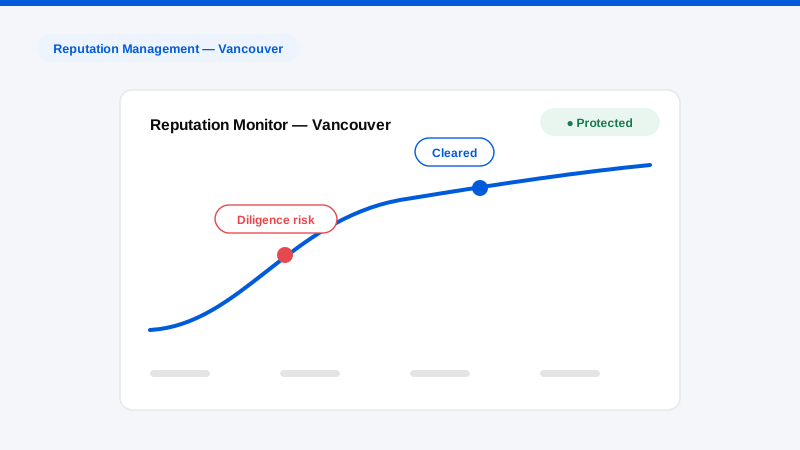
Reputation management in Vancouver is the ongoing discipline of controlling what the internet (and increasingly, what AI assistants) say about the names behind Canada’s Pacific gateway: the property family whose holdings make it a permanent subject of the city’s most emotive public conversation, the founder whose next raise will be preceded by a diligence search, the resource-sector director whose name circulates on stock boards decades after the companies are gone, the transpacific family whose record spans two languages and three jurisdictions, and the family office whose founding purpose is to keep all of the above out of view. It is not a cleanup and it is not publicity. It is a standing function with three moving parts (remove what is harmful, monitor what appears, strengthen what you control) run continuously, because in this market the record is examined continuously.
The distinction between removal and reputation management matters, because this firm provides both and they solve different problems. Content removal is surgical: a specific thread, article, impersonation account, or broker listing is identified and permanently taken down, work described in detail in our guide to content removal in Vancouver. Reputation management is the surrounding system: it decides what should be removed and in what order, detects new threats while they are hours old, and builds an authoritative record strong enough that the next attack, leak, or rumor lands on defended ground. One is an intervention; the other is a posture. Vancouver clients tend to arrive needing the first and stay because they understand, usually within a quarter, why they needed the second.
The Vancouver exposure equation
Vancouver’s reputational physics are unusual, and a program that ignores them fails quietly.
The city talks about wealth, constantly and personally. Property, foreign capital, affordability, and the provenance of fortunes are Vancouver’s standing public conversation, carried on in newspapers, forums, and comment sections that name names. A family that would be invisible in Toronto or Chicago is discussed in Vancouver simply for owning what it owns. This means ambient exposure: there is always a live thread for new hostility to attach to, and a family’s name is rarely more than one post away from circulation.
The record spans hemispheres. For a large share of significant Vancouver names, the online record is split across English and Chinese (and sometimes Korean, Farsi, or Punjabi) across platforms answering to different legal systems and invisible to each other’s search engines. A family can be pristine in English and compromised in Chinese, or the reverse, and the audiences that matter (Canadian banks, immigration authorities, business partners in Asia, the extended community on both sides of the Pacific) each read a different half. Managing one half is managing half the risk.
Diligence here is quiet and consequential. Bank onboarding and enhanced due diligence for internationally connected families; investor and acquirer diligence on founders; counterparty checks in property and resource transactions; private-school and university admissions review; immigration and residency processes that examine public records with increasing sophistication. None of these audiences announces what it finds. The terms tighten, the application stalls, the meeting cools, and the subject rarely learns why.
The machine layer now reads everything first. AI assistants answer “who is this person?” for bankers, journalists, and counterparties before any human reads page two of the results. They synthesize fluently from whatever exists (the stock-board thread, the decade-old article, the speculative comment) stripped of the context a careful reader might apply. For thin-record families, the synthesis is built almost entirely from other people’s words. An unmanaged Vancouver record does not stay still; it is re-summarized, annually and unfavorably, by systems that never knew it was contested.
The three pillars, run for Vancouver
Remove. Inside a standing program, removal is prioritized rather than reactive. The governing question: what does the first page (in English and in the other languages that matter, and in the AI answers built from them) show a diligence analyst, and which removal most improves it? Recurring targets: stock-board and forum threads attaching old ventures to current names; property-conversation hostility naming families and addresses; home-market press residue following transpacific families into English search; data-broker and people-search profiles mapping households; impersonation and fake-investment accounts trading on real names; and legacy coverage of matters long resolved. Each item is routed to the venue that will act on it (Canadian legal levers where they bind, platform policy where they do not, infrastructure and search layers where nothing else reaches) sequenced so early submissions never prejudice later ones.
Monitor. Monitoring converts ambient exposure into manageable information. We watch covered names (in the scripts, spellings, and transliterations that actually fragment a transpacific record) across Canadian and global search, Chinese-language platforms and media where relevant, forums and stock boards, local and national press, complaint sites, the data-broker ecosystem, and the major AI assistants. Alerting is tuned to the client’s real risk calendar: financings and transactions, project announcements and hearings, litigation milestones, family events, travel. The output is triage. Most mentions need nothing; some need watching; occasionally something needs action within hours (a doxxing post with a home address, an impersonation account soliciting the client’s contacts, a fabricated story moving through a community) and the program’s value concentrates into that window. Caught in its first day, such an item is a routine removal. Found six months later by a bank’s screening vendor, it has already done its work.
Strengthen. Vancouver’s wealth culture is reticent by instinct, and reticence has a cost the city’s families consistently underestimate: an empty record is not a private record. It is an undefended one, written by forums, aggregators, and machines. Strengthening is not publicity. It is the deliberate maintenance of an accurate, authoritative, well-structured public layer: current professional and corporate profiles, consistent biographical anchors across languages, authoritative third-party references, and structured information that search engines and AI systems resolve to the right person and the right facts. The test is severe but simple: a diligence analyst, or an AI assistant, reconstructing the client from public information should arrive at something true, current, and proportionate. For most Vancouver families, meeting that test requires publishing almost nothing personal; it requires making sure the little that exists is correct, ranks, and agrees with itself in every language that matters.
Managing a name across two hemispheres
The transpacific dimension deserves its own treatment, because it is where generic reputation services fail Vancouver clients most completely.
A family with history in Greater China or Southeast Asia and a present in Vancouver carries a record with two halves that behave differently. The English half is governed by Canadian and American platforms, Canadian defamation and privacy law, and Google. The other half lives on platforms with their own takedown regimes, their own evidentiary customs, and their own velocity, where material can move through community networks for weeks before any English-language monitoring notices. Hostile content migrates across the boundary at the worst moments: a home-market business dispute surfaces in English during Canadian bank onboarding; a Vancouver property thread is translated and recirculated in community media; an old regional article, invisible for years, is quoted by an AI assistant answering an English query.
A competent program treats this as one record, not two. Monitoring runs in both halves. Removal work is routed through each platform’s and publisher’s appropriate-language channels with properly localized evidence. The strengthening layer keeps the family’s minimal public anchors consistent across languages, so that machine translation and AI synthesis converge on the same facts rather than amplifying discrepancies, and sequencing respects both clocks, community-platform matters often need response in hours, while Canadian publisher negotiations run on editorial time.
The family dimension
Vancouver programs are family programs more often than in any market we serve except the private-banking capitals. Three reasons.
First, the security layer: the city’s property transparency and forum culture link names to addresses with unusual persistence, and for wealthy households the standing task of suppressing broker records, mapping posts, and address exposure is continuous, because the ecosystem repopulates continuously. This is where digital executive protection runs as a permanent workstream rather than a one-time sweep.
Second, the next generation: children of prominent families live online natively, and their exposure (social accounts, school and sport mentions, friend-network leakage) intersects the family name in ways adversaries and journalists have learned to use. Programs extend monitoring, hygiene guidance, and rapid takedown coverage across next-generation members without requiring them to live like fugitives: the family name is watched on the platforms younger members actually use, doxxing and harassment content is removed quickly through the urgent channels, broker records are suppressed as each member reaches adulthood, and practical guidance protects them without policing them, all under the same mandate and reporting as the principals’ coverage.
Third, succession: as wealth transitions, the record of the founding generation (including its disputes, its press, its enemies) becomes the inherited search result of heirs who had nothing to do with any of it. Programs address the legacy layer while it is still addressable; archives and aggregators only get harder with time.
Moments that test the record
A standing program earns its cost at predictable junctures. Before a financing or sale, when investor and acquirer diligence sweeps founders and directors. Before bank onboarding or a change of institution, when enhanced due diligence runs the family’s names through screening vendors. During immigration and residency processes, which increasingly examine public digital records. Ahead of school admissions, quietly consequential in this city. During project hearings and announcements, when developers’ names attract organized attention, and amid family events (divorce, estate matters, disputes) when adversaries are most motivated to publish. Clients who arrive after these moments get honest triage; clients who arrive before them typically pass through without incident, because the record was cleared and watched while everything was quiet. The difference in outcome is rarely the difficulty of the work. It is the timing.
A quarter inside a program
Abstractions aside, here is what a representative quarter of a Vancouver family program actually contains.
Week by week, the monitoring layer processes mentions across both language halves of the record. Most requiring nothing, a handful logged as watch items: a dormant stock-board thread that received a new reply, a property forum discussing the family’s neighborhood, a broker site that re-listed a suppressed address. Two or three matters typically progress to action. A people-search operator that repopulated the principal’s household record is re-suppressed through its opt-out and legal channels. A newly registered social account impersonating the family’s investment entity is documented and removed through the platform’s impersonation process within days. A years-old article about a settled dispute, surfaced by an AI assistant’s answer to a test query, is taken up with the publisher, a longer negotiation, carried across the quarter with counsel kept informed.
Meanwhile the strengthening layer gets its scheduled maintenance: corporate profiles checked for consistency, a stale biographical anchor updated, the structured information that search engines and assistants rely on verified against the current facts. The quarter closes with a review, one page for the principal, the full register for the family office: what appeared, what was done, what is in progress, what the AI layer now says, and what the next quarter’s calendar (a financing, a hearing, a graduation) implies for watchfulness.
Nothing in that quarter is dramatic. That is the point. The program’s product is the absence of drama, purchased through steady, unglamorous attention to a record that (in this city, for these names) never stops being written.
Why programs fail, and what a serious one does differently
Vancouver clients often arrive from unsatisfactory experiences elsewhere, and the failure patterns are consistent. Monitoring-only services that alert but cannot remove, a subscription to bad news. English-only coverage that misses half a transpacific record. SEO-era suppression schemes that try to bury hostile content under thin, machine-written filler, an approach that modern search actively penalizes and that AI assistants see straight through, since they read the buried material anyway. Guarantee merchants who promise outcomes no one controls, and project-only cleanups sold without the maintenance that Vancouver’s repopulating broker ecosystem and ambient forum culture make necessary.
A serious program is the opposite on each axis: removal-capable, not alert-only; multilingual where the record is; built on genuinely authoritative strengthening rather than filler; honest about probabilities; and continuous, because the exposure is. It is also selective, a program that tells you an item should be left alone, because acting would amplify it, is worth more than one that bills for motion.
How an engagement runs
A Vancouver program begins with a free, confidential Exposure Scan: a full map of what exists across languages, platforms, brokers, and archives, plus a documented snapshot of what the major AI assistants currently say about each covered name. Findings become a baseline register (removable now, removable with sequencing, suppressible, watch-only, leave alone) with honest probabilities attached, reviewed with whoever the client designates: the principal, counsel, or the family office.
Thereafter the program runs quietly on a set cadence. Removals proceed in sequence. Monitoring runs daily with pre-agreed escalation thresholds, so urgent categories move without a meeting. The strengthening layer is built and maintained. Reporting is written for its actual reader (one page for a principal, a full register for counsel or the office) and billing and communication can be structured through advisers where privilege and discretion argue for it. We are a global remote practice with a London office; we maintain no Vancouver office and no local footprint, which is part of the design: no visits, no observable relationships, nothing for the city’s well-developed curiosity to notice.
Programs run under our Protection Plans, combining continuous monitoring with a set number of removal applications and priority response, priced to the coverage involved; individual removals outside a plan are quoted per link in writing. We do not promise outcomes controlled by third-party platforms, editors, and search engines, no honest practitioner can. What a standing program changes is the odds: matters are caught while they are small, requests are framed professionally the first time, and nothing waits, unnoticed, for a diligence analyst to find it first.
Who engages
- Property families and developers: for whom the city’s standing conversation about wealth is a standing personal exposure.
- Founders and technology executives: managing diligence-readiness across raises, exits, and the residue of earlier ventures.
- Resource-sector officers and financiers: whose names outlive companies on boards that never forget.
- Transpacific families: running one record across two hemispheres, often through immigration, banking, and admissions windows.
- Professionals: physicians, lawyers, advisers whose practice is their name.
- Family offices: engaging for principals, spouses, and the next generation under one mandate, with reporting through the office.
A note on how engagements arrive: disproportionately through intermediaries (private-client and immigration lawyers, wealth managers, family-office executives) who have seen the work done discreetly for someone else and refer it quietly to the next client who needs it. In a market this networked and this attentive to who is doing what, that referral chain is the only marketing that matters, and preserving it is one more reason the work is built never to become visible.
Frequently asked questions
How is this different from a PR or marketing agency?
PR builds visibility; reputation management governs the searchable record: removing what is harmful, monitoring what appears in every language that matters, and keeping the authoritative layer accurate. Most of a good program’s output is invisible: threats that were handled at hour two instead of month six.
Can you really manage Chinese-language exposure alongside English?
Yes: for Vancouver it is a core requirement, not an add-on. Monitoring and removal run through the appropriate-language channels of the relevant platforms and publishers with localized evidence, and the strengthening layer keeps the record consistent across languages so machine synthesis converges on the same facts.
What do AI assistants have to do with my family’s reputation?
Bankers, journalists, and counterparties increasingly ask AI assistants about names before reading search results, and assistants synthesize from whatever the record contains, including forum speculation. We monitor what they say about covered names and manage the source layer they draw from, which is the practical lever that exists.
Is a standing program necessary, or can we just do one cleanup?
A cleanup fixes the current picture; it does not stop brokers repopulating, threads reappearing, or the next dispute publishing. Families with ambient exposure (property, markets, community prominence) get durable value from standing coverage. The Exposure Scan will tell you honestly which situation you are in; some clients genuinely need only the one-time work.
What does it cost?
Protection Plans are scaled to the number of names and languages covered and the intensity of removal work; individual removals are priced per link, each price set out in writing before you pay. The Exposure Scan is free and establishes exactly what a program would need to cover before you commit to anything.
If you want to know what the record, in every language and every layer that matters, currently says about your family or your name, start with the free, confidential Exposure Scan. For the surgical side of the discipline, see content removal in Vancouver; other markets are covered in our global directory.