
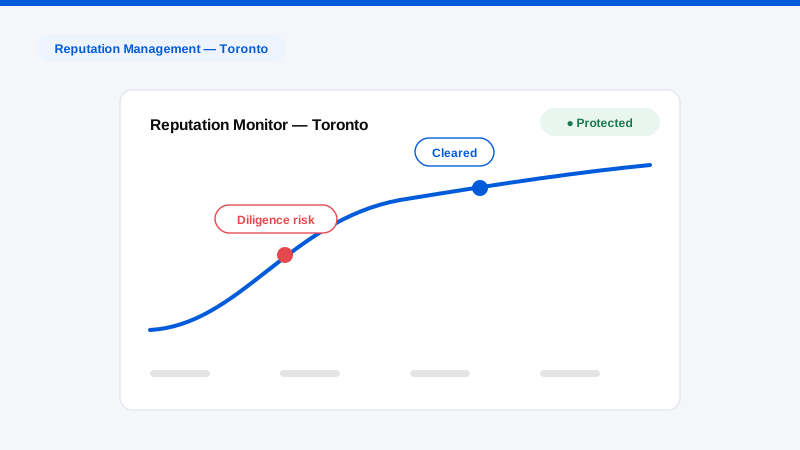
Reputation management in Toronto is the ongoing discipline of controlling what the internet (and increasingly, what AI assistants) say about the names that carry weight in Canada’s corporate capital: the bank and pension-fund executive whose signature moves institutional capital, the public-company director whose search results are read before every board vote, the fund manager courting allocators, the law-firm or accounting partner whose name is the practice, the developer whose projects draw organized opposition, and the family office whose entire design premise is staying out of the record altogether. It is not a one-time cleanup, and it is not public relations. It is a standing governance function with three moving parts (remove what is harmful, monitor what appears, strengthen what you control) run continuously, for the same reason Bay Street institutions run risk, compliance, and audit continuously.
The distinction between removal and reputation management matters, because this firm provides both and they solve different problems. Content removal is surgical: a specific article, thread, impersonation account, or data-broker listing is identified and permanently taken down, work we describe in detail in our guide to content removal in Toronto. Reputation management is the surrounding system: the function that decides what should be removed and in what order, detects new threats while they are hours old, and builds an authoritative record strong enough that the next attack, leak, or rumor lands on defended ground. Toronto’s institutional culture grasps the distinction quickly. Nobody who has sat through an audit committee believes that fixing one finding is the same thing as having controls.
What search results quietly decide in Toronto
Toronto is a large city that behaves, at its senior levels, like a small one. The population of people who allocate capital, appoint directors, refer clients, and approve transactions is compact, densely networked, and habitually discreet, and that combination gives online information unusual leverage. Nobody at a Bay Street table mentions what they found in a search. They simply adjust: the mandate goes elsewhere, the invitation is not extended, the terms tighten, the introduction is quietly dropped. The subject rarely learns why.
Consider the moments at which a Toronto name is actually examined. Enhanced due diligence at banks and counterparties, applied systematically to senior figures and their families. Institutional allocators screening a manager before a commitment, a process in which an unexplained forum thread can cost a fund a nine-figure allocation without a single question being asked. Board and governance reviews before appointments, where independent directors’ names are searched by every proxy adviser and journalist covering the company. Law and accounting firms’ conflicts and intake checks. Journalists building background files in a city that hosts the country’s national newsrooms. Lenders, insurers, and private schools running their own quiet checks on families, and now, before and beneath all of it, AI assistants answering “who is this person?” for every one of those audiences: fluently, confidently, and from whatever the record happens to contain.
That last layer changes the economics of neglect. A hostile item on page one used to do its damage only when someone searched. Today the same item is ingested, synthesized, and repeated by AI systems as if it were settled fact, stripped of the context a human reader might notice: the date, the retraction, the resolution. In a market where decisions are made silently, an unmanaged record does not stay neutral. It degrades: aggregators copy, stale profiles outrank accurate ones, and the machine layer resynthesizes the whole picture annually from whatever survives. Reputation management exists so that the silent examination, human or machine, finds a record the client actually stands behind.
The three pillars, run for Toronto
Remove. Inside a standing program, removal is prioritized rather than reactive. The governing question is what the first page of results, and the AI-generated answer built from it, shows a diligence analyst, an allocator, or a journalist, and which single removal most improves that picture. Recurring targets for Toronto clients: aged press coverage tying names to long-resolved litigation or regulatory matters; investor-forum threads dissecting deals, departures, and short theses; hostile review campaigns against professionals and firms; data-broker and people-search profiles mapping home addresses and family structures; impersonation accounts and cloned adviser profiles, which recur seasonally against financial names; and leaked personal detail with security implications. Each item is worked through the legal or policy route its venue requires (Canadian levers where they bind, platform and search-layer routes where they do not) sequenced so no early submission prejudices a later one.
Monitor. Monitoring converts Toronto’s decision culture (silent, networked, unforgiving) into manageable information. We watch the client’s names across global and Canadian search, national and trade press, social platforms, investor forums and boards, complaint sites, the data-broker ecosystem, and the major AI assistants, with alerting tuned to the client’s actual risk calendar: earnings and transactions, fund raises, board renewals, litigation milestones, succession events. The output is triage, not noise. Most mentions need nothing; some need watching; occasionally something needs action within hours (an impersonation account contacting clients, a fabricated story being shopped to a newsroom, a doxxing post with a home address) and the discipline’s entire value concentrates into that window. An item addressed in its first day is a routine removal. The same item discovered during an allocator’s diligence has already been priced in.
Strengthen. The third pillar is the one Toronto’s quiet-wealth culture resists, and needs most. Many of the city’s most significant names maintain almost no affirmative record: no interviews, no bylined work, a one-line biography. That restraint feels like discretion, but in search terms it is vacancy, and vacancy is occupied by whoever publishes first, including adversaries, aggregators, and machines. Strengthening does not mean self-promotion. It means ensuring that accurate, authoritative, verifiable material exists and ranks: professional profiles that are current and consistent, firm and fund pages that answer the obvious questions, authoritative third-party references that anchor the record, structured information that AI systems resolve to the right person. The test is not visibility; it is that a diligence analyst, or an AI assistant, reconstructing the client from public information arrives at something true.
The Toronto threat calendar
Standing programs earn their keep at predictable moments, and Toronto’s calendar has a recognizable shape.
Transactions and fund raises. Nothing increases search volume against a name like a deal. Counterparties, lenders, and allocators run their checks in the weeks before signing, which is precisely when adversaries with grievances time their posts. A program that has already cleared the record, and that watches it daily through the deal window, removes a variable from the transaction.
Short campaigns and market commentary. For public-company officers and directors, a short report or activist letter produces an instant secondary ecosystem of threads, videos, and commentary that attaches to individual names and outlives the campaign. The corporate response is the company’s business; the durable personal residue, the executive’s name fused to an allegation in perpetuity, is what the standing program manages, item by item, after the noise passes.
Proxy fights, restructurings, and departures. Contested governance events and senior exits generate anonymous commentary from people who know enough to be credible. Much of it is removable under platform rules when handled promptly and professionally; almost none of it is removable gracefully once it has aged into the record.
Family events. High-value divorces, estate disputes, and succession transitions produce strategic leaks and hostile filings coverage, and increasingly reach the next generation, children whose online lives intersect the family name. Programs covering Toronto families extend monitoring and removal across spouses and next-generation members under one mandate.
Media cycles. Toronto hosts the newsrooms, and business coverage here is serious and archival. A program does not, and should not, attempt to manage journalism; it ensures that when coverage comes, the surrounding record is accurate, the legacy items have been addressed while that was still possible, and the client is not defined by a decade-old headline the reporter found in the first thirty seconds.
What a program looks like in practice
A Toronto engagement typically begins the way removal engagements do: with a free, confidential Exposure Scan that maps everything discoverable about the name, search results in the markets that matter, forums, brokers, archives, and what the major AI assistants currently say. The difference is what happens next. Instead of a one-time project, the findings become a baseline: a prioritized register of standing risks, open removals, monitored watch items, and strengthening actions, reviewed on a set cadence with whoever the client designates: the principal directly, or counsel, or the family office.
Thereafter the program runs quietly. Removals proceed in sequence. Monitoring runs daily, with escalation thresholds agreed in advance so that a 2 a.m. impersonation account does not wait for a scheduled call. The affirmative record is built and maintained deliberately. Reporting is written for the reader it actually has (a principal who wants one page, a general counsel who wants the register, a family office that wants both) and billing, communication, and documentation can be structured through advisers where privilege and discretion argue for it.
We are a global remote practice with a London office. We maintain no Toronto office and no local footprint, which is not a limitation but part of the design: there are no visits, no observable relationships, and no local staff to be asked who their clients are. The work product is the record itself.
Programs run under our Protection Plans, which combine ongoing monitoring with a set number of removal applications and priority response. Where a family’s or executive’s exposure carries a physical-security dimension (addresses, travel patterns, family mapping) digital executive protection extends the program to the data-broker and personal-data layer on a standing basis. Individual removals outside a plan are priced per link and quoted in writing after the scan. We do not promise outcomes controlled by third-party platforms, editors, and search engines, no honest practitioner can, but a standing program materially shifts the odds, because it catches matters while they are still small and frames every request professionally the first time.
Who engages, and why
Bank, pension, and asset-management executives engage because their names are searched constantly and consequentially, and because the institutions they serve expect personal records to be as controlled as corporate ones. Public-company officers and directors engage because the venture-market forum culture and the short-selling ecosystem generate personal residue faster than any individual can address it. Fund managers engage because allocator diligence is silent and unforgiving, and a single unexplained item can cost a commitment nobody will ever discuss. Professional partners engage because their name is the practice, and a review campaign or aged discipline item compounds against it. Developers and business families engage because opposition to projects becomes opposition to people. And family offices engage on behalf of all of the above, typically covering principals, spouses, and the next generation under one mandate, with reporting through the office rather than to the family directly.
A recurring Toronto pattern deserves note: the referral chain. Engagements here arrive disproportionately through lawyers, wealth managers, and family-office executives who have watched a matter handled discreetly for another client. The city’s senior tier is small enough that discretion is itself the marketing, which suits a practice whose defining promise is that the work never becomes visible.
The first ninety days
Standing programs are built, not switched on, and the opening quarter of a Toronto engagement follows a consistent arc.
The first weeks belong to the baseline. The Exposure Scan is deepened into a full register: every meaningful search result for every covered name and spelling, every forum and board mention, every data-broker and people-search record, every archived item, and a documented snapshot of what the major AI assistants currently say when asked about each principal. Each entry is classified (removable now, removable with sequencing, suppressible, watch-only, or leave alone) with an honest probability attached. Clients are routinely surprised in both directions: items they feared prove readily addressable, and items they had never seen prove to be the real risk.
The middle weeks belong to the highest-value removals. Sequencing matters here more than speed. Broker suppression runs early because it is quiet and cumulative. Platform matters are filed in an order that avoids alerting hostile posters to a coordinated effort. Publisher approaches are prepared carefully and made once, a first approach to a Canadian newsroom is unrepeatable, and it is made only when the evidence package is at its strongest. Anything touching live litigation or a live transaction is coordinated with counsel before a single request is sent.
The final weeks put the standing machinery in place: monitoring tuned to the client’s names, variants, and risk calendar; escalation thresholds agreed so that urgent categories move without a meeting; the strengthening plan drafted and its first elements published; and the reporting cadence established. By day ninety the program is no longer a project. It is a function, and the measure of its success from that point forward is how little the client has to think about it.
What we watch for in this market
Every market has its signature threat patterns, and Toronto’s are distinct enough to shape the monitoring layer.
Investor-forum drift: threads on stock boards and Reddit communities where commentary about a company slides into commentary about named officers, directors, and their families. Caught early, much of this is removable under platform rules; aged, it becomes part of the name’s furniture.
Aggregator recycling: Canadian court coverage, regulatory notices, and professional-discipline items republished by scraper and aggregator sites that add nothing but durability. The originals are often addressable; the copies must be swept as they appear.
Broker repopulation: the North American data-broker ecosystem rebuilds profiles continuously from fresh feeds, and Toronto families’ addresses, relatives, and property associations resurface on a cycle. Suppression is maintenance, not an event.
Cross-border spillover, Toronto names with US business exposure accumulate American content, complaint sites, US press, litigation coverage, that Canadian legal instincts misjudge. The program routes each item to the layer that will actually act on it, on either side of the border.
Impersonation waves: cloned LinkedIn and adviser profiles, spoofed firm domains, and fake executive accounts targeting the city’s financial brands in recurring campaigns. These are urgent-category items: the damage is done in days, and the response is built to move in hours.
Reputation management versus crisis response
Toronto has capable crisis-communications firms, and a standing reputation program is not a substitute for them when a live, newsworthy event demands public response. The two disciplines meet at different moments. Crisis response manages the days when something true and significant is happening; reputation management governs the years on either side, clearing the record before scrutiny arrives, catching threats while they are hours old, and ensuring that when a crisis does come, the searchable record beneath it is accurate and defended. Clients who arrive mid-crisis get honest triage: what can be removed now, what must be weathered, and what should never have been left standing. Clients who arrive early rarely experience the crisis at all, because the raw material (the old thread, the broker profile, the unaddressed article) was dealt with while it was still quiet.
Frequently asked questions
How is this different from hiring a PR firm?
PR creates visibility and shapes narratives; reputation management governs the searchable record itself: removing what is harmful, monitoring what appears, and strengthening what ranks. The disciplines are complementary, but the work here is closer to risk management than to communications: most of a good program’s output is things that never happened.
Can you monitor and manage AI assistants’ answers about me?
Yes: monitoring covers what the major AI assistants say about the client’s names, and the levers are practical: removing the harmful source material assistants ingest, and strengthening the authoritative record they draw on. What a machine says about you is downstream of what the record contains; we manage the record.
We are a private family. Is a standing program overkill?
Privacy is precisely what programs protect. For families the core work is often not press at all but the data layer (brokers, people-search sites, leaked addresses, next-generation social exposure) maintained continuously because it repopulates continuously. Most family engagements are quiet by design and remain that way.
What does reputation management cost in Toronto?
Program pricing depends on the number of names covered and the intensity of monitoring and removal work; individual removals outside a plan are priced per link, with the exact figure beside each URL in a written quote. The Exposure Scan is free and establishes what a program would actually need to cover.
Can the engagement run through our counsel or family office?
Yes, and in Toronto it usually does. Reporting, billing, and communication can be structured through the advising professional, with the principal’s involvement compartmentalized to the minimum working set, a model built for exactly this market’s habits.
If you want to know what the record currently says about you, including what AI assistants answer when your name is asked about, start with the free, confidential Exposure Scan. It establishes the baseline a program would defend, with no commitment and no footprint. For the surgical side of the discipline, see content removal in Toronto; other markets are covered in our global directory.