
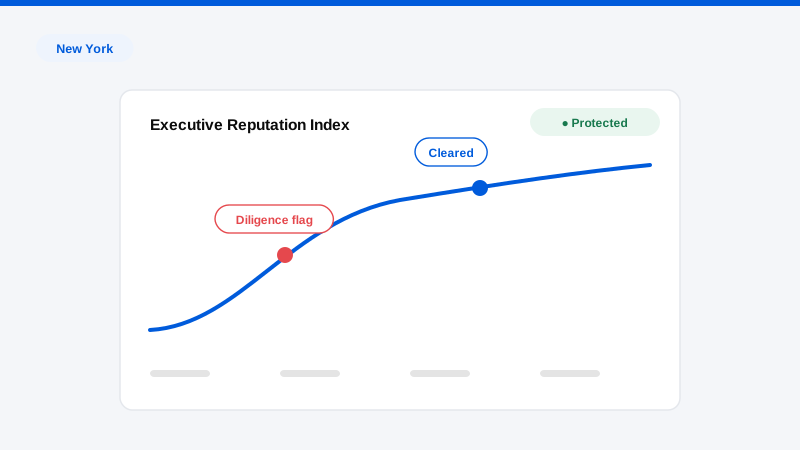
Reputation management in New York is the ongoing strategic discipline of controlling what the internet says when your name is searched (combining the removal of harmful content, continuous monitoring of new exposure, and the deliberate strengthening of accurate, authoritative material) practiced on behalf of the people this market judges hardest: fund managers and allocators, bankers, law-firm partners, founders, board directors, physicians, and the families behind the city’s private wealth. It is not a one-time cleanup and it is not publicity. It is the standing infrastructure that ensures the version of you that appears in a search box, a diligence report, or an AI assistant’s answer is the accurate one.
New York runs on reputation the way other cities run on electricity. Capital allocation, lateral hiring, board appointments, co-op approvals, client engagements, and press treatment all begin with the same act: someone typing your name into a search bar. In most markets a mediocre search presence is an inconvenience. In New York it is a tax on everything you do: paid in basis points, lost mandates, and meetings that never get scheduled. This page explains how professional reputation management works for New York clients: what the discipline actually consists of, why this market demands it, how the American legal environment shapes what is possible, and what a managed engagement looks like in practice.
Why New York reputations are stress-tested harder than anywhere else
Three structural features make this the most demanding reputation market in the world.
The scrutiny is professionalized. New York institutionalized diligence. Allocators commission background reports before committing to funds. Banks screen counterparties. Executive recruiters run candidates through search and database checks before the first call. Law firms and consultancies vet lateral partners. Co-op boards investigate buyers. The people evaluating you are not casually Googling. They are running structured processes designed to surface every negative item in existence, including material that ordinary search would never show. Reputation management for New York clients has to assume this level of scrutiny as the baseline.
The media supply is unmatched. New York produces more journalism per capita than any city on earth: national dailies, wire services, the business press, tabloids with real investigative muscle, and trade publications covering finance, law, real estate, fashion, and media itself. More coverage means more named individuals, more archived stories, and more opportunities for a decade-old article to define a current search result. It also means faster escalation: a negative item that would die quietly elsewhere gets picked up, aggregated, and commented on here.
The adversaries are motivated and sophisticated. Activist short sellers publishing on fund principals. Former partners litigating publicly. Anonymous finance and legal forums where reputations are traded like positions. Disgruntled employees who understand exactly how Glassdoor and Reddit affect recruiting. Competitive dynamics in this city produce deliberate, well-executed reputation attacks at a rate few other markets see, and defending against a deliberate attack requires an equally deliberate standing capability, not an improvised response.
There is a fourth, quieter feature: New York is a market of one degree of separation. The allocator reading a forum thread about you sits on a board with your former partner; the recruiter screening you had drinks with the journalist who covered your last dispute. Online content here does not circulate abstractly. It lands in front of people who know you, act on it, and repeat it. That social density is why New Yorkers feel search-result damage faster and more personally than clients anywhere else, and why the discipline of managing it has become as standard among the city’s senior professionals as estate planning or personal security.
What reputation management actually consists of
The discipline has three interlocking functions. Any vendor offering only one of them is selling a partial solution.
Remove. Harmful content that can come down should come down. Defamatory posts, policy-violating reviews, exposed personal data, impersonation accounts, outdated press about resolved matters, each has established removal or de-indexing routes when the work is done properly. Removal is the subject of its own discipline, covered in depth in our guide to content removal in New York; within a managed program it operates as a continuing function rather than a one-off project, because new content appears and old content resurfaces.
Monitor. New York moves too fast for quarterly check-ins. Professional monitoring watches search results for the client’s name and related terms, tracks mentions across news, forums, and social platforms, watches data brokers for republished personal information, and, a recent but essential addition, audits what AI assistants say when asked about the client. The purpose is speed: a defamatory post addressed within days is a removal; the same post discovered after six months is an entrenched search result with copies, commentary, and cached versions.
Strengthen. The most durable defense in the American legal environment is a strong, accurate, authoritative online presence. Where content cannot be removed, and some cannot, its practical impact depends on what surrounds it. Strengthening means ensuring the accurate record is well-documented and prominent: complete, consistent professional profiles; authoritative biography pages; properly maintained firm sites; and legitimate coverage of the client’s actual work. This is not fabricating a persona. It is making sure the truthful record is at least as visible as the noise, so that a single outdated item cannot masquerade as the whole story.
The three functions compound. Removal clears the ground, strengthening occupies it, and monitoring holds it. Clients who buy only removal find new problems appearing in a vacuum; clients who buy only “SEO suppression” find the buried content resurfacing the moment an algorithm shifts; clients who only monitor watch problems accumulate with no mechanism to resolve them.
How this differs from PR, SEO, and crisis communications
New York clients usually already retain communications advisers, and the disciplines are frequently confused, so the boundaries are worth drawing. Public relations earns attention: placements, profiles, messaging. Reputation management governs what that attention finds when it arrives: the search results, the archived coverage, the forum threads, the data trails. SEO, as commonly sold, optimizes a website for commercial keywords; reputation work optimizes the results for a person’s or firm’s name, a different problem with different tools, and one where removal is available in ways ordinary SEO never contemplates. Crisis communications is the emergency room, indispensable when the story breaks, but structurally reactive. A reputation program is the preventive medicine that determines how much material the crisis has to work with, and it continues operating after the communications firm has demobilized, cleaning up what the episode left behind in the index.
The practical relationship is complementary. On sensitive New York matters we regularly operate as the quiet third leg of a triangle with the client’s counsel and communications firm: they manage the message and the legal position; we manage what the internet permanently retains. Firms that skip that third leg win the news cycle and then lose the search results for the next decade.
The AI layer: the new front door to your name
A structural shift is underway that New York’s diligence-driven market is feeling first: increasingly, the first impression of a person is not a page of search results but a synthesized answer from an AI assistant. Analysts, journalists, recruiters, and counterparties now ask conversational AI tools about people by name, and those tools compress whatever the web says (accurate or not, current or not) into a few confident sentences. An outdated article or a defamatory forum thread that a human might have weighed skeptically becomes, in an AI summary, an unqualified assertion.
This changes the discipline in two ways. First, monitoring must now include the AI layer: we audit what the major assistants say about clients and track how those answers change. Second, it raises the premium on source-level removal and on authoritative strengthening, because AI systems inherit from the underlying web. Content that is removed at the source eventually falls out of the answers; strong, consistent, authoritative material about a client increasingly anchors them. New York clients who invested in the discipline early are conspicuously better represented in this new layer than those who assumed page two of Google was oblivion.
The legal environment New York clients operate in
American law shapes this discipline more than most clients expect, and it is worth understanding plainly.
The First Amendment gives publishers and commentators the strongest protections in the world. Truthful reporting and opinion are essentially immune from compelled removal, and there is no US right to be forgotten: unlike in the EU, you cannot generally force a search engine to delist accurate coverage. Section 230 shields platforms from liability for user content, which forecloses the lazy strategy of threatening the forum instead of the poster. Defamation law provides real recourse against false statements of fact, but public figures (a category that includes many senior New York executives, at least regarding their professional conduct) face an elevated standard of proof, and litigation itself creates public records and coverage.
Professionals read this landscape not as a wall but as a map. It tells you where removal pressure works (platform policies, privacy categories, copyright, falsity backed by evidence, negotiated publisher outcomes) and where the strategy must shift to strengthening and monitoring instead (protected, accurate, newsworthy content). The most expensive mistakes we see in this market come from clients, often advised by aggressive counsel, who spent a year and seven figures fighting content the American system was never going to let them remove, while doing nothing to build the countervailing record that would have neutralized it in a month. We are not a law firm; where legal action is warranted, we work alongside the client’s counsel, and New York’s media bar is the best in the country. But the sequencing matters: legal leverage is one instrument in the program, not the program.
The moments when New York reputations are decided
A standing program earns its keep at specific, predictable moments. If any of these are on your horizon, the time to establish the program is before they arrive.
Fund raises and capital events. Allocator diligence will surface everything. Funds that come to us mid-raise, after an LP flags a search result, are negotiating from weakness; funds that arrive six months ahead of a raise get their exposure resolved before anyone asks.
Transactions and exits. M&A diligence now routinely includes reputational screening of key principals. A founder’s search results are, functionally, part of the data room.
Lateral moves and board appointments. Search committees and nominating committees check first and interview second. Senior candidates are eliminated by page one of Google without ever knowing it.
Litigation and disputes. Lawsuits generate press, dockets, and commentary. Managing the online dimension of a dispute (what gets indexed, what gets amplified, what remains after settlement) is now a standard workstream alongside the legal one. This includes the quiet post-settlement phase where outdated coverage of the resolved matter is addressed.
Press attention, wanted or not. A profile, an award, a controversy, an activist campaign. Attention spikes create both risk and opportunity: whatever exists about you when the spotlight arrives is what the spotlight illuminates.
Family events. Divorces, estate disputes, a child’s college admissions or first job. New York families discover that reputational exposure is generational, and that the internet does not distinguish between the principal who sought a public life and the family members who did not.
Who we serve in New York
Hedge funds, private equity firms, and asset managers: protecting principals’ search results through raises, defending against short-side and forum attacks, and maintaining the clean diligence profile that allocators expect. For fund principals we typically pair the program with digital executive protection, which adds personal-data removal and privacy hardening for the individual and their family.
Banks, fintechs, and financial-services executives: managing the coverage that attaches to deals and departures, and ensuring an executive’s record travels accurately between institutions.
Law firms and professional-services partnerships: partner-level search management, response to review-site and employee-review campaigns, and handling the content generated by the firm’s own high-profile matters.
Founders and public-company executives: from pre-IPO cleanup through activist defense, with particular attention to the windows when disclosure rules constrain what the company itself can say publicly.
Family offices and private families: multi-generational programs covering principals, spouses, and children: data-broker suppression, monitoring for security-relevant exposure, and rapid removal response when incidents occur. For Manhattan family offices, this increasingly sits alongside physical security as a standing line item.
Physicians, and licensed professionals: in the most review-sensitive, competitive professional market in the country, where search results measurably drive patient and client acquisition.
Public figures: media personalities, authors, athletes, and cultural figures who need coverage managed with judgment rather than volume.
How a managed engagement runs
We operate as a global remote practice; New York clients are served confidentially by a dedicated team, with communication structured however the client requires: directly, or through counsel, chiefs of staff, or family-office executives, so that the principal’s name stays off correspondence.
It starts with an audit. Every engagement begins with a free, confidential Exposure Scan: a structured map of your current search results, social and forum presence, data-broker exposure, image results, and AI-assistant answers. The scan grades every negative or risky item by severity and by realistic treatability, and identifies the gaps in your authoritative presence that leave you vulnerable. New York clients are routinely surprised, not by the items they knew about, but by the data-broker listings, forum mentions, and AI-generated summaries they had never seen.
Then a strategy, then a cadence. From the audit we build a program: which items to remove and by what route, which to de-index or suppress, what strengthening work to do, and what monitoring perimeter to maintain. Execution then runs on a monthly cadence (removals filed and tracked, monitoring alerts triaged, strengthening assets built and maintained) with reporting that shows exactly what changed. When something breaks, the cadence compresses: new defamation, a leak, or a press inquiry triggers same-day response from a team that already knows your profile, which is the entire advantage of standing capability over emergency retention.
What it costs. Protection Plans are priced to the size of the monitoring perimeter and the volume of removal work included; individual removals outside a plan are priced per link. All pricing is in USD and quoted in writing after the free Exposure Scan, with the exact figure beside every URL before anything is paid. The honest framing we give every New York prospect: this is insurance priced against the stakes you actually play for. A single lost LP commitment, blown lateral move, or mishandled news cycle costs multiples of a year of the program.
What we will not do
Credibility in this field is defined by refusals. We do not fabricate reviews, astroturf coverage, or build fake personas, practices that violate platform rules and create catastrophic discovery risk for exactly the sophisticated clients we serve. We do not promise outcomes we do not control; anyone promising the deletion of accurate major-outlet journalism is lying to you. We do not teach adversarial tactics or run smear campaigns against clients’ opponents, and we tell clients when the right answer is to do nothing. Some content is best left alone, and knowing when is part of the judgment you are paying for.
Frequently asked questions
How much does reputation management cost in New York?
Ongoing programs run through our Protection Plans, which bundle monitoring, removal applications, and priority response; more extensive programs for funds, firms, and families scale from there. One-off removals are priced per link. Every engagement is quoted in writing after a free assessment, in USD, before you commit to anything.
How long before results are visible?
Removals of clear policy-violating content often land within weeks. Reshaping a search results page (de-indexing outdated press, strengthening authoritative material) typically shows meaningful movement in two to four months, with compounding gains after that. We set expectations item by item during the audit rather than promising a blanket timeline.
Do you work with our lawyers and PR firm?
Routinely, and the results are better for it. Counsel handles legal leverage, communications firms handle messaging, and we handle the removal, monitoring, and search-layer execution. New York clients usually have sophisticated advisers already; we slot into that structure rather than duplicating it.
Is the engagement confidential?
Yes: contractually and operationally. Work runs under NDA, correspondence can be routed through counsel or intermediaries, and nothing in our process requires public disclosure. Most of our New York clients are people whose hiring of a reputation firm would itself be a story; the program is built so it never becomes one.
Can you help if the negative coverage about me is accurate?
Honestly, yes, but not by deletion. Accurate reporting by legitimate outlets generally cannot be removed in the US, and we will tell you that plainly. What a program can do is ensure the coverage sits in accurate context: outdated matters get updated or de-indexed where routes exist, the authoritative record gets strengthened, and monitoring prevents pile-on content from compounding the original item.
The next step
The defining feature of New York’s reputation market is that by the time you need a clean search presence, it is too late to start building one. The professional move is to know your exposure now. Request a free, confidential Exposure Scan. We will map what exists, grade what can be fixed, and show you what a standing program would cover. If your immediate problem is one specific piece of content rather than the ongoing discipline, start with our guide to content removal in New York, and for the other markets we serve worldwide, see our global directory.