
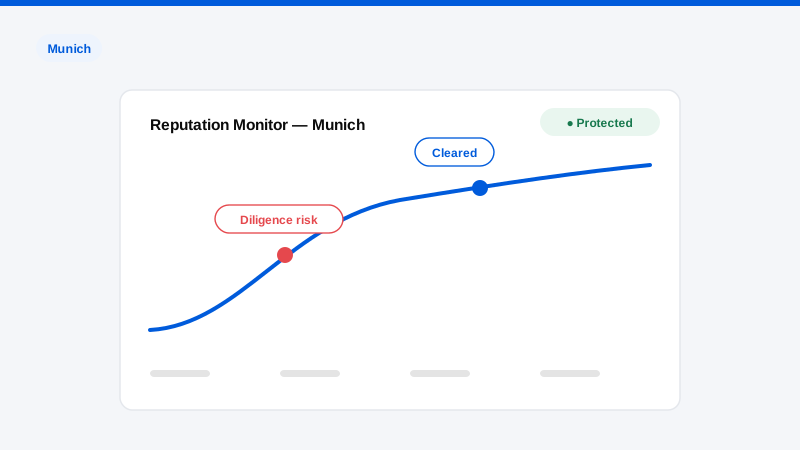
Reputation management in Munich is the ongoing discipline of controlling what appears when a name is searched (removing what is harmful, monitoring for what is new, and strengthening what is accurate) practiced for the people who own and run southern Germany’s economy: Mittelstand proprietors and their families, executives of the global industrial and insurance groups headquartered in the region, technology founders, investors, senior professionals, and the family offices that administer generational Bavarian wealth. It is not a cleanup project with an end date, and it is not public relations. It is a standing defense, maintained continuously and quietly, across the German- and English-language surfaces on which Munich names are actually searched.
The case for the ongoing discipline is different here than in a pure finance capital. Frankfurt careers are screened; Munich fortunes are inherited, and the horizon is generational. A family that controls an industrial company measures reputation risk not in the next appointment cycle but in decades: across successions, company sales, marriages, disputes, and the arrival of a next generation that grows up online. Managing a name on that horizon means treating the family’s search surface the way the family treats its holding structure: as permanent infrastructure, professionally maintained, reviewed on a schedule, and never left to chance. This page describes what that maintenance involves, who needs it, and what it costs.
The Munich exposure: owners, not just executives
Munich’s economy is built on an unusual combination: a handful of the world’s largest automotive, engineering, semiconductor, and insurance groups, surrounded by thousands of family-owned Mittelstand firms, world leaders in narrow industrial niches, mostly unlisted, and controlled by families whose surnames are often the company’s brand. Add one of continental Europe’s strongest venture ecosystems, the private-equity and legal infrastructure serving it, a substantial media sector, and a society scene that has always attracted press attention, and the city produces two distinct reputation profiles that ongoing management has to serve simultaneously.
The executive profile is familiar: leaders of listed groups named in coverage of every restructuring, recall, and compliance matter their employer passes through; screened by nomination committees, regulators, and adverse-media systems at every step; searched in German by domestic counterparties and in English by international ones. Their exposure is episodic and event-driven, spiking around appointments and corporate news.
The owner profile is the distinctly Bavarian one: principals and heirs whose optimal search result is almost nothing. Their exposure is not a bad article but the slow accumulation of findability (wealth-list entries, data-broker records, home regions, family connections, succession coverage, society photographs) each item small, together forming a reconnaissance file with security consequences. For these clients the management discipline is subtractive: the goal is not a better page one but a quieter one, maintained against an internet that re-aggregates and republishes on a cycle.
Both profiles share the same screening reality. Banks, family offices, and counterparties run automated adverse-media and KYC checks that flag anything negative attached to a name without weighing its credibility. M&A diligence sweeps every owner and director of a target, in both languages, before a process opens. And German press archives preserve decades-old coverage (a resolved succession dispute, a discontinued proceeding) that resurfaces on a fresh search as if it were news. Unmanaged, this sediment compounds. Managed, it gets removed, delisted, anonymized, or outranked before the moments when it would cost something.
Remove, monitor, strengthen, the standing functions
Ongoing reputation management here is three functions running together, and each is hollow without the others.
Removal eliminates harmful material at the source: outdated press, defamatory forum and complaint-site posts, false review-platform claims, broker and aggregator listings, fake profiles, leaked private material. Each item gets the channel most likely to kill it (platform policy, privacy and data-protection process, publisher negotiation, or search delisting) in a deliberate sequence, because a premature filing at one venue can harden another. The full removal discipline, including what German and European law does and does not make possible, is set out on our content removal in Munich page; within a managed engagement, removal runs as a standing capability rather than a one-off project, clearing the baseline backlog first and then dispatching new items while they are young.
Monitoring watches the name continuously: Google.de and international search, German and English news surfaces, press archives, the forums and review platforms where attacks on owners and managers actually start, social platforms, and the data-broker ecosystem that republishes personal information on a rolling basis. For families, monitoring extends to the surfaces the principals never see: tagged photographs, school and club mentions, event coverage, and the aggregation sites that connect names to faces and places. The value of monitoring is speed. Content challenged in its first days is often removable before it spreads to mirrors and screening databases; content discovered during a transaction is already in the data room.
Strengthening maintains the accurate layer that should rank. For executives, that means restrained, factually solid professional material (biographies, firm pages, authoritative references) built so hostile content must displace established authority rather than fill a vacuum. For owner families, strengthening is applied sparingly and deliberately: sometimes a minimal, controlled corporate presence is the right anchor; sometimes the correct strategy is near-total absence, with the company visible and the family not. Munich reads carefully, and inflated or promotional material damages credibility here; the strengthening layer must look like the natural record of a serious operation, because it is.
The generational calendar
What makes Munich engagements distinctive is the calendar they run against. The predictable, high-stakes events of Bavarian wealth are not quarterly earnings but generational transitions, and each one triggers waves of searching by parties who never announce themselves.
Succession. When leadership of a family firm passes, the incoming generation is searched by employees, banks, customers, suppliers, and journalists, often the first sustained scrutiny of a name that grew up semi-visible online. Preparing a successor’s search surface, in both languages, twelve months before the handover is quiet work that changes how the transition is received.
Company sale or investment. A process brings professional diligence: every owner and director searched, adverse-media sweeps run in waves, findings written into reports the family never sees. Material removed before the first sweep never enters the conversation; material removed after is a footnote that already did its damage.
Family events. Marriages, divorces, inheritance matters, and disputes generate coverage and court records that attach to names permanently unless managed. The discipline here is containment: remove what is removable early, delist what qualifies, and deny the story the searchable permanence that turns an episode into a definition.
The next generation coming online. Heirs accumulate digital exposure from adolescence (tagged photos, sports results, university lists, social accounts) that connects unpublicized surnames to faces, routines, and locations. Families on managed programs get this surface audited and minimized with the next generation’s cooperation, which is both a security measure and an education in how the family’s discretion is maintained. This work sits alongside our digital executive protection practice, and family offices increasingly commission it as a standard part of next-gen preparation.
Between events, the program idles deliberately low: monitoring runs, brokers are re-cleared on cycle as they republish, the strengthened layer is kept current, and the family hears from us rarely, which is the point. The measure of success is that when the next event arrives, nothing has to be fixed under deadline.
The bad day, with and without a program
Consider the same event landing on two families. A dispute inside a Mittelstand firm leaks: an anonymous account posts internal documents and accusations against the owning family on a forum, a regional journalist starts calling, and within days the material is being copied to secondary sites and discussed on social platforms.
The unmanaged family spends the first week in discovery (finding out what has been posted and where, arguing internally about whether responding makes it worse, waiting for a law firm to research venues it has never dealt with) while the content indexes, spreads, and gets captured by the adverse-media systems that their banks and counterparties run. By the time action starts, the item is a network: original, mirrors, scrapers, screenshots, and a search page that has re-organized itself around the story.
The managed family experiences a different week. Monitoring flags the first post within hours. The venue is known, its removal channels are known, and the evidentiary groundwork (identity documentation, the factual record, the privacy analysis) is already on file from the baseline audit. Takedown processes start the same day; delisting requests follow where they qualify; the strengthened layer means the story competes against established authoritative results instead of a vacuum. Counsel is briefed with a complete picture instead of fragments, and decisions about the journalist, the internal dispute, and any formal legal step are made with the containment already running. The event still happened, no honest firm claims otherwise, but it stays an episode instead of becoming the family’s permanent search result.
That difference, episode versus definition, is what the monthly retainer is actually buying. Extortion cases sharpen the point further: threats to publish private or fabricated material against wealthy Bavarian families recur, and the correct response is neither payment nor silence but an immediate, experienced assessment of credibility and removability, which managed clients get within hours because the groundwork already exists.
How to evaluate a provider, questions Munich buyers should ask
This market attracts vendors, and family offices doing selection can separate specialists from noise with a few questions. Does the provider work natively in German and English, or monitor one language and translate the other? Will they name, in writing, which items they assess as removable, delistable, suppressible, and untouchable, before taking a retainer? Do they refuse cases they cannot help, and can they describe one? How do they handle the evidentiary sequencing of filings, and what is their position on self-filed complaints? Do they litigate, or coordinate with your counsel when formal action is warranted? And what exactly does their reporting show, an item-level ledger of removals and detections, or a sentiment dashboard?
A serious practice answers all of these plainly. Guarantees of specific outcomes, promises to remove “anything,” reluctance to put feasibility in writing, or a pitch built on pushing links down rather than removing content are each, individually, sufficient reason to end the conversation.
What the legal environment contributes
Germany gives this work unusual leverage, and a competent practice uses it continuously. The GDPR’s right to erasure obliges controllers to delete personal data in defined circumstances; European delisting practice requires search engines to remove name-search results that are inadequate, irrelevant, or excessive absent overriding public interest; and German civil law protects the general right of personality (reputation, privacy, informational self-determination) with a seriousness that has no equivalent in American law. German publishers operate within a press tradition that recognizes intermediate remedies, including anonymization of a name in an article that will remain online, often exactly the right outcome for a family that objects not to the article but to being findable through it.
The limits are respected rather than obscured. Accurate, recent reporting on matters of genuine public interest generally survives the balancing tests, and the prominence of the person weighs in. Content on foreign platforms responds to German legal instruments only when converted through the right channels. Litigation is public and slow, and for clients whose asset is invisibility, a courtroom fight can cost more than the content it targets. The standing practice is therefore quiet-channels-first (platform policy, privacy process, publisher relations, delisting) with formal action reserved for cases that warrant it, run with the family’s German counsel. We fabricate nothing, promise no outcomes, and put every recommendation through one filter: does this step reduce the family’s exposure, or does it merely generate activity?
Who retains us in Munich
Mittelstand owner families: the core Bavarian client: principals and heirs of industrial firms, engaged for baseline cleanup, broker and aggregator suppression, succession preparation, and standing monitoring, almost always through the family office or counsel.
Executives of listed groups: screened at every step, named in every corporate story, searched in two languages; engaged for press-archive hygiene, forum monitoring, and pre-appointment preparation.
Founders and investors: Munich’s venture economy produces names whose diligence exposure is fast-moving: old ventures, disputes, commentary threads, fake profiles. Their programs run at deal tempo rather than generational tempo.
Professionals and public-adjacent figures: senior lawyers, advisors, physicians, and the occasionally press-covered figures of Munich society, whose practices depend on a search surface that matches their standing.
A large share of engagements arrive through intermediaries (family offices, private-client lawyers, tax advisors) and are run entirely through them, with the principal never contacting us directly. Our reporting, confidentiality, and billing are built for that structure.
Engagement model and cost
Content Removal is a global remote practice with a London base. Munich engagements run entirely remotely, in German or English, with no local footprint, deliberately, because a practice with no presence in the city leaves no trail in it. Managed clients sit on Protection Plans combining continuous monitoring, a standing allocation of removal applications, and maintenance of the strengthened layer; plans scale with the number of family members covered and the breadth of surfaces watched. Standalone removals outside a plan are quoted per link, in writing, after the scan. Fees are billed in USD across all markets.
Every engagement begins with a free, confidential Exposure Scan, a mapping of everything attached to the name across German and English surfaces, with an honest assessment of what should be removed, watched, or left alone. Family offices regularly commission the scan on a no-names basis before any principal is identified, and the assessment is genuinely honest: a name with one bad link needs a removal, not a retainer; a family whose exposure is minimal needs monitoring, not a program; and accurate current reporting of public interest is not removable by us or anyone, a firm claiming otherwise is selling something that does not exist.
Reporting when success is silence
A program whose best outcome is that nothing happens has to prove it is working, and hand-waving is not proof. Managed Munich engagements report against a concrete ledger: the baseline inventory of every item found attached to the family’s names; the disposition of each: removed, delisted, anonymized, suppressed, monitored, or assessed as untouchable with the reasoning stated; the monitoring log of new detections, response times, and outcomes; the recurring broker-clearance cycle and what it caught republished; and the current state of the priority search surfaces in both languages. The family office sees, at a glance, what the perimeter absorbed that quarter, which is usually more than the principals ever knew was arriving. The standard we hold the program to is the screening test: if a bank’s adverse-media system, a buyer’s diligence team, or a journalist read these names today, what would they capture? When the answer is “nothing inaccurate, nothing exposing, nothing unexplained,” the retainer is doing its work, and the ledger shows it without requiring anyone’s faith.
Frequently asked questions
What does ongoing reputation management cost in Munich?
Programs run under our Protection Plans, priced by family size, surface breadth, and included removal applications. One-off removals are quoted per link. You see the exact figure for every URL, in writing, before committing. All pricing is USD. The initial Exposure Scan is free and confidential.
Can one program cover a whole family?
Yes: and for Mittelstand families it usually should. A family program covers the principals, spouses, and next generation under one monitoring and removal umbrella, because attackers and aggregators treat the family as one target even when its members never appear together. Coverage scope is set at assessment and adjusted as circumstances change.
Do you work with our family office and lawyers?
That is our default structure in Bavaria. Engagements are commissioned by and reported to the family office or counsel, confidentiality flows through the professional relationship, and the principals participate only as much as they choose. We coordinate with German counsel whenever a matter has a formal legal dimension rather than duplicating their role.
How quickly would we know if something new appeared?
Monitored names are watched continuously, with detections triaged by a person who knows the client’s situation, typically within hours, not weeks. Speed is the operational advantage: new content challenged in its first days is routinely removable before it propagates into mirrors, scrapers, and the screening databases that give harmful material its permanence.
Is German-language coverage included?
Always. Munich names are attacked and searched in German first (forums, review platforms, regional press, archives) and in English wherever international counterparties are involved. Both surfaces are audited at baseline, monitored continuously, and worked natively, because a name that is clean in one language and damaged in the other is not protected.
Bavarian wealth has always understood that the best protection is the kind nobody sees working. Reputation management, done properly, is exactly that: a quiet perimeter around the family’s name, maintained for years, invisible until the day it turns out to have been essential. The right time to build it is before that day, while nothing is at stake, nothing is under deadline, and every option is still open. Start with the free, confidential Exposure Scan. Our full set of locations and practice areas is in our global directory.