
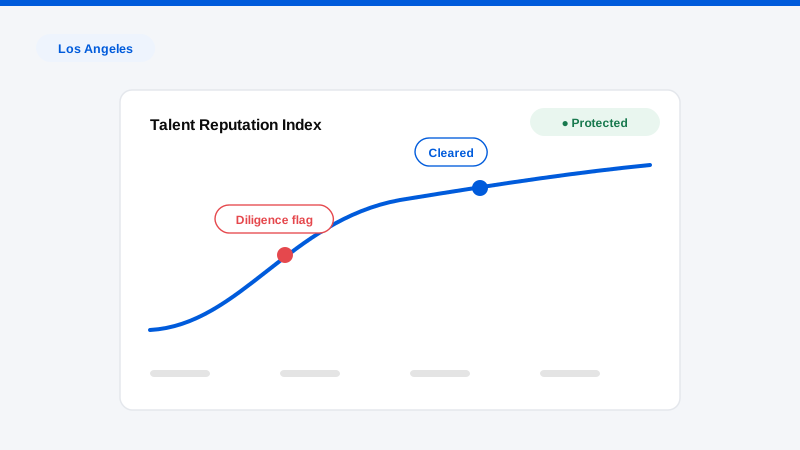
Reputation management in Los Angeles is the ongoing strategic discipline of governing what the internet says about you across an entire career (removing the content that can be removed, monitoring continuously for new exposure, and strengthening the accurate, authoritative record) practiced for the people whose names are assets in the world’s attention capital: talent and their teams, creators, entertainment executives, athletes, founders, physicians, and the private families of the city’s wealth. It is not publicity, which seeks attention, and it is not crisis PR, which survives it. It is the standing infrastructure that determines what all that attention finds.
Los Angeles is unique among world markets in one respect: here, reputation is not adjacent to the business. It is the business. A performer’s castability, a creator’s brand-deal pipeline, an executive’s next studio role, a surgeon’s patient flow, and a founder’s consumer brand all reprice in real time against what search engines, social platforms, and now AI assistants say, and no city’s residents generate more raw material for those systems to work with. This page explains how professional reputation management operates for Los Angeles clients: what the discipline consists of, why this market punishes the unmanaged, how American law bounds the possible, and what a confidential, ongoing engagement looks like.
The Los Angeles problem: a city that manufactures coverage of its own residents
Every market produces some online content about its notable people. Los Angeles industrialized it. The entertainment press, gossip aggregators, blind-item economies, fan wikis, stan and snark communities, commentary YouTube, and drama TikTok together form a permanent, decentralized newsroom whose beat is people, and not only famous ones. Reality participants, influencers, executives named in trade coverage, ex-partners of public figures, and children of celebrities all accumulate durable online records they never chose.
Three features make this environment uniquely demanding:
Volume without editors. Most content about LA names is published by people with no editorial standards and no legal exposure worth pursuing: anonymous accounts, forum posters, aggregators recycling each other. Volume is high, accuracy is low, and correction mechanisms are nonexistent. A false claim invented in a comment section can, through repetition, become the consensus answer an AI assistant gives about you.
Permanence without context. The industry’s memory is long and literal. A controversy from 2015, a lawsuit that settled, a flop, a feud, search engines serve them all as if they happened yesterday. Careers in this town are built on reinvention, but the index does not believe in second acts unless someone makes it.
Careers with cliff risk. Entertainment and creator careers concentrate enormous value in perception, and that value can reprice overnight. Brand partners run morals screens. Studios assess “audience sentiment.” Casting quietly checks what surfaces. The absence of management is itself a decision. It means the record that decides these moments is whatever accumulated on its own.
What the discipline actually is: remove, monitor, strengthen
Serious reputation management is three functions operating together, continuously.
Remove. Content that violates law or platform policy (leaked material, defamation, doxxing, stolen images, impersonation, harassment campaigns) should come down, and with professional execution it usually can. Removal is its own craft with its own routes and sequencing; we cover it in depth in content removal in Los Angeles. Inside a managed program, removal runs as a standing function: new violations are caught by monitoring and cleared while they are still small, instead of being discovered during a crisis when they have metastasized.
Monitor. The LA content machine never closes, so neither can the watch. Professional monitoring tracks search results for the client’s name and variants, image and video results, mentions across news, social, forum, and commentary ecosystems, data-broker republication of personal details, and the answers AI assistants give about the client. For talent and creators we also monitor content-theft channels, the accounts and sites that repost and monetize stolen media. The purpose is compression of response time: a problem addressed in its first 48 hours is a removal; the same problem at six months is an entrenched narrative.
Strengthen. Under American law, some content (accurate reporting, opinion, commentary) cannot be removed and should not be fought. Its practical weight, however, depends entirely on context. Strengthening builds that context: complete and authoritative profiles, a well-maintained personal or firm site, accurate biographical sources, legitimate coverage of real work, and consistent, credible material across every surface a searcher or an AI model consults. For LA clients this work has a specific texture. It is the difference between a search page that leads with a fifteen-year-old tabloid item and one that leads with the client’s actual body of work.
The functions are complementary and sequenced: removal clears, strengthening fills, monitoring holds. Vendors selling only suppression are renting you an algorithm’s mood; vendors selling only monitoring are selling you a subscription to bad news. The discipline is the integration.
What American law makes possible, and what it refuses
Los Angeles clients live under the most speech-protective legal system in the world, and honest reputation management starts by acknowledging it. The First Amendment shields truthful reporting, opinion, satire, and commentary, including most of what gossip media publishes about public figures. Section 230 means platforms generally cannot be held liable for their users’ posts, so the fantasy of suing a forum into deleting a thread is exactly that. There is no American right to be forgotten: accurate press does not come down because time has passed, and public figures face elevated standards even for defamation claims.
What the system does provide, professionals use fully: falsity is unprotected, and evidence-backed falsity claims change publisher and platform behavior; non-consensual intimate imagery now has strong statutory and platform-level removal rights, including mandated rapid-takedown processes; copyright compels removal of stolen media regardless of speech considerations; California’s privacy torts, likeness protections, and data-broker deletion rights add real state-level pressure points; and platform policies against harassment, doxxing, and impersonation function as enforceable private law when reports are engineered correctly. We are not a law firm, where litigation is the right tool, we work alongside the client’s entertainment or media counsel, of which this city has the world’s deepest supply. But most of a reputation program operates below the legal layer, in the platform and search machinery where outcomes are faster and quieter.
The communities you cannot remove, and must still manage
A defining feature of the Los Angeles problem is that much of the hostile content ecosystem is structurally permanent. Snark subreddits, gossip forums, and commentary channels devoted to discussing specific people are, in aggregate, lawful communities engaged in mostly protected speech. They cannot be deleted, and attempting to fight them wholesale is the fastest way to become their main character.
What professional management does instead is treat these communities as weather: monitored constantly, engaged never, and policed precisely at the edges where they cross enforceable lines. Individual posts that dox, defame with provable falsity, post stolen or intimate media, or organize harassment are removable under platform policy even when the community around them is not, and consistent, well-built enforcement at those edges materially changes what the community can do. Meanwhile, the strengthening layer ensures that forum chatter stays where it belongs in search results: present, perhaps, but subordinate to the authoritative record. Clients who internalize this framing stop chasing an unwinnable deletion war and start winning the war that matters, the one over what a normal searcher, a brand’s risk team, or an AI model actually sees and weighs.
The AI layer: when the machine summarizes your career
The newest front in this discipline matters more in Los Angeles than almost anywhere. Audiences, journalists, brand teams, and casting researchers increasingly begin not with a search page but with a question to an AI assistant, and the assistant answers by compressing the open web into a few confident sentences. For an LA name, that web includes two decades of tabloid archives, forum speculation, and repetition-laundered rumors. The result: AI summaries that state old controversies as present fact, repeat fabrications that were never corrected at the source, or define a person by the single worst-covered month of their life.
A modern program therefore treats AI answers as a monitored, manageable surface. We audit what the major assistants say about clients and how those answers shift over time; we prioritize source-level removal precisely because AI systems inherit from the underlying web, and a falsehood removed at origin eventually falls out of the answers; and we invest in strengthening because authoritative, consistent, well-structured material about a client increasingly anchors what the models say. The clients best represented in this new layer are, without exception, the ones whose underlying web presence was actively managed before the models read it.
Moments that decide LA reputations
A standing program proves its value at predictable inflection points. If any of these are ahead of you, the program should already be running:
Castings, greenlights, and brand deals. The screening happens silently and the results are never explained. What surfaces when a brand’s risk team or a studio’s audience-insights group searches your name is, functionally, part of your deal terms.
Press cycles: wanted or not. A premiere, an album, a profile, a lawsuit, a viral moment. Attention spikes illuminate whatever exists; the time to shape what exists is before the spike.
Career transitions. The executive moving between studios, the creator crossing into mainstream media, the athlete entering broadcasting, the actor becoming a founder. Each transition triggers fresh diligence by new counterparties who know only what they can find.
Disputes and departures. Entertainment litigation, agency splits, band breakups, co-founder conflicts, all covered by the trades, all litigated again in comment sections, all indexed permanently unless managed through and after resolution.
Family events. Divorce in a community-property state with an active tabloid press; children of prominent parents reaching the age where their online lives are scrutinized; estate transitions that surface family matters. LA family offices increasingly run reputation programs generationally, the way they run tax planning.
Security incidents. Doxxing, stalking, burglary targeting, extortion. In this city the line between reputational exposure and physical risk is thin, and the response has to serve both. A program that has already suppressed a family’s addresses, travel patterns, and children’s identifiers across the data-broker ecosystem is doing security work as much as reputation work, and the moment an incident occurs, the monitoring layer becomes the early-warning system the security team works from.
Who we serve in Los Angeles
Talent and their teams. Actors, musicians, athletes, and on-camera figures, almost always engaged through attorneys, managers, or business managers, with our work integrated into the existing team structure and invisible outside it.
Creators and digital-first talent. The city’s creator economy at every scale, where the reputation program doubles as revenue protection: stolen-content sweeps, impersonation control, harassment response, and brand-safety hygiene ahead of partnership screens.
Entertainment executives. Agents, managers, producers, and studio and streaming leadership, whose trade-press coverage, deal disputes, and departures follow them across a career. For senior executives we typically add digital executive protection, personal-data removal and privacy hardening for the executive and family.
Founders and consumer-brand builders. LA’s startup and DTC economy, where founder reputation and brand equity are the same asset, and where a funding round or acquisition will put every search result in front of diligence teams.
Physicians and licensed professionals. The most competitive cosmetic and concierge-medicine market in the country, where review integrity and search presence measurably drive practice economics.
Private families and family offices. Multi-generational protection: address and data-broker suppression, monitoring tuned to security-relevant exposure, cleanup for young adults, and rapid response when family matters produce content.
How a managed engagement runs
We are a global remote practice, Los Angeles clients are served confidentially by a dedicated team, with no local storefront and no public association between our name and yours. Engagements are routinely structured through counsel or business managers, under NDA, with communication routed however the client’s team requires.
The audit comes first. Every engagement begins with a free, confidential Exposure Scan: a structured map of search results, image and video surfaces, social and forum presence, data-broker listings, stolen-content spread, and AI-assistant answers. Each negative or risky item is graded for severity, treatability, and amplification risk. LA clients are rarely surprised by the items they knew about. The value is in what they did not know: the broker listing exposing a home address, the subreddit thread feeding an AI summary, the fake account collecting their fans’ money.
Then strategy, then cadence. From the audit we build the program (what comes down, what gets de-indexed, what gets built, what gets watched) and run it on a monthly rhythm with clear reporting. When something breaks, the cadence compresses to hours: monitoring flags it, the team that already knows your profile responds, and counsel and publicists are looped per the playbook agreed in advance. That pre-agreed playbook (who calls whom, what gets said publicly (usually nothing), which routes get used) is quietly the most valuable document in the engagement.
What it costs. Protection Plans scale with the monitoring perimeter and included removal capacity; standalone removals are priced per link. Pricing is USD, quoted in writing after assessment, with no charge for the honest advice that something should be left alone. Against the economics of an LA career (where a single lost brand deal, blown casting, or mishandled cycle costs multiples of a year of protection) the program prices as what it is: insurance on the asset the whole enterprise depends on.
Where the program sits in an LA team
Los Angeles clients rarely arrive unadvised, the typical principal already has an attorney, an agent or manager, a business manager, a publicist, and often a security consultant. The reputation program is not a rival to that structure; it is the specialized layer the structure is missing. The publicist shapes narrative but does not file takedowns or run data-broker suppression. The attorney supplies legal leverage but does not monitor forums or engineer platform reports at volume. The security team assesses physical risk but does not control the online exposure that creates it. The business manager sees the revenue impact but has no mechanism to act on its cause.
In practice we function as the connective layer: monitoring feeds the whole team early warning, removal execution gives counsel and publicists a quieter alternative to letters and statements, and the strengthening work compounds regardless of who is in crisis mode. The engagement is typically papered through counsel, reporting flows to whichever team member the client designates, and in many cases the principal never interacts with us directly at all, which is exactly how a discreet program should run.
What we will not do
In a market full of vendors promising miracles, our refusals are the credential. We do not promise removal of constitutionally protected press, and we will say so before you spend a dollar. We do not fabricate reviews, run bot networks, astroturf fan sentiment, or build fake personas, practices that violate platform rules and detonate spectacularly when exposed, which for public-facing clients means catastrophe. We do not run offensive campaigns against clients’ rivals, and we do not sell suppression as if it were removal: burying content is sometimes the right tool, but clients are always told which one they are buying.
Frequently asked questions
How much does reputation management cost in Los Angeles?
Ongoing programs run through our Protection Plans, scaling with scope, a creator’s program and a studio executive’s program watch different surfaces. Individual removals are priced per link, the figure shown beside each URL. Everything is quoted in writing, in USD, after a free assessment, before any commitment.
I’m not famous. Do I still need this?
If your name is searched before deals, hires, patients, or partnerships, yes. Most of our LA clients are not celebrities; they are executives, physicians, founders, and family members whose search results carry real economic and security weight. The discipline scales down as well as up.
How is this different from what my publicist does?
Publicists earn and shape attention; we govern what that attention finds: the search results, archived coverage, forums, data trails, and AI answers. The two functions are complementary and we work alongside publicists constantly. A great press strategy pointing at a damaged search page is a wasted press strategy.
Can old tabloid coverage ever stop dominating my search results?
Usually, yes, though rarely by deletion. Accurate coverage by established outlets generally cannot be removed under American law, but it can be updated, sometimes de-indexed, and reliably outweighed by strengthened authoritative content, while monitoring prevents fresh pile-on. The realistic goal is proportion: the old story becomes a footnote instead of the headline.
Is the engagement confidential?
Contractually and structurally. Work runs under NDA, is routinely routed through counsel or business managers, and involves no public filings unless a legal strategy, decided with your counsel, requires them. For most clients, the fact of the engagement is itself sensitive, and the program is built so it never surfaces.
The next step
In this market, your search results are working every day whether anyone manages them or not. Find out what they are doing. Request a free, confidential Exposure Scan and we will map your exposure across search, social, brokers, and AI, grade what can be fixed, and show you what a standing program would cover. If your immediate problem is one specific piece of content, start instead with content removal in Los Angeles, and for the other markets we serve worldwide, see our global directory.