
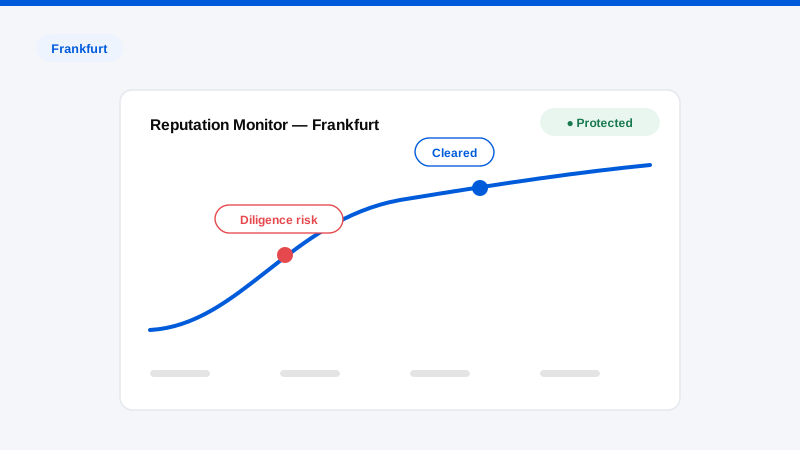
Reputation management in Frankfurt is the ongoing discipline of controlling what appears when your name is searched (removing what is harmful, monitoring for what is new, and strengthening what is accurate) practiced for the people this city’s economy runs on: bank executives, supervisory and management board members, fund principals, dealmakers, fintech founders, senior lawyers, and the family offices that administer German industrial wealth from quiet addresses in the Westend. It is not a one-time cleanup, and it is not public relations. It is a standing defense for a name, run continuously, in both of the languages Frankfurt is searched in.
The distinction between removal and management matters more here than in most cities. A single takedown solves a single problem. But a Frankfurt career generates screening events on a rolling basis (appointments, mandates, fund raises, regulatory assessments, press cycles) and each one triggers name searches by people who will never disclose what they found. The professionals who treat their search results as infrastructure, maintained the way their firms maintain compliance systems, hold a durable advantage over those who deal with reputation only when something has already gone wrong. This page describes what that maintenance actually involves in this market, and when it is worth paying for.
Why Frankfurt careers are screened harder than most
Frankfurt is the supervisory and operational center of continental European finance: the European Central Bank, Germany’s central bank, the country’s largest commercial banks, Deutsche Börse and its market infrastructure, and, since Brexit relocated functions out of London, the continental headquarters of dozens of international institutions. Around that core sit asset managers, private banks, a dense corporate legal market, a maturing fintech scene, and family offices whose principals prize invisibility above almost everything else.
The consequence is a city where reputation is checked constantly and formally. Regulated institutions run adverse-media screening on hires, board candidates, clients, and counterparties as a matter of course. Fitness-and-propriety expectations attach to senior roles. Executive-search firms, nomination committees, co-investors, lenders, and journalists all run their own checks on top, and the checking is bilingual: domestic counterparties and regulators search in German on Google.de; international institutions search in English. A name that is clean on one surface and damaged on the other is not protected. It is simply damaged in the language the owner doesn’t monitor.
The threat side is equally structural. Financial journalism treats Frankfurt as a permanent beat, and German press archives preserve old reporting indefinitely, resurfacing decade-old coverage of resolved disputes on a fresh name search. Anonymous finance forums and gossip communities discuss individual bankers with impunity. German-language employer-review platforms host accusations against named managers. Data brokers and wealth aggregators publish home addresses and compensation estimates. Every senior career in this city accumulates this sediment; the only question is whether anyone is managing it.
The three functions: remove, monitor, strengthen
Serious reputation management in Frankfurt is built from three functions running together. Each one alone is incomplete.
Removal takes harmful content down at the source. Outdated press coverage, defamatory forum threads, false review-platform claims, broker listings, fake profiles. Each item is assessed for the channel most likely to eliminate it: platform policy enforcement, privacy and data-protection process, publisher negotiation, or search delisting. Removal is the sharpest tool in the set and the foundation of everything else, because monitoring a name that is already damaged merely documents the damage, and strengthening a name while defamation sits on page one merely decorates it. The removal discipline itself (what comes down, how, and in what order) is covered in depth on our content removal in Frankfurt page.
Monitoring watches the name continuously so that new problems are caught in days rather than discovered during a screening event months later. In Frankfurt that means watching German- and English-language search, news and press-archive surfaces, the finance forums where attacks on bankers actually start, review platforms, social platforms, and the data-broker ecosystem that republishes personal information on a cycle. Speed is the entire value: platform takedowns are most effective before content spreads, delisting is most effective before a screening system captures the item, and a fabricated accusation confronted in its first week is a fundamentally different problem from one that has sat in search results for a year.
Strengthening builds the accurate layer: the profiles, biographies, professional commentary, and authoritative references that a searcher should find. This is not vanity content. In search, something ranks for every name; the strategic question is whether what ranks is material you control and stand behind, or material assembled by aggregators, forums, and whoever last wrote about you. A deliberately built, factually solid presence raises the cost of every future attack, because hostile content must displace established authority rather than fill a vacuum. For Frankfurt professionals, whose counterparties read carefully, the strengthening layer must be restrained and precise, inflated or promotional material actively damages credibility in this market.
The two-language problem, treated seriously
Most reputation firms monitor a name in one language and call it coverage. In Frankfurt that is malpractice. The city’s professional life runs bilingually: German for regulators, domestic institutions, the national business press, and the employer-review platforms that shape local hiring; English for the international banks, the funds, the cross-border press, and the diligence teams in London and New York. The two surfaces index different content, rank it differently, and are attacked separately, a defamatory German forum thread will never appear to an executive who only searches themselves in English, and an English-language complaint site is invisible to a German-only monitor.
A managed Frankfurt name therefore gets both surfaces audited at baseline, both monitored continuously, and removal and strengthening work executed natively in each language, not translated, because platforms, publishers, and search reviewers respond to arguments framed in the conventions they actually use. This is one of the clearest dividing lines between specialist work and commodity reputation services, and one of the first things sophisticated Frankfurt buyers should probe when selecting a provider.
The rhythm of a managed name
In practice, ongoing management runs to a rhythm. A baseline audit establishes the full picture: everything attached to the name across both languages, ranked by visibility and risk. Most clients discover material they did not know existed, because they search themselves logged in, personalized, and in one language only. Standing removal work then clears the backlog over the first weeks and months, item by item, hardest cases last. Monitoring runs continuously in the background, with alerts triaged by a human who understands the client’s situation rather than a dashboard the client is expected to interpret. New threats are assessed and, where removable, removed while they are young. The strengthening layer is built and maintained gradually, so it reads as the natural record of a career rather than a sudden publicity effort, and the whole posture is reviewed against the client’s calendar, because the point of the discipline is to be clean before the events that matter, not after.
That calendar-awareness is worth underlining. The highest-stakes moments in a Frankfurt career are predictable: a board nomination, a move to an international institution, a fund raise, a transaction announcement, a regulatory assessment, an IPO process, a succession event in a family firm. Each generates a wave of searches. Managed correctly, the months before such an event are spent quietly removing what is removable and reinforcing what should rank, so that when the wave arrives, it finds nothing. Clients who arrive after the wave has already broken can still be helped, but the economics are worse and some outcomes are no longer available.
What the law contributes, and what it cannot
Germany and the EU give Frankfurt clients unusually strong legal footing, and a competent management practice uses it continuously rather than saving it for emergencies. The GDPR’s right to erasure obliges controllers to delete personal data in defined circumstances. European delisting practice requires search engines to remove name-search results that are inadequate, irrelevant, or excessive, subject to a public-interest balancing. German civil law protects the general right of personality (reputation, privacy, informational self-determination) with a seriousness that has no American equivalent, and German publishers operate within a press-law tradition that recognizes remedies like anonymization of a name within an article that will not be removed outright.
These rights are leverage, not magic. The balancing tests are real: accurate, recent reporting on matters of public interest generally survives, and a senior executive’s role in a regulated industry weighs into the analysis. Much of the most damaging content sits on platforms and hosts outside Germany, where German legal instruments have practical force only when converted through the right channels, and litigation is public, German court proceedings can generate exactly the coverage the client wanted gone. The professional pattern is therefore quiet-channels-first: platform policy, privacy process, publisher relations, and delisting, with formal legal action reserved for the cases that genuinely warrant it, run in coordination with the client’s German counsel. We do not fabricate legal theories, cite section numbers at platforms that respond to policy arguments, or pursue public fights whose publicity cost exceeds their value.
When something breaks: crisis inside a standing engagement
The clearest argument for ongoing management is what happens on a bad day. A hostile article publishes. A forum thread appears naming the client. A leaked document starts circulating. An anonymous email arrives demanding payment against a threat of publication. For an unmanaged name, the first days are consumed by discovery (finding out what exists, where it is hosted, who is spreading it, and which advisor to call) while the content indexes, syndicates, and hardens. For a managed name, those questions are already answered: the baseline is documented, the monitoring caught the item within hours, the venue’s removal channels are known, and the response begins immediately with evidence already assembled.
The difference compounds. Content that is challenged in its first days is often removable before it spreads to mirrors and scrapers; content that has aged is a network, not an item. Screening systems that sweep a name weekly may never capture an item that came down in seventy-two hours, and a client who is not spending a crisis learning the landscape can make the decisions that actually matter (what to tell the board, whether counsel should engage, whether silence is the better strategy) with a clear picture instead of a guess. We handle the containment; the client handles the judgment calls, informed rather than blindsided.
Extortion deserves a specific word, because Frankfurt professionals are targets for it. Threats to publish fabricated or private material unless payment is made are a recurring pattern against finance names, and the correct response is almost never the intuitive one. Paying rarely ends the demands; ignoring rarely ends the risk. Managed clients get an immediate, experienced assessment of the threat’s credibility and the removal options if publication occurs, which is frequently enough to change the economics of the attack itself.
How progress is measured
Reputation management has a measurement problem: its best outcome is the absence of events, which looks identical to nothing happening. We address that with concrete reporting rather than sentiment scores. Clients see the item-level ledger (what existed at baseline, what has been removed, what has been delisted, what remains and why) alongside the state of both language surfaces for their priority search terms, the monitoring log of new detections and their resolution, and the standing of the strengthened layer. The test we hold ourselves to is simple: if a screening system read the name today, what would it capture? When that answer is “nothing that isn’t accurate and current,” the program is doing its job, and the reporting shows it without requiring faith.
Who retains us in Frankfurt
The client profiles track the city’s economy, and each carries a distinct posture.
Bank and institutional executives. The core Frankfurt client: senior enough to be named in coverage of every restructuring and dispute their institution passes through, screened at every career step, and searched in two languages. Management here is defensive infrastructure (press-archive hygiene, forum monitoring, a strengthened factual layer) maintained so that the next appointment’s diligence finds a record that matches reality.
Fund principals and dealmakers. Private-equity, credit, and venture professionals whose names attract coverage whenever a transaction sours, and whose fundraising depends on institutional diligence that sweeps years of material. The work is heavier on outdated-press remediation and counterparty-facing accuracy.
Fintech founders. Earlier ventures, old interviews, and failed products generate material that distorts diligence on the current company. Founder searches blend personal and corporate reputation, and the management program has to handle both without confusing them.
Family offices and principals. Frequently the most privacy-focused clients in the market: industrial wealth administered through Frankfurt structures, with exposure concentrated in data brokers, wealth aggregators, and the security consequences of a searchable home address. For these clients the program overlaps heavily with our digital executive protection work. The goal is not a better search page but a quieter one.
Senior advisors and lawyers. Professionals whose own names are part of their practice’s credibility, and who also commission work for clients who will never contact us directly. A substantial share of our Frankfurt engagements arrives through counsel and family-office intermediaries, and our processes are built for that: need-to-know handling, reporting to the advisor, and nothing filed that identifies the principal beyond what the specific process requires.
Engagement model and what it costs
Content Removal is a global remote practice with a London base; Frankfurt engagements run entirely remotely, in English or German, and under strict confidentiality. We claim no Frankfurt office and no local staff, deliberately, because the discretion this market expects is easier to guarantee from outside it.
Most managed clients sit on a Protection Plan, scaled to the names covered and the capacity included, which combines continuous monitoring, a standing allocation of removal applications, and the strengthening work described above, the “insurance plus response” posture. One-off removals outside a plan are priced per link, fixed in writing before engagement. We keep pricing in USD across all markets for consistency. Every engagement begins the same way regardless of scale: a free, confidential Exposure Scan that maps the name across both language surfaces and produces an honest assessment of what should be removed, what should be watched, and what should be built. Advisors regularly commission the scan on a no-names basis before introducing the principal.
The honest-assessment point is not marketing language. Some prospective clients do not need ongoing management, a clean name with one bad link needs a removal, not a retainer, and we say so. Others have problems that management cannot fix, accurate recent reporting of genuine public interest, and we say that too, because a firm that promises erasure of everything is describing a service that does not exist. What we commit to instead is the disciplined version of what can be done: every removable item pursued through the channel most likely to succeed, every new threat caught early, and a factual record strong enough that the residue, where residue exists, is read in context rather than in isolation. In a market that runs on diligence, that is the difference between a name that requires explanation and a name that requires none.
Frequently asked questions
What does reputation management cost in Frankfurt?
Ongoing programs run under our Protection Plans, scaling with monitoring scope and the number of removal applications included. Standalone removals are quoted per link, in writing, after the scan. Pricing is in USD for all markets. The Exposure Scan that begins every engagement is free and confidential.
How is this different from hiring a PR agency?
PR creates visibility; we manage exposure. A PR agency places stories and builds profile, valuable, but the opposite instinct from what a damaged or screening-sensitive name needs. Our work is removal, monitoring, and quiet reinforcement of the factual record, with no press outreach, no announcements, and no publicity footprint. For most Frankfurt clients the two disciplines coexist: PR handles what the firm says publicly; we handle what search says privately.
Do you monitor German-language sources or just English?
Both, always. Frankfurt names are searched in German by domestic counterparties and regulators and in English by international institutions, and attacks frequently exist in only one language surface. Monitoring covers Google.de and international search, German press and archive surfaces, finance forums, and review platforms in both languages, treated as one problem, not two.
Can you help before a board appointment or fund raise?
That is the ideal engagement. Pre-event work (removing what is removable, delisting what qualifies, and reinforcing the accurate record before diligence begins) changes outcomes in a way that post-event remediation cannot. The earlier the runway, the more options exist; three to six months ahead of a known event is a realistic working window for a name with accumulated issues.
Is the engagement confidential?
Structurally, yes. Work is handled need-to-know, communications are designed not to create new discoverable records, and engagements can be run entirely through counsel or a family office, with the principal never contacting us directly. Discretion is usually the reason clients in this market choose a specialist practice over handling matters in-house.
A Frankfurt name is checked more often, more formally, and in more languages than its owner ever sees. The professionals who treat that fact as an operating condition (audited, maintained, and defended continuously) are the ones whose careers never hinge on an explanation. Start with the free, confidential Exposure Scan, and see what the screeners see. Our full set of locations and practice areas is in our global directory.