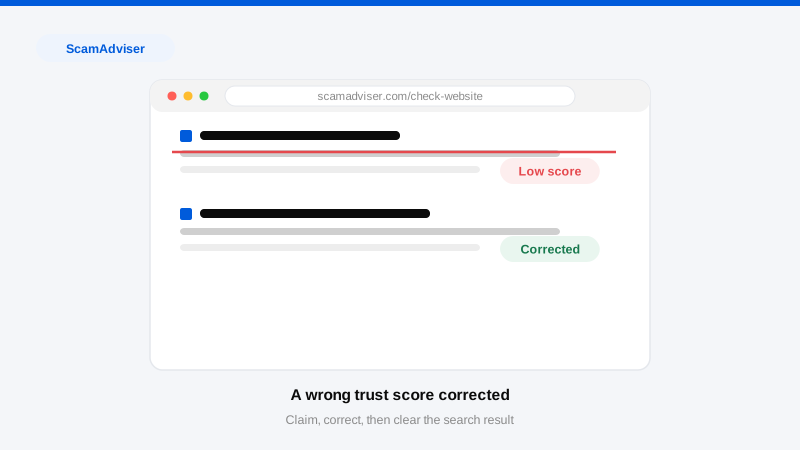
A ScamAdviser listing is an automatically generated page that scores your domain for trustworthiness. It is not written by a person, so the first job is usually correction rather than removal: fixing the signals that produced the low score, claiming the listing, and dealing separately with any user reviews underneath it.
Key facts
- A ScamAdviser listing is generated automatically for practically every domain, so its existence is not evidence of anything about your business.
- The trust score is an algorithm output built from signals such as domain age, WHOIS privacy, hosting location, traffic and blacklist appearances.
- The score responds to verifiable information about the business, which is why most low scores are a correction problem rather than a removal problem.
- WHOIS privacy, applied by default at most registrars since GDPR, reads to an automated checker as concealment.
- A score presented as an automated assessment with a disclosed methodology is very hard to challenge as defamation in any jurisdiction.
- User reviews published under the score follow completely different rules and are handled as review removals, on evidence.
- Where a listing page carries unlawful content or personal information, a search result can sometimes be dealt with even though the page stays online.
How ScamAdviser scores a domain
ScamAdviser produces a trust score for practically every domain on the internet, using automated signals rather than editorial judgement. The inputs are the kind of thing you would expect an automated checker to look at: how old the domain is, whether the registration details are hidden behind WHOIS privacy, where the site is hosted and in what country, whether the certificate and technical setup look ordinary, how much traffic the site gets, whether the domain appears on any blacklist, and what other review sources say about it.
Then it publishes a page titled with your domain, scored out of one hundred, and that page is indexable. For a young brand with a low score, it frequently ranks on the first page for the domain name itself.
Why a legitimate business gets a low score
Almost every low score we are asked to fix comes from the same handful of causes, none of which say anything about whether the business is honest.
- A new domain. Recently registered domains are scored down as a class, because most genuinely fraudulent sites are new.
- WHOIS privacy, which nearly every registrar now applies by default, reads to an automated checker as concealment.
- Hosting or company registration in a country the model treats as higher risk, which catches a lot of legitimate international businesses.
- Low traffic, which affects anything selling to a niche audience.
- A payment or checkout setup the crawler cannot verify.
- A handful of angry user reviews on the listing itself, or scraped from elsewhere.
- A rebrand. Move to a new domain and you start again at zero, however long the business has traded.
This is the important thing to understand before anyone gets angry: for most clients this is an algorithm output, not an accusation. It is fixed by supplying the information the algorithm could not find, not by threatening anybody.
Can the score be corrected?
Usually, yes, and that is a different job from getting a page deleted. The score is an assessment of what an automated checker could and could not find out about your business, so it moves when the missing information becomes findable and verifiable. That is evidence work rather than argument, and it is the part of this problem that most reliably changes.
Which of the inputs is actually driving your number is the diagnosis, and it is worth getting right before anyone does anything. Timelines depend on which signals are involved and on how quickly the checkers recrawl, and they are set out in writing after the free Exposure Scan.
Get a Free, Confidential Exposure Scan
The user reviews are a separate problem
Underneath the automated score, listings carry user reviews, and those follow completely different rules from the score itself. A cluster of reviews arriving in the same week, phrased alike, from accounts with no other activity, is a competitor pattern rather than customer feedback, and it is treated as one.
Individual reviews containing false statements of fact, personal information about your staff, or accusations of criminal conduct with nothing behind them are handled the way we handle any other review site. Our review removal hub and our Sitejabber page cover what is realistic there.
When it is defamation and when it is an algorithm
Worth separating clearly, because the answer determines everything you do next.
An automated score, presented as an automated score, with the methodology disclosed, is very difficult to attack as defamation in any jurisdiction. It is an opinion generated by a stated process. Correcting the inputs is the realistic route, and a legal letter about a number is usually a wasted letter.
A user review published on that page which says you stole money, that you were prosecuted, or that a named person committed an offence, is a statement of fact. If it is false, ordinary defamation routes are open. Confusing the two is how businesses spend money on the wrong lawyer.
De-indexing the listing for your brand name
Where the score has been corrected but the page still ranks, or where the listing carries content that is unlawful, search work is the remaining lever. Sometimes the result can be dealt with directly. More often the honest answer is that the pages which ought to outrank a third party checker for your own domain name are not doing their job, and that is fixable. See remove search results and our brand protection work, which is where this normally sits for an established company.
Financial and trading educators get this more than most, because the sector is new-domain heavy and payment-heavy. See our page for financial educators and our page for trading educators.
What the law says, and where it does not help
This page divides into two problems with two different legal answers, and spending money on the wrong one is the most common mistake in this category.
The score itself is an opinion produced by a stated process. Courts across the common law world treat a disclosed methodology applied to public signals as opinion rather than a statement of fact, and an automated assessment presented as an automated assessment is close to unassailable. In England and Wales the Defamation Act 2013 requires serious harm and, for a company, serious financial loss, which is a high bar to clear against a number. A letter about a score is usually a wasted letter, and in some cases it produces a permanent record of your objection without changing anything.
The content around the score is a different matter. A user review saying you stole money, that you were prosecuted, or that a named person committed an offence is a statement of fact and is actionable if false. In the United States, Section 230 protects the site itself from liability for a reviewer’s words, which changes who the argument is with rather than whether there is one. So there are routes here, and they are not the same routes as the ones that move a number.
Where a listing is being used to extract payment from you, that is a different matter again, and it has its own answers. We do not pay operators, because payment funds the model and invites the next listing.
What we need from you to start
The scan runs on public information. Correcting a listing is document work.
- The listing URL, the current score, and the queries where the page ranks for you.
- Company registration details, the registered address, and the trading history including any previous domain.
- Verifiable contact information, terms, refund and returns policies as published on your site.
- Regulatory registrations or licenses where your sector has them.
- Registrar and hosting details, including whether WHOIS privacy is on and who controls the account.
- Payment processor and checkout information sufficient to show the setup is ordinary.
- Order and support records if user reviews on the listing need auditing, plus any evidence of a competitor wave.
- Written authorization naming who instructs us, usually the founder, a head of ecommerce or your agency.
NDA is standard, and corporate documents are used only where a verification process requires them.
Timelines and what usually happens first
The first work is a diagnosis. We establish which of the score inputs are actually driving the number, because there is no point in changing things that were never the problem.
After that, timelines depend on which signals are involved and on how quickly the automated checkers recrawl, and you get ranges in writing rather than a single date. Domain age is the one input nobody can accelerate. Where that is the dominant factor we say so, and the honest plan becomes making everything else verifiable while the domain matures.
Common mistakes that make it harder
- Treating an algorithm as an accusation. Anger aimed at an automated checker produces letters that go nowhere and delays the work that would have changed the score.
- Rebranding to a new domain to escape it. You reset domain age to zero and usually end up with a worse score than the one you left.
- Turning off the wrong signals. Changing hosting or registrar without a plan can make the profile look less stable, not more.
- Paying anyone who offers to raise a score. There is no such product, and the offer itself is a reason to walk away.
- Ignoring the user reviews. They are the removable part, and they are frequently what a prospect actually reads.
- Asking customers for a wave of positive reviews. Clusters are detectable and read as manipulation.
- Launching a new brand without checking any of this first, which turns a solvable setup issue into a year of explaining a number to customers.
How this works alongside your lawyer, PR team or security team
Most of this work is administrative rather than legal, and that is the point.
Where user reviews contain false statements of fact, your lawyer decides whether the author is worth pursuing, and we provide a documented file rather than screenshots. Where a competitor is behind a wave, that is a commercial matter counsel may take up directly, and the pattern evidence is built to be usable there. Where marketing or an agency owns the brand, they need to know which of the signals feeding the score are things they control, since published company information, contact details and policy pages are ordinary site work. Where a rebrand or a new domain is planned, we would rather be in that conversation before launch than after. Everything runs under NDA and the report belongs to you.
Who usually makes first contact and what the 15-minute call covers
First contact is usually a founder or a head of ecommerce, sometimes their agency, and it is normally triggered by a customer sending a screenshot of the score or by a drop in conversion on branded search.
Fifteen minutes covers what is driving the score, what can realistically be corrected, whether the user reviews are the bigger problem, and whether a scan is worth doing at all. Nothing is signed on the call. Where the fix is publishing company details and waiting for the domain to age, we will tell you that rather than proposing a project.
Frequently asked questions
Can a ScamAdviser listing be deleted completely?
Rarely, and it is not usually the goal. The page is automatically generated for practically every domain, so its existence is not the problem. A corrected score with verified business details on the page does more for you commercially than a deletion you are unlikely to get.
How long does it take to fix a trust score?
Weeks rather than days, and it depends on how many underlying signals need changing. Domain age is the one input nobody can accelerate, which is why a rebrand needs planning rather than a rescue.
Does paying anyone raise the score?
No, and treat any offer to sell you a higher score as a reason to walk away. The score responds to verifiable business information and to the domain’s own signals. Everything else is a story.
A competitor is posting fake reviews on our listing. What can be done?
The reviews are handled separately from the score, on evidence: timing, phrasing, account patterns, and any link between the reviewers and a rival. Pattern cases move; individual denials do not.
We are rebranding to a new domain. What should we do first?
Talk to us before the launch, not after. Registration details, published company information, hosting choices and the redirect plan all feed the automated checkers, and getting them right at launch avoids a year of explaining a low score to customers.
Who contacts you about this, and what does it cost?
Usually a founder or a head of ecommerce, sometimes their agency. The 15-minute call is short and confidential, NDA is standard, and pricing is quoted in writing after the free Exposure Scan, mostly tied to results actually moving: see success-based pricing.
Will fixing the score also fix the other checkers?
Often, because they read overlapping signals. Published organization details, verifiable contact information, ordinary hosting and a clear returns policy improve how every automated checker reads your domain, not just one. We look at the whole set rather than the single page that prompted the call.
A customer sent us a screenshot of the score. What do we say to them?
Answer plainly and once: explain that the page is an automated assessment of the domain rather than a review of the business, give the verifiable facts, and point them to your company registration and contact details. Never argue, and never claim the checker is broken. A calm, factual answer converts far better than a defensive one.
If a trust score page is sitting on page one for your own domain name, start by finding out what is driving it. Get a free, confidential exposure scan, and read our process before you commit to anything.