
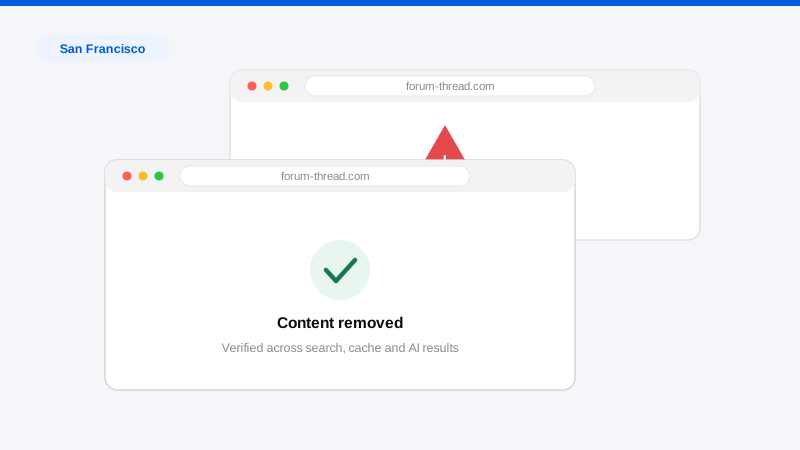
Content removal in San Francisco is the professional practice of getting specific harmful online content taken down (defamatory forum threads, hostile press that outlived its context, leaked personal data, anonymous review-site campaigns, fake profiles, and doxxed home addresses) on behalf of the people who run the world’s technology capital: startup founders, venture capitalists, public-company executives, engineers turned public figures, crypto principals, and the families behind Bay Area wealth. It is targeted, URL-by-URL work with a defined objective: make the specific content stop existing or stop surfacing, without creating a bigger story in the process.
San Francisco presents a paradox for the people who live at its center. The industry built the platforms that host the world’s harmful content, yet its own leaders are among the most exposed people on the internet, discussed by name on Hacker News and Blind, rated by anonymous employees on Glassdoor, chronicled by a tech press that covers founders the way other cities’ papers cover politicians, and researched by the most diligence-obsessed investor community on earth. When something false, private, or weaponized enters that ecosystem, it moves fast and settles permanently. This page explains how professional content removal works for San Francisco clients: why Bay Area names are targeted, what American law actually permits, which routes get content down, and how a discreet engagement runs.
Why San Francisco names are targeted
The ecosystem discusses its own people, constantly and anonymously. Tech has a forum culture unlike any other industry. Hacker News threads dissect founders by name. Blind hosts verified-employee discussion of executives that would be unthinkable in most industries. Reddit communities track companies, layoffs, and personalities. X remains the industry’s public square, where a single accusatory thread can reprice a founder’s reputation in an afternoon. This culture produces enormous value, and a constant stream of content about individuals that is anonymous, unedited, permanently indexed, and frequently wrong.
Diligence is the industry’s reflex. Every consequential relationship in the Bay Area begins with research. VCs run reference and search checks on founders before term sheets; founders reverse-diligence their investors; enterprise customers screen vendors’ leadership; executive recruiters and board committees search everything. Back-channel culture means what surfaces online gets cross-checked against whisper networks, and a negative search result becomes the prompt for every back-channel call. Content that might be ignored elsewhere is, here, guaranteed to be found and weighed.
Startup conflict generates content. Co-founder splits, down rounds, layoffs, failed companies, investor disputes, the ordinary casualties of a high-failure-rate industry, each produce durable online residue: press coverage, forum postmortems, angry ex-employee reviews, litigation records. A founder on their third company still carries the searchable wreckage of their first. The tech press compounds this: the Bay Area is one of the most heavily covered business communities in the world, and coverage written at the moment of maximum drama remains the top result years after the facts changed.
Ideology and grievance find targets here. Tech leaders attract activist attention, harassment campaigns, and doxxing at rates far above other executives, for their politics, their products, their wealth, or simply their visibility. The industry’s own tools are used against its people: coordinated brigading, address exposure, deepfakes, and harassment that jumps from platform to platform. Several high-profile incidents have made physical security a board-level topic, and online address exposure is now understood in the Bay Area as a genuine safety issue, not a privacy nicety.
Wealth arrived fast and publicly. Liquidity events are covered, house purchases are reported, and data brokers aggregate the rest. Bay Area families, including founders’ spouses and children who never chose public life, accumulate exposure that maps directly onto extortion, scam-targeting, and physical-security risk.
What we remove for San Francisco clients
- Forum and community threads: Hacker News, Reddit, Blind, and niche communities where individuals are discussed by name; removable when threads cross into defamation, doxxing, harassment, or other policy violations, addressed through precisely built platform enforcement.
- Anonymous review campaigns: coordinated or fabricated Glassdoor and review-site attacks on companies and, increasingly, on named executives; addressed through policy-violation reporting and platform escalation.
- Defamatory posts and articles: false factual claims on blogs, newsletters, social platforms, and smaller press outlets, worked through publisher outreach, platform policy, and coordination with defamation counsel where warranted.
- Outdated press: accurate-at-the-time coverage of resolved matters: dropped disputes, settled litigation, abandoned investigations, failed ventures long since eclipsed. Candidates for updating, de-indexing, or suppression depending on outlet and circumstances.
- Leaked and exposed personal data: home addresses, phone numbers, family details, and travel patterns on data-broker sites, paste sites, and forums; also breach-derived data being used for harassment or extortion.
- Doxxing and harassment campaigns: multi-platform efforts targeting executives and their families, requiring coordinated same-week removal across every venue involved.
- Fake profiles and impersonation: accounts impersonating founders and executives to run scams (a chronic problem in crypto), solicit fake investments, or damage reputations.
- Non-consensual intimate imagery and synthetic media: including deepfakes of executives used for fraud or humiliation, addressed through the strong statutory and platform-policy routes now available.
- Stale legal and regulatory residue: coverage and aggregator pages about matters that were closed, dismissed, or resolved without action, which continue to dominate search results absent intervention.
If your concern is the overall shape of your search presence rather than specific URLs, that is the standing discipline covered in reputation management in San Francisco.
The legal reality: removal in the most speech-protective jurisdiction on earth
San Francisco clients tend to arrive with unusually accurate priors about the law, this is the industry that operationalized Section 230, but the practical implications still surprise.
What the system protects. The First Amendment shields truthful reporting, opinion, and commentary, including brutal commentary about public figures, a category that includes many founders and investors with respect to their professional conduct. There is no US right to be forgotten; accurate press does not come down because it is old. Section 230 means platforms are generally not liable for user content, so legal threats against the forum hosting a thread are usually empty. California adds robust protections against lawsuits designed to silence speech, which make ill-conceived defamation claims expensive and public. Anyone selling guaranteed deletion of protected content in this jurisdiction is selling fiction.
What the system permits. False statements of fact are not protected, and credible, evidence-backed falsity claims move publishers and platforms without litigation. Platform policies, the private law of the internet, prohibit doxxing, harassment, impersonation, and intimate-image abuse, and are enforceable by anyone who knows how to build reports that survive automated triage and reach empowered reviewers. Copyright compels fast removal of misused owned media. Search engines maintain their own removal standards for exposed personal data and certain other categories. California’s privacy statutes give residents deletion rights against data brokers, which we execute across the full broker ecosystem, and negotiated outcomes with publishers (updates, de-indexing, context) are available far more often than clients expect when the approach is professional rather than adversarial.
We are not a law firm and none of this is legal advice. Where legal action is the right tool, we work alongside the client’s counsel, and the Bay Area’s bench of media, privacy, and defamation counsel is deep. But most successful removals in this market happen without a lawyer’s letterhead, through platform and publisher machinery worked correctly.
Why tech-savvy clients still should not do this themselves
Bay Area clients are the most technically capable people we serve, and the most tempted to self-help. The failure modes are predictable, and we see them weekly:
The report that burns the route. Platforms triage reports algorithmically. A vague or mis-categorized report gets auto-denied, and repeated denials on the same content build a record that makes properly framed escalation harder. The first report is the best report, and most people spend it badly.
The reply that becomes the story. Founders are communicators, and their instinct when attacked is to respond publicly. On the forums where these fires burn, engagement is oxygen: replying to a Hacker News or Blind thread reliably extends and amplifies it, and the reply itself gets quoted, archived, and indexed.
The legal threat that backfires. In a jurisdiction with strong protections against speech-suppressing lawsuits and a community that treats takedown demands as content, a clumsy threat converts one problem URL into a news cycle. The industry’s press actively covers removal attempts by tech figures; discretion is not optional here.
The partial fix. Removing one instance while mirrors, caches, aggregator copies, and AI-ingested versions persist produces the illusion of progress. Professional work sequences source, copies, index, and downstream layers so the fix actually holds.
Positioning matters: content removal is our full-time specialization. The right division of labor is the same one tech clients apply everywhere else, specialists for specialized work.
The archive problem: why Bay Area removals must go deeper than the source
Tech-community content has a property that makes half-measures fail: it is archived, mirrored, and re-ingested more aggressively than content anywhere else on the web. Forum threads are preserved by archive services within hours of posting. Aggregators scrape and republish tech press automatically. Deleted tweets survive in screenshot form and in third-party archives, and the entire corpus is continuously ingested by search indexes and AI training pipelines, which means a defamatory claim can persist in an AI assistant’s answers after the original post is gone.
Professional removal in this market therefore treats every engagement as a multi-layer operation. The source comes down first, because every downstream system inherits from it. Then the layer of copies: cached versions, archive snapshots where removal criteria are met, aggregator republications, and screenshot reposts, each with its own procedure. Then the index layer: confirming search engines have dropped the URLs and thumbnails rather than serving stale caches, and finally the AI layer: verifying over the following weeks that assistant answers about the client stop reproducing the removed claims, and addressing residual sources when they do not. Clients who previously attempted self-help usually got one layer deep; the reason the problem “came back” is that it never fully left.
Timing: removal and the funding calendar
Bay Area removal work has a rhythm dictated by the industry’s own calendar, and sequencing against it is part of the craft. The worst time to discover a problem is mid-raise, when a partner’s associate surfaces a thread during diligence and the founder is negotiating leverage away by the day. The best time is the quiet quarter before: assessment, removal, and verification completed before anyone is looking, so diligence finds the record rather than the noise.
The same logic governs other windows. Before a launch or major press cycle, because incoming attention illuminates whatever exists. Before an acquisition, because acquirer diligence on key personnel is now standard and reputational findings affect retention terms. Before a board fight or dispute becomes public, because content posted mid-conflict is maximally motivated and maximally covered, and immediately upon any leak of personal data, where hours determine spread. Founders plan runway, hiring, and announcements against the calendar; exposure should be planned the same way. The free, confidential Exposure Scan exists precisely so that the map is in hand before the window opens.
How a San Francisco engagement works
We are a global remote practice serving Bay Area clients confidentially. There is no local office and no need for one. This work happens on platforms, with publishers, and through procedures, not in conference rooms. Engagements are routinely structured through counsel, chiefs of staff, or fund operations teams, under NDA, with the principal’s name kept off correspondence wherever strategy allows.
Assessment. Everything starts with a free, confidential Exposure Scan: a structured audit of search results, forum and social presence, review-site content, data-broker listings, image results, and AI-assistant answers. Each harmful item is graded for severity, removability, and amplification risk, with the honest probability of success stated up front. Founders and investors are consistently surprised less by the visible items than by the invisible ones, the broker profiles exposing home addresses, the archived threads feeding AI summaries, the impersonation accounts soliciting their network.
Execution. Items are worked in parallel by the routes suited to them: engineered platform-policy enforcement for threads, posts, and profiles; publisher and webmaster outreach for articles; copyright notices for misused media; privacy-based search removals and broker opt-outs executed at scale; de-indexing where source removal is unavailable; and coordination with counsel where legal leverage is the unlock. Source removal is always the priority, content deleted at origin stops feeding search, mirrors, and model training.
Verification. A removal is finished when it is verifiably finished: source down, caches cleared, duplicates addressed, search results updated, and AI answers checked. Clients receive documentation of what came down and how.
Monitoring. Removed content resurfaces, and adversaries who posted once post again. Ongoing monitoring catches recurrence in days rather than months, when re-removal is fastest. Clients with continuing exposure (funded founders, public-fund partners, executives with activist attention) typically move to a Protection Plan so monitoring, removal capacity, and same-day response are standing infrastructure rather than crisis procurement. For individual executives, digital executive protection adds proactive privacy hardening for the principal and family.
Who we protect in San Francisco
Founders: from seed-stage entrepreneurs whose first search page is being decided now, through late-stage and public-company founders carrying a decade of coverage, in the windows that matter most: fundraises, launches, acquisitions, and IPOs. Repeat founders in particular use removal work to keep a previous venture’s wreckage from defining the current one.
Venture capitalists and fund principals: GPs and partners whose deal flow, LP relationships, and board seats all run through their searchable reputation, and who are increasingly targets of forum campaigns and disputes that generate content.
Public-company and late-stage executives: where disclosure rules constrain what the company can say, making quiet removal and de-indexing of false or outdated content the only viable channel.
Crypto and fintech principals: the most impersonated people on the internet, facing scam accounts, fake giveaways using their names, and extortion attempts built on exposed data.
Engineers and technical leaders turned public figures: open-source maintainers, researchers, and executives whose visibility arrived faster than their privacy practices, and who often discover their exposure only when a project dispute or viral moment turns hostile attention toward everything the internet already held about them.
Bay Area families and family offices: post-liquidity households managing address exposure, children’s digital footprints, and the targeting that follows covered wealth. For newly liquid families in particular, the first months after a covered exit are when broker profiles, scam targeting, and unwanted attention spike, and when a systematic sweep of the family’s data exposure pays for itself fastest.
What removal costs in San Francisco
Every removal is priced per link, quoted in writing after the free Exposure Scan with the route and realistic probability stated before you commit. Multi-platform campaigns and broker-ecosystem sweeps are scoped as projects. Ongoing Protection Plans bundle monitoring, removal applications, and priority response, scaled to the names covered. Pricing is USD; performance-based structures are available for defined targets, and we will tell you plainly when an item is protected speech that no honest vendor can remove. Bay Area clients price risk professionally, so we frame it their way: against a term sheet, an enterprise deal, or a board seat, removal costs are a rounding error with asymmetric payoff.
Frequently asked questions
How much does content removal cost in San Francisco?
Individual removals are quoted per link after the free Exposure Scan, with campaigns and data-broker sweeps scoped as projects; Protection Plans are priced to the names covered and the removal capacity included. Assessment is free, every fee is quoted in writing before commitment, and performance-based terms are available for defined removal targets.
Can you remove a Hacker News or Blind thread about me?
Sometimes. Wholesale thread deletion is rare, but individual posts that dox, defame with provable falsity, harass, or otherwise violate platform policy are removable when reports are built correctly, and de-indexing can reduce a thread’s search visibility even when it stays up. We assess the specific thread honestly before recommending action, including whether touching it is wise at all.
Can you remove TechCrunch or other tech-press coverage?
Accurate coverage by established outlets generally cannot be deleted under American law, and we will say so up front. Realistic outcomes include corrections, updates reflecting how the matter resolved, occasional de-indexing, and suppression beneath stronger content. False factual claims are a different matter, with real removal and retraction routes.
How fast can a doxxing incident be handled?
Same-day. Address and family-data exposure is triaged as an emergency: platform emergency channels, search-engine personal-data removals, and broker suppression begin immediately, with the full mirror-sweep following. Clients on Protection Plans have the response running within hours because the team already knows their profile.
Will anyone know we hired you?
No. Engagements run under NDA, are routinely papered through counsel or fund operations, and involve no public filings unless a legal strategy, decided with your counsel, requires them. In a community this networked, invisibility is a design requirement, and our process is built for it.
The next step
If a specific thread, article, listing, or leak is costing you deals, talent, or peace of mind, start with precision: know exactly what exists and what can be done. Request a free, confidential Exposure Scan and we will map your exposure, grade each item’s removability, and give you an honest plan, including what we would not touch. For the ongoing discipline of managing a Bay Area reputation through funding cycles and press cycles alike, see reputation management in San Francisco, and for the other markets we serve, browse our global directory.