
Removing search engine results starts with classifying the content, identifying who controls the source page and mapping the jurisdiction, then choosing between three lanes: direct takedown from the publisher, a search engine request under a specific policy such as personal data or outdated content, or legal action for defamation, copyright or privacy breaches. Google is often only the display layer.
Key facts
- Google’s Results about you tool lets users submit removal requests and track them as in progress, approved, denied or undone.
- Google’s Removals tool hides a page you control within a day but only for about six months.
- Blocking a page with robots.txt alone does not de-index it; permanent removal requires changing the source.
- A denied platform request means the content did not fit that policy, not that it is lawful.
Where ContentRemoval.com comes in. ContentRemoval.com manages search result removal for individuals and companies whose name search is being read by boards, lenders and journalists. Clients or their advisers come to us when a self-service request has been denied, the publisher will not cooperate, or the material is reappearing across several domains. A free 15-minute Exposure Scan maps each result to its correct pathway, and the report is yours to keep. Get a Free, Confidential Exposure Scan or read how our content removal work is done.
A damaging result usually appears at the worst possible moment. A board candidate searches your name before a meeting. A client forwards a screenshot without comment. A family member finds your home address, phone number, or an old allegation sitting in plain view on Google. The panic is rational. The instinct to start clicking every reporting form you can find is not.
If you’re trying to work out how to remove search engine results, treat it like a reputational incident, not a housekeeping task. Search removal sits at the intersection of platform policy, source-site control, legal power, and timing. If you act too loosely, you create delay. If you contact the wrong party first, you can harden opposition. If you rely on the wrong mechanism, you get a temporary disappearance instead of a durable fix.
The right response is controlled, documented, and strategic. That starts before the first form is filed.
The Moment of Discovery and Your First Response
A common mistake is confusing visibility with permanence. You see the result in Google, so you assume Google is the problem. Often, Google is only the display layer. The underlying problem sits upstream on the source website, in the publisher’s archive, on a scraper domain, or in a data broker’s automated feed.
That distinction matters immediately. If you rush into a complaint without preserving evidence, you can lose the record of what was published, when it appeared, and how it was framed. If the material later changes, you may need that record for a host complaint, a legal demand, or a platform escalation.
Start with control, not outrage.
Stabilize the situation
First, capture the search result exactly as it appears. Save the query used, the result title, the snippet, the ranking position, and the target URL. Then open the live page and preserve that as well. If images are involved, preserve those too.
Second, stop discussing the matter casually by email or text with multiple people. High-profile matters leak through internal chatter more often than clients expect. Keep circulation narrow.
Third, separate what is merely unpleasant from what is immediately dangerous. A stale profile page is one thing. Exposed personal contact data, impersonation, intimate content, or a false accusation tied to your name is another.
Practical rule: Don’t file anything until you know whether you need removal from the source, delisting from the search engine, or a legal record for escalation.
Many clients discover the issue only because they finally searched themselves properly. Regular self-auditing is basic reputational hygiene, and searching and Googling your name should be treated as ongoing surveillance, not vanity.
What your first response should avoid
Panic produces predictable errors:
- Contacting the publisher emotionally. Angry demands invite defensiveness and can trigger wider attention.
- Using the wrong form first. A privacy request, a legal complaint, and an outdated-content request are different mechanisms.
- Assuming one success solves the problem. A delisted result can coexist with a live source page, mirrors, and republication risk.
The aim in the first hours is simple. Preserve evidence, identify the threat type, and choose a path that leads to a lasting outcome.
Assess the Threat Before Taking Action
Before you remove anything, classify it. Search-result removal fails most often because the person filing the request hasn’t identified what kind of problem they have.

Classify the content
Not all harmful results belong in the same bucket. Start by asking which of these you’re dealing with:
| Content type | What it usually means | Likely first move |
|---|---|---|
| Private personal data | Search engines may offer a direct request path | Platform request plus source review |
| Outdated content or stale snippet | The page may already be changed or deleted | Recrawl or outdated-content request |
| Defamatory or false allegations | Policy tools may be too narrow | Source demand and legal review |
| Reviews, forum posts, commentary | Harder to remove unless they breach rules | Evidence assessment and escalation strategy |
| Leaked or unauthorized media | Often time-sensitive and high-risk | Fast platform, host, and legal coordination |
Google has made personal-data and outdated-content handling more user-facing. In its redesign of Results About You, Google said users can scan for results containing information like a phone number or address and submit removal requests in fewer clicks directly from Search, and if the source page has already changed or been deleted, users can use Refresh Outdated Content so Search can recrawl and reflect the current version, according to Google’s announcement on Results About You.
That sounds straightforward. It isn’t, unless the content fits the right category.
Identify who controls the source
The next question is who sits behind the page. That determines tone, influence, and likelihood of cooperation.
- Established publisher. You may be dealing with editorial standards, legal counsel, and documented correction policies.
- Anonymous site or throwaway blog. These operators often ignore polite requests and respond only to host pressure or legal force.
- Data broker or aggregator. The issue may come from automated ingestion, meaning removal has to happen at the source database or through repeated opt-outs.
- Platform or user-generated site. Success depends on policy fit and evidence quality, not moral outrage.
Map the jurisdiction
Jurisdiction alters the situation. Where the publisher sits, where you sit, and where the harm occurs can alter the tools available to you. A lawful demand in one place may carry little practical force in another unless paired with platform escalation or host intervention.
Don’t ask, “Can this be removed?” Ask, “Who has the power to remove it, under which rule, and in which jurisdiction?”
Decide whether the issue is static or active
Some content is a single page. Some is a campaign. If multiple domains, reposts, fake profiles, or copied snippets are appearing, you’re not handling one bad result. You’re handling a repetition problem.
That changes the plan. A single webmaster request might solve a static issue. It won’t solve a hostile actor who republishes as soon as one URL disappears.
Choosing Your Removal Pathway
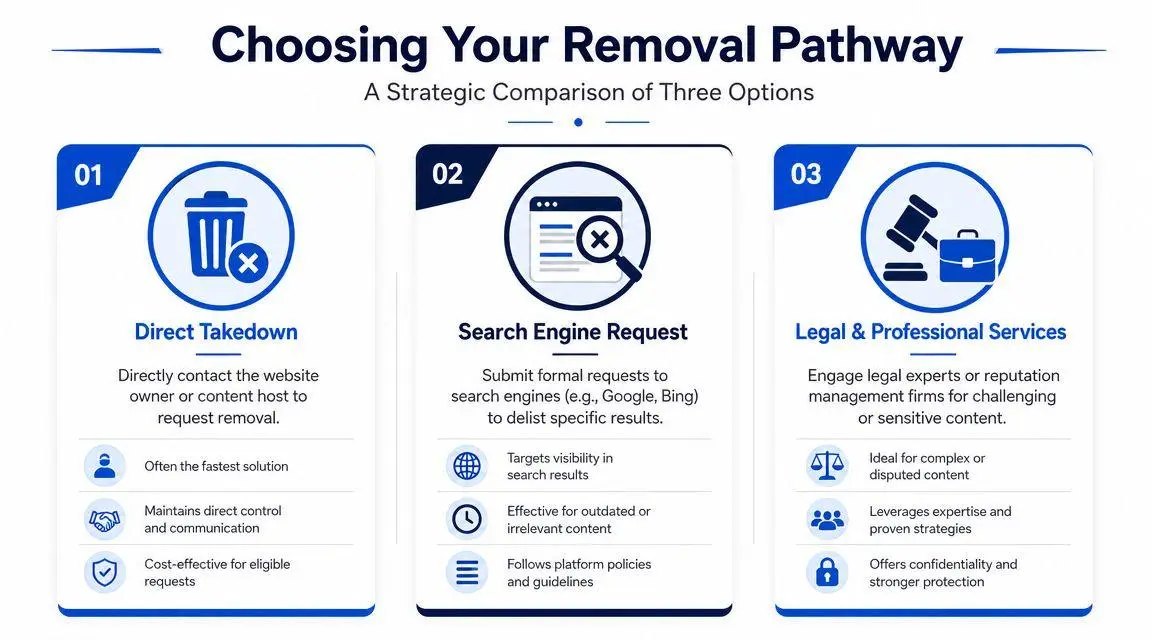
Once the threat is classified, the path usually falls into one of three lanes. Direct source takedown. Search engine delisting. Legal escalation. People blur these together and waste time. They’re not interchangeable.
Direct takedown from the source
If the website owner will cooperate, this is usually the cleanest outcome. Remove the page, correct it, restrict access, or apply the appropriate indexing controls at the source. When the content disappears at origin, the search result can eventually disappear as well.
This path works best for outdated profiles, accidental disclosures, internal site pages you control, or material published by parties who have some incentive to act reasonably.
It works poorly when the publisher benefits from conflict, hides ownership, or treats your request as a signal to entrench.
Search engine request
A search engine request is a visibility solution, not necessarily a publication solution. The page can remain online while the result is reduced or removed from the search interface under specific policies.
For controlled pages, Google’s own documentation makes the distinction clear. The Removals tool is for quick, temporary hiding, while permanent change requires changing or removing the underlying content. Google says a page hosted on your site can be removed from Google Search with the Removals tool within a day, but the request lasts only about 6 months unless the page itself is changed, password-protected, or marked noindex, according to Google’s removal guidance.
That’s why experienced operators treat this tool as a bridge, not a cure.
Legal removal action
When the content is unlawful, infringing, or part of a sustained attack, legal process becomes the operative mechanism. That can mean a copyright-based complaint, a court-backed defamation strategy, or a targeted legal demand tied to privacy or harassment.
This is slower to prepare than a simple reporting form, but often far more effective where policy-based requests fail. It also changes the posture of the recipient. A platform denial may mean the issue doesn’t fit that platform’s category. It doesn’t mean the content is lawful or untouchable.
Which path fits which problem
| Pathway | Best for | Main weakness |
|---|---|---|
| Direct takedown | Cooperative publishers, pages you control, factual corrections | No leverage if the site refuses |
| Search engine request | Personal data, outdated snippets, policy-defined harms | Content may stay live elsewhere |
| Legal action | Defamation, copyright, repeated abuse, serious privacy violations | Requires evidence, precision, and cost discipline |
My recommendation in practice
For high-stakes matters, don’t choose only one lane at the outset if the facts support parallel action. If personal data is exposed, file the search request while preparing the source demand. If a false article is harming commercial relationships, preserve the evidence before contacting the publisher, then decide whether direct engagement will help or only serve to alert them to harden their position.
The wrong sequence can damage your chances more than a slow sequence. Strategy matters more than speed alone.
If you control the page yourself, act at source first. If you don’t control it, assess whether the search engine has a policy hook. If neither route is likely to resolve the matter cleanly, move to legal preparation quickly instead of pretending a generic complaint will do the job.
Executing Direct Search Engine Requests
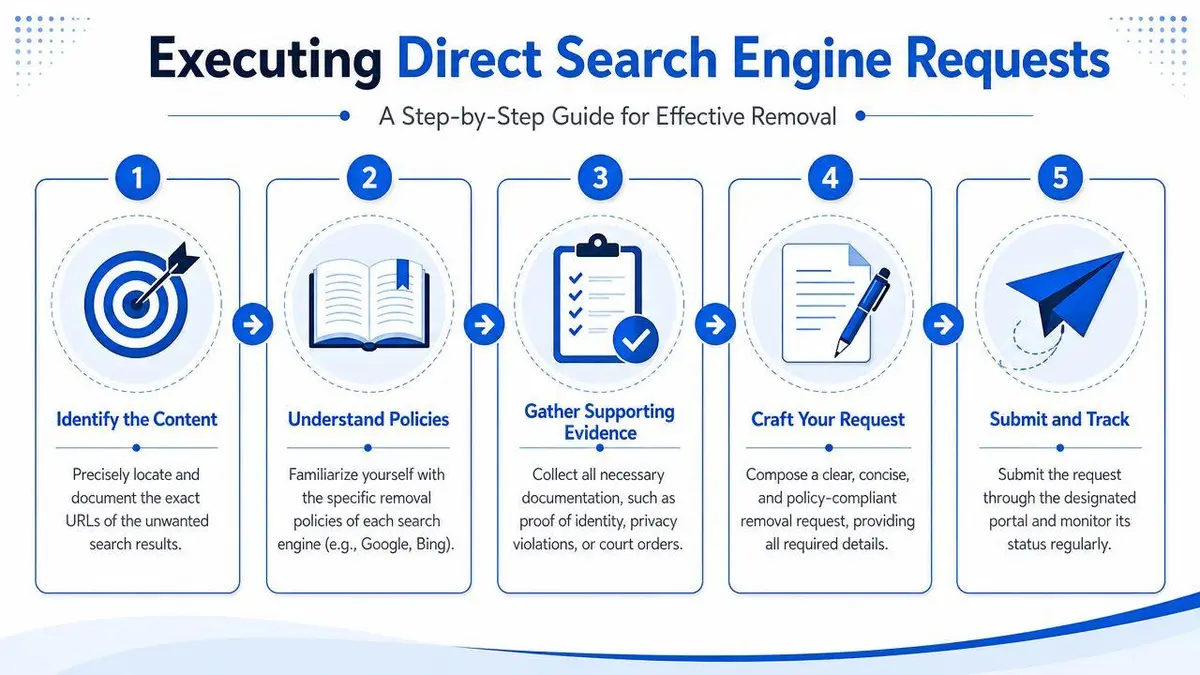
Once you’ve chosen the search-engine route, execution matters. Most denials come from sloppiness. Wrong URL. Wrong content category. Vague explanation. Broad complaint instead of precise policy match.
Build the request around the exact result
Google’s personal-data workflow is specific. The strongest operational route is to submit the result through Results about you or the Remove result path after identifying the exact URL and matching it to the correct content category. Google says users receive email confirmation within a few hours and can track statuses such as in progress, approved, denied, or undone, according to Google’s help page for removing personal info from Search.
That tells you two things. First, precision matters. Second, monitoring the request is part of the work, not an afterthought.
What to submit
Use a disciplined package:
- Exact result URL. Not the homepage. Not a search page. The exact indexed result.
- Correct policy category. Contact information, personal identifiers, or the relevant qualifying type.
- Proof that supports the category. Enough to show the issue fits the rule without oversharing.
- A concise explanation. Factual, narrow, unemotional.
If the source page has already been changed, don’t keep filing the wrong removal type. Use the outdated-content route where appropriate. If the source page remains live and unchanged, don’t mislabel the issue as “outdated” just because you want it gone.
For a practical outside perspective on cleaning up search results, Raven SEO gives a useful overview of the distinction between removal and suppression. That distinction becomes critical when a result is harmful but doesn’t fit a clean policy category.
How to interpret request status
A status update isn’t administrative trivia. It tells you what to do next.
| Status | What it means operationally | Your next move |
|---|---|---|
| In progress | The request is under review | Keep evidence organized and avoid duplicate messy filings |
| Approved | The result qualifies under the selected path | Verify actual visibility changes and monitor for reappearance |
| Denied | The request didn’t meet the policy or lacked precision | Reassess category, source action, and legal options |
| Undone | The prior change has been reversed or conditions changed | Investigate republication or renewed indexing |
Here’s the practical point many people miss. A denial is information. It doesn’t close the file. It tells you that your argument, evidence, or chosen route didn’t fit the platform’s rule set.
A lot of clients need a legal route after they’ve exhausted the self-service path. If that’s where your matter is heading, this guide to submitting a Google legal request is the next document to review.
A short visual explainer can help if you’re delegating the process internally.
Common reasons requests fail
The biggest operational errors are avoidable:
- Overbroad framing. “Remove all results about me” is not a valid request.
- Policy mismatch. A reputational complaint isn’t automatically a privacy complaint.
- Incomplete documentation. If the evidence doesn’t show the issue clearly, review stalls or fails.
- No parallel source action. Even where delisting succeeds, the underlying page can continue causing trouble.
If the matter is sensitive, affects a public figure, or involves multiple URLs, use a case log. Track every URL, every request, every response, and every follow-up deadline. That’s how professionals keep a removal campaign coherent under pressure.
Escalation to Legal and Professional Services
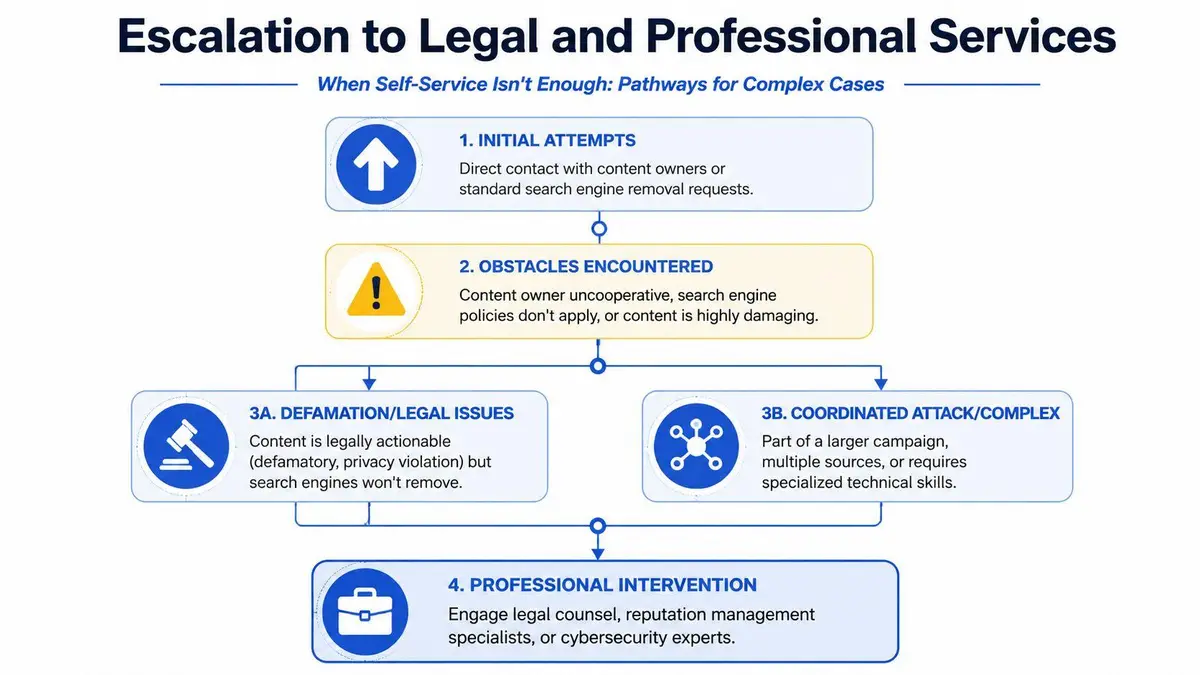
There’s a point where self-service stops being serious enough for the problem. If the source site refuses to cooperate, the content sits outside a platform’s narrow policy categories, or the attack spans multiple domains and reposts, you need escalation. Not eventually. Now.
The signs that DIY has reached its limit
Google’s own support materials leave a gap that many articles ignore. They address submitting web-result removals, refreshing outdated content, and using legal removal under specific conditions. But the harder question is what to do when the source refuses to cooperate or the material reappears elsewhere. Google’s Results About You experience also reflects a shift toward ongoing monitoring, with users able to track requests as approved, denied, or undone, as noted in Google’s guidance on monitoring and removal follow-up.
That’s the key strategic shift. Removal isn’t a one-time event. In difficult matters, it becomes an ongoing enforcement function.
Where legal pressure changes the outcome
Legal escalation is appropriate when you can articulate a recognized basis for action. Common examples include copyright infringement, defamatory falsehoods, privacy violations, impersonation, and the publication of sensitive material without consent.
The legal process does two things that self-service requests often can’t. It narrows the argument to a formal claim, and it forces the recipient to evaluate risk instead of convenience.
If the content is causing real commercial, personal, or security harm, a denied platform request is not a conclusion. It’s a signal to change instruments.
Why professional management matters
Professionals don’t just “submit more forms.” They sequence actions to avoid conflict between tactics, preserve evidence in a way that supports escalation, identify where host, registrar, publisher, and search engine obligations diverge, and manage the reputational risk of contact itself.
That matters in at least three situations:
- Defamation with factual complexity. The strongest move may be evidence assembly and legal preparation before any publisher contact.
- Coordinated attacks. Multiple fake profiles, copied posts, and forum threads require pattern analysis, not one-off complaints.
- Privacy and security exposure. Doxxing, home-address exposure, and related material may require rapid technical, platform, and legal coordination.
If the incident overlaps with broader data-handling or security questions, technical compliance context can matter too. For readers dealing with organizational obligations around privacy and systems exposure, this overview of Indiana cybersecurity compliance is a useful companion reference.
One practical option in this market is ContentRemoval.com, which handles search-result de-indexing and source removal workflows across major search engines and websites. For complex matters, that kind of operational coordination is often what separates isolated requests from a controlled campaign.
Beyond Removal Proactive Monitoring and Defense
A result disappearing today doesn’t guarantee safety tomorrow. Harmful content returns through reposts, syndication, scraper sites, copied snippets, and fresh indexing. If you stop at takedown, you leave the second half of the problem untouched.
Monitor continuously
High-risk individuals should assume recurrence is possible. Monitoring catches new appearances early, before a copied page accumulates visibility and before a stale issue turns into a fresh crisis.
That means watching not only your name, but also common name variations, business names, image associations, and known hostile domains. If the material involved personal data, monitoring matters even more because reappearance often happens through redistribution rather than original reporting.
For ongoing oversight, a structured reputation monitoring service is more useful than occasional vanity searches. The point is early detection and disciplined response.
Build a defense, not just a cleanup
Some results can’t be removed cleanly. A lawful article may remain. A historical report may stay indexed. In those cases, suppression becomes the practical strategy. You publish and strengthen accurate, authoritative, positive assets that you control so they compete effectively for branded search visibility.
That doesn’t replace removal. It complements it. Removal reduces exposure where possible. Suppression reduces prominence where removal isn’t available.
Don’t rely on superficial fixes
A common technical error is blocking first and thinking the problem is solved. That’s not how durable deindexing works. Relying on robots.txt alone is a mistake because it can block crawling without guaranteeing deindexing, and blocked URLs can still remain discoverable through other signals. For permanent removal, the content needs to be removed at the source, as explained in FIU’s guidance on removing webpages from Google Search.
That’s why serious reputation defense uses layers:
- Source control when you can get it
- Search visibility control where policies allow it
- Legal escalation where rights are being violated
- Monitoring and suppression for persistence and resilience
A search-result problem is only solved when the result is gone, stays gone, or is pushed so far down that it stops shaping first impressions.
If you’re under pressure and need a controlled plan, ContentRemoval.com can assess the result, identify the right removal pathway, and manage source, search, and escalation steps discreetly. The right next move depends on the content, the publisher, and the means at one’s disposal. A confidential review is the fastest way to stop guessing and start acting.
Frequently asked questions
Why was my Google removal request denied?
Most denials come from imprecision: the wrong URL, the wrong content category, a vague explanation, or a reputational complaint filed as a privacy complaint. A denial is information rather than a conclusion, and the next step is to reassess the category, act at the source, or move to a legal basis.
What is the difference between removing a page at the source and delisting it from Google?
Source removal deletes or changes the page where it is published, so the search result eventually disappears too. A search engine request only affects visibility in the results interface, and the page can stay live, be mirrored, or be republished. For durable outcomes the two are usually pursued together.
How do I stop a removed search result from coming back?
Assume recurrence is possible through reposts, syndication and scraper sites, and monitor your name, name variations, business names and known hostile domains. Where a lawful page cannot be removed, publish and strengthen accurate assets you control so they compete for the branded search results.