
Removing negative content means treating each damaging URL as its own case: classify it as false, private, infringing, abusive, policy-violating, public-interest reporting or lawful but harmful, then pursue source removal where the publisher will act, Google de-indexing where a policy applies, and suppression where neither is available. The first 24 hours belong to evidence and containment.
Key facts
- Source removal is the strongest first move because Google drops a deleted page after recrawling.
- Google’s search removal tools cover exposed personal data, intimate imagery and exploitative schemes, not general reputation harm.
- Review platforms remove reviews for policy breaches like impersonation or fabrication, not for low ratings.
- Hosting providers, registrars and payment processors offer abuse channels when the publisher ignores you.
Where ContentRemoval.com comes in. ContentRemoval.com is brought in when a hostile page has appeared at the worst possible moment, often by the executive’s chief of staff, general counsel or communications agency. We build the incident file, classify each URL and run source outreach, de-indexing requests and infrastructure escalation as separate workstreams. A free 15-minute Exposure Scan maps what is removable, and the report is yours to keep whether or not you engage us. Get a Free, Confidential Exposure Scan or read how our content removal work is done.
A damaging result rarely arrives at a convenient time. It appears when a board member is vetting you, when a journalist is preparing a story, when a regulator is searching your name, or when a prospective client decides whether to proceed. The screen fills with a hostile review, a false allegation, a leaked document, an old arrest record, or a page that is technically lawful but ruinous in context.
The first mistake is emotional action. Executives call the publisher in anger. Staff respond publicly. Someone threatens litigation before the facts are organized. That usually weakens your position.
The right response is controlled escalation. If you want to understand how to remove negative content, you need to treat the issue as a multi-track matter involving evidence, platform policy, legal means, search visibility, and reputation containment. Some material can be removed at the source. Some can be de-indexed from search. Some can only be corrected or suppressed. The only bad strategy is treating every case as if one email or one complaint form will solve it.
The Moment of Discovery and the Need for a Plan
Most clients remember the exact moment. A chief of staff forwards a search result with no comment. Investor relations flags an article before a funding conversation. A spouse sees an image that should never have been public. The common feature is pressure. The second common feature is confusion about what has happened.
One URL is not one problem. It may sit on the publisher’s site, in search engine indexes, in social shares, in copied reposts, and in cached versions. The visible result is only the surface. If you react to the surface alone, you will miss the structure that keeps it visible.
That is why negative-content removal has to start with a professional frame. You need to identify whether the issue is false, private, infringing, abusive, platform-prohibited, public-interest reporting, or unpleasant but lawful. Those distinctions govern everything that follows.
Practical rule: Don’t ask first, “How do I get this off Google?” Ask, “What is this content, who controls it, and what legal or policy path applies?”
A privacy breach demands one response. A copied image demands another. A review written by a real customer, however hostile, requires a different strategy than an impersonation attack or fabricated complaint. The law treats those scenarios differently. Platforms do too.
High-stakes clients need a decision framework, not internet folklore. The workable sequence is simple: contain the incident, preserve evidence, classify each asset, pursue source removal where possible, use search-engine de-indexing where policy or law permits, and deploy suppression where removal is unavailable. Precision matters more than speed, although in serious matters you need both.
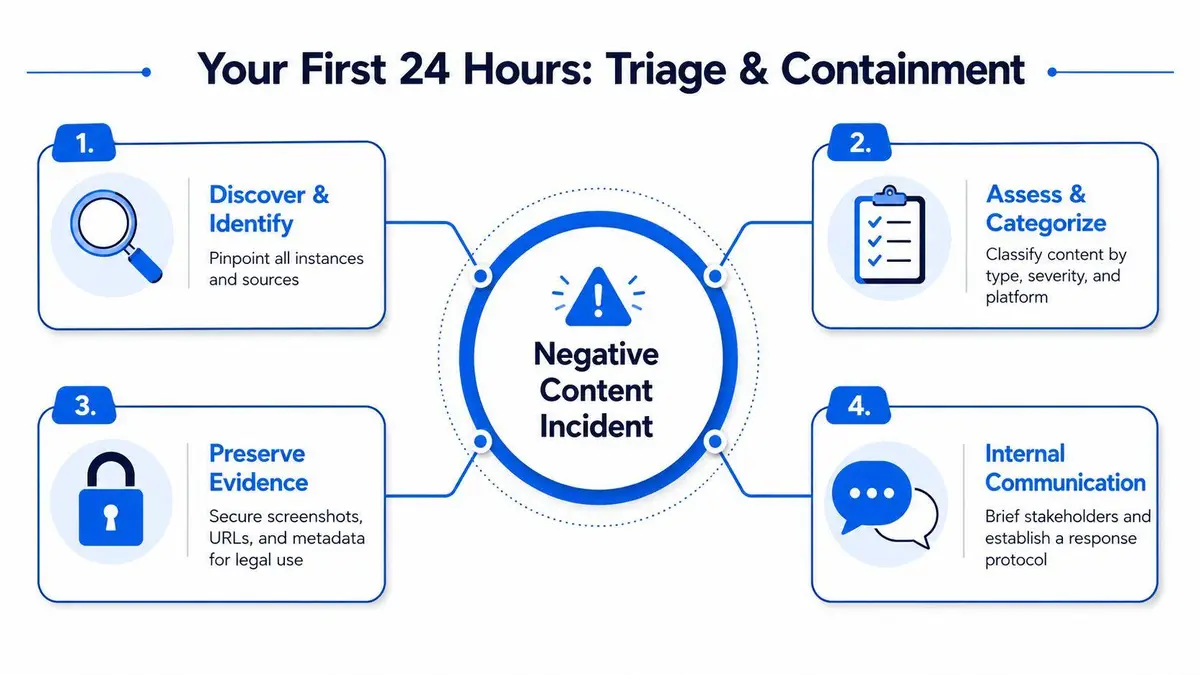
Your First 24 Hours Triage and Containment
The first day is about control. Not optics. Not outrage. Control.
A practical removal workflow begins with a structured audit of the top-ranking URLs, followed by classification of each item by type, because the removal path changes depending on whether the content is inaccurate, defamatory, policy-violating, lawful-but-harmful, or duplicate. Source removal is usually the strongest first move, because if the publisher deletes or corrects the page, Google will typically drop it after recrawling. A noindex tag can also remove a page from listings once crawled, as outlined in this removal workflow guidance.
What to do immediately
Start by building an incident file. That file should exist before anyone sends a complaint, a demand, or a platform report.
- Capture the live page. Take screenshots that show the full page, the URL, the date, and any identifying account information.
- Save the exact URLs. Not just the domain. Record the precise page URLs, profile URLs, image URLs, and review links.
- Record search visibility. Search your name, company name, product names, and key executives. Note where the harmful result appears and for which queries.
- Identify the owner and the host. Publisher, platform, registrar, and hosting provider are different actors. You need to know which one can act.
- Check for replication. Harmful content is often mirrored, syndicated, screen-captured, or reposted.
What not to do
The wrong move in the first day can turn a manageable issue into a durable one.
- Don’t engage publicly. Public rebuttals can amplify the material and invite more commentary.
- Don’t threaten before you assess. An empty legal threat tells the other side you’re anxious, not prepared.
- Don’t ask junior staff to “clean it up”. They may contact the wrong party, concede facts, or create discoverable records that hurt you later.
- Don’t assume Google controls the page. Search engines usually index content. They usually do not host it.
The first response should lower exposure, not increase audience.
Build a classification matrix
A simple triage table brings order quickly.
| Content type | Primary issue | Initial path |
|---|---|---|
| False factual allegation | Potential defamation or correction issue | Evidence review, publisher demand, legal assessment |
| Doxxing or exposed personal data | Privacy and safety risk | Platform report, search removal request, host escalation |
| Stolen photo, video, article, or design | Copyright issue | Source notice, DMCA analysis, search complaint |
| Harassing post or coordinated abuse | Safety and policy issue | Platform workflow, account tracing, escalation protocol |
| Harsh but truthful review or article | Lawful but harmful | Correction, suppression, reputation strategy |
When the issue includes stalking, threats, impersonation, or coordinated abuse, a specialized incident protocol matters more than generic reputation advice. This broader strategic response guide for online harassment cases is a useful companion if the conduct goes beyond a single post or review.
Internal containment matters too
Someone inside the organization should own the file. One person manages facts. One person approves outbound communication. Everyone else stays off the record. If outside counsel or a reputation advisor is involved, route all action through that channel.
Discipline in the first 24 hours often determines whether the matter is resolved discreetly or publicly prolonged.
Executing Platform-Specific Takedown Workflows
A week after the first post appears, executives often discover they have been solving the wrong problem. The legal team has drafted a demand to Google. The communications team is arguing with a reviewer. The damaging page is still live on the publisher’s site, indexed, screenshotted, and spreading. Platform-specific execution starts with one decision. Are you trying to remove the source, or reduce visibility while the source remains online?
That distinction determines speed, remedy, and legal posture. Source removal changes or deletes the material where it is published. De-indexing limits discoverability in search but usually leaves the page intact. If you confuse those tracks, you waste time and create evidence problems. Google’s removal framework reflects that split, as summarized in this explanation of Google removal pathways.

Start with the platform that controls the page
If a publisher, forum moderator, review platform, or site owner can remove the content directly, go there first. A successful source takedown eliminates the page itself, which is the best outcome in almost every case. Search engines usually follow after recrawling or after a separate removal request tied to the updated status.
Use source requests for content that falls into one of four categories:
- False factual statements supported by records, correspondence, or other documentary proof
- Outdated content that is misleading because material facts have changed
- Policy-violating content under the host platform’s own rules
- Correctable editorial content on sites with a reachable editor, webmaster, or compliance contact
Keep the request narrow. Identify the exact URL, quote the exact statement, attach the proof, and state the remedy you want. Removal, correction, redaction, or account suspension are different outcomes. Ask for one.
Use search engine removal for defined categories, not general reputation harm
Google is useful for privacy, safety, and certain rights-based complaints. It is not a general reputation court. If the content involves exposed personal data, non-consensual explicit imagery, material involving minors, exploitative removal schemes, or similar policy categories, submit a search removal request while you pursue the source in parallel.
That two-track approach matters. Search suppression can reduce immediate harm, but it does not fix the underlying publication. For executives dealing with lawful but damaging material, the harder question is whether any statutory or platform-specific right applies at all. This strategic guide to online content removal laws for executives is useful when the issue sits in the gray area between policy violation and reputational damage.
Reviews demand rule-based analysis
Review platforms remove content for policy breaches, not because the business dislikes the rating. Treat reviews as an evidence problem. Can you show impersonation, conflict of interest, fabricated experience, prohibited hate content, or another express rule violation? If not, the review is more likely a suppression and response issue than a takedown matter.
For Google reviews, use the Google Business Profile reporting flow, choose the precise policy basis, preserve the case ID, and submit supporting context if an appeal is needed. Google’s process is outlined in Google’s review appeal guidance video. The standard is simple. A harmful review comes down only when it violates a rule.
Copyright, images, and manipulated media follow different channels
Stolen photos, copied articles, product images, and branded creative assets should not be forced into a defamation or harassment workflow. They belong in a copyright or unauthorized-use process. File with the host, then with search engines if the content remains indexed. If the issue involves altered visual content or unauthorized reuse of marked images, document ownership and prior publication before you file. For practical context on how image modification and mark removal issues arise, see Direct AI’s watermark removal guide.
Escalate through the service stack when the visible platform fails
If the page stays live and the operator ignores you, move below the surface layer. Hosting providers, registrars, CDN services, and payment processors may each offer abuse channels, especially in cases involving impersonation, extortion, privacy violations, or unlawful use of content. Those routes are less public and often more effective.
ContentRemoval.com is often used for this reason. Source outreach, de-indexing requests, and infrastructure escalation are separate workstreams with different standards, evidence packages, and timelines. Treat them that way.
Leveraging Legal Pathways for Content Removal
At 6:30 a.m., your general counsel forwards a link that names your company, your CEO, or you personally. The post is climbing in search, investors can find it, and the platform has refused to act. At that point, legal action is not a gesture. It is a screening exercise. You identify the claim, the remedy, the defendant, and the fastest path to a result.
Legal removal works only when the facts fit a legal standard. Embarrassing content, harsh commentary, and accurate reporting rarely qualify. Start with a disciplined assessment of what the content is, who published it, where it is hosted, and which forum can compel change.

Defamation is powerful but demanding
Defamation requires precision. The core question is whether the statement asserts a false fact that can be proved false, was published to others, caused harm, and meets the applicable fault standard. Opinion, rhetorical insults, and substantially true reporting usually survive challenge.
Executives often waste time on the wrong target. A demand letter built on indignation rather than legal merit can strengthen the publisher’s position, especially if the content cites public records or addresses a matter of public concern. Media defendants are harder still. Public-facing leaders should expect tougher standards and more resistance.
Use defamation claims for verifiable falsehoods. Use them early, with evidence in hand, and against the party that can remove, retract, or correct the statement.
Copyright can be cleaner than reputation law
Unauthorized use of your photos, videos, articles, marketing copy, or internal materials often presents a stronger removal path than a reputation claim. The argument is simple. The publisher used protected work without permission.
This route is effective in copied executive bios, scraped company profiles, fake sites, leaked presentations, and reposted media. It also helps when the surrounding commentary is protected but the asset itself is yours.
For readers dealing with unauthorized visual reuse, including branded or overlaid media, Direct AI’s watermark removal guide is a useful technical reference for understanding how copied visual assets are manipulated and republished online. That context can help you trace whether an image was altered, stripped, or reused in a way that supports a stronger takedown position.
Privacy and data protection claims
Privacy claims remove content that defamation law often cannot touch. If a page exposes personal identifiers, medical information, intimate material, financial details, or other sensitive data, privacy statutes or data protection rules may provide a direct basis for removal or de-indexing.
Jurisdiction matters. So does status. Public-interest balancing narrows remedies where the subject is a public figure, a court matter, or a legitimate news event. The right question is not whether the content is damaging. It is whether the law treats the publication itself as unlawful, excessive, or avoidable.
Lawful but damaging content changes the objective
The hardest files involve content that is damaging and legal. A news article drawn from public filings. A genuine customer review. An old incident reported accurately. In those matters, the legal path may be narrow or closed.
That is why senior decision-makers need a three-track framework: removal, correction, or suppression. Each track serves a different outcome, carries a different risk profile, and depends on different facts. As noted earlier in this legal overview of removing negative online content, lawful speech often survives even when the business impact is serious.
A strong legal strategy is often negative selection. Eliminate weak claims early. Concentrate effort where the law gives you influence, where the publisher is exposed, and where the remedy changes visibility or indexing on a meaningful timeline.
Timelines and expectations
Legal matters run on proof, procedure, and counterpart behavior. Some disputes resolve through a targeted notice and a credible evidentiary record. Others require platform legal submissions, negotiated corrections, or court orders.
Executives should treat this as a staged decision process:
- Immediate legal review to classify the content and identify viable claims
- Evidence preservation so edits, deletions, and metadata changes do not erase your record
- Targeted pre-action outreach where a publisher may remove, correct, or anonymize
- Formal legal notices or filings when the claim is strong and the remedy justifies escalation
- Court intervention only when the stakes, enforceability, and likely outcome support the cost
For a deeper treatment of claim selection, jurisdiction, and remedy design, review this strategic guide to online content removal laws for executives before authorizing any aggressive step.
Advanced Suppression When Removal Is Not an Option
Some content won’t come down. That is not a moral judgment. It is a strategic fact.
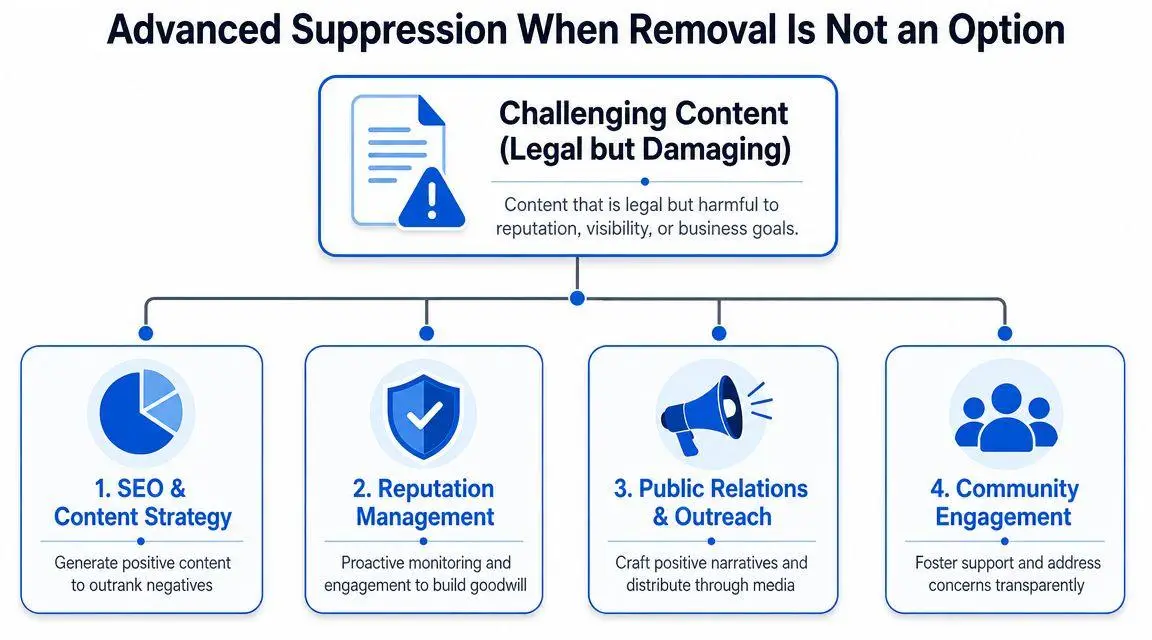
A lawful article, a public record, a harsh but genuine review, or commentary protected as opinion may remain online despite every complaint you file. At that point, serious reputation management shifts from deletion to displacement. At this point, many people misunderstand how to remove negative content. In difficult matters, “remove” often means remove from prominence, not from existence.
The distinction is not cosmetic. It is operational. The right objective becomes reducing visibility, limiting recurrence, and controlling what high-intent searchers see first.
Suppression is not surrender
Suppression is an advanced answer to a lawful-content problem. If the damaging item survives because it is protected, partly true, or considered newsworthy, your influence moves from legal attack to search architecture and narrative control.
That approach matters because users usually form impressions from what is most visible, not from what exists somewhere deep in the index.
A strong suppression program usually includes:
- Controlled owned assets such as a personal site, executive bio pages, and company leadership pages
- Authoritative third-party profiles on professional and industry platforms
- Thought leadership content tied to the executive’s real expertise
- Positive media and speaking visibility that can rank for name-based searches
- Ongoing optimization so favorable assets hold position
Use a decision framework, not wishful thinking
The hardest category in online reputation work is lawful but damaging content. That is exactly where generic advice breaks down. The more useful framework is deciding between removal, suppression, and correction based on the actual legal and platform posture of the material, as emphasized in this discussion of lawful but harmful online content.
Correction works when a publisher will update. Removal works when law or policy gives you influence. Suppression works when neither of those conditions is available.
Build assets that deserve to rank
Weak content does not bury strong negative results. Search engines reward relevance, authority, and consistency. If you want harmful material displaced, your replacement assets must be credible enough to outrank it.
That usually means publishing fewer things, but publishing them well. A rushed microsite and thin social profiles won’t do much. A disciplined portfolio often will. This executive guide to suppressing negative search results explains the mechanics in more detail for readers managing entrenched page-one issues.
If a damaging result is legal and durable, fight for ranking position, not fantasy deletion.
Building Long-Term Digital Resilience
Removal is an event. Resilience is a system.
The strongest clients don’t wait for a crisis to discover what search results say about them. They maintain a monitored, reinforced digital profile so that a future attack, leak, or unfair posting has less room to dominate. That means active observation of branded search results, recurring audits of exposed data, and a stable portfolio of favorable assets that can absorb reputational shock.
This is not theory. Content-removal work is now handled at scale, not as an occasional ad hoc request. One provider reports having removed over 100,000 pieces of content, while independent guidance notes that straightforward matters may resolve in 2 to 4 weeks and complex legal matters can take 3 to 6 months or more, according to this overview of large-scale content mitigation timelines. The practical implication is obvious. Harmful content can reappear, spread, or persist across multiple layers, so ongoing monitoring is not optional.
What resilient organizations actually do
The organizations that handle this well tend to adopt a standing protocol.
- Monitor branded search terms so new threats are identified before they harden into ranking positions.
- Maintain owned properties that already rank for executive and company names.
- Review exposure points such as old bios, archived files, forgotten subdomains, and stale press pages.
- Coordinate legal, communications, and security teams instead of letting each function improvise separately.
A useful outside perspective on recurring reputation signals and local visibility patterns appears in AI Tools for Local SEO reputation insights. It’s relevant because reputation risk often begins with small, visible signals that organizations dismiss until they become entrenched.
The real mandate
If you are dealing with harmful online material now, the immediate issue needs action. But the larger lesson is that your digital reputation is an asset class. It requires governance, not occasional cleanup.
That means you need a repeatable model: detect early, assess correctly, act through the right channel, and reinforce the search results so one hostile asset cannot define you. Clients who adopt that model recover faster and stay cleaner.
If you need a confidential assessment, ContentRemoval.com can review the content, identify whether the proper path is removal, de-indexing, correction, or suppression, and outline a discreet action plan specific to the jurisdiction, platform, and risk level involved.
Frequently asked questions
What should I do in the first 24 hours after finding negative content about me online?
Build an incident file before anyone sends a complaint: capture full-page screenshots with the URL and date, record the exact page and image URLs, note which searches surface the result, and identify the publisher, host and registrar. Do not respond publicly, do not threaten legal action before assessing the facts, and do not let junior staff contact the site.
Can a negative article that is true be removed from the internet?
Usually not. Accurate reporting, genuine customer reviews and public records are protected in most cases, so the legal path is narrow or closed. For lawful but damaging material the realistic options are a publisher correction, persuading the site to add a noindex tag, or a suppression program that pushes the page off the first results with stronger assets.
How long does it take to remove negative content online?
It depends on the route. The article cites independent guidance that straightforward matters may resolve in two to four weeks, while complex legal matters can take three to six months or more. Cooperative publishers and clear policy violations move fastest, and court orders take the longest.