
Brand reputation management for executives is a control system for reputational risk, not a messaging exercise. It runs across search results, review platforms, social platforms and data hosts, combining monitoring with thresholds, a disciplined 72-hour crisis playbook and pre-built owned assets. When the content itself is false, impersonating, leaked or invasive, removal becomes the central workstream rather than suppression.
Key facts
- Sprout Social data cited: 76 percent of consumers regularly read reviews and 46 percent say they influence decisions.
- False allegations, impersonation accounts, leaked material, intimate imagery and doxxing usually require removal, not response.
- Day one is containment: lock outward communications, preserve URLs, screenshots and metadata, then classify the incident.
- Cited data shows 53 percent of consumers expect review responses but 63 percent say a business never replied.
Where ContentRemoval.com comes in. ContentRemoval.com is the remediation partner the article describes: source removal, de-indexing, platform escalation and evidence preservation for executives whose problem is a specific hostile asset rather than general sentiment. A chief of staff, general counsel or the executive’s communications adviser usually makes the call when a board packet, financing or press inquiry is live. A free 15-minute Exposure Scan maps what is removable, and the report is yours to keep. Get a Free, Confidential Exposure Scan or read how our reputation management work is done.
An executive usually learns about a reputation problem at the worst possible moment. A board packet is due. A financing conversation is live. A journalist has emailed for comment. Then someone forwards a search result, a fake profile, a leaked image, or a hostile article that now sits one query away from investors, customers, employees, and family.
At that point, most advice on brand reputation management becomes useless. Your communications team wants language. Your marketing team wants content. Your agency wants to “push down” the negative result. That can help when the issue is ordinary criticism. It fails when the asset itself is unlawful, false, manipulated, or strategically published to injure you. In those situations, the operative question isn’t how to sound better. It’s how to regain control.
Defining the Modern Reputation Battlefield
A high-profile client rarely calls because of “brand sentiment.” They call because a specific asset has become dangerous. An anonymous site has published fabricated allegations. A former contractor has posted internal material. A cloned social account is soliciting contact from customers. A review pattern no longer looks organic. A search result now creates legal, commercial, and personal exposure every time someone types a name.
That distinction matters. Conventional brand reputation management literature still leans heavily on monitoring, reviews, and response cadence. It under-serves the harder problem identified in Birdeye’s discussion of brand reputation management: when the issue is the content itself, such as defamation, impersonation, or leaks, the question becomes not “how do we improve perception?” but “how do we eliminate this damaging asset?”
Where marketing stops
A marketing team can publish thought leadership, improve owned media, and coordinate customer messaging. A public relations team can brief reporters, shape narrative, and contain fallout. Neither function is built to handle source-level removal, search de-indexing, platform escalation, evidentiary preservation, or legal positioning across jurisdictions.
That’s why many leading organizations mishandle the first phase of a digital attack. They treat a hostile asset as a messaging problem rather than a control problem. The result is predictable. They reply publicly to a false allegation and give it more oxygen. They threaten litigation before preserving evidence. They ask for a correction where a takedown demand was required. They wait for sentiment to improve while the harmful page continues to rank.
Practical rule: If a false or invasive asset is discoverable in search, shareable on social, or indexable by aggregators, you don’t have a reputation issue alone. You have a distribution problem.
What the battlefield actually looks like
For executives and public figures, the modern reputation battlefield has four contested surfaces:
| Surface | Typical threat | Real risk |
|---|---|---|
| Search results | Defamatory articles, old allegations, copied forum posts | Investor friction, hiring resistance, press amplification |
| Review platforms | Coordinated negatives, false reviews, extortionary complaints | Conversion loss, local trust erosion, operational distraction |
| Social platforms | Impersonation, clipped video, anonymous accusations | Viral spread, audience confusion, reputational contamination |
| Data and media hosts | Leaked documents, stolen images, doxxing, intimate content | Privacy invasion, security exposure, legal liability |
The executive mistake is assuming all four can be managed the same way. They can’t. Some require response. Some require silence. Some require removal first and narrative management later.
Brand reputation management, properly understood, is not a soft discipline. It is a control system for reputational risk, and for high-stakes matters, active content removal sits at the center of that system, not at the edge of it.
The Quantifiable Cost of Reputational Damage
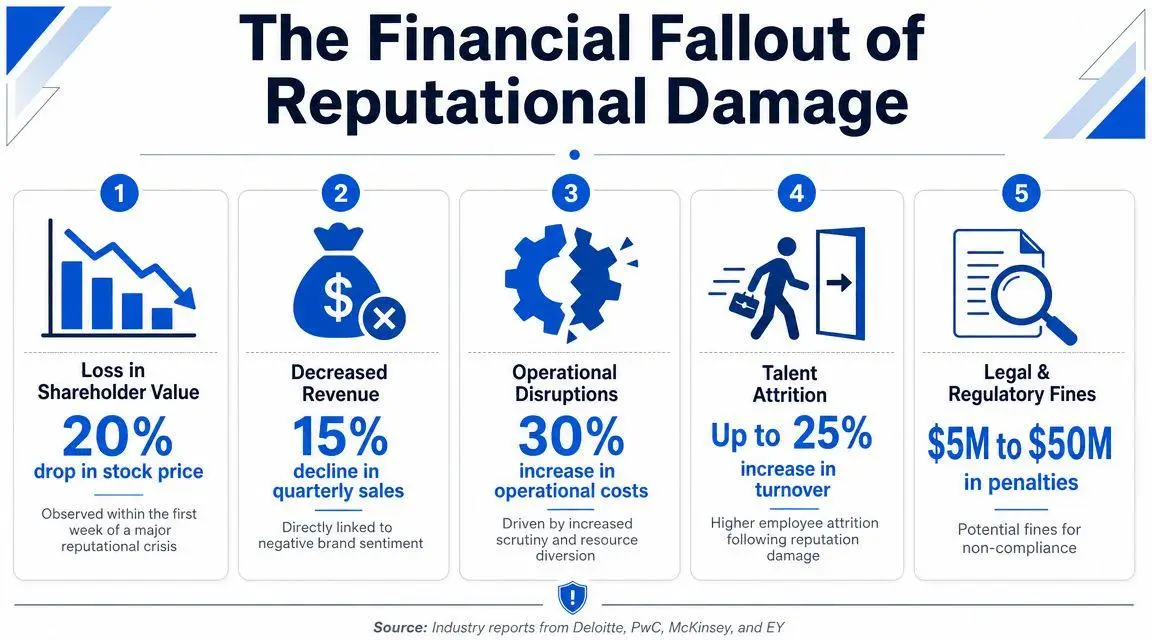
Boards don’t allocate budget to “image.” They allocate budget to risk, revenue protection, and operational continuity. That is the correct frame. Online reputation affects trust at the point where decisions are made, often in public channels you don’t control.
The first cost is decision friction
Consumers don’t evaluate you in a vacuum. Sprout Social reports that 76% of consumers regularly read online reviews when browsing for local businesses, and 46% say reviews are important enough to influence their decisions. For any company with a public-facing brand, that means digital trust signals shape whether a prospect books a meeting, places an order, applies for a role, or forwards your name to counsel.
For executives, the same pattern plays out in a more rarefied setting. A lender searches your company before underwriting. A prospective independent director reviews your press profile. A strategic partner checks public commentary before moving a draft term sheet forward. Negative visibility inserts delay into each of those moments. Delay has a cost even when the deal survives.
The second cost is management distraction
Once harmful content gains visibility, executives start burning expensive time on issues they shouldn’t be touching. General counsel is dragged into screenshot review. Investor relations rewrites talking points. HR fields questions triggered by external chatter. Customer support becomes an intake desk for a problem it didn’t create.
That is why serious organizations treat brand reputation management as an operating function rather than a campaign. If you want a more detailed commercial framework, our analysis of the financial realities of online reputation management breaks down how these issues affect budget, resource allocation, and strategic optionality.
Public damage rarely stays public. It moves inward fast, into hiring, legal review, sales velocity, and executive time.
The third cost is trust asymmetry
The problem with reputational damage isn’t only that a falsehood exists. It’s that audiences often see the falsehood before they see your correction. Search results, review snippets, and reposted allegations compress context. The hostile version travels first. Your answer arrives later, if it arrives at all.
A practical board-level way to think about the exposure is this:
- Commercial exposure: prospects hesitate, compare harder, and ask more defensive questions.
- Capital exposure: investors and lenders impose more diligence, more delay, and less confidence.
- Talent exposure: candidates and recruiters become wary of avoidable controversy.
- Litigation exposure: discoverable falsehoods, leaks, and impersonation can complicate parallel disputes.
- Personal exposure: executives and family members absorb reputational harm outside the company perimeter.
That is the actual cost structure. It is not abstract. It touches every decision-maker who types your name into a search bar.
A Modern Framework for Reputation Control
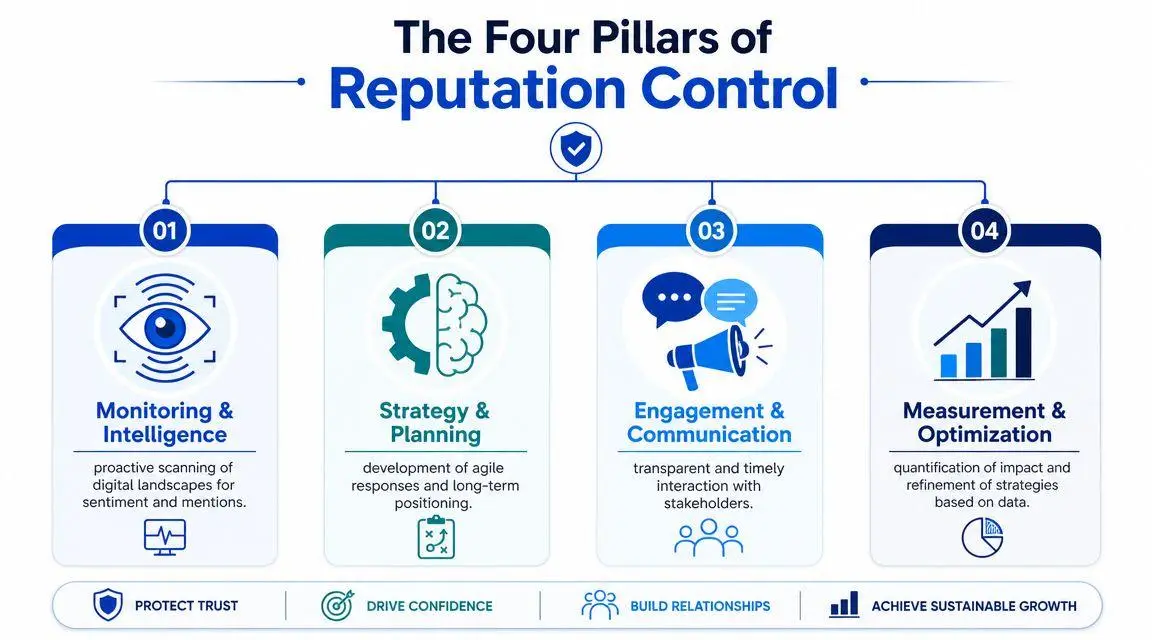
The firms that manage reputation well don’t improvise. They run a system. That system combines intelligence, decision rules, communication discipline, and remediation authority. Without all four, you’re left with scattered dashboards and nervous meetings.
Monitoring and intelligence
An effective program starts with extensive monitoring across search, review sites, social platforms, forums, and relevant news surfaces. As Reviewshake’s guidance on brand reputation management explains, the operating model is a measurement-and-response system. Teams monitor mentions, normalize the data, and track KPIs including sentiment score, review volume, ratings, share of voice, and response time to detect drift early.
For a high-profile client, I’d add a stricter requirement. Monitor the executive name, principal product lines, flagship domains, common misspellings, and known threat vectors such as fake review bursts or impersonating profiles. If you aren’t watching variants, you’re watching too little.
Strategy and thresholds
Data without thresholds is noise. Set channel-specific trigger points and assign consequence levels. A single hostile tweet from an account with no reach is not equivalent to a copied allegation indexed on a high-authority site. The same term can be trivial on one surface and severe on another.
Use a simple control table:
| Signal | What it means | Required action |
|---|---|---|
| Negative review spike | Possible service issue, spam, or coordination | Validate pattern, preserve evidence, platform review |
| Sentiment drop tied to a keyword | Emerging narrative or misinformation | Investigate source, prepare factual position |
| New branded search result | Search-visible reputation shift | Assess truth, authority, and removability |
| Impersonation or leak indicator | Identity or privacy threat | Escalate immediately to legal and technical remediation |
Engagement and communication
Not every criticism deserves a public answer. Mature teams know the difference between customer remediation and adversarial bait. If the issue is legitimate dissatisfaction, respond cleanly and move the discussion toward resolution. If the issue is fabricated, extortionary, or designed to provoke amplification, a public volley may worsen the damage.
The correct response cadence depends on the threat type, not on a social media team’s service-level agreement.
Measurement and optimization
The final pillar is performance review. Track not just visibility and sentiment, but whether interventions changed exposure. Did harmful assets lose discoverability? Did review anomalies stop? Did search results stabilize? Did platform enforcement hold?
A reputation program should answer one hard question at any time: where are we vulnerable right now, and what are we doing about it? If your current setup can’t answer that inside a few minutes, it isn’t a framework. It’s theater.
Executing the Crisis Response Playbook
The first 72 hours decide whether a reputational incident becomes containable or expensive. Most organizations waste that window by reacting emotionally, publishing too quickly, or letting too many people freelance on facts. Discipline matters more than speed if the speed is sloppy.
The first day
Start with containment. Lock down outward communications so only designated personnel can comment, post, or answer inbound media and customer questions. Preserve evidence immediately. Capture URLs, source code where appropriate, screenshots, publication times, account metadata, and any related correspondence. If you later need platform escalation, injunctive relief, or de-indexing support, a poor evidentiary record will weaken your position.
Then classify the incident. Is this a customer complaint, a factual allegation, a manipulated asset, an impersonation event, a privacy breach, or a coordinated smear? Those categories demand different responses. Treating them as interchangeable is how companies step into avoidable liability.
The next decision
There is a persistent myth that silence always looks guilty. It doesn’t. Sometimes a rushed statement validates an accusation, broadens publication, or creates admissions that opposing counsel will revisit later. Strategic silence can be stronger than visible panic.
Use this decision matrix:
- If the content is substantially true and operationally grounded, prepare a narrow factual response and remediation path.
- If the content is false, invasive, or unlawfully published, prioritize preservation, legal review, and removal options before public engagement.
- If the facts are still unclear, acknowledge awareness internally, not publicly, until you’ve verified the record.
For customer-facing incidents that do require a written apology, teams often struggle to sound direct without over-admitting. A useful reference is SupportGPT’s apology email framework, which is helpful for structuring customer communications while preserving clarity and restraint.
The operational gap is real
The market has expanded because organizations know reputation work matters. But execution still breaks down under pressure. Electro IQ’s overview of reputation management statistics notes the market was valued at around $175 million in 2022 and is forecast to reach $585 million by 2030, while also highlighting a basic failure of response discipline: 53% of consumers expect brands to respond to reviews, yet 63% report that a business has never responded to theirs. That gap tells you something important. Many companies understand the doctrine. They do not have the operating capacity to execute it.
The second and third day
By the second day, build your action stream around three tracks:
- Facts and evidence: finalize chronology, ownership, and legal posture.
- Platform and search actions: submit reports, escalation packages, and preservation requests where warranted.
- Stakeholder control: give investors, employees, and partners one approved factual line, not five improvised versions.
If the incident is targeted, hostile, and digital-first, our guide on handling a targeted online smear campaign is the framework I’d want a principal team following.
Bad crisis management usually looks busy. Good crisis management looks controlled.
Building a Proactive Reputational Defense
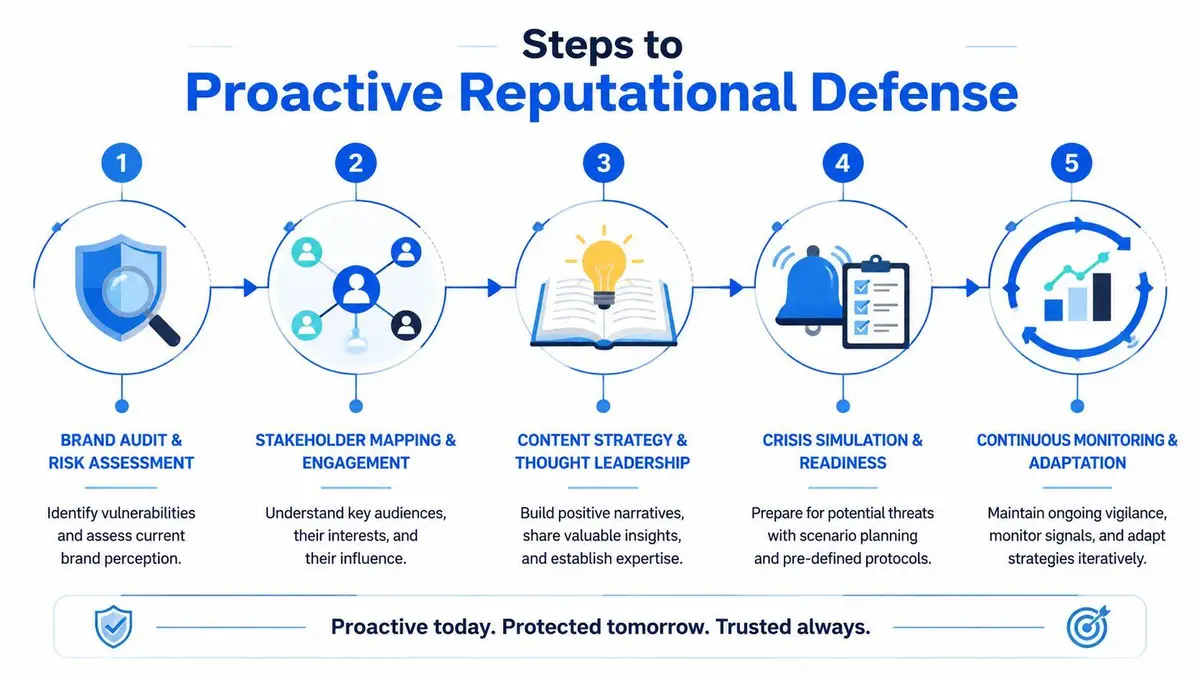
Most executives invest in reputation after they’ve been hit. That’s backwards. The stronger move is to build a defensive perimeter before a hostile asset appears. When you already control the high-trust surfaces around your name, attackers have less room to operate and less chance of owning page one.
Build the moat before you need it
A proactive defense has two components. First, build and maintain authoritative digital assets you own or can strongly influence. That includes executive bios, company profiles, thought leadership, verified social accounts, newsroom pages, and professionally managed third-party profiles. Second, define how those assets map to the search queries that matter most.
This is not vanity publishing. It is defensive infrastructure. If a hostile article appears tomorrow, your prior work determines whether it lands in a sparse search environment or a crowded one dominated by credible assets.
A common failure point is workflow. Companies often know what should be published but can’t move materials through review fast enough. If your approvals are slow, your reputation program will be slow. The operational fixes described in SleekPost’s guide on how to prevent content bottlenecks are useful because reputational defense depends on consistent publication, not sporadic bursts.
Use automation for early warning
For high-stakes matters, manual monitoring is too slow. Reputation.com’s guidance on aligning reputation management with marketing notes that AI-powered tools can detect sentiment shifts, predict emerging issues, and identify trends before they escalate. More importantly, the benchmark isn’t just response speed. It’s time-to-detection and time-to-action, because faster intervention reduces the amplification risk of harmful material in search and social systems.
That is the right benchmark. If a false accusation sits untouched while it is being indexed, scraped, reposted, and discussed, every hour matters.
A mature defense program does not wait for outrage. It watches for anomaly.
What to put in place now
Use a standing program with five working parts:
- Asset control: claim and maintain official profiles, executive pages, and key branded properties.
- Query mapping: know which names, products, and combinations must stay clean in search.
- Monitoring logic: set alerts for sentiment shifts, fake accounts, unusual review activity, and new indexed results.
- Approval discipline: pre-clear holding statements, escalation contacts, and evidence procedures.
- Remediation readiness: know in advance who handles platform reports, legal review, and technical takedown work.
One specialist provider in this area is ContentRemoval.com, which offers content removal, de-indexing, and monitoring workflows for executives, brands, and public figures. That kind of capability belongs in a defense plan before an incident, not after one.
When Standard Responses Fail and Removal is Required
Not every reputational problem calls for removal. Some can be managed through clarification, service recovery, and stronger content control. But some matters cross a line where standard PR and SEO become inadequate. That line is reached when the asset itself is unlawful, false in a legally significant way, privacy-invasive, or structurally persistent.
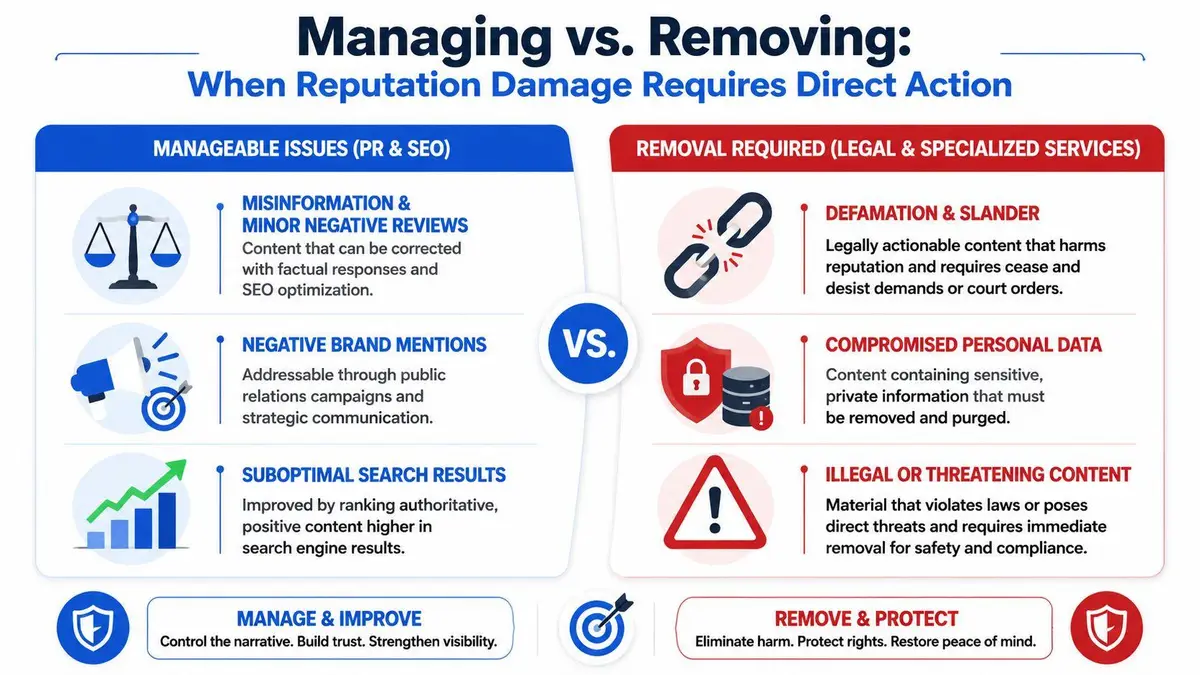
Manage versus remove
Use this distinction:
| Situation | Standard management may work | Removal is usually required |
|---|---|---|
| Minor negative reviews | Yes, if authentic and addressable | No, unless fraudulent or policy-violating |
| Critical press with factual basis | Yes, via response and context | Rarely |
| False factual allegations | Not enough on its own | Yes |
| Impersonation accounts | No | Yes |
| Leaked confidential material | No | Yes |
| Non-consensual intimate imagery or invasive media | No | Yes |
| Doxxing or exposed personal data | No | Yes |
The mistake many brands make is trying to “out-publish” a poison asset that should have been challenged directly. Suppression has a role. It does not replace source removal or de-indexing when the content remains active, searchable, and copyable.
Here is a useful visual summary before we go further:
Why these assets persist
False and invasive content tends to persist for three reasons. It is often published on platforms that separate hosting decisions from search visibility. It gets copied or syndicated faster than legal process moves, and it may be engineered to exploit hesitation, with anonymous authorship, offshore hosting, throwaway accounts, or mixed truth-and-falsehood drafting that complicates a casual takedown request.
That is why removal is a distinct discipline. It requires platform policy fluency, search de-indexing knowledge, evidentiary packaging, legal analysis, and reappearance monitoring. A press release won’t do it. A generic cease-and-desist letter often won’t do it either.
If the asset creates continuing discoverability, continuing harm, and continuing republication risk, “respond and move on” is not a serious strategy.
The threshold questions
Ask these questions immediately:
- Is the content false, impersonating, invasive, or unlawfully obtained?
- Is it ranking in search or likely to become searchable?
- Can it be copied faster than a narrative response can catch up?
- Would a public answer increase distribution or create admissions risk?
- Is there a realistic policy, technical, or legal route to removal?
If the answer pattern points toward persistence and direct harm, removal is no longer optional. It becomes the central workstream.
Selecting a Professional Remediation Partner
Most vendors in this space can monitor, post, and advise. Far fewer can remediate. The difference matters. If you’re hiring for a high-stakes matter, ask how the firm handles source removal, de-indexing, platform escalation, evidence preservation, legal coordination, and reappearance monitoring. If they answer with broad language about “improving sentiment,” keep looking.
You also need confidentiality that is operational, not performative. Ask who touches the file, where evidence is stored, how cross-border matters are handled, and whether the team has a documented escalation path for urgent privacy or impersonation events. For review-specific problems, even basic platform hygiene matters. Adwave’s guide on reporting spam Google reviews is a useful example of the kind of platform-specific knowledge a competent partner should already have.
A serious buyer should also insist on a concrete process. Our executive guide to evaluating professional content removal services sets out the questions I’d ask before retaining any outside firm for a matter with legal and reputational consequences.
Do not buy reassurance. Buy capability.
If your brand, executive team, or family office is dealing with defamatory content, impersonation, leaked media, false reviews, or search-visible attacks, ContentRemoval.com provides confidential assessments and clear remediation plans focused on removal, de-indexing, and long-term digital risk control. The right time to involve specialists is before the content hardens into a permanent search problem.
Frequently asked questions
When should an executive remove content instead of responding to it?
When the asset is false in a legally significant way, impersonating, privacy-invasive or unlawfully obtained, is ranking or likely to rank, and can be copied faster than a narrative reply can catch up. Minor authentic reviews and factually grounded press are better handled through response and context.
Is staying silent during a reputation attack a mistake?
Not necessarily. The article notes a rushed statement can validate an accusation, broaden publication or create admissions opposing counsel will revisit. If facts are unclear, acknowledge awareness internally and verify the record before any public engagement.
What should a proactive executive reputation program include?
Asset control over official profiles and executive pages, query mapping for the names and products that must stay clean, and monitoring alerts for sentiment shifts and fake accounts. Add pre-cleared holding statements and a named path for platform reports, legal review and takedown work.