
Reputation management for financial advisors is the practice of controlling what prospective clients find when they search an advisor’s name, and removing the damaging content that decides, before any meeting, whether that prospect ever calls. No professional relationship depends more completely on personal trust than the one between an advisor and a client handing over their life savings, and no trust decision is made faster: a prospect who searches an advisor’s name and sees a complaint record, a one-star review cluster, or a “scam” association does not ask for context. They simply book with someone else.
The economics make this brutal. An advisory client relationship is worth years of fees and referrals, which means a single damaging search result doesn’t cost one meeting. It costs a compounding stream of relationships, silently, for as long as it ranks. Advisors spend heavily on referral cultivation, seminars, and marketing to fill the top of the funnel, then lose an invisible percentage of it at the search results page, the one step in the funnel most never audit.
This guide maps the threat landscape for financial advisors and wealth managers, explains exactly how search-page damage converts into lost households and stalled recruitment, and describes what professional, removal-first reputation protection looks like, as practiced by specialists rather than generic marketing shops. It is written for individual advisors, RIA principals, and the branch and compliance leaders responsible for teams of them.
Why financial advisors are targeted
Advisors accumulate damaging online content through structural channels that have little to do with the quality of their practice.
Every market downturn manufactures grievances. Clients experience losses as betrayal, even when allocations were suitable and communication was constant. Some fraction of those clients writes reviews, posts in forums, or files complaints, and the content outlives both the market cycle and, often, the relationship’s eventual repair. An advisor with decades of service and hundreds of satisfied households can be publicly defined by three angry paragraphs from 2020.
Regulatory disclosure records rank powerfully, and third-party sites weaponize them. Advisors operate under public disclosure regimes, and an entire ecosystem of law-firm marketing pages and complaint aggregators republishes disclosure events with names in headlines and inflammatory framing, built specifically to rank for the advisor’s name. A denied-and-closed complaint from fifteen years ago can sit above the advisor’s own website in search results indefinitely, not because it is important, but because someone profits from ranking it.
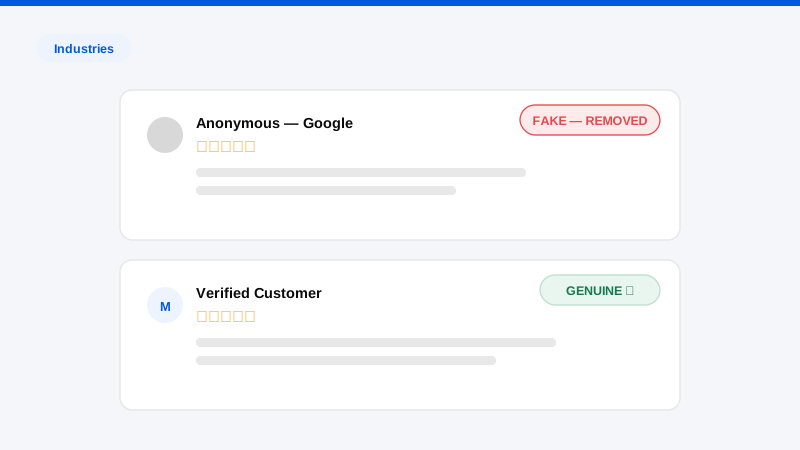
Fake and misattributed reviews land on the wrong advisor. Review platforms routinely host reviews intended for a different advisor with a similar name, reviews from people who were never clients, and reviews planted by competitors or personal adversaries. Prospects cannot tell the difference, and the star rating does its damage regardless. This category is among the most consistently addressable, the subject of our review removal practice.
Divorces, disputes, and personal history attach to the professional name. An advisor’s name is their storefront, which means personal litigation, a contentious divorce filing, an old news item, or a data-broker profile exposing home address and family members all surface in the same search a prospect runs. For advisors serving high-net-worth households, that exposure is also a physical-security issue, one reason data broker removal is standard in our advisor engagements.
AI assistants now answer for you. Prospects increasingly ask AI tools “is [advisor name] trustworthy?” or “reviews of [advisor]”, and the model composes an answer from whatever it finds, including the aggregator page and the misattributed review, delivered with unearned confidence. An advisor can lose a prospect to a machine-generated summary they have never seen. Auditing and correcting this layer is the province of our AI reputation management practice.
What’s at stake
For advisors, reputation damage is not abstract brand erosion. It is direct interference with the three engines of a practice.
Client acquisition dies at the search page. The modern referral does not end with a name passed at a dinner party; it ends with that name typed into a search bar. Prospects google before they call, vetting an advisor online is precisely what every consumer-protection resource tells them to do. A damaging first page converts referred, pre-sold prospects into no-shows, and the advisor never learns it happened. There is no bounced email, no declined meeting, just silence where a client should have been.
Existing clients re-verify during stress. In drawdowns and after news events, current clients re-search their advisor’s name, and a newly surfaced complaint or a fresh one-star cluster arrives at exactly the moment trust is being re-priced. Attrition conversations that begin with “I saw something online” are usually the end of the relationship, not the start of a dialogue.
Recruitment and transitions inherit the record. Advisors changing firms are searched by prospective employers and by every client deciding whether to follow. RIA principals acquiring books or recruiting teams inherit whatever search baggage comes with each name. A damaged search presence quietly reduces an advisor’s transition value and a practice’s acquisition price, an asset-value problem, not merely a marketing one.
Teams are only as clean as their most-searched member. For RIAs and branches, one advisor’s search-page problem contaminates the firm brand that appears alongside it. Firm-level reputation programs that ignore individual advisor names are defending the wrong keyword.
Key takeaway: An advisor’s search results page is a 24-hour storefront that every referral walks past before calling. Most advisors have never audited theirs, and the ones with a problem are almost never told about it by the prospects it cost them.
Your next referral will google you tonight.See exactly what they'll find: free confidential Exposure Scan, live results on a 15-minute call, yours to keep either way.
Book Your Free ScanWhat professional reputation management for financial advisors looks like
Professional reputation management for financial advisors follows a removal-first sequence: remove damaging content at its source, de-index what cannot be removed, suppress the remainder with credible coverage, and monitor continuously. The order is the method, every dollar spent promoting an advisor whose page still hosts removable attacks is a dollar spent decorating a problem.
Remove at the source. A large share of what damages advisors is removable content: reviews that are fake, misattributed, or in violation of platform policies; defamatory posts and forum attacks; impersonation profiles; and personal data held by brokers and people-search sites. Each platform has its own standards and its own escalation paths, and the difference between a denied request and a removed item is usually how well the case is built and where it is directed, the craft at the center of our review removal and defamation removal practices. We are direct about limits: platforms make the final call, so no honest firm guarantees a specific removal. Specialists change the odds, the speed, and the completeness.
De-index from search. Some content (republished complaint records on aggregator sites, pages exposing personal information) persists at the source but qualifies for removal from search results under the search engines’ own policies, or can be pushed out of the name-search surface where prospects actually encounter it. Our search results removal work targets this layer: if a page no longer appears when someone searches your name, it has lost nearly all of its power over your practice.
Suppress with real press and owned assets. Content that can be neither removed nor de-indexed (accurate news coverage, official records) gets displaced. We build authoritative, accurate visibility for the advisor: press placements in credible publications, properly structured professional profiles, and owned assets engineered to rank. For individual advisors, whose name-search results are typically sparse, this stage moves quickly, but it is deliberately the third step, applied to the residue after removal has done its work, not a substitute for it.
Monitor continuously. New reviews appear weekly; data brokers republish scraped profiles on a cycle; aggregator sites add pages; AI answers shift as their sources shift. Continuous reputation monitoring across all of these surfaces catches new damage within days of appearing, when it is easiest to address and before any meaningful number of prospects has seen it. Our Protection Plans put monitoring and standing removal capacity behind an advisor’s name year-round, the reputation equivalent of the ongoing, rather than episodic, relationship advisors themselves sell.
Key takeaway: Removal first, promotion second. Suppressing a fake review that could have been deleted outright is the most expensive mistake in advisor reputation work. The threat stays alive one page deep, waiting for the next platform algorithm change to resurface it.
Why financial advisors choose Content Removal for reputation management
Advisors evaluate us the way they would want to be evaluated (on specialization, discretion, and straight answers) and those are the grounds on which they hire us.
Removal is our entire practice, not a line item. Content Removal LLC exists to remove and neutralize damaging online content. That single focus, applied across thousands of engagements, is what builds the platform-by-platform fluency that determines outcomes. Our client work spans global brands such as Danone and Sweat and public figures such as Alex Hormozi, see our case studies, and the same machinery works for an individual advisor’s name, where the target set is smaller and results are often faster.
We understand the compliance context. Advisors operate under advertising, testimonial, and communication rules that make generic reputation-marketing tactics genuinely dangerous. Our removal-first approach targets third-party content through platform and search-engine processes. It does not require the advisor to publish a word. Where a matter touches regulatory disclosure or legal action, we say so plainly: we are not a law firm, we do not provide legal advice, and we work alongside your counsel and compliance team rather than around them.
We tell you what we can’t do before you pay us. Every engagement begins with an item-by-item assessment: what is removable, what is de-indexable, what must be displaced, and what should simply be left alone. We do not promise outcomes that platforms and publishers control, and we decline work we don’t believe in. Advisors, professionals whose own value is honest counsel, tend to recognize what that is worth.
One bad result can quietly cost you households for years.Find out if you have one: free confidential Exposure Scan, live on a 15-minute call, findings yours to keep either way.
Book Your Free ScanFrequently asked questions
Can old complaint records and the sites that republish them be removed?
The official disclosure record itself generally has formal processes that belong in your counsel’s hands, and we don’t touch that side. What we address is the ecosystem around it: third-party aggregator and law-firm marketing pages that republish the record with inflammatory framing are frequently addressable (through removal requests, de-indexing pathways, and displacement) so that a resolved, decades-old event stops functioning as your search-page headline. The right mix depends on the specific pages, which is what the initial assessment determines.
A review on my profile is fake or was meant for a different advisor. What are the chances it comes down?
Reviews that violate platform policies (fabricated experiences, wrong-subject reviews, conflicts of interest, prohibited content) are among the most consistently removable categories we handle, and success depends largely on how precisely the violation is documented and pursued through the platform’s own standards. No one can promise a specific platform decision, but this is a category where specialist execution changes outcomes dramatically, and where speed matters: every week a fake review stands, it is converting referrals away.
How is this different from the reputation add-on my marketing agency offers?
Marketing agencies generate positive content; they have no practice for eliminating negative content, so their instinct is to bury everything, including items that could have been removed outright. Removal-first sequencing is the difference: remove at the source, de-index what remains, then build. Burying a removable fake review means it resurfaces whenever rankings shift; removing it means it is gone. Many advisors keep their marketing agency for growth and retain us for the threat side. The two functions are complementary and entirely different crafts.
I’m one advisor, not a bank. Is professional protection proportionate for a practice my size?
The economics usually answer this quickly. Price the lifetime value of one advisory household, years of fees plus the referrals that household generates, and compare it to the cost of a protection engagement. A single damaging result that turns away even a small fraction of referred prospects costs multiples of the program annually. Our Protection Plans are structured for exactly this profile: individual advisors and small RIAs who need enterprise-grade removal and monitoring at practice scale.
Every prospect you meet this year will search your name before deciding to trust you with their savings. See what they see, before it costs you another household. Book a free, confidential Exposure Scan: a complete map of what ranks for your name, reviewed live on a 15-minute call, yours to keep whether or not we ever work together.