
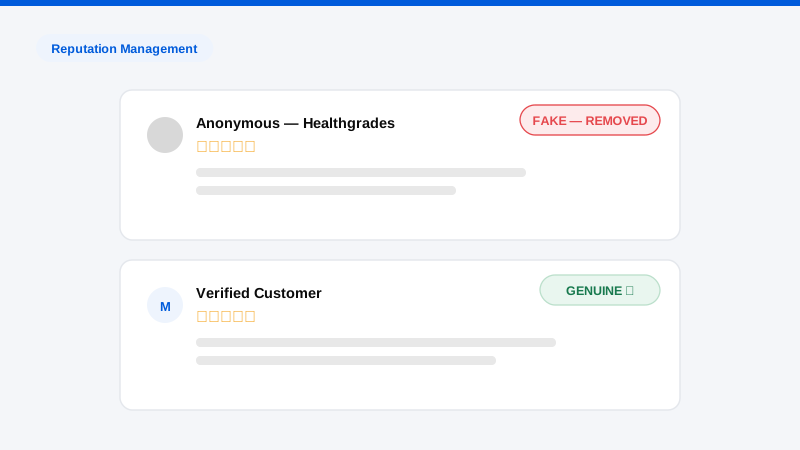
Reputation management for doctors is not a marketing nicety. It is patient acquisition, referral flow, and career security compressed into a search results page. Patients now research physicians the way they research any high-stakes purchase, except with higher anxiety and lower tolerance for ambiguity: they read reviews before booking, they Google a name after a referral, and increasingly they ask an AI assistant whether Dr. So-and-So is “good.” A single one-star cluster, an old news item, or a lawsuit mention can quietly divert new patients to the practice down the street, and you will never see the patients you lost.
The standard industry answer for physicians, flood the zone with new content and solicit five-star reviews until the bad fades, misreads the problem. The defamatory review is still there for every patient who sorts by “lowest.” The 2015 article about a dismissed complaint still ranks for your name. The review-gating tactics some vendors push can violate platform rules and, in healthcare, brush against regulatory lines. Our approach is different: remove what can be removed at the source (fake reviews, policy-violating posts, defamatory content, outdated coverage) respond to the rest within strict HIPAA-safe boundaries, and then keep watch continuously, because in medicine a reputation attack is never a one-time event.
This guide covers the terrain physicians actually face: how patients choose from search, the anatomy of review attacks and fake reviews, old case and news coverage, HIPAA-safe response practice, what AI assistants now say about physicians, and the fact, missed by almost every generic ORM vendor, that a doctor defends two reputations at once: the physician’s and the practice’s.
Patients choose from search, before you ever get a chance
Physician selection has become a search behavior. Referrals still start the process for much of medicine, but they no longer end it: a large share of referred patients research the referred physician online before booking, and some fraction of them silently books elsewhere based on what they find. Self-directed patients (the norm in dentistry, dermatology, plastic surgery, ophthalmology, fertility, and elective procedures generally) may choose almost entirely from search and reviews.
What a patient’s screen actually shows
Search a physician’s name and the deciding surface is compact: the Google Business Profile with its star rating, two or three review platforms (Google, Healthgrades, Vitals, Yelp, RealSelf or ZocDoc depending on specialty), the practice website, a hospital-affiliation page, and whatever news or forum content ranks. Most patients never scroll past this screen. That compactness cuts both ways, a small number of damaging items can dominate the entire decision surface, and conversely, cleaning a small number of items can transform it.
The economics of a single star
Patients screen by rating before they read a single review, and many filter out anything below four stars by default. For a practice, the arithmetic is unforgiving: each new patient represents not one visit but a multi-year relationship (and in procedural specialties, a five- or six-figure lifetime value) so a rating dragged down by a handful of unfair or fake reviews taxes every week of new-patient flow. That is why the correct first move on a bad rating is forensic, not promotional: determine how much of the damage is illegitimate (fake, policy-violating, or misattributed) and remove it, rather than pricing years of review solicitation to outvote reviews that should never have counted.
Key takeaway: You cannot rebut, delight, or out-market a patient you never met because a search result turned them away. In medicine, reputation defense is patient acquisition.
Review attacks and fake reviews: the physician’s most common wound
Physicians are unusually exposed to review abuse, for a structural reason: HIPAA prevents you from telling your side, and attackers know it. The most common patterns we see:
- The non-patient review. Left by someone never treated: a competitor, a former employee, a patient’s relative, or a stranger recruited in a dispute. Platforms prohibit these, and they are among the most removable content in this field, if you build the evidentiary case correctly.
- The billing-dispute proxy. A disagreement over an invoice or insurance denial recast as a clinical-competence attack. Factually reframable, sometimes removable, always answerable within safe limits.
- The extortion review. A one-star with an explicit or implied offer to remove it for a refund or free care. Document everything; this violates platform policy nearly everywhere and strengthens removal petitions.
- The coordinated burst. Multiple negative reviews in a short window, often after a staff termination or a public dispute. Velocity patterns, account histories, and phrasing overlaps are exactly the evidence platforms respond to, when someone assembles it.
- The defamatory review. False statements of fact (“he lost his license,” “she was drunk”) as opposed to protected opinion. These may support defamation-content removal pathways, pursued with independent counsel where a legal remedy is the right tool.
The difference between a removal that succeeds and one that dies in a moderation queue is almost always the quality of the submission: policy citation, evidence assembly, escalation past first-line review, and persistence across the platform’s appeal tiers. This is unglamorous specialist work, and it is precisely what generic ORM subscriptions do not do.
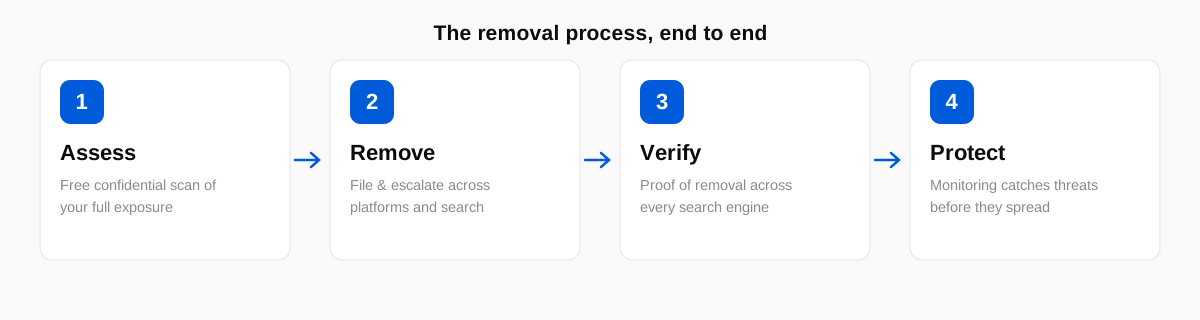
A four-step sequence for a physician under review attack
1. Audit. Capture everything before it changes: screenshots with timestamps, reviewer profiles and histories, cross-platform patterns, and a check of scheduling records (internally, never publicly) to identify non-patients. Extend the audit to the full name surface: news items, forums, provider directories, and AI answers.
2. Remove. Petition each illegitimate review under the specific policy it violates, with evidence, and escalate through the platform’s full appeal path. In parallel, pursue takedown or de-indexing of any off-platform attack content and correct erroneous directory listings, which quietly feed both search and AI systems.
3. Build. Only after removal has shrunk the problem: an authoritative practice site and physician bio, corrected structured data, and a compliant review-generation cadence: asking all patients consistently, never gating by sentiment, never incentivizing. Legitimate volume is the durable defense against future attacks because it dilutes them on arrival.
4. Protect. Continuous reputation monitoring across review platforms, search, and AI answers, with alerts measured in hours. Review attacks recur; the practices that fare best treat detection as infrastructure, not as something the front desk notices eventually.
Find out which of your negative reviews are actually removable.Free confidential Exposure Scan for physicians: we assess your reviews, search results, and AI answers, and walk you through it live in 15 minutes. The findings are yours either way.
Book Your Free ScanOld cases, old coverage: when the past outranks the present
The second great physician exposure is archival: coverage of a malpractice filing that settled without admission, a board complaint later dismissed, a disciplinary matter long resolved, an arrest never prosecuted. News archives and court-record aggregators hold this material indefinitely, and because news domains carry enormous search authority, a 2014 headline can outrank a decade of subsequent unblemished practice.
Here the removal-first difference is starkest. Suppression vendors will sell you years of content production to push the article to page two, where it remains fully intact for the diligent patient, the credentialing committee, the referring physician’s office manager, and every AI model that ingested it. The removal-first sequence instead works the source:
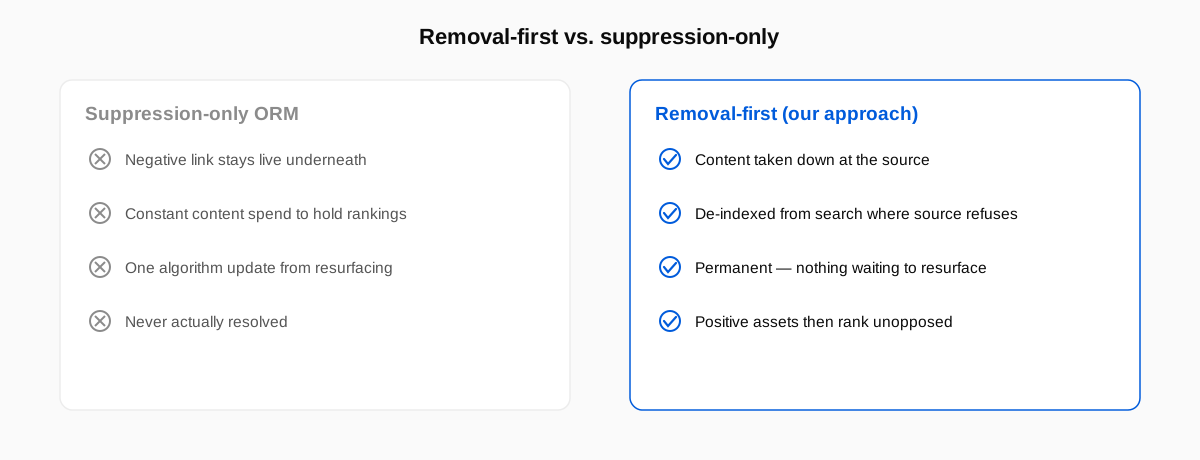
- Publisher remedies. A growing number of outlets maintain formal policies for revisiting dated coverage: updating outcomes, adding resolution context, de-indexing, or unpublishing, particularly where charges were dropped or complaints dismissed. These petitions succeed far more often than physicians assume, and far more often when made by practitioners who know each outlet’s process.
- Aggregator and mirror cleanup. Court-record scrapers and content mirrors that republish the story often violate their own stated policies or applicable privacy rules, and are frequently more removable than the original.
- De-indexing. Where a source will not act, search-result removal mechanisms can sever specific URLs from queries for your name, imperfect, but materially better than suppression because nothing needs to “hold” a ranking forever.
- Suppression, last. For the genuinely immovable residue, owned assets and legitimate coverage, sized to a shrunken problem, not to the original one.
Key takeaway: An old article pushed to page two is still read by every careful patient and quoted by every AI model. An old article corrected, de-indexed, or unpublished is finished. Exhaust removal before you buy a single unit of suppression.
Responding in public without violating HIPAA
The fastest way a physician converts a reputation problem into a career problem is a review response that confirms a patient relationship or discloses anything about care. HIPAA has no “they talked about it first” exception: a patient publicly describing their own treatment does not authorize you to acknowledge, correct, or add a single clinical detail. Regulators have penalized practices for exactly this, and plaintiff’s counsel screenshots review responses.
Safe response practice fits in a few rules: respond generically without confirming the reviewer was ever a patient (“We take all feedback seriously and are committed to every patient’s experience; please contact our office directly”); never mention diagnoses, visits, dates, billing specifics, or outcomes; take every substantive conversation offline; let a compliance-aware second reader approve responses to hostile reviews; and never let a marketing vendor with posting access respond on clinical matters unsupervised. A measured public response is written for the hundreds of future patients reading it, not for the one reviewer. Its job is to make you look calm, professional, and safe.
This is also the compliance argument for removal-first in medicine: removal requires no public statement at all. Every fake or policy-violating review eliminated is a conversation you never have to have with one hand tied behind your back.
What AI assistants now say about you
A fast-growing share of patients (and referral coordinators, and credentialing staff) now ask AI assistants direct questions: “Is Dr. [Name] a good cardiologist?” “Has Dr. [Name] been sued?” The assistant answers in confident prose synthesized from whatever it ingested: reviews, old articles, directory data, forum threads. The failure modes are serious and specific to medicine: outdated disciplinary matters stated in the present tense, physician mix-ups between same-named doctors, stale affiliations and specialties from unmaintained directories, and hostile review language repeated as neutral fact.
Remediation runs through the sources: remove the removable content (deleted material eventually falls out of refreshed models: suppressed material does not, which is another quiet advantage of removal-first), correct the structured directory and profile data models weight heavily, strengthen authoritative owned pages, and use the platforms’ own correction channels. We monitor and remediate this layer as a dedicated discipline, see our AI reputation practice, and for physicians we treat it as part of the standard surface, not an add-on.
Ask us what ChatGPT says about you: before your patients do.Our free confidential Exposure Scan covers your reviews, search results, directories, and AI answers, walked through live on a 15-minute call. No obligation, and the report is yours.
Book Your Free ScanTwo reputations, one attack surface: the physician and the practice
A subtlety generic vendors miss: a doctor defends two distinct names. The practice has a Google Business Profile, a website, review pages, and local-search rankings. The physician has a personal name that appears in news coverage, state-board records, provider directories, hospital pages, and AI answers, and that name follows you across employers, practice sales, and relocations for the rest of your career.
The two surfaces interact but fail independently. A pristine practice profile does not protect a physician whose personal name search leads with an old lawsuit; patients cross-check. Conversely, a physician with a clean personal record can be dragged by a practice profile poisoned by front-desk and billing complaints. Group-practice physicians carry a third exposure: the conduct of partners and even predecessors bleeds into shared profiles. Any serious program, and any serious protection plan, must audit, remediate, and monitor both surfaces explicitly, because attackers and algorithms make no distinction between them, and the physician’s personal surface is the one that never resets.
Choosing a reputation partner as a physician
Healthcare reputation work has specific failure modes, so the vetting questions are specific too:
- HIPAA literacy, demonstrated. Ask how they handle review responses, what a Business Associate Agreement covers if they touch anything patient-adjacent, and what their compliance review process is. A vendor who proposes responding to clinical complaints “on your behalf” without a compliance framework is a liability, not a service.
- Removal capability with evidence. Ask what percentage of their physician work is source-level removal versus content production, and to walk you through anonymized examples of review and article removals, mechanism by mechanism, without guarantees. A firm that only talks about “review generation velocity” is a marketing agency wearing a reputation label.
- No review gating or fake positives. Sentiment-gating violates platform rules and, in healthcare, invites regulatory attention; purchased reviews can destroy a profile overnight when platforms purge. If a vendor offers either, end the call.
- Both surfaces covered. Confirm the scope includes your personal name (news, directories, AI answers) not just the practice’s local-search presence.
- Honest pricing. In our practice, each removal is priced per link or item (the exact figure arrives in a written quote after the free Exposure Scan, beside every URL, before you pay anything) and continuous Protection Plans are scaled to surface and specialty risk. The market ranges from $99-per-month dashboard tools (monitoring, not remediation) to five-figure retainers. Whatever you pay, tie it to items eliminated and surface defended, the model behind our physician practice.
Frequently asked questions
Can negative reviews about me actually be removed?
Illegitimate ones, frequently: reviews that are fake, from non-patients, extortionate, defamatory, or otherwise policy-violating are removable when the evidentiary case is built properly and escalated persistently. Genuine reviews from real patients expressing opinions generally are not, and any firm promising to “delete all your negative reviews” is describing either fraud or fantasy. The honest work is separating the two categories and eliminating the first completely.
How do I respond to a false review without violating HIPAA?
Without confirming the person was ever a patient and without any clinical, billing, or scheduling detail: a brief, calm, generic statement of your standards and an invitation to contact the office directly. In parallel, and more importantly, petition the platform for removal if the review is false or policy-violating, since removal requires no public statement at all. When in doubt, have compliance-aware review before posting; a response can be quoted forever.
An old news article about a resolved case dominates my search results. Am I stuck with it?
Often not. Publisher-side remedies (updates, resolution context, de-indexing, unpublishing under dated-coverage policies), aggregator takedowns, and search-engine removal mechanisms all exist, and matters that ended in dismissal or resolution are the strongest candidates. Success is never guaranteed and timelines run months, not days, but “stuck with it” is usually wrong, and suppression should be the fallback, not the plan.
How long does physician reputation remediation take?
Typical arc: full audit inside two weeks; first review removals and directory corrections within 30 to 60 days; publisher and de-indexing outcomes over two to nine months; and, where needed, owned-asset ranking consolidating over three to six months. AI-answer corrections follow source cleanup on the platforms’ refresh cycles. Continuous protection then keeps the surface clean, which is faster and cheaper than ever remediating from scratch again.
Every week, patients you never meet are deciding against you, or for you, based on a screen you may not have looked at critically in years. Look at it the way they do. Book a free, confidential Exposure Scan: in 15 minutes we walk you through your reviews, your search results, your directory data, and what AI assistants say when a patient asks about you, and the findings are yours to keep whether or not we ever work together.