 By
By 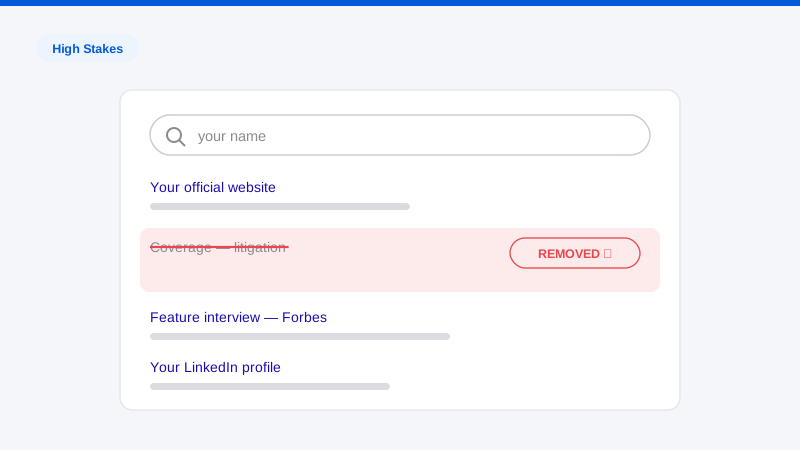
Reputation management during litigation is the protection of a party’s public search footprint while a legal dispute is active — and the repair of that footprint after the dispute resolves. It exists because the internet treats accusations and outcomes with radically different weight. A complaint is filed in an afternoon and covered the same day; a vindication arrives years later, if it is covered at all. In between, the accusation ranks, circulates, feeds screening databases, and gets absorbed into AI-generated summaries as though it were the whole story.
For executives, business owners, and prominent families, this asymmetry is the central reputational fact of any lawsuit. Court filings are public documents drafted by an adversary to be as damaging as the rules allow, and the modern web gives those documents distribution their drafters could once only dream of: docket aggregators republish them, legal-news outlets summarize them, and search engines rank coverage of the allegation above nearly everything else about the person named — often for years after the matter closes.
This guide explains the reputational mechanics of litigation: what a lawsuit does to your search page and to AI answers about you, how the timeline of a case interacts with the timeline of the web, and what professional, removal-first protection looks like at each phase. One note before anything else: Content Removal LLC is not a law firm. Everything described here is reputational work conducted in coordination with — never in place of — a client’s litigation counsel, and nothing in this guide is legal advice.
What litigation does to your search page — and to AI answers about you
The moment a complaint is filed, a machine starts running that has nothing to do with the merits.
Filings become content. Docket-scraping services index new cases within hours. Legal-news outlets and industry publications write up complaints — frequently reproducing the plaintiff’s allegations in detail, because the complaint is the only document that exists yet. Local and trade press pick up the story. Each article is fresh, keyword-rich, and hosted on authoritative domains: exactly the profile search engines reward.
Allegations outrank identity. For a person with a modest search footprint, a single covered lawsuit can occupy multiple first-page positions under their name. For a company, “company name + lawsuit” becomes a suggested search that advertises the dispute to everyone who types the name. The coverage describes claims, not findings — but a searcher skimming headlines does not make that distinction, and neither, functionally, does an adverse-media screening tool.
The outcome is under-covered. Dismissals, withdrawals, favorable settlements, and defense verdicts generate a fraction of the coverage the complaint did — often none. The result is a permanent record that ends mid-story: the accusation indexed in detail, the resolution invisible. Outlets that covered the filing rarely return to cover the dismissal unless someone brings it to them with documentation.
AI answers compress the worst version. Ask an assistant about a person mid-litigation and it will synthesize what is indexed — which is, by the mechanics above, dominated by allegation-phase coverage. The answer typically states the claims in confident summary prose, sometimes without the word “alleged” surviving the compression. After resolution, AI answers frequently lag far behind the actual outcome, repeating the accusation era until the underlying corpus changes.
Everyone searches. Counterparties, business partners deciding whether to renew, lenders, journalists, prospective employers of the executive’s children — and, notably, prospective jurors. Courts instruct jurors not to research the case; the practical reality every trial lawyer plans around is that panels arrive having already seen what search engines chose to show them about the parties. What your search page says during the months before trial is part of the environment the case is tried in.
Key takeaway: Litigation coverage is structurally one-sided: the complaint is written to be quotable and the resolution is rarely news. Without deliberate work, your public record ends at the accusation.
Timeline dynamics: the case clock and the web clock run separately
Understanding when reputational damage compounds — and when repair becomes possible — requires tracking two clocks at once.
Filing and the first weeks. The highest-velocity period. Coverage propagates, syndicates, and gets scraped onto aggregators and mirror sites. Every week of inaction multiplies the number of URLs that will eventually need attention; a story addressed at two copies is a different project than the same story at forty.
The long middle. Motions, discovery, continuances — years in which nothing newsworthy happens but the filing-era coverage sits at the top of your results, accruing age and authority. This is also when quiet work is most possible: mapping the full footprint, addressing the unlawful and defamatory satellite content that accretes around covered litigation (forum threads, copied filings on gripe sites, commentary that crosses from reporting into defamation), clearing data-broker records that expose parties and witnesses, and preparing the documentation that will support post-resolution publisher outreach.
Trial windows. Search interest spikes; old coverage resurfaces; new coverage arrives daily. Active removal outreach to publishers covering a live trial is generally counterproductive and is a period for monitoring and rapid-response coordination with counsel and communications, not source-level campaigns.
Resolution — the pivot point. A dismissal, favorable settlement, or verdict transforms the reputational legal landscape. Coverage that was protected reporting of live allegations may now be demonstrably outdated or misleading as it stands. This is when publisher updating and unpublishing standards, outdated-content processes, de-indexing mechanisms, and — where counsel obtains them — court findings and orders become working tools. The months immediately after resolution are the richest cleanup window in the entire arc, and the one most parties, exhausted by the case itself, fail to use.
The long tail. Absent post-resolution work, allegation-era coverage simply persists — outranking the outcome indefinitely and feeding every future background check, diligence process, and AI summary.
See what the lawsuit has already done to your search results.Free confidential Exposure Scan — live results on a 30-minute call, covered by strict confidentiality.
Book Your Confidential ScanWhat professional protection looks like
Reputation work during litigation is a discipline of sequencing and restraint: knowing what can be pursued now, what must wait for resolution, and what should never be attempted at all. It is removal-first — aimed at making harmful content cease to exist or cease to be findable at the source — and it runs strictly in coordination with litigation counsel, because a misstep here is not just a wasted effort; it can touch the case.
Phase one: mapping the litigation footprint. A complete inventory of coverage, docket aggregators, forum and social discussion, copied filings, screening-database entries, and current AI-assistant answers about the parties. Counsel gets visibility into the public information environment around the case; the client gets an honest triage of what is addressable now, later, or never.
Phase two: the wartime workstream. During the active case, the viable targets are the satellites, not the core reporting: defamatory commentary that goes beyond the privileged filing into independent false assertions; doxxing and unlawfully published private information about parties, family members, or witnesses; scraped and mirrored copies on sites with no journalistic standing; and data-broker exposure. Where legal mechanisms are the right tool, the work proceeds through and alongside counsel. Core press coverage of a live case is generally left alone — approaching a reporter mid-case to remove a story is how a one-day story becomes a two-story arc.
Phase three: monitoring as standing infrastructure. Continuous reputation monitoring across news, forums, social platforms, and AI answers, tuned to the case’s vocabulary. In litigation, hours matter: counsel and communications teams that learn of a new post or a leaked document the day it appears have options that vanish by the following week.
Phase four: the post-resolution campaign. This is where the deepest repair happens. With the outcome documented, publishers can be approached — professionally, with evidence — to update, correct, or unpublish coverage that no longer fairly represents the matter. Aggregator and mirror copies are pursued systematically. De-indexing avenues that require showing content is outdated or misleading become available. And the affirmative record — accurate bios, substantive press assets, authoritative profiles — is built or rebuilt so the resolution, not the accusation, is what ranks and what AI systems synthesize. For executives and families emerging from public disputes, this phase typically runs six to eighteen months and often continues under a standing protection plan.
Key takeaway: During the case, the work is containment of the satellites and preparation. After resolution, it becomes repair of the record itself — and the window opens widest in the first months, when most parties have stopped paying attention.
Why specialists beat DIY and PR alone
Litigation reputation work fails in predictable ways when handled by the wrong hands.
DIY is dangerous here in a way it is nowhere else. A party emailing a journalist about their coverage, posting rebuttals in comment sections, or filing platform complaints mid-case is generating discoverable communications and potential story material simultaneously. Anything a party publishes or sends can surface in the litigation itself. This is the one arena where well-intentioned self-help most reliably makes both the legal and reputational positions worse.
Litigation counsel is essential and not sufficient. Your lawyers are consumed with winning the case, and their toolkit for the public web — demand letters, court orders — is powerful but narrow. Publisher unpublishing standards, platform legal frameworks, de-indexing criteria, syndication tracing, data-broker cycles, and AI-answer remediation are a different trade. The best outcomes come from counsel and removal specialists running in parallel, each inside their lane; that is how we work.
PR alone cannot fix a record it cannot subtract from. Communications firms manage the narrative during trial and are worth their fees. But when the case ends, the problem is no longer narrative — it is that specific URLs saying superseded things still rank under your name and still feed screening tools and AI models. No volume of new content removes the old complaint coverage from a diligence file. Removal and communications are complements: one clears the record, the other fills it.
The case will end. Your search results won't fix themselves.A free, confidential Exposure Scan maps the damage and the repair path — live, on a 30-minute call, under strict confidentiality.
Book Your Confidential ScanWhy clients call Content Removal
Content Removal LLC works the seam between the courtroom and the search page. Litigants, general counsel, litigation boutiques, and family offices managing disputes for principals bring us in because the firm does removal-first work at a professional standard — source-level takedowns, publisher corrections, de-indexing, data-broker suppression, and AI-answer remediation — with the operational discretion active litigation demands.
We are not a law firm, we do not give legal advice, and we treat coordination with counsel as a requirement of the engagement, not a courtesy. We are equally direct about limits: privileged fair reporting of live proceedings is generally not removable, no outcome can be guaranteed, and any firm promising to “delete the lawsuit from the internet” mid-case is selling something that does not exist. What we deliver is the honest map, the correctly sequenced work on everything legitimately addressable, standing monitoring while the matter is live, and the disciplined post-resolution campaign that most parties never run — which is precisely why their records never recover.
Frequently asked questions
Can news coverage of my lawsuit be removed while the case is active?
Usually not, and a credible specialist will tell you so upfront. Accurate reporting on public court filings sits on strong legal and editorial footing while a matter is live. The productive wartime targets are different: defamatory commentary that exceeds the filing, unlawfully published private information, scraped copies on aggregator and gripe sites, and data-broker exposure of the people involved. The core coverage becomes addressable — through updates, corrections, unpublishing requests, and de-indexing — after resolution, when its incompleteness can be documented.
The case settled with no admission of wrongdoing. Why do the articles still rank?
Because nothing told the web the story changed. Search engines rank the allegation coverage on its accumulated age, links, and authority; settlements are rarely covered, and confidential ones cannot even be fully described. This is exactly the situation post-resolution work exists for: approaching publishers with what can be documented, pursuing updates and removals under their standards, addressing mirrors, and building the current, accurate record that gradually displaces the old one in both search results and AI summaries. What is sayable about a confidential settlement is a question for your counsel, and we work within it.
Will removal efforts interfere with my case?
That risk is real when the work is done carelessly, which is why sequencing and counsel coordination are the discipline, not an add-on. Nothing is sent, filed, or requested regarding case-adjacent content without alignment with your litigation team, and entire categories of action are deliberately deferred until resolution. Properly run, the workstreams are complementary: counsel prosecutes or defends the case; we contain the public-web damage in the lanes counsel clears, and prepare the repair campaign that begins the day the matter closes.
How long does post-litigation cleanup take?
Expect months, not weeks — publishers deliberate, platforms review, search engines re-crawl on their own schedules, and AI answers lag the corpus they draw from. Matters with modest coverage often see meaningful movement within a few months of resolution; heavily covered disputes are typically six-to-eighteen-month campaigns. We will not predict a specific result for a specific URL, but we will give you an honest, item-by-item assessment of tractability before you commit to anything.
If you are in a dispute now — or emerging from one and discovering that the internet has not gotten the news — start by seeing your exposure clearly. Book a free, confidential Exposure Scan: a 30-minute call, live results across search, screening sources, and AI answers, under strict confidentiality and with your counsel welcome on the line. The record can be repaired. It starts with the map.