
Political reputation management is the protection of political capital across search, media, social platforms and stakeholder networks when the information field turns hostile. Unlike PR, which persuades, it controls exposure through five pillars: rapid takedown and de-indexing, legal remedies, real-time monitoring, coordinated public response and long-term suppression, with pre-agreed triggers for when a specialist takes over.
Key facts
- Reputation research separates performative, moral and legal-procedural reputation; each attack type needs a different defense.
- Impersonation, intimate imagery and privacy violations usually have cleaner takedown paths than political criticism.
- Anonymous offshore hosting plus mirrored reposts frustrates domestic legal threats; search and platform strategy work faster.
- Messaging should follow evidence review and platform assessment so a statement does not validate a false framing.
Where ContentRemoval.com comes in. ContentRemoval.com works alongside campaign and officeholder teams on the technical layer of a hostile narrative: source removal, de-indexing, impersonation takedowns, mirror tracking and monitoring while counsel and communications keep their own lanes. The chief of staff or campaign counsel usually makes the first call. A free, confidential 15-minute Exposure Scan maps what is removable and what must be suppressed instead, and the report is yours to keep. Get a Free, Confidential Exposure Scan or read how our reputation management work is done.
At 6:12 a.m., your chief of staff sends a screenshot. By 6:20, donors are texting. By 7:00, a fabricated allegation is ranking for your name, clipped into short-form video, reposted by hostile accounts, and repeated by people who don’t care whether it’s true. Your press secretary wants a statement. Your lawyers want restraint. Your digital team is trying to identify the original source while journalists ask for comment on a story that was invisible a few hours earlier.
That’s the operating environment for political reputation management. It isn’t a branding exercise. It isn’t image polish. It’s the discipline of regaining control when the information field turns hostile and starts moving faster than your normal approval chain.
The first mistake most political teams make is treating a reputation event like a communications inconvenience. It’s not. Once search results turn, negative pages index, clips proliferate, and anonymous sites mirror the same allegation, the issue stops being a press problem and becomes an infrastructure problem. You are no longer just persuading voters. You are managing discoverability, credibility, escalation, and legal exposure at the same time.
The second mistake is waiting for certainty. By the time everyone agrees the attack is serious, the narrative has already hardened. That is why serious candidates, officeholders, and advisers now plan removals, de-indexing, suppression, and monitoring before the crisis breaks, not after. If you’re preparing for office, a pre-campaign audit like this guide to scrubbing your internet history before running for office is often the difference between a contained vulnerability and a public spiral.
Calm teams win these fights. Not because they talk better, but because they recognize early that political reputation management is a control system. It imposes order on speed, assigns triggers before panic sets in, and treats every hostile narrative as something to be assessed, segmented, and acted on with precision.
Introduction
A political crisis rarely announces itself politely. It usually arrives as an ugly stack of small signals that quickly become one large event. A fringe post is screenshotted by a larger account. A local blog republishes it without verification. Search begins to autocomplete the allegation. A clipped video strips away context. Supporters ask whether they should defend you or stay quiet. Opponents don’t need to prove anything. They only need to keep the allegation circulating long enough for it to feel familiar.
That’s the moment clients usually call. Not at the first lie, but at the point where the lie starts ranking, spreading, and attracting institutional attention. They’ve already learned the hard lesson. Traditional PR can shape tone, but it can’t remove an anonymous offshore post, de-index a harmful page, stop a coordinated impersonation campaign, or contain a search ecosystem that is now feeding on itself.
Practical rule: If a damaging narrative is searchable, repeatable, and easy for third parties to quote, you are no longer dealing with chatter. You are dealing with an operational threat.
The pressure is acute because modern attacks are layered. A single falsehood can be packaged as a “question,” turned into social content, echoed by bad-faith commentators, and then used by reporters as a reason to seek comment. Once that loop forms, delay becomes its own admission. The public may not know what is true, but they quickly register who appears in control and who does not.
Political reputation management exists for that exact environment. It gives you a disciplined method for triage, containment, removal, suppression, and rebuttal. It tells your team what gets ignored, what gets answered, what gets challenged legally, what gets pushed down in search, and what requires specialist intervention immediately. Without that framework, campaigns improvise. Improvisation is how manageable incidents become defining narratives.
Defining Modern Political Reputation Management
Political reputation management is the protection of political capital across search, media, social platforms, and stakeholder networks. It is not interchangeable with public relations. PR aims to persuade. Reputation management aims to control exposure, reduce attack surface, and protect legitimacy under hostile conditions.
A political figure’s reputation is not one vague popularity score. Research on public-agency reputation identifies three distinct factors: performative, moral, and legal-procedural reputation in a validated model, and a parallel 2024 reputation study cited by Echo Research reported that reputation accounts for approximately 30% of market value among listed companies, with some UK sectors reaching around 40% of capitalization, which underscores why reputation is treated as a structural asset rather than cosmetic messaging (public-agency reputation research).

What this means in practice
A candidate can look disciplined on policy and still suffer moral reputational damage from a personal allegation. An officeholder can be seen as ethical and still lose legal-procedural credibility if records, compliance, or process questions start circulating. Smart teams separate these dimensions because each one requires a different defense.
If the attack concerns competence, you answer with evidence, endorsements, and performance proof. If it concerns ethics, you need source scrutiny, factual challenge, and often removal or de-indexing work. If it concerns legitimacy or procedure, your legal and compliance posture matters as much as your media response.
That is why generic messaging advice isn’t enough. Political reputation management needs analysts, legal review, search intelligence, platform escalation, and a disciplined social layer. If your internal team needs a practical companion on the platform side, this overview of social media reputation strategies is useful because it frames reputation as an ongoing system of response rather than a sequence of isolated posts.
What it is not
It is not buying time with a statement and hoping the cycle moves on.
It is not flooding the internet with flattering content while defamatory pages remain live.
It is not arguing with anonymous accounts while harmful search results keep ranking.
Reputation becomes manageable when you break it into components, assign owners, and act on each component with the right tool.
The teams that handle this well operate like risk managers. They inventory vulnerable content, map hostile sources, define escalation paths, and decide in advance which categories of threat trigger legal action, technical takedown requests, or search suppression. That is the mature version of political reputation management. It treats reputation as an asset that can be measured, segmented, defended, and, when necessary, rebuilt under pressure.
Digital and Offline Threats to Political Actors
Most political teams still prepare for yesterday’s threat model. They expect negative press, a leaked memo, or a hostile clip from a debate. Those still matter. They are no longer the whole problem.
The current threat environment is hybrid. Digital attacks drive reach. Offline activity gives those attacks legitimacy. The damaging event is often not the original act but the way it is framed, distributed, and made searchable.
Digital attacks that move fastest
Deepfakes are dangerous because they collapse verification time. Even when they are disproven, they force the target to spend political capital on authentication rather than message control. Coordinated inauthentic behavior works differently. It doesn’t need a convincing lie. It only needs repetition, volume, and enough account activity to make journalists, staff, and voters think a fringe narrative has momentum.
Search manipulation is often more damaging than the initial post. A hostile publisher, partisan site, or anonymous blog can become a permanent liability if a negative page starts ranking for your name, office, or campaign. Once that happens, every reporter, donor, volunteer, and opposition researcher encounters the same poisoned result set.
Short-form video accelerates all of this. A clip stripped of context can outrun any statement you issue. Platform-native misinformation also adapts quickly. Accounts delete and repost. Captions change. Screenshots migrate from one service to another. Legacy response models fail because they assume a single channel and a single correction.
Offline events designed for digital exploitation
Opposition research leaks now land with digital packaging already built in. Selective documents appear alongside prewritten narratives, influencer distribution plans, and visual assets sized for social circulation. A staged protest can be minor on the ground and still become reputationally significant once edited for virality. A confrontation in a parking lot can matter less as an event than as a searchable symbol.
That’s why serious teams don’t separate field, legal, digital, and communications work. Adversaries don’t.
Consider the mechanics:
- Doxxing campaigns target safety, then force reactive coverage.
- Impersonation accounts distort statements, bait journalists, and confuse supporters.
- Anonymous blogs create jurisdictional friction and buy time for falsehoods to spread.
- Manufactured grassroots pressure creates visual proof of “public anger,” even when the operation is orchestrated.
If the event is designed to be clipped, captioned, and indexed, a press release won’t catch it.
Traditional political communication assumes facts prevail once stated clearly. In hostile environments, that assumption is expensive. You need source tracing, evidentiary triage, search containment, and removal strategy running in parallel with message development. Otherwise your team spends the day drafting the perfect statement while the attack settles into search results and syndicated reposts.
The Strategic Pillars of Reputation Defense
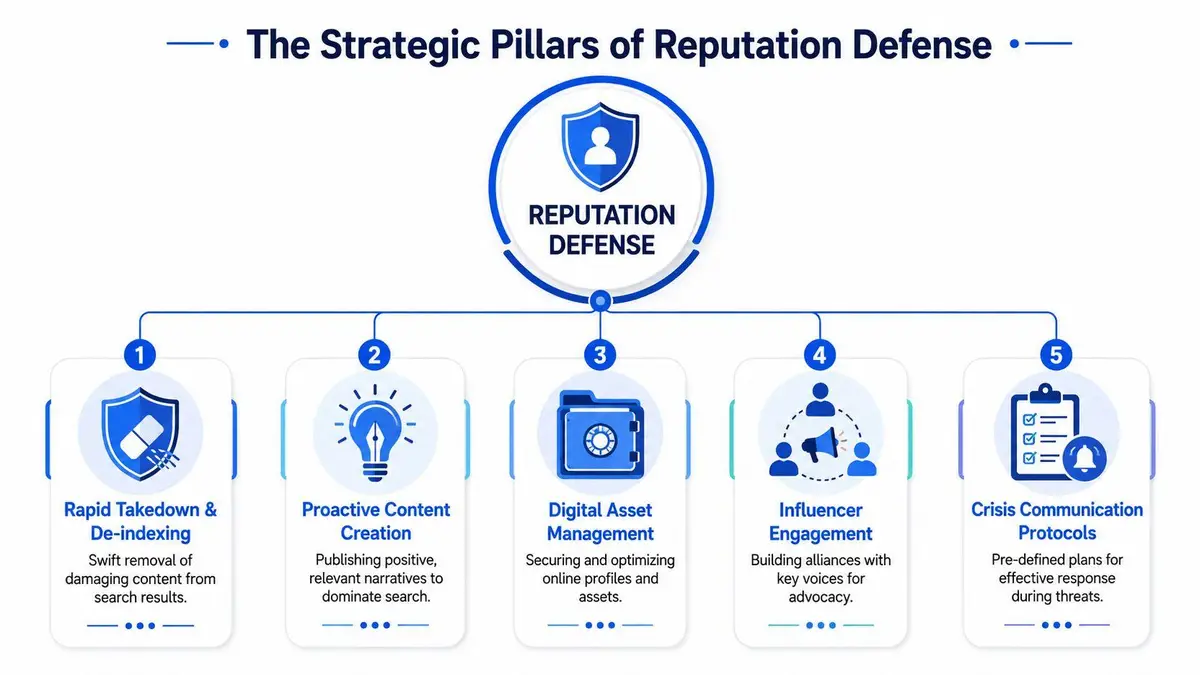
Political reputation defense works when it runs as an integrated system. Failure often occurs because legal review, communications, and digital monitoring are separated into different silos, leading to lagging responses. The correct model is coordinated pressure. One signal triggers several actions at once.
Pillar one and two
Rapid takedown and de-indexing comes first because harmful material does its worst work while it remains easy to find. Remove at source where possible. If source removal is blocked, pursue platform enforcement, search de-indexing, and mirror tracking. Every hour a false or invasive page remains visible increases the odds that journalists, donors, and opponents treat it as established background.
Legal remedies support takedowns when voluntary compliance fails. That may involve defamation analysis, copyright enforcement where applicable, privacy claims, impersonation complaints, or targeted demand letters. Legal action is not theater. It is a powerful tool. It establishes record, increases pressure on intermediaries, and can force reluctant publishers to assess their own exposure.
Teams that understand broader protective operations usually grasp this faster. A useful parallel sits in A complete guide to risk security management, which frames risk as a layered system rather than a single barrier. Political reputation defense works the same way. One safeguard is never enough.
Pillar three and four
Monitoring is the central nervous system. Industry guidance for political ORM prioritizes real-time listening, sentiment analysis, and source evaluation, including tracking keyword clusters, scoring mentions by sentiment and source influence, and segmenting by channel because faster detection shortens response time and reduces the window for misinformation to spread (real-time political monitoring guidance).
If your internal operation lacks that capability, a dedicated system for reputation monitoring closes the gap between detection and action. The point isn’t dashboard aesthetics. The point is decision speed.
Coordinated public relations then shapes interpretation. Many teams often start here, but it should ideally follow evidence review and platform assessment. You don’t want a polished statement that inadvertently validates a false framing or amplifies a low-visibility accusation. Messaging should support the legal and technical strategy, not outrun it.
Here is the sequencing that works:
- Identify the source chain. Find the original publication, the first major amplifier, and the search terms carrying the attack.
- Classify the threat. Falsehood, privacy breach, impersonation, manipulated media, old but accurate content, or mixed allegation.
- Choose the primary objective. Remove, de-index, suppress, rebut, or document without engagement.
- Deploy the public line. Only after the factual and technical path is clear.
A short operational briefing belongs here:
Pillar five
Long-term suppression and sentiment fortification is where campaigns either recover or keep bleeding. If a harmful page can’t be removed immediately, you build competing assets that outrank it, absorb branded search intent, and restore context. That includes official profiles, issue pages, interviews, third-party coverage, and controlled digital properties that you can optimize and defend.
Strong defense is cumulative. Monitoring triggers action. Action informs messaging. Messaging buys time for suppression. Suppression restores control.
These pillars only work together. Takedown without monitoring is slow. PR without legal review is risky. Suppression without source evaluation is wasteful. Political reputation management demands orchestration, not a menu of disconnected tactics.
Navigating Legal and Jurisdictional Constraints
Every political client wants the same answer in the first call. Can this be removed? Sometimes yes. Often not cleanly. The legal environment is narrower than people assume, especially in the United States, where speech protections are broad and platforms often rely on intermediary protections. That means the right strategy begins with an honest classification of the material, not wishful thinking.
What the law can and cannot do quickly
Clear impersonation, non-consensual intimate content, certain privacy violations, and some forms of copyright misuse often present cleaner takedown paths than political criticism or harsh commentary. Defamation can be powerful, but only when the facts, publication context, jurisdiction, and evidentiary record support it. If the content is opinion, fair comment, or hosted by a platform that won’t act without a court order, legal force may be slower than the reputational harm.
Cross-border publication complicates everything. Anonymous domains, offshore hosts, mirrored reposts, and foreign operators can frustrate direct enforcement. A domestic legal threat may impress no one if the operator sits elsewhere, ignores correspondence, and knows the content will be copied before any order arrives. In those matters, search strategy and platform policy often do more immediate work than courtroom posturing.
For clients exploring erasure and search rights, the legal and strategic limits are laid out clearly in this analysis of the Right to Be Forgotten in the US. The key point is simple. Venue matters, remedy matters, and not every harmful result is vulnerable to the same process.
The ethical line serious teams respect
Political reputation management becomes reckless when it treats all criticism as something to be buried. That approach is legally weak and strategically stupid. You should challenge falsehoods, manipulated media, impersonation, privacy breaches, and unlawfully published material aggressively. You should not confuse that with trying to erase legitimate public scrutiny.
There is also a governance risk that astute clients need to understand. A 2021 public-administration study argues that strong reputations can create “reputation-sourced authority,” weakening incentives for oversight and increasing the risk of mismatches between perceived and actual competence, especially under ambiguity (public-administration analysis of reputation-sourced authority).
That finding matters because defensive reputation work can become self-deception if no one inside the operation is willing to separate unfair attacks from legitimate warning signs.
A disciplined rule helps:
- Defend against falsity. Challenge false claims hard and early.
- Contain invasive exposure. Act on privacy, impersonation, and unlawful publication.
- Absorb valid criticism. Respond with facts, reform, or silence, depending on the stakes.
- Preserve internal candor. Never let external reputation management replace internal accountability.
The right legal strategy protects the client without pretending the law can delete reality. Mature counsel knows the difference.
The Escalation Framework for Specialist Intervention
Internal teams should not hand every hostile mention to a specialist firm. That wastes time, money, and credibility. They also should not cling to control once the matter has crossed the line from messaging issue to technical removal problem. The right approach is trigger-based. You decide in advance what conditions require outside intervention.
Research on reputation management shows that these strategies are built to reduce punitive attitudes by contesting facts or reframing blame, and that such strategies can reduce audiences’ willingness to punish. The same body of work also reports strong model fit in academic analysis of reputation management behavior, including RMSEA = 0.052, which reinforces a practical point. This process is observable, time-sensitive, and manageable with precision when teams act quickly (research on political reputation response dynamics).
The rule that matters most
Escalate when the issue is no longer primarily a communications problem.
If a harmful result is ranking, syndicated, anonymous, mirrored, technically persistent, or legally complex, your press team should stop pretending it can solve the problem alone. Their job becomes coordination, not ownership.
| Threat Level / Type | Internal Team Action (First 24 Hours) | Trigger for Specialist Escalation | Expected Specialist Outcome |
|---|---|---|---|
| Low-level criticism from identifiable commentators | Log the content, assess whether response helps or amplifies, prepare talking points | Escalate if the content is republished in search-visible formats or begins appearing in branded search results | Source mapping, search-risk review, suppression planning if needed |
| False factual allegation on a mainstream social platform | Capture evidence, request platform review, issue a narrow factual correction if necessary | Escalate if the post is copied across accounts, clipped into video, or picked up by blogs and search engines | Coordinated platform escalation, copycat tracking, de-indexing and suppression strategy |
| Anonymous offshore blog post targeting the principal | Preserve evidence, avoid public overreaction, identify whether any domestic amplifier is involved | Immediate escalation once anonymity, offshore hosting, or mirrored reposting is confirmed | Jurisdictional analysis, publisher pressure, technical takedown pathways, search containment |
| Impersonation account or fabricated campaign communication | Report the account, alert staff and core stakeholders, publish a verification notice through official channels | Escalate if platform action stalls or the impersonation spreads to multiple services | Multi-platform enforcement, documentation package, identity misuse escalation |
| Doxxing, leaked private material, or intimate imagery | Secure personal safety, preserve evidence, notify counsel and internal security leads | Immediate escalation without waiting for internal consensus | Removal requests, emergency platform action, reupload monitoring, search and mirror suppression |
| Negative page ranking prominently for the client’s name | Audit ranking page, assess truth status and legal posture, prepare response options | Escalate if the page remains page-one visible long enough to shape stakeholder research or if it is tied to falsehood, privacy invasion, or extortionate conduct | De-indexing assessment, suppression campaign, source challenge, reputation asset buildout |
| Coordinated attack mixing protest footage, clipped video, and hostile commentary | Centralize approvals, stop ad hoc staff replies, map the main amplifiers and keywords | Escalate when multiple channels reinforce the same narrative and internal teams cannot contain spread | Integrated removal, search defense, platform escalation, response architecture |
Non-negotiable triggers
Some conditions should end the debate immediately:
- Anonymous origin with cross-border hosting. That combination creates legal friction and usually signals an operator counting on delay.
- Search visibility attached to the principal’s name. Once branded search is contaminated, the audience expands beyond activists and opponents.
- Impersonation or synthetic media. Authenticity disputes need specialized handling fast.
- Private material or safety risk. This is not a media matter. It is a containment matter.
- Repeated reposting after platform reports. Persistence means the attack has moved from isolated content to adversarial operation.
“Escalation is not panic. It is discipline applied at the moment internal capacity stops matching the threat.”
The best clients decide these triggers before the crisis. They don’t ask whether specialist intervention looks bad. They ask whether delay increases exposure. That is the only question worth asking under pressure.
Anticipating Outcomes and Setting Realistic Expectations
You can remove some material entirely. You can de-index some pages. You can suppress other results so effectively that most stakeholders never encounter them in ordinary research. You cannot promise universal deletion, instant vindication, or a world in which every hostile actor behaves rationally.
That distinction matters. Cooperative platforms may act quickly on impersonation, privacy breaches, or certain unlawful content. Search engines may limit visibility in some circumstances. Publishers may fold when faced with strong evidence and credible legal pressure. But anonymous operators, offshore sites, and politically motivated outlets often force a different strategy. In those cases, the objective shifts from pure removal to containment, suppression, and narrative replacement.
Clients under pressure don’t need false comfort. They need controlled expectations. The practical win is often this: the harmful content stops dominating search, stops multiplying unchecked, stops defining the first impression, and stops dictating every inbound conversation. That is what restored control looks like.
Conventional methods leave too much to chance. They rely on patience while the attack compounds. Specialist intervention replaces ambiguity with a plan. You get triage, priority, sequencing, and a realistic map of what can be removed, what must be pushed down, and what should be answered publicly.
That is the value. Not magic. Control.
If a political attack is ranking, spreading, or crossing jurisdictions, waiting will only increase the cost of recovery. ContentRemoval.com handles source removal, de-indexing, suppression, impersonation takedowns, and ongoing monitoring for high-profile clients who need a discreet action plan under pressure. Start with a confidential assessment, identify the exact threat surface, and move before the narrative hardens.
Frequently asked questions
When should a political campaign bring in a reputation specialist?
When the problem stops being a communications issue: a harmful result is ranking for the candidate’s name, the content is anonymous or offshore, it is being mirrored after platform reports, or it involves impersonation, synthetic media, doxxing or private material. Decide those triggers before the crisis rather than debating them under pressure.
Can defamatory political content be removed from Google?
Sometimes, but rarely cleanly in the United States where speech protections are broad and platforms rely on intermediary protections. Clear impersonation, non-consensual imagery, privacy violations and copyright misuse have stronger paths; opinion and harsh commentary usually call for suppression and rebuttal rather than removal.
Should a candidate respond publicly to a false allegation right away?
Not before the source chain is identified and the threat classified. Work out the original publication, the main amplifiers and the search terms carrying the attack, choose whether to remove, de-index, suppress or rebut, and only then issue a narrow factual correction that supports the legal and technical strategy.